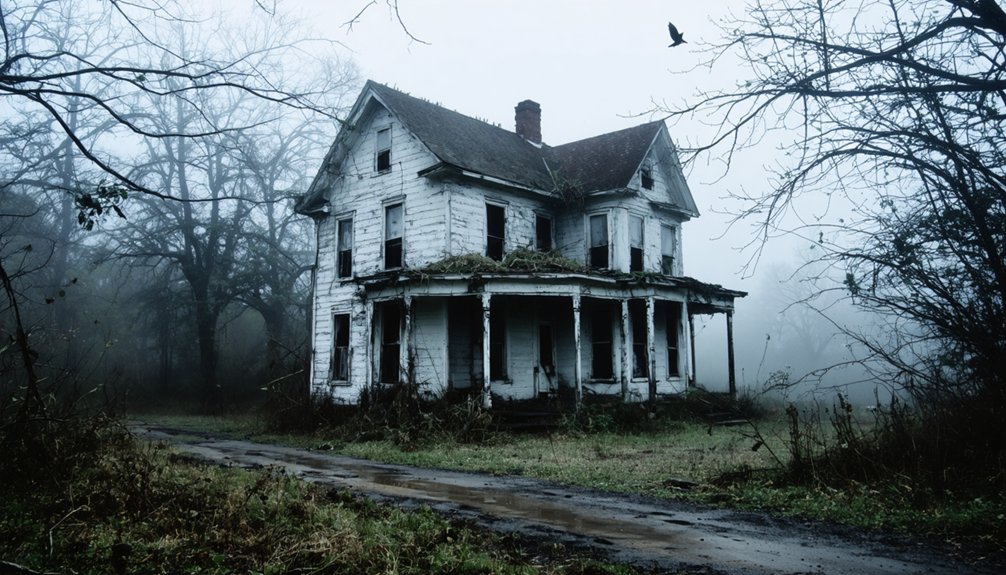
You’ll find Delaware’s ghost towns spanning from the 1631 Dutch settlement of Zwaanendael near Lewes, where Native American raids killed all colonists, to Civil War-era Fort Delaware on Pea Patch Island that housed 33,000 Confederate prisoners. Notable abandoned sites include Fort Saulsbury’s coastal defense ruins, the isolated Allee House plantation from 1753, and forgotten mining communities in the Piedmont region established by Welsh miners in 1703. These settlements reveal three centuries of Delaware’s hidden boom-and-bust cycles.
Key Takeaways
- Zwaanendael (1631) near Lewes was Delaware’s first failed settlement where all 32 Dutch colonists were killed by Lenape warriors.
- Fort Delaware on Pea Patch Island served as a Civil War prison where 3,000 Confederate prisoners died in unsanitary conditions.
- Fort Saulsbury operated as coastal defense from 1924-1943, later became a WWII POW camp before abandonment in 1946.
- Northern Piedmont mining communities established by Welsh miners in 1703 operated until 1884 before becoming ghost settlements.
- Railroad towns like Clayton, Felton, and Harrington declined after transportation networks shifted, leaving abandoned infrastructure behind.
Zwaanendael: Delaware’s First Failed Settlement
Delaware’s first European settlement met a tragic end before most colonists could unpack their belongings.
You’ll find this Dutch settlement‘s story begins in 1631 when the Dutch West India Company founded Zwaanendael, meaning “swan valley,” near present-day Lewes.
Twenty-eight colonists aboard the ship Walvis established Fort Oplandt, complete with Holland’s red lion banner flying proudly from the gate.
The settlers pursued whaling and beaver fur trading with ambitious dreams of prosperity.
However, Native relations quickly soured due to cultural misunderstandings and trade disputes.
Within months, Lenape warriors raided the settlement, killing all thirty-two colonists and destroying their hopes of freedom in the New World. Only two boys managed to escape the massacre that ended Delaware’s first colonial experiment.
This tragic episode defined Delaware’s earliest European contact, leaving the site desolate for years. The Zwaanendael Museum opened in 1931 to preserve and share the story of this ill-fated colony.
Fort Delaware: The Haunted Island Fortress
While most ghost towns crumble into dust on dry land, Fort Delaware sits majestically on Pea Patch Island, surrounded by the Delaware River’s murky waters that have witnessed centuries of tragedy.
You’ll discover this pentagon-shaped fortress, completed in 1859, transformed from military stronghold into Civil War prison camp by 1862. Over 33,000 Confederate prisoners suffered here, with nearly 3,000 dying from unsanitary conditions that earned it comparison to Andersonville.
This pentagon fortress witnessed over 33,000 Confederate prisoners, with nearly 3,000 perishing in conditions rivaling the infamous Andersonville prison camp.
The fort’s haunted history attracts visitors who report ghost sightings throughout the stone corridors where desperate men once lived and died. A devastating February 1831 fire had previously destroyed much of the original fort’s construction work, adding another layer of tragedy to the island’s dark past.
You can explore this preserved nightmare via ferry, walking where spirits allegedly roam among the casemates. The massive structure required 25 million bricks in its construction, creating the labyrinthine passages that now serve as corridors for both tourists and restless spirits.
Today’s Fort Delaware State Park maintains the chilling atmosphere that makes this America’s most accessible haunted fortress.
Fort Saulsbury: Abandoned Coastal Defense Base
You’ll find Fort Saulsbury‘s concrete gun batteries and ammunition magazines scattered across private land near Slaughter Beach, remnants of Delaware’s primary coastal defense installation that protected Delaware Bay from 1924 to 1943.
The Army constructed this World War I-era fortification beginning in 1917, equipping it with four 12-inch long-range guns and coordinating its operations with underwater mines and detection systems throughout both world wars. Fort Saulsbury became inactive shortly after receiving its artillery placement, reflecting the rapid changes in military priorities following the end of World War I.
During World War II, the fort served as a prisoner-of-war camp for German and Italian captives before its military functions were transferred to Fort Miles.
After military deactivation in 1946 and surplus sale in 1948, the abandoned base passed into private hands, leaving its deteriorating structures as fragmented archaeological evidence of Delaware’s 20th-century military heritage.
Military Construction and History
When the United States entered World War I in 1917, the federal government launched an ambitious coastal fortifications program that included Fort Saulsbury’s construction near Slaughter Beach, Delaware.
You’ll discover this military heritage site was named for Senator Willard Saulsbury, who served Delaware from 1859-1871.
Construction began with Batteries Hall and Haslet in August 1917, featuring innovative reinforced concrete design that’s now the last surviving example in America.
The fort’s four 12-inch guns could fire 2,000-pound shells twenty miles out to sea.
Each battery housed two guns with ammunition bunkers built from reinforced concrete.
Construction finished in December 1920 as World War I ended.
During World War II, the fort served as a POW camp for German and Italian soldiers after receiving upgrades in 1940.
The military deactivated Fort Saulsbury in 1946, selling it as surplus property two years later. This fortification was part of a broader network of coastal defenses established across the United States during the early 20th century.
Wartime Operations and Defense
Fort Saulsbury’s massive guns didn’t remain silent for long after construction ended. You’ll find that these coastal fortifications served as Delaware’s primary heavy gun defense from 1924 to 1943, maintaining military readiness against maritime threats.
During World War II, the fort reactivated to defend Delaware Bay approaches from German U-boat attacks that threatened American shipping lanes. You’d have witnessed four 12-inch guns capable of hurling 2,000-pound shells twenty miles offshore, supported by emergency 6-inch batteries at nearby positions.
The naval base deployed sub chasers and minesweepers while utilizing controlled submarine mines and underwater detection systems in Battery Hunter. Anti-aircraft missile testing through Operation Bumblebee at Herring Point further demonstrated the installation’s strategic importance until deactivation in 1946. Five fire control towers were constructed around 1940 to provide crucial targeting assistance for the gun crews. After the guns were removed, the facility became a Prisoner of War camp housing up to 300 prisoners who provided agricultural labor to local farms until the war’s end.
Current Abandoned State
Though decades have passed since Fort Saulsbury’s deactivation in 1946, its massive reinforced concrete batteries still stand as weathered sentinels along Delaware’s coast.
You’ll find these abandoned structures showing extensive spalling and exposed rebar from relentless salt spray and freeze-thaw cycles. Coastal erosion has undermined foundation edges while rising groundwater floods low-lying areas with standing saltwater.
The smaller buildings you’ll encounter exist in various states—some intact, others partially collapsed with missing roofs claimed by vegetation.
Metal fittings have succumbed to heavy corrosion, while collectors removed valuable brass and bronze artifacts before state acquisition.
Sand accumulation and salt-crust deposits accelerate ongoing deterioration throughout the complex, creating safety hazards that limit public access to exterior viewing only.
Allee House: Remnant of Plantation Era
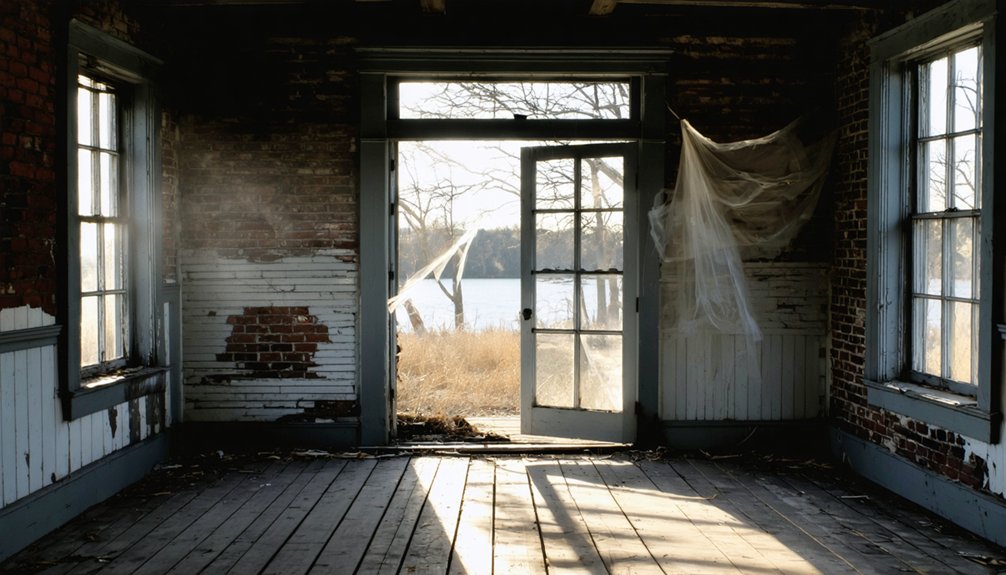
Built around 1753 by Abraham Allee, a descendant of Huguenot settler John Allee, the Allee House stands as Delaware’s most significant surviving example of colonial plantation architecture.
You’ll find this brick structure showcasing authentic Flemish bond construction with glazed headers typical of mid-18th-century plantation homes. The Allee architecture reflects the family’s agricultural empire spanning 600 acres, where tobacco and orchards flourished through enslaved labor.
The plantation legacy traces back to 1706 when John Allee purchased Woodstock Bower, establishing Huguenot influence in Kent County.
John Allee’s 1706 acquisition of Woodstock Bower marked the beginning of significant Huguenot agricultural influence throughout Kent County’s colonial landscape.
After Jonathan Allee’s death in 1775, inheritance disputes fractured family ownership. Though the federal government leased it to Delaware in 1963 and restoration occurred in 1966, you’ll discover it’s largely closed to public access today—a preserved yet isolated monument to Delaware’s colonial past.
Nemours: Lost Estate in DuPont Country
You’ll find Nemours Estate’s story begins in 1909 when Alfred I. du Pont constructed this 47,000-square-foot mansion as a tribute to the family’s gunpowder manufacturing fortune.
The estate’s decline mirrors the broader transformation of DuPont country, where industrial dynasties gave way to modern development pressures and changing economic realities.
Today, you can witness how the Nemours Foundation has integrated this once-private domain into Delaware’s contemporary landscape through controlled tours and its connection to Nemours Children’s Hospital.
DuPont Estate Origins
When Alfred I. duPont commissioned his grand estate in 1909, he chose the name “Nemours” to honor his family’s French heritage, specifically referencing the town associated with his great-great-grandfather Pierre Samuel du Pont de Nemours.
You’ll discover this mansion wasn’t just another wealthy family’s retreat—it represented the pinnacle of duPont legacy ambitions on their vast Wilmington landholdings.
The estate architecture reflected Alfred’s vision of French aristocratic grandeur. He enlisted New York’s prestigious Carrère and Hastings firm to design a Louis XVI château that’d rival European palaces.
Built as a wedding gift for his second wife Alicia, the project’s ambitious 18-month timeline demonstrated the duPont family’s resources and determination. This 47,000-square-foot mansion would eventually house 105 rooms filled with authentic French antiques and royal timepieces.
Manufacturing Legacy Decline
As the DuPont Company’s manufacturing empire began its inevitable shift away from its Brandywine River origins, the Nemours estate stood as both monument and paradox to the family’s industrial legacy.
By the 1950s, you’d witness a company over 150 years old abandoning its manufacturing roots along the very river that built its fortune. The original gunpowder mills had closed thirty years before Alfred I. duPont’s death in 1957, marking the end of an era that once supplied one-third to one-half of Union Army powder during the Civil War.
This manufacturing decline transformed the lavish estate into a symbol of industrial nostalgia—a 47,000-square-foot mansion preserving memories of when DuPont dominated America’s military gunpowder production during its mid-19th century peak.
Modern Club Integration
Following Alfred I. duPont’s death in 1957, the Nemours Foundation transformed his private family retreat into a controlled cultural institution that operates more like an exclusive club than a traditional public museum.
You’ll find access severely restricted—only 48 visitors per tour, ages 13 and above, touring just eight months yearly.
The Foundation’s $39 million renovation between 2005-2008 installed modern amenities while maintaining historical preservation standards, upgrading electrical systems and restoring French neoclassical interiors.
Yet Delaware’s state government challenged these limitations in 2012, arguing the Foundation wasn’t fulfilling duPont’s charitable intentions.
You’re fundamentally visiting what amounts to an elite cultural preserve rather than the accessible public space duPont originally envisioned for his grand estate.
Old Furnace: Industrial Ruins by Deep Creek
Key features you’ll encounter include:
- Crumbling furnace foundations that once supported intensive metalworking operations
- Stone remnants scattered throughout the wooded landscape near Deep Creek
- Historical markers recognizing its 1977 National Register designation
Today, you can explore this abandoned industrial site that exemplifies early American manufacturing‘s rise and decline, contrasting sharply with thriving nearby Seaford.
Forgotten Mining Communities of the Piedmont
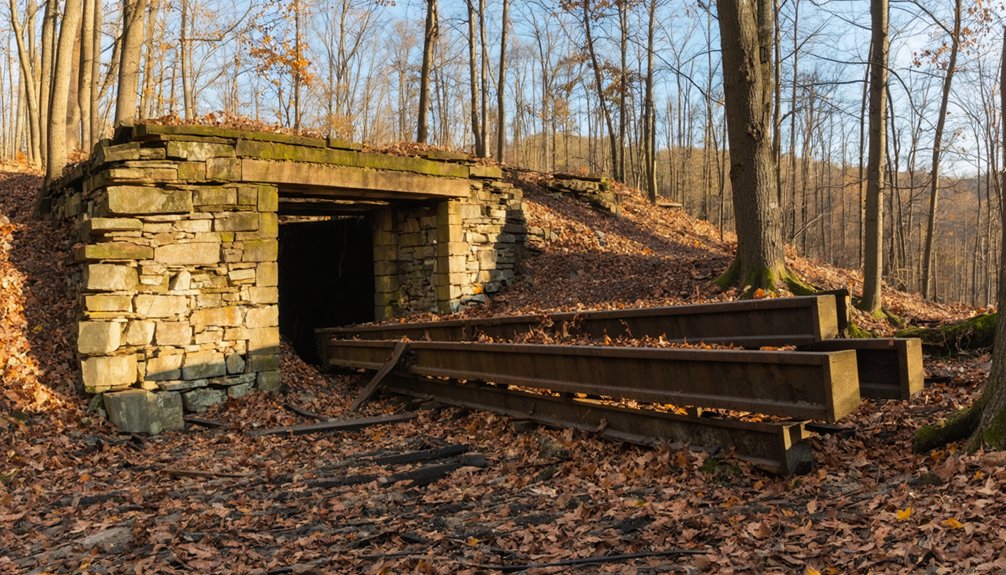
While Delaware’s coastal plains capture most attention, the state’s northern Piedmont region harbored thriving mining communities that have since vanished into history.
You’ll discover that Welsh miners established settlements around Iron Hill in 1703, extracting limonite from weathered gabbro deposits until 1884. These forgotten communities flourished during peak operations between 1841-1884, when workers transported ore by wagon to Maryland furnaces.
You can still explore remnants of Delaware’s mining heritage at sites like Woodlawn Quarry, where feldspar extraction supported porcelain manufacturing from 1850-1910.
Workers used hand tools to quarry minerals shipped to Philadelphia factories. Today’s state parks at Hagley Museum and Winterthur preserve former gabbro quarries that once supplied building materials throughout the region, marking where entire communities once bustled with industrial activity.
Railroad Towns Left Behind by Progress
When Delaware’s first railroad charters emerged in 1829-1832, they sparked the creation of entirely new communities that hadn’t existed before.
You’ll find that towns like Clayton, Felton, and Harrington sprouted around depots, creating depot-centric economies entirely dependent on rail service. This railroad legacy shaped Delaware’s settlement patterns for decades.
However, mid-20th century changes devastated these communities through systematic town transformation:
- Loss of passenger service eliminated the primary economic driver for depot-dependent settlements
- Freight line consolidations under Penn Central and Conrail abandoned unprofitable branch routes
- Highway competition reduced rail dependence, making small railroad towns obsolete
Hartly exemplifies this decline—once renamed for a railroad employee who brought the line, it’s now one of Delaware’s smallest towns by population after losing both passenger and freight service.
Frequently Asked Questions
Are These Ghost Towns Safe to Visit or Are They on Private Property?
You’ll find mixed safety concerns and property rights issues. Allee House, Fort Delaware, and Cape Henlopen offer safe public access through managed tours, while Glenville’s abandoned remnants present unclear private property restrictions.
What Caused Most Delaware Ghost Towns to Become Abandoned Over Time?
Like dominoes falling, you’ll find economic decline toppled Delaware’s ghost towns when manufacturing, fishing, and agriculture faded. Military decommissioning after WWII, violent conflicts with Native Americans, and construction failures also contributed considerably.
Can You Still See Original Foundations or Structures at These Sites Today?
You’ll find original architecture remnants throughout Delaware’s abandoned sites. Stone foundations, brick footings, and concrete slabs retain historical significance at Zwaanendael, Glenville, and military installations, though coastal erosion’s reduced some visibility.
How Do Delaware’s Ghost Towns Compare to Those in Western States?
Like David facing Goliath, you’ll find Delaware’s ghost towns are tiny colonial remnants with profound historical significance, while western sites represent massive mining boomtowns whose urban decay spans acres of abandoned infrastructure.
As you explore these ghost towns for sale in Delaware, you’ll uncover stories etched into weathered buildings and crumbling streets. Each site holds potential for restoration or transformation, inviting adventurers and investors alike to breathe new life into these forgotten places. The allure of owning a piece of history is not just about real estate; it’s a chance to connect with the past in a unique way.
Are There Any Guided Tours Available for Visiting Delaware’s Abandoned Places?
You’ll find guided exploration through Dover Dark History Tours covering abandoned sites with historical significance, plus Fort Delaware’s paranormal investigations. These tours reveal Delaware’s forgotten places through documented chronicles of past inhabitants and tragic events.
References
- http://freepages.rootsweb.com/~gtusa/history/usa/de.htm
- https://99wfmk.com/delaware-ghost-town-and-abandoned-mine/
- https://www.youtube.com/watch?v=ex8Hld_imPU
- https://yesterdaysamerica.com/rediscovering-the-forgotten-towns-of-delaware-county/
- https://www.farmweddingde.com/wedding-blog/haunted-history-in-delaware-city-tourism-in-the-first-state
- https://www.visitkeweenaw.com/listing/delaware-the-ghost-town/515/
- https://en.wikipedia.org/wiki/Zwaanendael_Colony
- https://kids.kiddle.co/Zwaanendael_Colony
- https://www.britannica.com/place/Delaware-state/The-colony
- https://www.tehistory.org/hqda/html/v01/v01n3p001.html