You’ll discover Florida’s most famous ghost towns include Fort Dade on Egmont Key, a military outpost from 1837 that’s now accessible only by boat, and Ellaville in Madison County, where Drew Mansion still stands from the 1860s lumber boom. Eldora’s citrus community collapsed after the devastating 1894-1895 freeze, while Hopewell transformed from plantation to phosphate mining before abandonment. White City and Kerr City also fell victim to economic collapse and natural disasters, leaving haunting remnants that reveal their fascinating stories.
Key Takeaways
- Fort Dade on Egmont Key served as a military outpost from 1837-1920s, with ruins now accessible only by boat through state park.
- Ellaville was a prosperous lumber town founded in 1861, featuring Drew Mansion and abandoned Hillman Bridge as key remnants.
- Eldora thrived as a citrus community until the devastating 1894-1895 freeze destroyed orange groves, leaving behind a schoolhouse and state house.
- White City was a failed Danish colony from 1893, devastated by fraudulent land schemes and the Great Freeze of 1894-1895.
- Hopewell transformed from Turner Plantation to phosphate mining town, now featuring overgrown ruins and reported paranormal activity since the 1990s.
Fort Dade: Military Outpost Turned Eerie Ruins
When you explore Florida’s forgotten military history, Fort Dade stands as one of the state’s most haunting reminders of past conflicts.
Named after Major Francis L. Dade, who died with 107 troops in the 1835 Dade Massacre, two forts carried this legacy forward.
Major Francis L. Dade’s tragic death alongside 107 soldiers in 1835 would immortalize his name across two military fortifications.
The first Fort Dade emerged in 1837 during the Second Seminole War, hosting the pivotal Fort Dade Capitulation signing. Construction began on Christmas Day 1836 under Lieutenant Colonel William S. Foster’s command. Seminoles burned it in 1838, and it was abandoned by 1849.
The second Fort Dade rose on Egmont Key in 1898 during the Spanish-American War. This military outpost housed 300 residents, growing to 600 during World War I. The fort remained active until the mid-1920s, when military operations finally ceased.
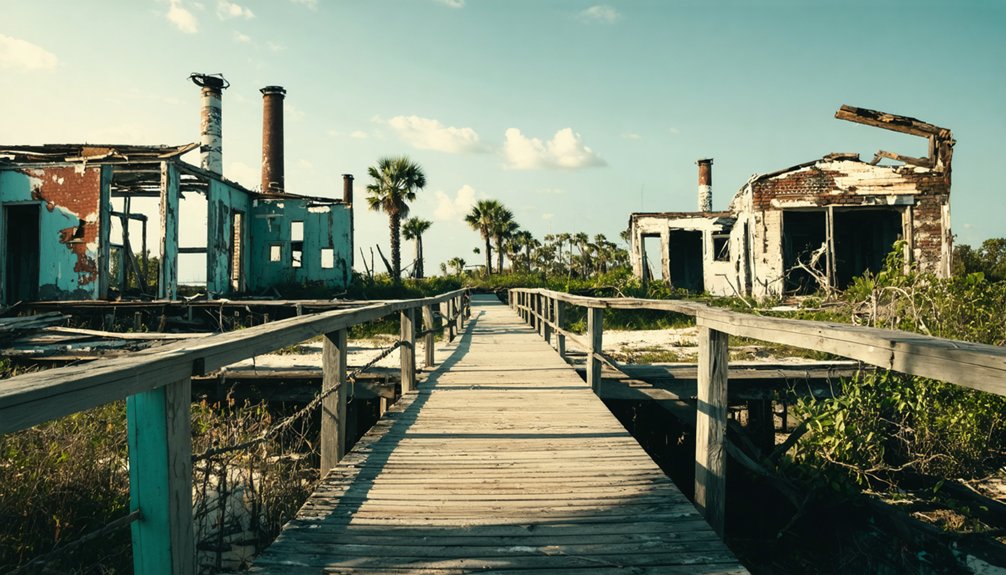
Today, you’ll find ghostly remnants scattered across Egmont Key State Park—crumbling batteries, foundations, and structures creating an eerie ghost town accessible only by boat.
Ellaville: Madison County’s Forgotten Settlement
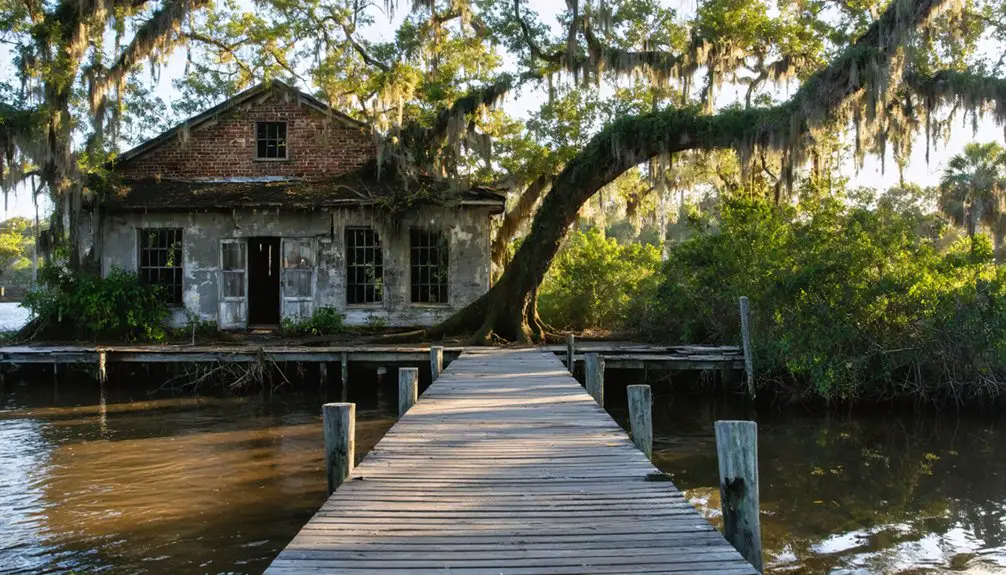
Deep in Madison County’s wilderness, the forgotten settlement of Ellaville once thrived as Florida’s most prosperous lumber town before vanishing entirely into history. Founded in 1861 by George Franklin Drew, this riverside community became Florida’s economic powerhouse through timber production. The town was named after Ella, Drew’s long-time African-American servant who inspired the community’s enduring tribute.
Key remnants you’ll discover today:
- Ruins of the Drew Mansion, once Florida’s most luxurious residence
- Abandoned Hillman Bridge from 1925, now bypassed by modern roads
- Overgrown foundations where 500 mill workers once lived
- Steam-operated sawmill foundations along the Suwannee River
- Scattered infrastructure from Florida’s largest lumber operation
Economic Decline struck after the 1898 sawmill fire and pine resource depletion. Flooding damaged the Drew Mansion, and the Great Depression sealed Ellaville’s fate, transforming this millionaire’s empire into Madison County’s most intriguing ghost town. Drew himself later became Florida’s first post-Civil War governor in 1876, cementing his political legacy beyond the lumber industry.
Eldora: Citrus Dreams Destroyed by the Great Freeze
You’ll find Eldora’s story along the shores of Mosquito Lagoon, where citrus groves once flourished after the town’s founding in 1882.
The settlement’s economy thrived on orange cultivation, commercial fishing, and small-scale farming until residents built a sustainable community complete with post office, school, and local businesses by the 1890s.
Then the devastating freeze of 1894-1895 struck, destroying the citrus trees that formed the backbone of Eldora’s prosperity and triggering the town’s rapid decline. The area had been home to Native Americans and woodsmen long before European settlers arrived to establish their agricultural community.
Today, visitors can explore the preserved ruins of structures like the Eldora State House and Schoolhouse that stand as reminders of this once-thriving community.
Thriving Citrus Industry Era
Although Eldora began as a modest coastal settlement around 1876–1886 along the Mosquito Lagoon, it quickly transformed into a thriving agricultural community centered on citrus production.
The citrus boom drove substantial investment as settlers poured their life savings into grove establishment, creating a specialized economy that supported 100–200 residents by the 1890s.
The community’s economic resilience depended entirely on citrus cultivation, which generated multiple revenue streams:
- Orange grove harvests providing primary cash income
- Orange blossom honey production creating valuable secondary products
- Seasonal packing and transport labor opportunities
- Commercial fishing supplementing agricultural income
- Small-scale truck farming diversifying local production
You’ll find that water transport via the Indian River Lagoon connected Eldora’s produce to broader markets, with New Smyrna serving as the distribution hub fourteen miles away. However, the community’s expansion efforts were repeatedly thwarted by hard freezes that devastated the temperature-sensitive citrus crops. Today, visitors can explore the remnants of this once-prosperous settlement along a 0.5 mile trail that leads to historical sites including former wharves and the preserved Eldora State House.
1895 Freeze Devastation
When devastating freezes struck Florida in 1894–1895 and again in 1899–1900, Eldora’s citrus-dependent economy collapsed virtually overnight.
You’ll find that temperatures dropped below freezing for consecutive nights, killing mature orange trees through freeze-induced cambial damage and widespread defoliation. The citrus decline eliminated primary cash crops, forcing complete harvest losses that made replanting financially impractical for most landowners.
The agricultural impact extended beyond groves—ancillary enterprises like beekeeping and truck farming lost market access as citrus shipments ceased. A hurricane struck just one year after the freeze, delivering a final blow to the already struggling community.
Property values plummeted as labor needs disappeared and capital fled the area. Within five years, only a handful of families remained. Today, Eldora has transformed into a peaceful retreat with hiking trails where visitors can explore its abandoned past.
You can still trace this devastation today along Eldora Loop Road, where overgrown homesteads and abandoned grove remnants tell the story of a community destroyed by nature’s fury.
Hopewell: Hillsborough County’s Haunting Remnants
You’ll discover Hopewell’s complex origins stretching from the antebellum Turner Plantation through its 1883 establishment as Callsville to its eventual transformation into a phosphate mining community that declined by the 1950s.
As you explore the overgrown ruins scattered beneath towering oaks, you’ll encounter the surviving McDonald and Hull houses, the weathered Baptist church, and cracker-style homesteads that emerge from orange groves like monuments to forgotten lives.
Local residents and visitors have reported unexplained phenomena around these remnants, particularly near the old cemetery and abandoned mining sites where Hopewell’s restless past seems to linger.
Hopewell’s Mysterious Past Origins
Before the Civil War transformed the landscape of central Florida, Turner Plantation stretched across what would become Hopewell in Hillsborough County along present-day Florida State Road 60.
You’ll discover these Hopewell origins trace back to a dramatic transformation when freedom arrived for enslaved workers, dividing the vast plantation into smaller homesteads.
The McDonald legacy shaped this community’s destiny through several key developments:
- Originally named Callsville in 1870 before J.R. McDonald’s influence
- J.R. McDonald donated vital land for Hopewell Church and Cemetery
- William McDonald continued the family’s generosity with additional church land in 1897
- Pioneer families like McDonald, Hull, Wiggin, and Cassels established deep roots
- George W. Wells operated the short-lived post office from 1883-1884
You can still trace these founding families’ descendants in the surrounding area today.
Exploring Overgrown Town Ruins
Along State Road 39 just south of its intersection with State Road 60, you’ll find Hopewell’s scattered remains hidden beneath sprawling orange groves that now blanket this forgotten Hillsborough County settlement.
These overgrown landscapes reveal fragments of a community that thrived from the 1870s through the mid-20th century.
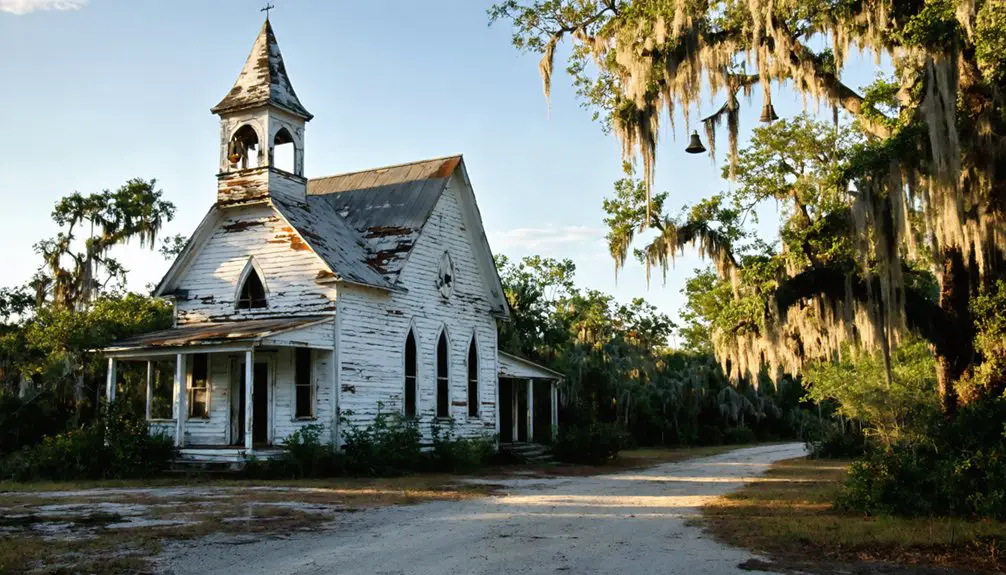
You can still discover Hopewell Baptist Church standing among gigantic oaks, its 1902 clapboard structure modified in 1955 with a steeple and front steps.
The adjacent cemetery holds pioneer families like the McDonalds and Hulls.
Abandoned phosphate mines dot the terrain, remnants of operations that ceased in the 1950s.
The citrus groves that replaced original homesteads create a peaceful maze where foundation stones and forgotten roads occasionally surface among the trees.
Paranormal Activity Reports
Visitors to Hopewell’s decaying remnants have documented unexplained phenomena since the 1990s, particularly around the 1902 Baptist Church and its adjacent cemetery where pioneer families like the McDonalds and Hulls rest beneath ancient oaks.
You’ll find these paranormal sightings concentrated near structures that’ve witnessed over a century of community history.
Documented ghostly encounters include:
- Shadowy figures moving between weathered headstones during twilight hours
- Disembodied voices echoing from the church’s original segregated seating areas
- Cold spots reported inside the Hull House despite Florida’s humid climate
- Unexplained lights flickering in abandoned phosphate mines after dark
- Footsteps heard on the church’s 1955 front steps when no one’s present
Local archives contain witness testimonies spanning three decades, creating a compelling record of supernatural activity in this forgotten settlement.
White City: Saint Lucie County’s Abandoned Community
While most Florida ghost towns emerged from failed mining or lumber ventures, White City represents a unique chapter in the state’s settlement history as a planned Danish colony that began around 1893.
You’ll find this community’s origins tied to the brightly lit “White City” exhibit at the 1893 Chicago World’s Fair, which inspired its name.
The settlement faced devastating setbacks when Colonel Myers ran a fraudulent land-and-banking scheme, absconding with settlers’ savings and down payments.
The Great Freeze of 1894–1895 destroyed the community’s agricultural heritage of pineapple and citrus cultivation, forcing many Danish families to abandon their dreams.
Today, you can visit surviving structures like the Jorgensen House and Captain Hammond House near the intersection of US-1 and Midway Road, remnants of this ambitious but ill-fated colonial experiment.
Kerr City: Marion County’s Lost Settlement
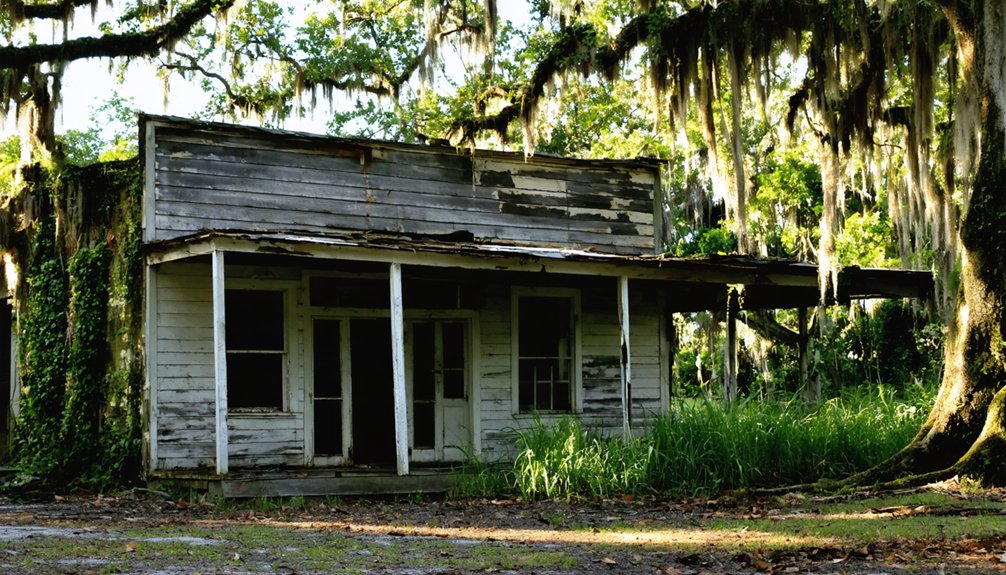
Deep within Marion County’s Ocala National Forest, Kerr City stands as one of Florida’s most intact yet forgotten settlements, founded in 1884 by George Smiley on 205 acres of eastern woodland.
You’ll discover Kerr City history reveals a thriving community that peaked at 100 residents before economic collapse. The Great Freeze of 1894-1895 destroyed the citrus industry overnight, forcing mass exodus. Railroad development bypassed the town, sealing its fate by 1905.
Today, you can’t visit these abandoned structures publicly—they’re privately owned by Smiley’s great-grandson.
Key remnants include:
- 14 buildings in the National Register Historic District
- Original wooden houses with weathered porches
- Florida’s oldest gas station
- Robert B. Henley home
- Rusting bed frames and gas lamps
Exploring Florida’s Ghostly Past: What Remains Today
Across Florida’s diverse landscapes, five remarkable ghost towns tell distinct stories of boom, collapse, and nature’s reclamation of human ambition.
You’ll find Ellaville’s sawmill ruins along the Suwannee River, where 1,000 residents once thrived before fire devastated George Franklin Drew’s empire.
Ruby’s flooded mining shafts remind you of catastrophic early 1900s disasters that claimed miners’ lives.
Beneath Ruby’s waterlogged earth lie haunting reminders of mining tragedies that forever changed this abandoned Florida community.
St. Joseph’s dry remains mark where Florida’s capital briefly stood during the Second Seminole War.
Eldora’s citrus groves, destroyed by 1895’s Great Freeze, now shelter manatees instead of families.
Centralia’s cypress logging traces hide within protected preserves.
These ghostly legends carry profound historical significance, demonstrating Florida’s cycles of prosperity and abandonment while offering you tangible connections to the state’s forgotten communities.
Frequently Asked Questions
Are There Any Safety Concerns When Visiting These Abandoned Florida Ghost Towns?
Yes, you’ll face structural collapse risks from unmaintained early 1900s buildings, wildlife encounters requiring awareness, hurricane debris hazards, and legal restrictions. Take safety precautions including sturdy footwear and emergency supplies.
What Is the Best Time of Year to Explore Florida’s Ghost Towns?
You’ll find winter and spring offer ideal weather for exploring Florida’s ghost towns, with comfortable temperatures and reduced humidity. Seasonal events like Cedar Key’s October festival provide additional cultural context during visits.
Do You Need Special Permits to Access These Historical Ghost Town Sites?
You don’t need special permits for Florida’s ghost town sites. Standard park entrance fees apply at state and federal locations, but ghost town regulations follow normal park protocols without additional permit requirements for exploration.
Are Guided Tours Available for Any of Florida’s Famous Ghost Towns?
You’ll discover guided exploration opportunities at select sites like Fort Dade and Indian Key, where boat tours reveal their historical significance through ranger programs and licensed operators offering scheduled excursions to these preserved ruins.
What Should Visitors Bring When Exploring These Remote Abandoned Settlements?
You’ll need essential hiking gear including sturdy boots, insect repellent, and ample water, plus camera equipment with extra batteries to document historical remnants while traversing Florida’s challenging subtropical terrain safely.
References
- https://www.ghosttowns.com/states/fl/fl.html
- https://www.atlasobscura.com/things-to-do/florida/ghost-towns
- https://www.timeout.com/florida/florida-ghost-towns
- https://patchproflorida.com/blog/the-fascinating-history-of-floridas-ghost-towns/
- https://www.freakyfoottours.com/us/florida/
- https://floridatrailblazer.com/tag/ghost-towns/
- https://www.legendsofamerica.com/fort-dade-pasco-county-florida/
- https://floridaseminoletourism.com/a-dark-history-at-egmont-key/
- https://www.legendsofamerica.com/fort-dade-egmont-key/
- https://www.museumoffloridahistory.com/explore/exhibits/permanent-exhibits/world-war-ii/historical-sites/westcentral-listing/fort-dade/