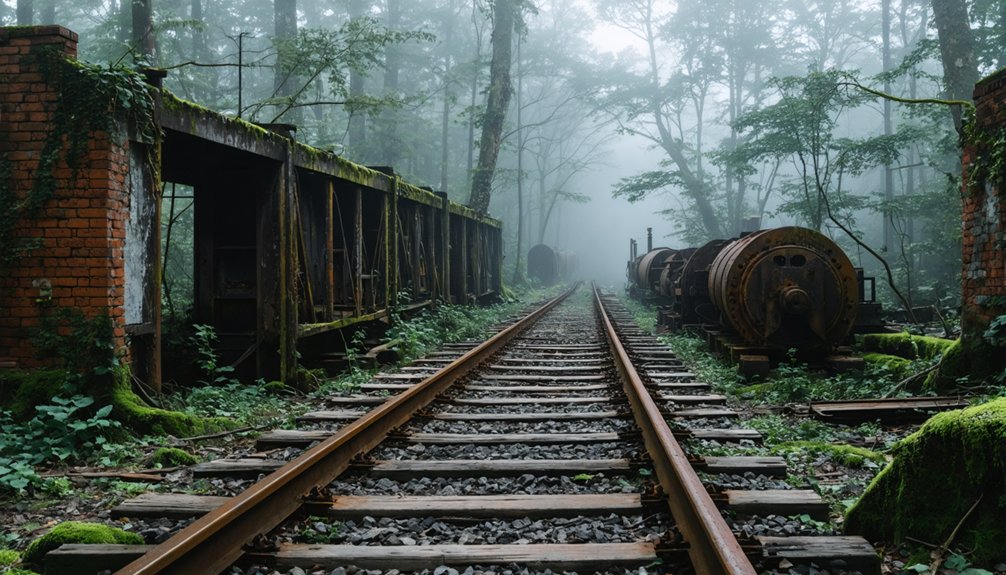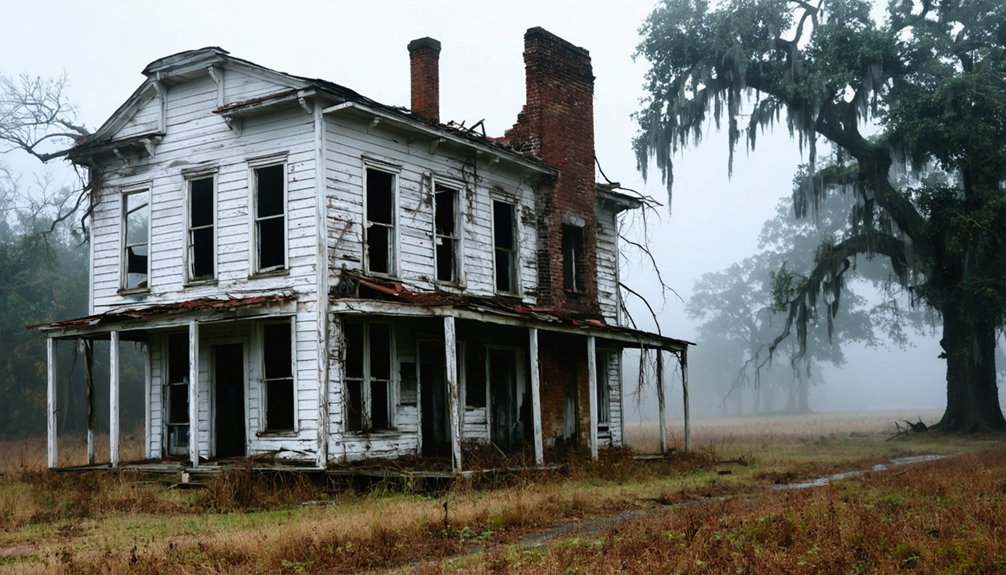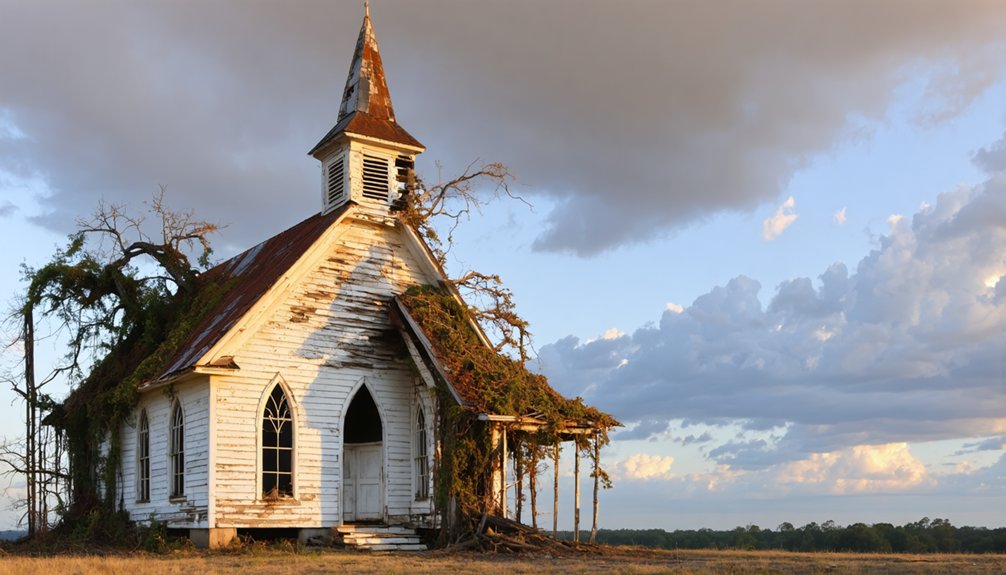
You’ll discover Georgia’s most famous ghost towns scattered across the state, each telling unique stories of rise and fall. Wrightsboro, established in 1767, was the South’s largest Quaker settlement until families fled to Ohio after Revolutionary War hardships. Scull Shoals housed Georgia’s first paper mill along the Oconee River, employing 600 workers before disasters struck. High Falls thrived as an industrial center until railroads bypassed it, while New Manchester’s cotton mill ruins showcase Sherman’s devastating Civil War march. These preserved remnants offer fascinating glimpses into Georgia’s complex past.
Key Takeaways
- Scull Shoals features ruins of Georgia’s first paper mill from 1811, including weathered chimneys and an arched stone bridge along the Oconee River.
- New Manchester preserves Civil War-era cotton mill ruins destroyed by Sherman in 1864, with scorched bricks and bullet holes still visible today.
- High Falls showcases a complete 19th-century industrial town abandoned when railroads bypassed it, now preserved within High Falls State Park.
- Wrightsboro was established by Quaker families in 1767 but abandoned by 1809, leaving only a historic cemetery and Rock House structure.
- New Ebenezer represents Georgia’s oldest Protestant settlement from 1734, featuring Jerusalem Church, the state’s oldest surviving church building from 1769.
Wrightsboro: Georgia’s Southernmost Quaker Settlement
In 1767, Joseph Maddock and Jonathan Sell led forty determined Quaker families from North Carolina into the Georgia wilderness, establishing what would become the southernmost Quaker settlement in colonial America.
You’ll find Wrightsborough was named after Royal Governor James Wright, who granted them 44,000 acres in what’s now McDuffie County.
Their Quaker beliefs centered on nonviolence and strong opposition to slavery. However, these principles proved costly during the Revolutionary War’s chaos.
Their principled stance against violence and slavery became a dangerous liability when war erupted around them.
You’d discover that Patriots imposed 25% extra taxes on refusing Quakers, while raiders burned their homes and murdered dozens between 1780-1781. The Revolutionary impact devastated the community—thirty-five murders occurred by May 1781 alone.
Facing continued hardships and prophetic warnings about slave uprisings, most families migrated to Ohio and Indiana between 1805-1809, seeking the freedom their faith demanded. Ironically, less than one-fifth of landholders in the settlement were actually practicing Quakers, as Maddock had welcomed sympathetic non-Quakers for protection. Today, only remnants survive including the historic cemetery and the remarkable Rock House, built entirely of stone by Thomas Ansley around 1784-1785.
Scull Shoals: Home to Georgia’s First Paper Mill
Along the banks of the Oconee River, Scull Shoals emerged as Georgia’s industrial pioneer when the state legislature funded Zachariah Sims and George Paschal’s groundbreaking paper mill in 1811.
You’ll discover this paper mill history began with a $3,000 legislative loan that transformed existing grist mills into Georgia’s first paper production facility.
The town flourished under Dr. Thomas Poullain’s ownership, operating 2,000 spindles and employing over 600 workers by 1854. The Scull Shoals Manufacturing Company was established by Poullain and his associates in 1834 to expand operations. After Poullain’s death in 1868, the town faced multiple ownership changes that contributed to its economic instability.
However, disasters struck repeatedly—the 1814 drought crippled operations, devastating fires destroyed wooden structures in 1845, and the catastrophic 1887 flood finally submerged the entire settlement.
Today’s ghost town exploration reveals haunting remnants within Oconee National Forest: crumbling mill foundations, weathered chimneys, and an arched stone bridge—silent witnesses to Georgia’s ambitious industrial dreams.
High Falls: Industrial Center Bypassed by Progress
Where the Towaliga River cascades 135 feet over massive boulders in what’s now Monroe County, High Falls flourished as an early 1800s industrial powerhouse that harnessed the waterfall’s energy to drive multiple mills and factories.
You’ll find remnants of this industrial heritage scattered throughout what became one of Georgia’s most prominent ghost towns. The settlement thrived with its grist mill, cotton gin, blacksmith shop, shoe factory, multiple stores, and hotel, all strategically positioned along the fall line for reliable water power.
However, progress bypassed High Falls when the railroad routed to Jackson instead in the 1880s. The community endured further devastation when Confederate troops burned the grist mill during the Civil War to prevent looting, though it was rebuilt in 1866 and operated until 1960.
You can explore foundation ruins and the partially standing 1890 Old Alabama Road bridge, witnessing firsthand how this once-prosperous community earned its reputation as Georgia’s “unluckiest city.” The dramatic cascade below the dam earned recognition as the largest waterfall in middle Georgia, inspiring musician Dickey Betts of The Allman Brothers Band to compose a 14½-minute instrumental tribute titled “High Falls” in 1975.
New Ebenezer: The Salzburger Utopian Dream
You’ll find New Ebenezer’s story begins with religious persecution in 1731, when Protestant Salzburgers fled Austria and accepted King George II’s invitation to settle in colonial Georgia.
What started as a utopian community of 300 German-speaking settlers in 1734 flourished through silk production, water-powered mills, and strong Lutheran faith until economic pressures and Revolutionary War devastation triggered mass exodus. The community faced another major challenge when the ban on slavery was lifted in 1752, which significantly affected their small farming operations. The Salzburgers built Georgia’s first orphanage in 1737, establishing a legacy of caring for vulnerable members of their community.
Today, you can explore the remnants of this ambitious experiment where Jerusalem Church still stands as testimony to their remarkable attempt at creating a self-sufficient religious community on Georgia’s frontier.
Salzburger Settlement Origins
When Catholic authorities expelled German-speaking Protestant colonists from the principality of Salzburg in present-day Austria, these Lutheran refugees found an unexpected opportunity in England’s newest American colony.
Your ancestors’ Salzburger heritage emerged from religious persecution that forced them to seek refuge after fleeing their homeland. King George II and Georgia’s Trustees recognized these exiles’ potential, offering sanctuary where they could practice their Lutheran faith freely.
The first transport settled temporarily around Augsburg, Swabia, before departing for Georgia in 1734.
You’ll discover how Parliament, the Trustees, and the Society for Promoting Christian Knowledge funded their journey, providing travel expenses and initial supplies. This foundation enabled approximately 200 settlers to establish their community by 1736. General Oglethorpe personally marked out the town layout for their initial settlement at Old Ebenezer.
The settlers documented their experiences through detailed diaries kept by community leaders, preserving the struggles and triumphs of establishing their new homeland.
Key settlement characteristics included:
- Religious freedom from Catholic persecution
- Financial backing from English Protestant supporters
- Strategic timing with Georgia’s colonial development
Community Decline Factors
Despite the initial promise of religious freedom and fertile lands, New Ebenezer’s decline began almost immediately after settlement as multiple devastating factors converged to undermine the Salzburger community’s utopian vision.
You’d find that malaria and typhoid outbreaks killed one-third of early settlers, while swampy terrain forced costly relocations. The community couldn’t compete once Georgia legalized slavery in 1750, destroying their small-farm economic model.
Agricultural decline accelerated when sericulture collapsed after 1766, eliminating their primary industry. Revolutionary War disruptions shattered local governance and trade networks.
Community fragmentation intensified as families migrated to better lands, weakening their collective identity. Internal disagreements over adapting to colonial pressures created irreparable social divisions that ultimately dissolved their unified settlement.
Preserved Historical Remnants
Although centuries have passed since the Salzburger community’s dissolution, New Ebenezer’s most remarkable survivor stands as a proof of their enduring legacy—the Jerusalem Church, completed in 1769 and recognized today as the oldest church building in Georgia with a continuously meeting congregation.
You’ll discover that this sacred structure embodies Salzburger culture and their quest for religious freedom. The church’s historical significance extends beyond worship, having served as a Revolutionary War hospital when British forces occupied the settlement in 1778.
Key preserved elements include:
- The original Jerusalem Church building with its distinctive German Protestant architecture
- Salzburger descendants who continue living in the surrounding area
- Archaeological remnants of the mill sites and original settlement foundations
These tangible connections allow you to experience firsthand the remarkable story of America’s early religious liberty seekers.
New Manchester: Civil War Ruins at Sweetwater Creek
You’ll find the haunting brick ruins of New Manchester’s five-story cotton mill standing as stark reminders of Sherman’s destructive march through Georgia in 1864.
The preserved foundation walls and scattered debris tell the story of the Confederacy’s largest textile operation north of Atlanta, where Union cavalry burned the entire factory town and arrested nearly 100 workers for treason.
Today’s hiking trails at Sweetwater Creek State Park guide you through the same paths where enslaved laborers once carried Georgia clay bricks and mill workers operated the water-powered machinery that produced Confederate uniforms.
Mill Ruins History
When James Rogers and Charles McDonald purchased land along Sweetwater Creek in 1845, they envisioned a textile empire that would become the tallest structure in the Atlanta area.
Construction began in 1846, and by December 1849, their five-story water-powered mill opened as the Sweetwater Manufacturing Company. The bustling operation supported 250 residents and employed 90 workers.
During the Civil War, the mill’s historical significance grew as it supplied Confederate uniforms.
However, Sherman’s troops captured it without resistance on July 2, 1864, burning it seven days later.
Today’s preserved ruins tell compelling ghost stories of imprisoned workers and wartime destruction:
- Warped bricks still show scorch marks from the 1864 fire
- Bullet holes remain from post-war target practice
- Recent preservation efforts reopened the site in 2017
Exploring the Trails
Since Sweetwater Creek State Park established protected access in 1972, visitors can explore well-maintained trails that wind through dense Georgia foliage to reach New Manchester’s haunting Civil War ruins.
You’ll start your journey at the visitor center, where rangers lead guided tours along the creek shores. The path takes you past the former mill village site before reaching the fenced ruins area.
Trail maintenance guarantees safe passage through this increasingly beautiful, grotto-like setting where rushing creek waters create natural splendor.
Rangers open the protective fencing, allowing you to explore down into the crumbling five-story brick walls. The 2015 erosion stabilization project addressed visitor safety concerns while preserving these unchanged 1864 remnants.
You’ll discover the slave-built millrace channel and burned factory foundations overtaken by forest growth.
Bridgeboro: Railroad Town Lost to Time
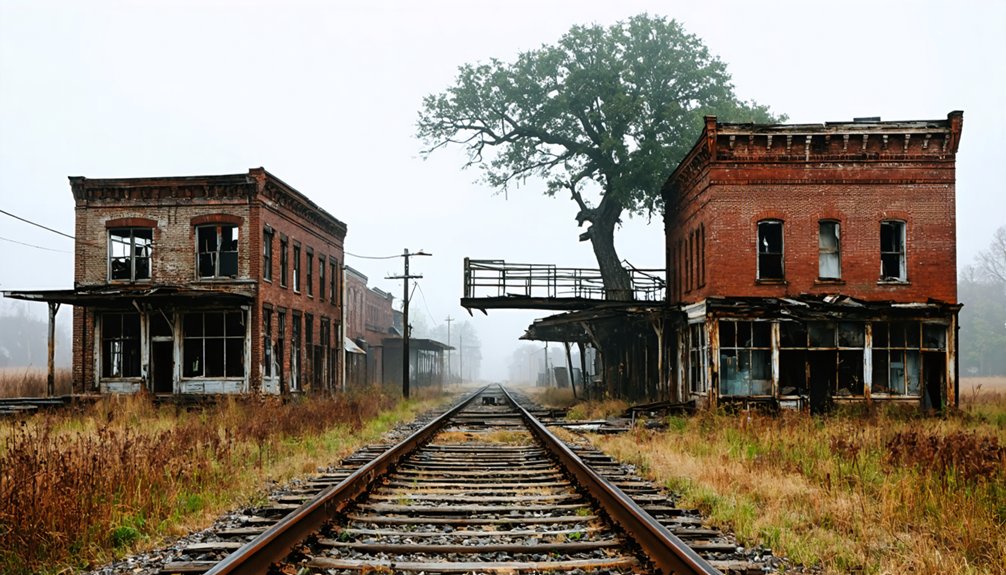
Ambition drove Worth County planners to establish Bridgeboro in the early 1900s as a strategic railroad town designed to serve the region’s agricultural workers and limestone quarry operations.
You’ll discover this incorporated town, officially recognized by Georgia’s General Assembly in 1912, thrived as a shipping hub where farm goods flowed through railroad history’s corridors.
The town featured essential infrastructure:
- General stores like Hollingsworth serving local commerce
- Churches anchoring community life
- Active limestone quarry supporting industrial needs
Economic shifts proved devastating when railroad operations relocated, severing Bridgeboro’s lifeline.
The Great Depression amplified this collapse, while quarry abandonment accelerated population exodus.
Today, you’ll find only crumbling foundations and abandoned structures marking where this once-prosperous agricultural hub stood, reduced to historical memory.
Exploring Georgia’s Abandoned Heritage Today
Adventure awaits across Georgia’s countryside, where remnants of forgotten communities offer tangible connections to the state’s complex past.
You’ll discover abandoned architecture telling stories of resilience and decline throughout these scattered settlements. At Scull Shoals, you can hike through Georgia’s first paper mill ruins along the Oconee River.
Weathered stone and crumbling brick reveal tales of triumph and tragedy in Georgia’s forgotten settlements along ancient riverbanks.
High Falls State Park preserves a complete 19th-century town’s remains, including grist mill foundations beneath middle Georgia’s largest waterfall.
New Manchester’s brick mill walls frame sky views at Sweetwater Creek, where Civil War destruction froze time.
Each site carries profound historical significance, from Wrightsboro’s pioneering Quaker heritage to Sunbury’s maritime cemetery overlooking coastal marshes.
These locations offer freedom to explore authentic American frontier experiences without modern interference.
Frequently Asked Questions
Are There Any Guided Tours Available for Visiting These Ghost Towns?
You won’t find guided tour options specifically for Georgia’s abandoned ghost towns like Mallory or Apalachee. Local tour companies focus on Savannah’s historic haunted sites instead of actual deserted settlements.
If you’re interested in discovering abandoned places to explore in Georgia, consider taking a road trip to visit some of these hidden gems. From the remnants of old mill towns to derelict railroad stations, each site tells a unique story of the past. Make sure to bring your camera, as these locations offer stunning views and a chance to capture the eerie beauty of Georgia’s forgotten history.
If you time your visit right, you might even catch some ghost towns in Georgia with festivals that celebrate their rich history and culture. These events often feature local art, music, and food, making them a perfect opportunity to experience the vibrant community spirit that persists even in these abandoned places. Embrace the haunting atmosphere and connect with fellow explorers who share your passion for uncovering the stories hidden within the remnants of the past.
What Safety Precautions Should Visitors Take When Exploring These Abandoned Sites?
You’ll need proper safety gear and emergency contacts since 70% of ghost town injuries involve falls through rotted structures. Always explore during daylight, wear sturdy boots, and inform someone of your exact location.
Can Artifacts or Souvenirs Be Collected From These Ghost Town Locations?
You can’t collect artifacts from Georgia’s ghost towns due to strict legal restrictions under federal and state laws. Artifact preservation efforts protect these sites, with fines up to $10,000 for violations.
Which Ghost Towns Are Most Accessible for Families With Young Children?
You’ll find Scull Shoals and Mallory area offer the smoothest family friendly activities, featuring short walks and visible ruins perfect for exploring ghost town history with toddlers without wrestling dangerous terrain or trespassing concerns.
Are Camping or Overnight Stays Permitted Near Any of These Sites?
You’ll find camping regulations allow overnight stays at all four sites. Scull Shoals offers dispersed camping with permits, High Falls provides state park facilities, while Wrightsboro and New Ebenezer have nearby public camping options.
References
- https://roughdraftatlanta.com/2021/05/23/travels-with-charlie-georgias-ghost-towns-slideshow/
- https://www.ezhomesearch.com/blog/ghost-towns-in-georgia/
- https://www.youtube.com/watch?v=hW4R7F_l9cM
- https://everafterinthewoods.com/georgia-ghost-town-landscapes-where-nature-and-history-share-the-same-ground/
- https://vanishinggeorgia.com/tag/georgia-ghost-towns/
- https://www.freakyfoottours.com/us/georgia/
- https://exploregeorgia.org/things-to-do/article/where-to-find-famous-georgia-ghosts
- https://theforgottensouth.com/quaker-rock-house-georgia/
- https://www.georgiaencyclopedia.org/articles/history-archaeology/wrightsborough/
- https://freepages.rootsweb.com/~gentutor/genealogy/Wrights.pdf