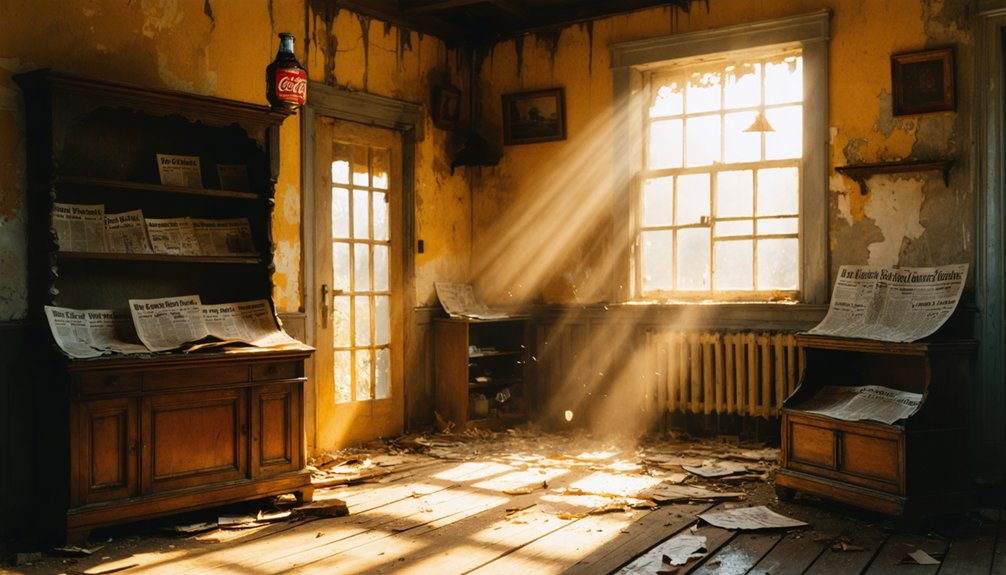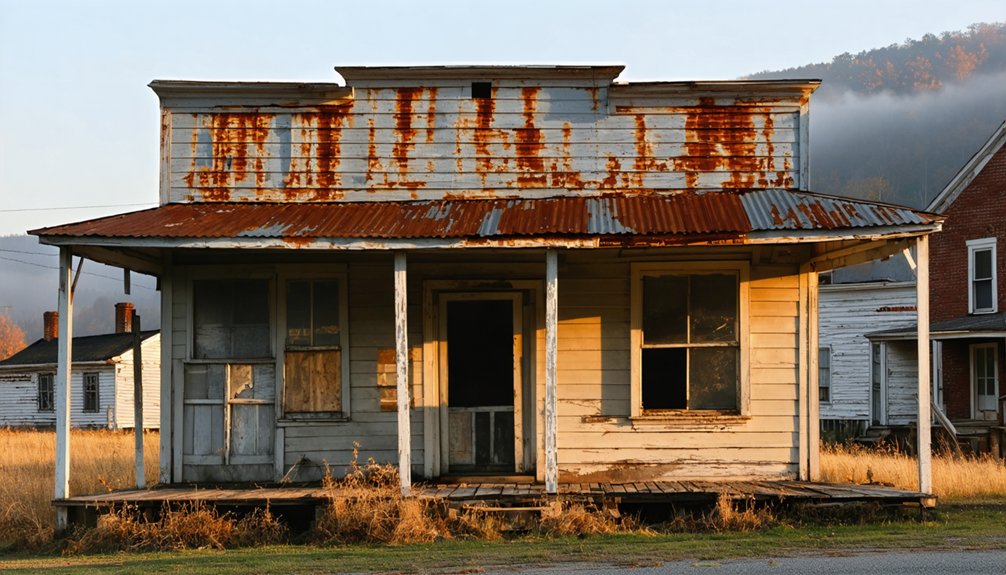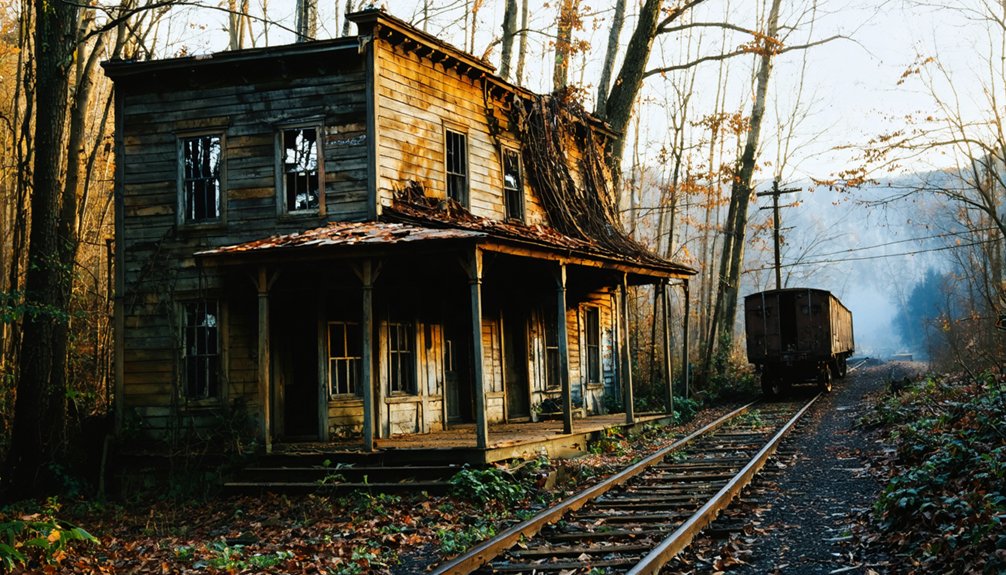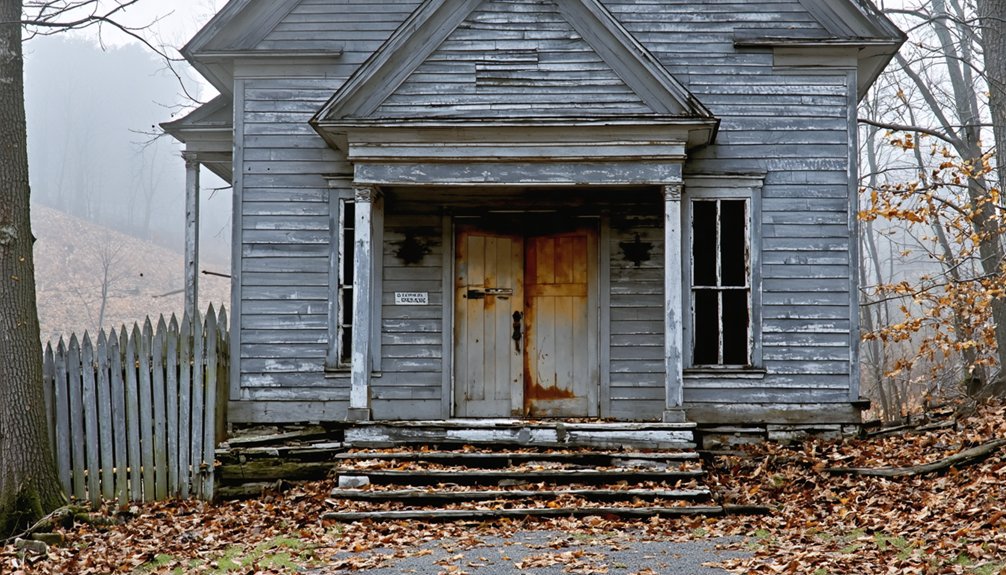
Kentucky’s most famous ghost towns include Paradise, immortalized in John Prine’s 1971 ballad after coal mining destroyed the community by 1967, and Blue Heron, where Mine 18 supported over 2,200 residents until 1962 before becoming an outdoor museum. You’ll also find Barthell, Kentucky’s best-preserved coal camp with authentic company houses, Creelsboro, a river port abandoned after Wolf Creek Dam’s construction, Rocky Hill, destroyed by a devastating 1941 fire, and Golden Pond, the former “Moonshine Capital of the World.” Each location offers unique insights into Kentucky’s industrial heritage and the forces that shaped these communities’ dramatic rises and falls.
Key Takeaways
- Paradise was a thriving community until strip mining began in 1959, immortalized in John Prine’s 1971 ballad.
- Blue Heron operated as Mine 18 from 1937-1962, now preserved as an outdoor museum with ghost structures.
- Creelsboro flourished as a Cumberland River port until Wolf Creek Dam construction led to its abandonment in 1951.
- Golden Pond was known as the “Moonshine Capital of the World” before federal acquisition evacuated residents by 1970.
- Barthell remains Kentucky’s most authentically preserved coal mining camp with restored company houses and mining artifacts.
Paradise: The Town That Inspired a Song
Paradise began its quiet existence in the early 1800s as Stom’s Landing, named after Leonard Stom who established a ferry crossing over the Green River in eastern Muhlenberg County.
You’ll find this town history represents a tragic transformation from thriving community to industrial sacrifice. After operating as a trading post for forty years, Paradise received its post office in 1852 and flourished until strip mining arrived in 1959.
Paradise’s story epitomizes industrial progress destroying small-town America—a once-prosperous trading community reduced to rubble by corporate greed.
The Tennessee Valley Authority’s coal operations created unbearable living conditions with ash fallout and toxic gases, forcing complete resident buyouts by 1967. The Peabody Company conducted extensive strip mining operations that fundamentally altered the landscape and destroyed the community’s natural environment. The construction also made way for the Paradise Fossil Plant, which would feature the largest cyclonic fired boiler in the world.
Today, only a hilltop cemetery remains, but Paradise’s song legacy lives on through John Prine’s haunting 1971 ballad about Mr. Peabody’s coal train destroying this once-beautiful Kentucky community.
Blue Heron: From Coal Mine to Living Museum
You’ll find Blue Heron‘s transformation from active coal mining community to interpretive museum represents one of Kentucky’s most unique preservation efforts.
The Stearns Coal & Lumber Company operated Mine 18 from 1937 until 1962, supporting hundreds of residents in this isolated Big South Fork River settlement before economic pressures forced closure. At its peak, the community housed over 2,200 residents who lived in company-provided housing and enjoyed amenities like a swimming pool, baseball field, and recreation center.
Today’s Blue Heron Interpretive Center recreates the vanished town through distinctive ghost structures—open metal frames that outline original buildings while audio recordings share former residents’ memories. The self-guided trail features large informational signs with photographs that detail each building’s historical significance and original purpose in the mining camp.
Mining Operations History
When Justus Stearns purchased 30,000 acres on Kentucky’s Cumberland Plateau in 1899, he set in motion a coal mining enterprise that would transform the remote wilderness into a thriving industrial operation.
You’ll discover that Stearns Coal & Lumber Company, formed in 1902, employed sophisticated mining techniques including underground tunnels and electric tram systems that extended miles along Big South Fork River.
The company’s crown jewel, Mine 18, opened in 1937 and operated until December 1962. Community life centered around company towns like Blue Heron, where hundreds of workers and families lived in isolation.
Coal cars hauled raw material to 120-ton hoppers that sorted coal into sizes, while the deafening tipple processed tons daily for railroad transport to distant markets. Today, visitors can explore the site as an outdoor museum that preserves the mining camp’s history through open steel structures and authentic artifacts. After the mine’s closure, all buildings were removed or torn down, leaving behind only memories of the once-bustling community.
Ghost Structure Recreation
After the last mines closed in 1987, the National Park Service transformed the abandoned Blue Heron site into an innovative outdoor museum that uses “ghost structures” to recreate the original coal camp.
You’ll discover open metal shells positioned where buildings once stood, each serving as interpretive stations equipped with audio recordings from former residents. These structures aren’t replicas—they’re artistic interpretations that let you experience the town’s layout while hearing authentic stories. The camp operated from 1937 to 1962 under the Stearns Coal & Lumber Company before its eventual abandonment.
- Audio-guided exploration: Listen to former miners’ families share intimate stories of daily life at each ghost structure
- Original coal tipple access: Walk across the authentic mining structure for spectacular river gorge views
- Self-guided freedom: Explore Mine 18’s interior and follow paved paths connecting all interpretive stations at your own pace
Museum Experience Today
Interactive exhibits throughout the self-guided loop tour include the original Mine 18 slope entrance, coal tipple displays explaining processing into different sizes, and a 1950s scale model at the depot.
You can access the site by driving Blue Heron Road or taking the Big South Fork Scenic Railway for $28.
The preserved talking exhibits, original rail equipment, and encased memorabilia create an immersive experience documenting Stearns Coal & Lumber Company operations. The site also features remnants of the original company store that once served the mining community.
Barthell: Surviving Structures in the Appalachian Foothills
Nestled in a narrow hollow of McCreary County’s Appalachian foothills, Barthell stands as Kentucky’s most authentically preserved coal mining camp from the early 1900s.
You’ll find restored company houses aligned shoulder-to-shoulder, exactly as miners’ families lived when Stearns Coal and Lumber Company established this community in 1902. The Barthell history comes alive through reconstructed structures including the tipple site, bathhouse, doctor’s office, and barber shop that once served this isolated settlement.
- Original mine entrance – Explore 300 feet underground via golf cart tours
- Machine shed exhibits – View authentic mining equipment and tools from operational years
- Museum building – Discover period artifacts donated by local families representing Appalachian culture
The museum exhibits provide detailed accounts and personal stories of the hardworking families whose calloused hands built this mountain community. The site’s dedication to historical accuracy has earned recognition through multiple preservation awards from organizations including the National Park Service.
Unlike audio-only experiences elsewhere, you’ll access actual buildings while trains pass nearby on the Big South Fork railway.
Creelsboro: River Town Lost to Progress
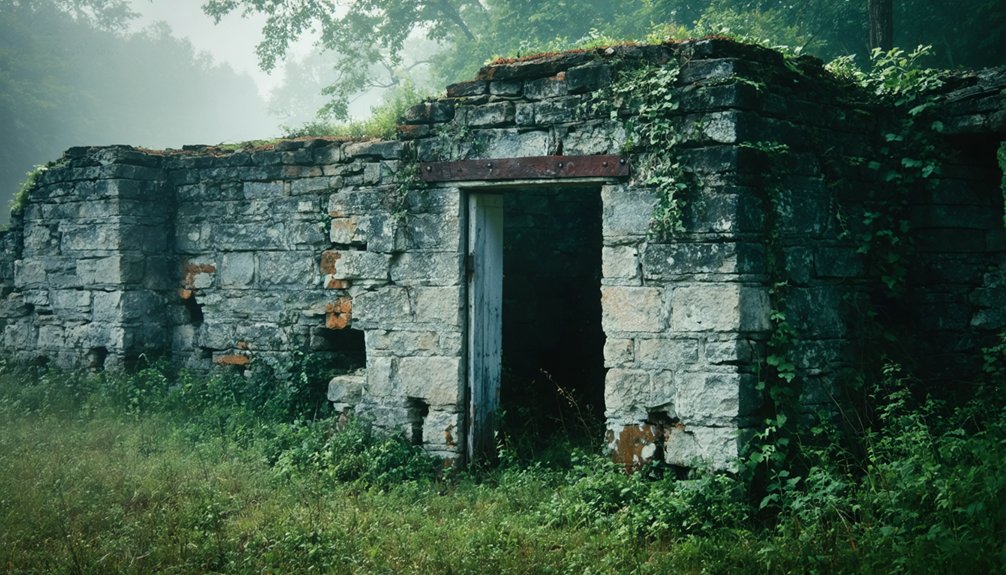
Before Wolf Creek Dam forever changed the Cumberland River‘s landscape in 1951, Creelsboro thrived as one of Kentucky’s most prosperous river ports for over a century.
You’d have found steamboats regularly docking at this bustling trading center, one of twelve major hubs along the Cumberland River between Nashville and Burnside.
Established in the early 1800s by the Creel brothers, who built a tavern and trading post, the town incorporated in 1836.
You can still visit remnants of this lost civilization, including Campbell’s Country Store from 1876 and the ancient Creelsboro Natural Arch.
The shift away from river life led to inevitable community abandonment after the dam’s completion inundated the town, transforming this once-thriving port into today’s ghost town designation.
Rocky Hill: Railroad Hub Destroyed by Fire
You’ll find Rocky Hill’s story represents one of Kentucky’s most dramatic ghost town transformations, where railroad prosperity gave way to catastrophic destruction.
This Edmondson County community thrived as a bustling L&N Railroad depot in the early 1900s, supporting thousands of residents and numerous businesses that served the region’s coal, tobacco, and livestock shipping needs.
The town’s fate changed forever in 1930 when a massive fire destroyed over half its buildings, triggering an exodus that reduced this once-thriving railroad hub to scattered remnants.
Railroad Boom Era
When the Louisville & Nashville Railroad completed its line to Rocky Hill in 1859, the small Edmonson County settlement transformed into a bustling transportation hub that would define the region’s economy for decades.
The railroad significance became immediately apparent as Rocky Hill positioned itself as a key station connecting travelers and commerce throughout Kentucky.
You’d witness the economic impact firsthand during the town’s peak in the 1920s, when businesses flourished around the depot and coal dropoff operations sustained local commerce.
The station served thousands of passengers while supporting major freight operations that brought prosperity to this once-quiet settlement.
- Coal dropoff operations generated substantial revenue through the 1930s
- Passenger services connected Rocky Hill to major cities across the region
- Local businesses thrived from railroad-generated foot traffic and commerce
Devastating 1930 Fire
However, Rocky Hill’s prosperity came to an abrupt end on a catastrophic July day in 1941 when a massive fire swept through the town’s commercial heart.
You’d have witnessed flames engulfing the drug store, creamery, barber shop, post office, and grocery store in a devastating inferno that obliterated homes and sidewalks throughout the town center.
The volunteer fire department couldn’t respond effectively to contain the destruction.
In the fire aftermath, the Louisville & Nashville Railroad ceased its coal operations, abandoning the once-vital hub that had sustained the community’s economy. Most residents packed up and left, never to return.
Though some structures were partially rebuilt, the town decline proved irreversible.
Rocky Hill’s population plummeted from thousands in the 1920s to nearly nothing, transforming this thriving railroad center into Kentucky’s most documented ghost town.
Golden Pond: Moonshine Capital Turned Park
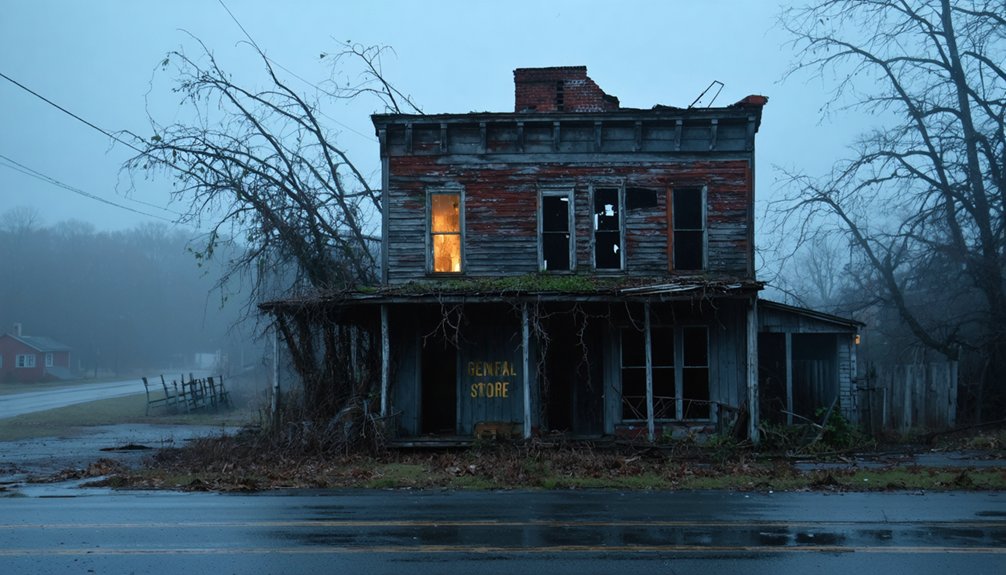
Though Golden Pond began as a modest post office site in 1848, this small Kentucky community would eventually gain notoriety as the “Moonshine Capital of the World” before disappearing entirely beneath federal bulldozers.
The town’s moonshine legacy flourished thanks to limestone caves, natural springs, and remote hollows that concealed up to 15 operating stills daily. High-quality whiskey reached Chicago and Detroit markets, with reports of Al Capone’s patronage. This illicit economy sustained families through regional poverty and isolation.
Federal acquisition began after President Kennedy’s 1962 recreation initiative. TVA’s Land Between the Lakes project required evacuating 170,000 acres, forcing Golden Pond’s final residents out by 1970 despite fierce resistance.
- Limestone caves provided perfect concealment for moonshine operations
- Federal revenuer “Big Six” Henderson destroyed thousands of regional stills
- Only concrete mounting blocks remain at the original townsite today
Frequently Asked Questions
Are There Any Other Ghost Towns in Kentucky Worth Visiting?
You’ll find other ghost towns like Paradise in Muhlenberg County and Hensley Settlement in Bell County worth exploring. Kentucky’s ghost town history spans coal mining, flooding, and economic decline across multiple counties statewide.
There are numerous historic ghost towns in Kentucky that tell the stories of a bygone era. From the remnants of once-thriving communities to fascinating historical sites, these towns offer a glimpse into the challenges faced by their former residents. Exploring them provides a unique opportunity to appreciate the state’s rich history and cultural heritage.
What Safety Precautions Should Visitors Take When Exploring These Abandoned Sites?
Like stepping through time’s minefield, you’ll need sturdy boots, first aid supplies, and flashlights when exploring abandoned structures. Watch for unstable floors, wildlife encounters, and always tell someone your location before venturing into Kentucky’s ghost towns.
Can You Camp Overnight Near Any of These Kentucky Ghost Towns?
You can camp overnight near several Kentucky ghost towns. Land Between the Lakes offers full campgrounds near Golden Pond, while Big South Fork permits backcountry camping. Check camping regulations and overnight permits for each area.
Which Ghost Town Offers the Best Photography Opportunities for Visitors?
Blue Heron provides the best photography opportunities with intact mining structures offering dramatic silhouettes and high-contrast textures. You’ll find excellent night photography conditions, minimal crowds, and accessible trails for ideal angles and composition flexibility.
Are There Guided Tours Available for Kentucky’s Most Famous Ghost Towns?
You’ll discover guided tour options at Blue Heron and Barthell, where preserved structures reveal their historical significance. Paradise and Golden Pond offer self-guided exploration, letting you uncover mining and moonshining stories at your own pace.
References
- https://wbkr.com/visit-these-20-creepy-kentucky-ghost-towns-for-a-halloween-road-trip/
- https://www.onlyinyourstate.com/experiences/kentucky/12-ghost-towns-in-ky
- https://www.youtube.com/watch?v=D9gOmfCuKLs
- https://www.youtube.com/watch?v=ua6VZ_nsero
- https://www.kentuckybb.com/Blog/Get-Haunted-and-Go-Ghost-Hunting-in-Kentucky.html
- https://everafterinthewoods.com/abandoned-ghost-towns-in-kentucky-that-still-hold-echoes-of-the-past/
- https://www.freakyfoottours.com/us/kentucky/
- https://www.onlyinyourstate.com/experiences/kentucky/ghost-town-ky
- https://dablogfodder.blogspot.com/2017/01/paradise-kentucky.html
- https://www.youtube.com/watch?v=AyHrapNoTG4