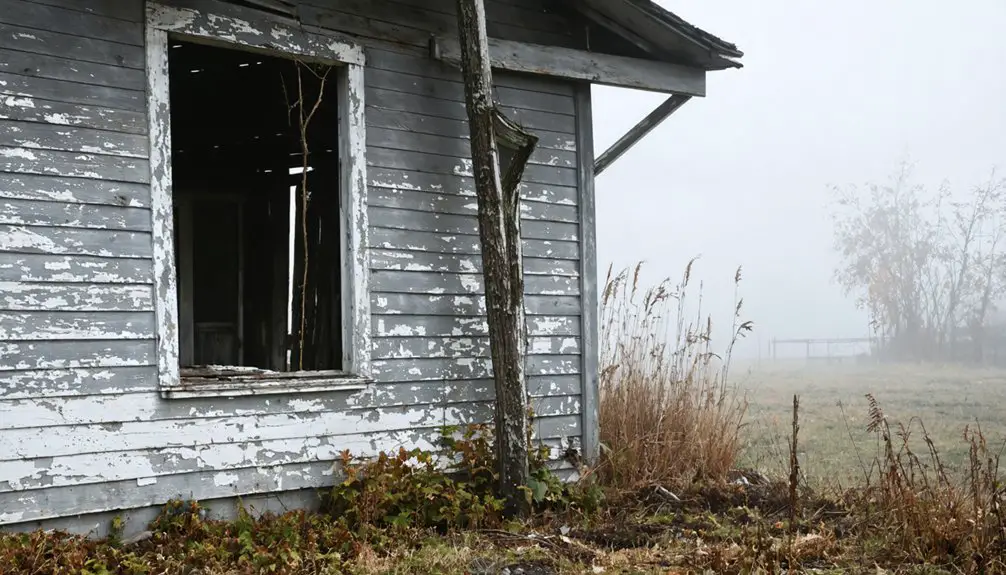
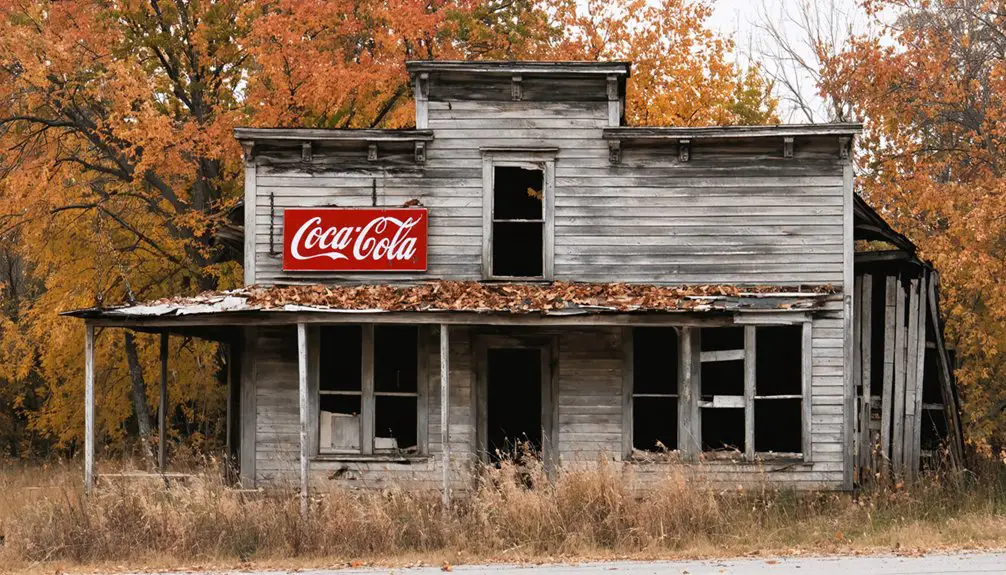
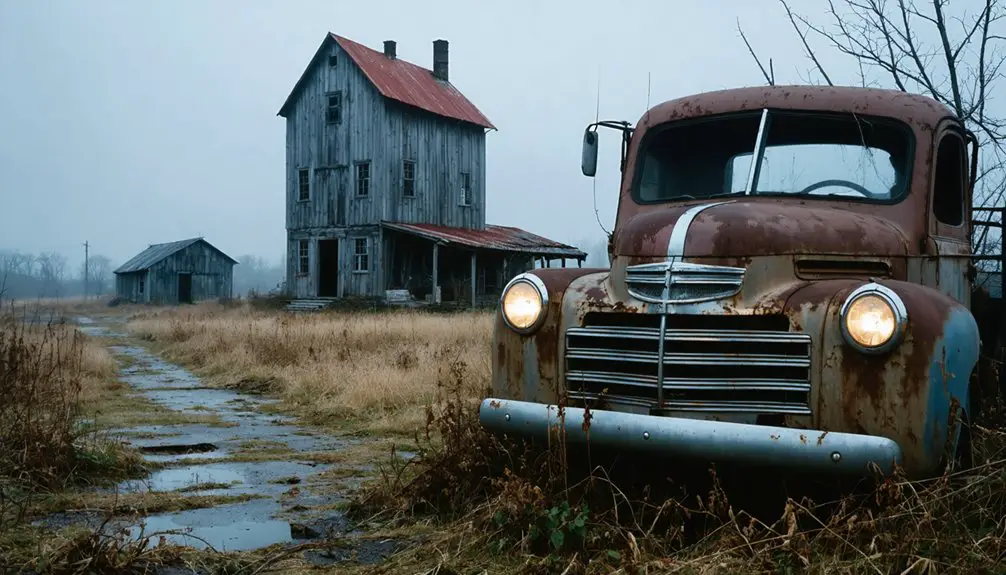
You’ll find Michigan’s most famous ghost towns concentrated in the Upper Peninsula‘s mining regions, where Laurium stands as America’s best-preserved Victorian mining town with elaborate Queen Anne mansions from its 10,000-resident heyday in 1910. Glen Haven offers a restored 1920s logging village within Sleeping Bear Dunes, while Fiborn Karst Preserve showcases abandoned limestone quarry operations from 1904. The Keweenaw Peninsula hosts numerous copper boom settlements where Native Americans mined for 7,000 years before industrial operations produced 90% of the world’s copper from 1860-1920s. These 73 documented sites reveal Michigan’s industrial heritage through preserved architecture and accessible wilderness locations.
Key Takeaways
- Fiborn Karst Preserve features Michigan’s longest cave system and abandoned limestone quarry structures from 1904 operations.
- Glen Haven transformed from logging settlement to preserved 1920s village within Sleeping Bear Dunes National Lakeshore.
- Laurium preserves America’s best Victorian architecture from the copper boom era, housing elaborate Queen Anne mansions.
- Calumet stands as a Victorian time capsule from the world’s richest copper mine operations of the late 1800s.
- Port Oneida contains Michigan’s largest rural historic district with 121 buildings across 3,400 acres of farmland.
Fiborn Karst Preserve: From Limestone Quarry to Natural Wonder
Deep in Michigan’s Upper Peninsula, where the Niagara Escarpment’s ancient dolomite bones pierce through dense forest, you’ll discover the haunting remains of what was once a thriving industrial community.
Fiborn Quarry’s quarry history began in 1898 when Chase Osborn and William Fitch purchased this remote land, opening limestone operations in 1904. The village that sprouted around the quarry housed families, operated a school, and shipped high-calcium limestone to steel companies until the Great Depression killed the dream.
Today, nature’s reclaimed this ghost town with spectacular karst formations—caves, springs, and limestone sinks carved by millennia of patient water. The preserve’s underground network includes the remarkable Hendrie River Water Cave, which features both a flowing stream and a distinctive circular passage known as the Goop Loop.
The 480-acre preserve protects both industrial remnants and geological wonders, including Michigan’s longest cave system stretching 1,500 feet underground. Visitors can still explore concrete structures from the quarry’s heyday, including the sorting bin, powerhouse, and railcar storage building that stand as silent monuments to the area’s industrial past.
Glen Haven: Revival of a Sleeping Bear Dunes Settlement
You’ll discover Glen Haven’s remarkable transformation from C.C. McCarty’s 1857 sawmill settlement called Sleeping Bearville into one of Michigan’s most successfully preserved ghost towns.
Unlike other abandoned communities that crumble into obscurity, Glen Haven’s story reads like a phoenix rising—from lumber boom to economic collapse, then resurrection through the National Park Service’s meticulous restoration efforts in the 1970s. The town’s economic struggles intensified during the Great Depression, when the shift from steamboat transportation to automobiles left the community increasingly isolated despite its swampy surroundings.
When you walk its reconstructed wooden sidewalks today, you’re experiencing what archivists consider the Great Lakes region’s best-preserved 1920s logging village, complete with operational blacksmith shop and maritime museum housed in the former cannery. The newly renovated Sleeping Bear Inn stands as testament to the community’s ongoing revival, welcoming visitors to experience this historic lakeside settlement.
Historic Sawmill Community Origins
When C.C. McCarty established Sleeping Bearville in 1857, you’ll discover he chose this remote Lake Michigan shore for its strategic advantages—protected docking and abundant timber resources.
His sawmill heritage began with that first mill on the beach, followed by a second facility on Little Glen Lake where tugboats transported logs efficiently.
You can trace the village evolution through archival records showing how McCarty’s original inn served steamers needing firewood before the Civil War transformed everything.
The 1865 dock addition marked serious commercial intent, though initial settlement attempts failed when men departed for military service.
This sawmill heritage shaped Glen Haven’s identity, creating the foundation for what would become Michigan’s best-preserved cordwood station. McCarty’s original establishment included the Sleeping Bear House, an inn that would serve as a crucial refueling station for passing steamships along the Lake Michigan corridor. The community thrived as a vital firewood source for steam-powered vessels navigating the Great Lakes shipping routes.
Modern Preservation Efforts
After Congress established Sleeping Bear Dunes National Lakeshore in 1970, the National Park Service’s acquisition of Glen Haven in the mid-1970s rescued what archival photographs show was becoming a collection of weathered, abandoned buildings slowly surrendering to Lake Michigan’s harsh winters.
You’ll discover preservation strategies that’ve transformed this ghost town into the best-preserved cord wood station on eastern Lake Michigan’s shore. Rangers reconstructed wooden sidewalks and stabilized the general store, blacksmith shop, and Sleeping Bear Inn to their 1920s condition.
You can explore functioning buildings where blacksmiths demonstrate period techniques and browse the reopened general store. The Glen Haven Canning Company now houses maritime exhibits, while archaeological features like the old curling rink naturally deteriorate, balancing preservation with authentic decay. The village’s transformation from Sleeping Bearville reflects its origins when C. C. McCarty first established the settlement in 1857.
Laurium: Michigan’s Best-Preserved Mining Town
You’ll find Laurium’s Victorian-era streetscapes remarkably unchanged since the copper boom peaked in 1910, when this Keweenaw Peninsula community housed 10,000 residents as the largest incorporated village in America.
The town’s architectural integrity stems from its rapid abandonment after labor strikes and western competition killed local mining—residents simply locked their doors and left, preserving elaborate Queen Anne homes and commercial blocks that mining barons like Thomas Hoatson built during the industry’s golden age.
Walking through Laurium’s six original blocks today, you’re experiencing what mining company records describe as a “frozen moment” from 1908-1912, complete with the 13,000-square-foot Laurium Manor and dozens of National Register properties that escaped the demolition waves that claimed other boom towns. The community’s name itself reflects its mining heritage, derived from Lavrion, Greece, a historic copper mining town that inspired the 1895 name change from the original Village of Calumet. The ancient Greek site featured silver mines that operated for over two millennia, dating back to the Bronze Age around 3200 BC.
Victorian Architecture Remains Intact
While most mining towns sacrificed their historic buildings to demolition or neglect, Laurium stands as Michigan’s crown jewel of preserved Victorian architecture, where copper boom mansions remain virtually untouched since their construction over a century ago.
You’ll discover authentic architectural significance in these meticulously preserved structures, where Victorian restoration efforts maintained original elements rather than replacing them. This preservation reflects the broader pattern of boom and bust cycles that shaped communities throughout the Keweenaw Peninsula during America’s first major mining era.
The Laurium Manor Inn and Victorian Hall B&B showcase this commitment to historical integrity:
- Original gilded elephant leather wall coverings remain intact, never painted over despite cosmetic wear
- Hand-painted ceilings from 1906 display authentic craftsmanship of the copper boom era
- Stained glass windows replicated from archival photos preserve the original design aesthetic
- Rich oak paneling and period hardware maintain the mansions’ opulent character
These preserved mansions offer you genuine glimpses into Michigan’s mining wealth disparity.
Former Copper Mining Community
These architectural treasures tell the story of Laurium’s extraordinary origins as a copper mining powerhouse that shaped Michigan’s industrial landscape.
You’ll discover this former company town was established in 1877 when Laurium Mining Company platted twenty acres after their copper exploration ended. Originally called Calumet, it was renamed after Greece’s ancient copper mining center of Lavrion in the early 1900s.
During the 1890-1915 boom, you’re looking at what became America’s largest incorporated village, with 5,643 residents extracting wealth from shafts reaching 456 feet deep.
The consolidation of ten major mining companies created an empire producing 12-16% of the world’s copper. Unlike many ghost towns, Laurium’s streets still echo with stories of mining captains who built mansions from elemental copper’s extraordinary abundance.
Keweenaw Peninsula: America’s First Copper Boom Legacy
Eight thousand years before Michigan’s famous gold rush fever gripped California, Native Americans on the Keweenaw Peninsula had already established North America’s earliest metalworking operations, extracting pure copper from ancient veins that would later spark America’s first major mineral boom.
Long before California’s gold fever captured headlines, indigenous peoples had already mastered sophisticated copper extraction techniques on Michigan’s remote Keweenaw Peninsula.
When you explore this rugged peninsula today, you’ll discover remnants of copper mining operations that transformed wilderness into America’s premier industrial frontier.
The historical significance of these abandoned settlements tells stories of unprecedented wealth and crushing hardship.
Key landmarks you can still visit include:
- Cliff Mine ruins – First profitable operation that paid investors equivalent to $104 million today
- Quincy Mine Hoist – “Old Reliable’s” 99-year legacy as National Historic Landmark
- Central Mine foundations – Ghost town remnants from 1854-1898 operations
- Ancient Native American mining pits – 7,000-year-old extraction sites
Calumet and the Copper Country Giants

You’ll discover Calumet’s extraordinary transformation from the world’s richest copper mine to a preserved Victorian time capsule when you walk through its red sandstone streets today.
The Calumet and Hecla Mining Company’s 1865-1968 operations created America’s most cosmopolitan mining community, where over 40,000 residents from dozens of countries built elaborate theaters, churches, and mansions that still stand as evidence of copper wealth.
These architectural survivors tell the story of a company that employed 4,000 miners and produced 10.5 billion pounds of copper before economic reality turned this industrial giant into one of Michigan’s most haunting ghost towns.
Copper Boom Mining Legacy
The boom’s staggering statistics reveal its magnitude:
- Global dominance: Keweenaw supplied 90% of world’s copper from 1860-1920s
- National production: 95% of U.S. copper originated here by mid-nineteenth century
- Peak efficiency: C&H refined 97 pounds of metal per ton in 1874
- Workforce scale: Over 4,000 men employed, representing one-third of regional workers
This copper rush created America’s most ethnically diverse county, with 60% foreign-born residents seeking fortune in these depths.
Victorian Architecture Remains
Standing amid Calumet’s weathered streets today, you’ll discover remnants of an architectural golden age that once rivaled Detroit’s grandest districts.
The Ryan Block, constructed in 1898 on Sixth and Oak Street, showcases intricate Victorian details despite its abandonment. You’ll find the VC OPO building from 1902 still partially functioning, while the Shoot Saloon from 1890 represents the era’s commercial prosperity.
Mining era immigrants created unique sandstone and brick structures with ornate cornices that demonstrate significant architectural significance.
Though many buildings suffer from pigeon infestation and collapsing mezzanines, refurbished Victorian houses on Oak Street prove restoration’s potential.
The Bring Back Calumet group now pursues emergency stabilization, fighting demolition costs exceeding $200,000 per structure to preserve this copper country heritage.
North Unity and the Shalda Cabin Experience
When Bohemian and German immigrants formed their “Verein” society in Chicago during 1855, they couldn’t have anticipated that their carefully planned lakeside settlement would become one of Michigan’s most compelling ghost town stories.
Francis Kraitz’s family and other refugees from Chicago’s typhoid epidemic established North Unity near Pyramid Bay, constructing makeshift barracks and hemlock shelters.
The 1871 Michigan fires obliterated their lakeside dreams, but Shalda resilience transformed tragedy into opportunity. Survivors relocated inland to what became Shalda Corners, where North Unity history continued:
- Joseph Shalda’s original store anchored the southeast corner
- A larger store with upstairs dance hall replaced it
- John Shalda’s gristmill processed grain along Lake Michigan’s outlet
- An icehouse preserved dairy products and beer
Today, these Sleeping Bear Dunes remnants showcase immigrant determination.
Port Oneida: The Largest Rural Historic District

Spanning 3,400 acres within Sleeping Bear Dunes National Lakeshore, Port Oneida stands as Michigan’s largest rural historic district—a remarkable proof of 19th-century agricultural settlement that you won’t find replicated anywhere else in the Great Lakes region.
Port Oneida History traces back to 1852 when federal settlement opened mainland Michigan through homestead acts, creating a thriving community named after the first supply ship to dock nearby.
Federal homestead acts transformed this remote Michigan shoreline into a bustling settlement in 1852, forever linking it to maritime commerce.
You’ll discover 121 buildings and 22 farmsteads preserving extraordinary Agricultural Heritage spanning 1870-1945.
Walk through abandoned Olsen and Burfiend farms where German and Scandinavian immigrants once cultivated difficult soil until economic pressures forced exodus after World War II.
The 1970 National Lakeshore designation ended over a century of farming, leaving behind Michigan’s most intact rural landscape.
North Manitou Island’s Abandoned Villages
While Port Oneida represents Michigan’s most complete rural farming community, North Manitou Island tells a different story—one of repeated settlement cycles that rose and fell with the island’s natural resources over more than a century.
You’ll find this Lake Michigan island transformed from Native American seasonal settlements spanning 3,000 years to European logging operations and farming communities before becoming an uninhabited wilderness.
The island’s most significant abandoned structures include:
- Crescent Village – Smith and Hull Company’s 1906 logging town with sawmill, boarding house, and saloon-turned-school
- Life-Saving Station – Built in 1896 for dangerous Manitou Passage navigation
- Lighthouse ruins – Dimmick’s Point remnants from the shipping era
- Homestead foundations – Seven claims filed between 1875-1880, including the persistent Maleski family operation lasting until the 1950s
Alpha, Atwood, and Early 20th Century Mining Camps
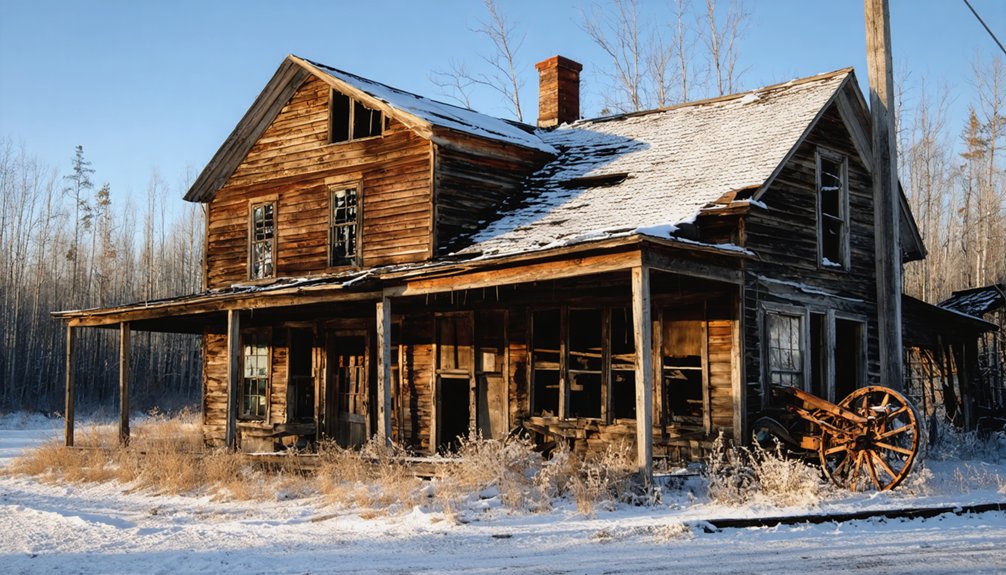
As iron ore fever swept across Michigan’s Upper Peninsula in the 1880s, Alpha emerged from the wilderness when surveyors discovered massive deposits alongside prehistoric mastodon bones—a find so significant that the surrounding Mastodon Township adopted its name from these ancient remains.
Alpha history reveals a bustling community that sprouted around Civic Circle, its unique roundabout business district. The Alpha Train Depot anchored the nearby Stager district, while outlying camps like Pentoga and Buck Lake flourished with their own schools and infrastructure.
The Atwood mystery persists—despite numerous references to early mining camps, no concrete records exist for this supposed ghost town.
You’ll find hundreds of authenticated camps like Central Mine, which housed 1,200 residents before copper prices collapsed in 1898, but Atwood remains historically elusive.
Exploring Michigan’s Accessible Ghost Town Network
Though Michigan’s 73 documented ghost towns span from subtle foundation remnants to hauntingly preserved cemeteries, you’ll discover that accessibility varies dramatically across the state’s forgotten settlements.
Your ghost town exploration journey requires strategic planning, as these sites range from roadside stops to remote wilderness locations demanding careful navigation.
Essential Access Points for Ghost Town Exploration:
- Pere Cheney – Navigate the one-lane dirt track southeast of Grayling to reach this lumber town’s eerie cemetery.
- Sleeping Bear Dunes Network – Follow M-22 through Empire and Glen Arbor to access multiple interconnected ghost settlements.
- Keweenaw Peninsula Sites – Utilize Michigan Tech’s Time Traveler App for nearly 100 copper mining locations.
- Central Mine – Experience overnight stays at this fully accessible former mining community.
Each location’s historical significance emerges through conversations with locals who preserve invaluable community memories.
Frequently Asked Questions
Are Michigan’s Ghost Towns Safe to Visit Without a Guide?
You can safely explore most Michigan ghost towns independently with proper safety precautions, though guided tours offer valuable historical context. Avoid Highland Park’s dangerous areas, dress warmly for remote Upper Peninsula sites during winter months.
When venturing into the best ghost towns in upper peninsula, make sure to bring a camera to capture the haunting beauty of abandoned buildings and landscapes. Each town tells its own unique story, often reflecting the rich history of Michigan’s mining and lumber industries. It’s an experience that combines adventure with a sense of nostalgia, drawing in history buffs and nature lovers alike.
While there are many ghost towns in Michigan’s history, each location is a testament to the state’s evolution and the transient nature of its once-thriving communities. Exploring these sites often reveals remnants of the past, such as old storefronts and forgotten railroads, making it easy to imagine the bustling life that once filled these areas. Additionally, many of these towns are situated in stunning natural settings, offering a perfect blend of history and scenic beauty for those willing to venture into the unknown.
What Is the Best Time of Year to Explore These Abandoned Sites?
You’ll find fall offers magical exploration when 240 inches of snow typically blanket these sites by winter. Fall foliage creates stunning backdrops, while winter wonderland conditions make access nearly impossible until May.
Can Visitors Enter the Buildings in These Ghost Towns?
You’ll find building conditions vary dramatically between sites, with visitor guidelines ranging from unrestricted exploration at Victoria to strictly supervised access at Fayette, while Port Crescent requires extreme caution due to structural decay.
Do Any of Michigan’s Ghost Towns Require Entrance Fees or Permits?
Most won’t lighten your wallet, though entrance requirements vary. Fayette needs Michigan’s Recreation Passport for vehicle access, while permit regulations don’t restrict Fiborn Karst or Central Mine’s free exploration opportunities.
Are Camping Facilities Available Near These Historic Ghost Town Locations?
You’ll find excellent camping amenities near Michigan’s ghost town attractions, from primitive wilderness sites in the Keweenaw to national lakeshore campgrounds at Sleeping Bear Dunes and state forest facilities throughout logging regions.
References
- https://www.awesomemitten.com/ghost-towns-in-michigan/
- https://www.youtube.com/watch?v=7-vjuqiGWJU
- https://99wfmk.com/michigan-ghost-town-gallery/
- https://www.nps.gov/slbe/learn/historyculture/ghosttowns.htm
- https://thecoddiwomplist.com/fiborn-karst-preserve-the-most-peaceful-ghost-town-around/
- https://mkc.caves.org/preserve_fiborn.html
- https://beaumier.nmu.edu/ghosttowns/towns/Fiborn
- http://nckms.org/wp-content/uploads/2018/05/curl.pdf
- https://www.michiganbackroads.com/daytrips/fibornruins.html
- https://99wfmk.com/fiborn-kart-preserve-quarry-ruins/