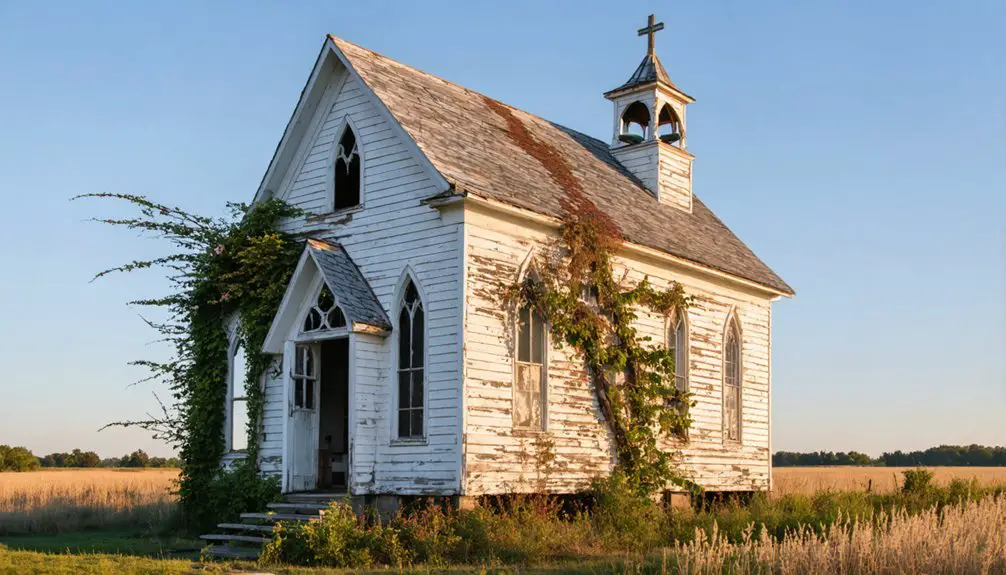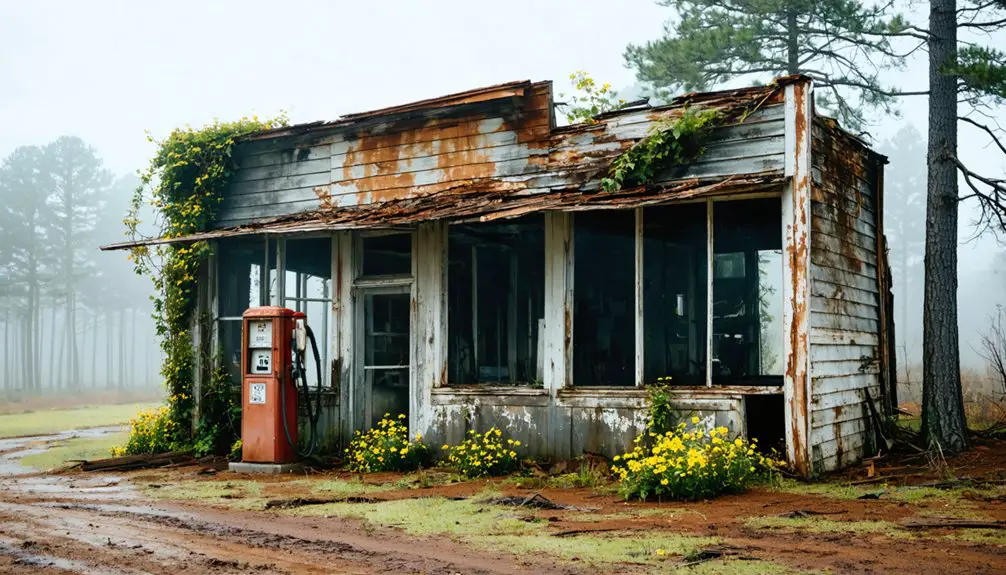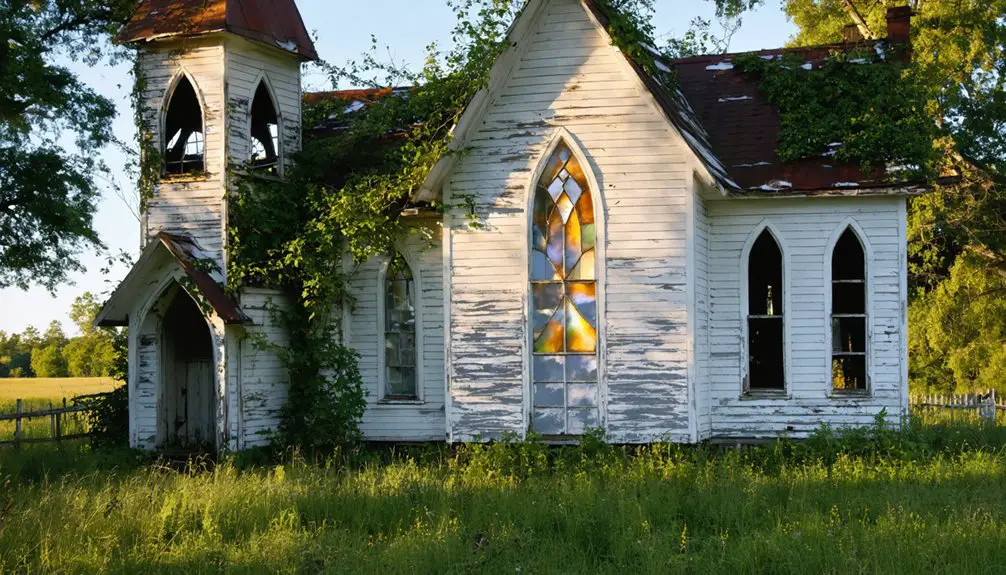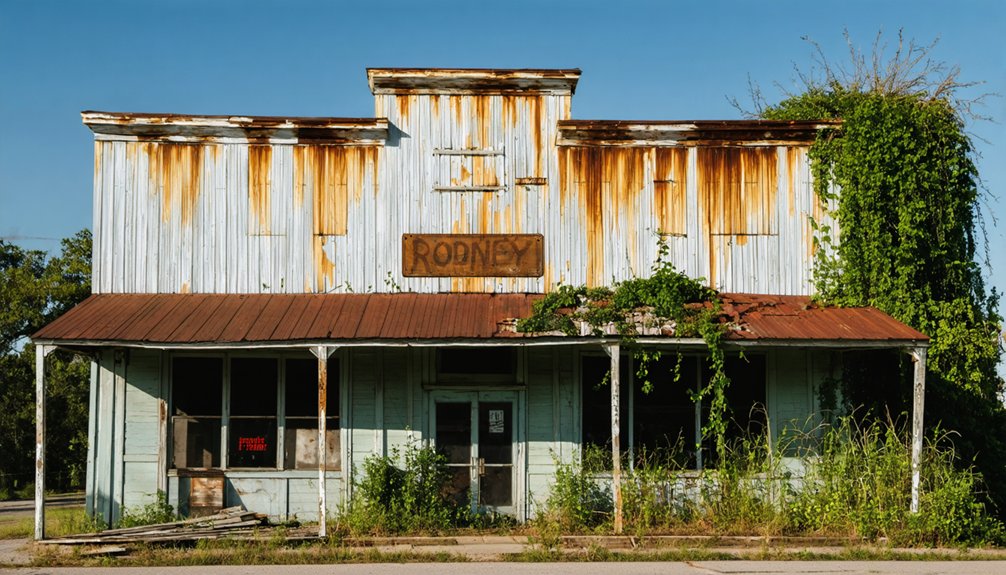
Mississippi’s most famous ghost towns reveal fascinating stories of rise and fall. You’ll find Rodney, which nearly became the state capital before yellow fever and river changes destroyed it in the 1800s. Bankston thrived as a textile hub until Civil War raiders burned it down in 1864. Electric Mills pioneered as America’s first fully electrified sawmill before abandonment, while Brewton and Americus lost their courthouse functions and populations. These abandoned communities hold deeper secrets about Mississippi’s forgotten past.
Key Takeaways
- Rodney nearly became Mississippi’s capital but declined after yellow fever epidemics and the Mississippi River shifting course around 1870.
- Bankston was Mississippi’s first successful textile mill town, destroyed by Union forces in 1864 during the Civil War.
- Electric Mills became America’s first fully electrified yellow pine sawmill town before eventual abandonment when operations ceased.
- Brewton served as a courthouse town until devastating fires destroyed the sawmills and administrative buildings, forcing residents to leave.
- Americus lost its county seat status in 1871 and never recovered after neighboring Scranton merged with Pascagoula in 1904.
Rodney: The Town That Almost Became Mississippi’s Capital
While Native Americans and Spanish explorers had long used the Mississippi River crossing as part of El Camino Real, European settlers didn’t establish a permanent community at Rodney until the 1700s.
You’ll find that by 1828, this strategic location incorporated as the Town of Rodney with twenty buildings stretching from river to bluff.
The settlement’s golden era lasted from 1820-1860, when river transportation and the cotton industry fueled remarkable growth. Dr. Rush Nutt established Laurel Hill Plantation and developed the successful Petit Gulf cotton strain that contributed significantly to the region’s agricultural prosperity.
The bustling decades when cotton and steamboats transformed a modest river crossing into Mississippi’s most prosperous inland port.
You’d have witnessed a thriving port town with 500 residents, thirty-five stores, two banks, and Mississippi’s first opera house. Notable figures like Andrew Jackson and Zachary Taylor visited this prosperous community that nearly became the state capital.
A devastating yellow fever epidemic in 1843 killed over half of those infected and left every doctor in town ill, marking the beginning of the community’s struggles.
However, when the Mississippi River shifted two miles west around 1870, Rodney lost its lifeline and began its inevitable decline into ghostly abandonment.
Bankston: Civil War Manufacturing Hub Left in Ruins
Deep in the wilderness of Choctaw County, the Mississippi Manufacturing Company established what would become the state’s first successful mechanically powered textile mill in 1847.
James M. Wesson’s enterprise began operations in December 1848, rapidly expanding from twelve workers to 100 employees by the 1850s. You’ll find Bankston was designed as a company town, strategically isolated to minimize distractions while maximizing productivity.
During the Civil War, the mill became Mississippi’s last working woolen facility, producing 1,000 yards of cloth and 150 pairs of shoes daily for Confederate forces. The operation expanded beyond textiles to include additional facilities like a tannery and machine shop that supported the broader manufacturing complex.
However, Federal raiders under General Benjamin H. Grierson destroyed the operation on December 30, 1864. After the war, Wesson rebuilt the mill in 1867, though it would later be guided to national prominence in the 1870s and 1880s under Captain William Oliver’s leadership.
Bankston’s legacy reflects both industrial innovation and Civil War impact, leaving behind only ruins in today’s ghost town.
Electric Mills: From Industrial Innovation to Abandonment
After the Sumter Lumber Company‘s Alabama mill burned down in 1911, the company seized an opportunity to relocate across state lines to Kemper County, Mississippi, where abundant timber resources awaited harvesting.
You’ll discover that this new mill represented groundbreaking electric innovation—becoming the first fully electrified yellow pine sawmill in the country.
The company built an entire town that earned the nickname “brightest town south of St. Louis” due to its revolutionary electric lighting system. The thriving community included essential amenities such as a company store, church, schools, clubhouse, library, and theaters to support the mill workers and their families. At its peak, the population swelled to over 2,500 residents, primarily consisting of mill employees and their families.
Brewton: Courthouse Town Destroyed by Outlaws
When Jackson County needed a new courthouse location in the late 19th century, officials chose the thriving lumber town of Brewton to serve as the county’s second administrative center.
You’ll find this ghost town’s story rooted in Mississippi’s timber industry, where bustling sawmill operations once attracted settlers and commerce to the region.
Brewton’s lumber legacy flourished as the community grew around its economic foundation.
However, you’d witness a devastating pattern of destruction that sealed the town’s fate. The sawmills burned down twice during operations, crushing the local economy. Fire also consumed the courthouse, eliminating the town’s administrative importance.
Fire struck mercilessly at Brewton’s heart, destroying sawmills twice and claiming the courthouse, sealing the town’s inevitable doom.
These repeated disasters created cascading economic misfortune that forced residents to abandon their homes. The name Brewton now appears on disambiguation pages due to multiple locations sharing this designation across different regions. Like other Mississippi ghost towns, Brewton reflects the state’s broader economic struggles, as the region remains one of the poorest counties in America.
Today, you’ll discover only remnants of what was once Jackson County’s promising governmental and commercial hub.
Americus: When the Courthouse Moved Away
While Jackson County’s administrative center shifted frequently during its early decades, Americus served as the county seat from 1826 to 1871, representing one of the longest periods of governmental stability in the region’s history.
You’ll find that Americus’s decline began when officials relocated the county seat to Scranton in 1871. The town’s fate was sealed by subsequent courthouse fires that plagued the new location.
Scranton’s fourth courthouse burned in 1873, just one year after construction. The fifth courthouse met the same fate in 1875. These courthouse fires destabilized the entire region’s administrative functions. The loss of these courthouses symbolized the community’s diminishing pride and identity, much like other Mississippi counties experienced when their centers of governance were threatened.
When Scranton merged with Pascagoula in 1904, Americus’s chances of reclaiming county seat status vanished permanently, leaving it a ghostly reminder of Mississippi’s shifting political landscape. The county itself was originally named after Andrew Jackson, the 7th President of the United States who served from 1829 to 1837.
Frequently Asked Questions
Are These Ghost Towns Safe to Visit and Explore on Foot?
You’ll find most ghost towns safe for foot exploration with proper safety precautions like sturdy footwear and daylight visits. Follow exploring etiquette by respecting private property, staying on marked paths, and preserving historical structures.
What Paranormal Activity Has Been Reported at Mississippi’s Abandoned Towns?
You’ll encounter ghost sightings like Mary Elizabeth Howard’s childbirth apparition at McRaven House and Stuckey’s hanging specter at his bridge. These haunted locations feature full-body apparitions, disembodied voices, and lantern-carrying spirits roaming riverbeds.
Can Artifacts or Historical Items Be Legally Collected From These Sites?
You can’t legally collect artifacts from Mississippi’s ghost towns without proper permits and landowner permission. Artifact preservation laws carry serious legal implications including fines and imprisonment for unauthorized collection on public or private property.
Which Ghost Towns Offer the Best Preserved Buildings for Photography?
You’ll discover photographic gold at Rodney’s renovated 1850 Baptist church and 1831 Presbyterian church, showcasing Greek Gothic Revival and Federalist building styles perfectly. These structures offer ideal subjects for advanced photography techniques capturing architectural decay.
Are There Guided Tours Available for Mississippi’s Most Famous Ghost Towns?
You won’t find guided tour options through local tour companies for Mississippi’s famous ghost towns. These abandoned settlements like Rodney, Bankston, Electric Mills, and Brewton offer only self-guided exploration opportunities.
For those eager to delve into the past, ghost towns in Mississippi to explore present a unique opportunity for adventure. The remnants of these once-thriving communities allow visitors to imagine the vibrant lives that once filled the streets. Each site holds stories waiting to be uncovered, appealing to history buffs and curious explorers alike.
References
- https://www.onlyinyourstate.com/experiences/mississippi/ms-ghost-towns
- https://kids.kiddle.co/List_of_ghost_towns_in_Mississippi
- https://mississippifolklife.org/articles/haunted-by-a-ghost-town-the-lure-of-rodney-mississippi
- https://www.hauntedrooms.com/mississippi/haunted-places
- https://freepages.rootsweb.com/~gtusa/history/usa/ms.htm
- https://theforgottensouth.com/rodney-mississippi-ghost-town-history-tour/
- https://www.tripadvisor.com/Attraction_Review-g28945-d10045204-Reviews-Rodney_Ghost_Town-Mississippi.html
- https://www.legendsofamerica.com/ms-rodney/
- https://sethparker.net/rodney-mississippi-the-ghost-town-youve-probably-never-heard-of/
- https://www.susantregoning.com/blog/rodney-ghost-town