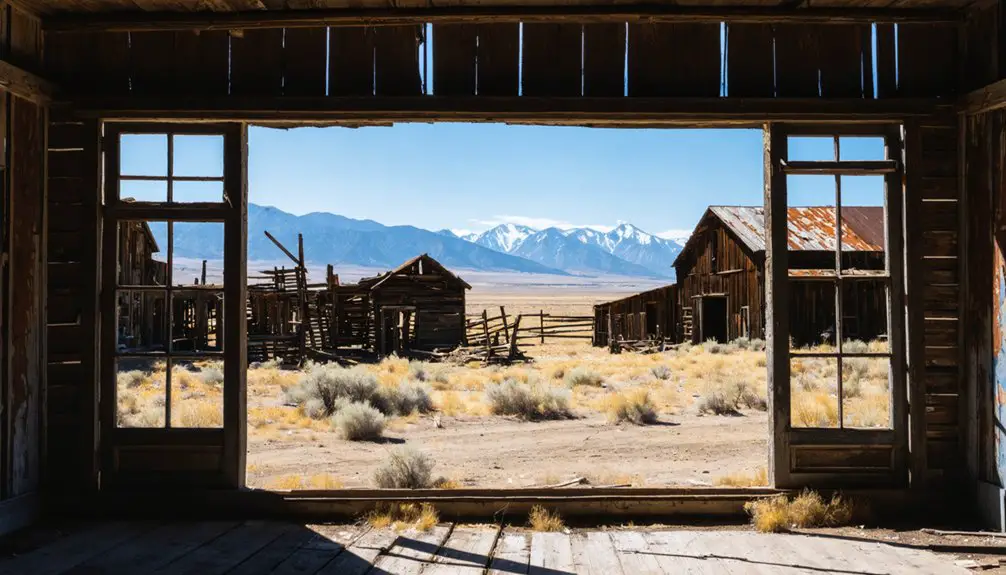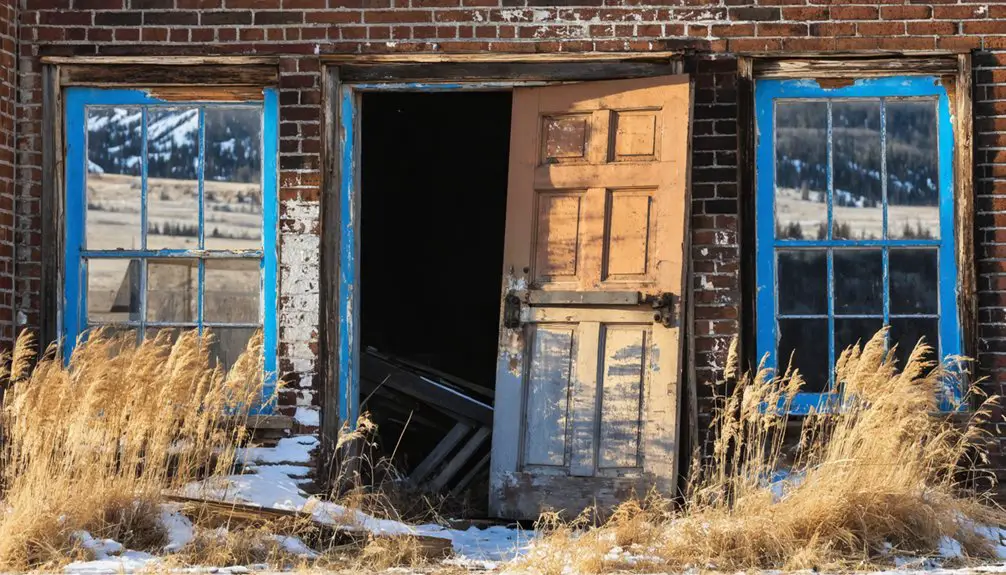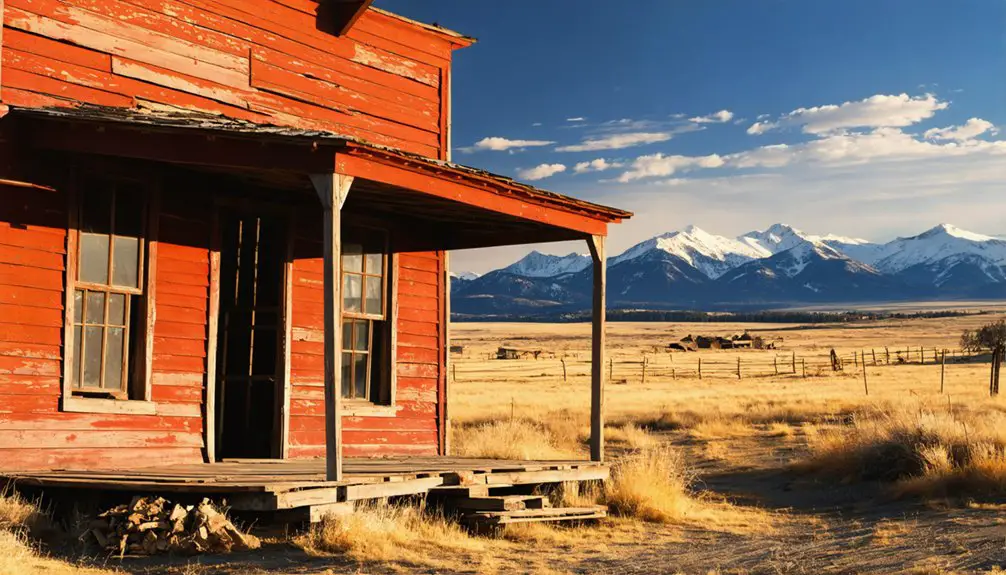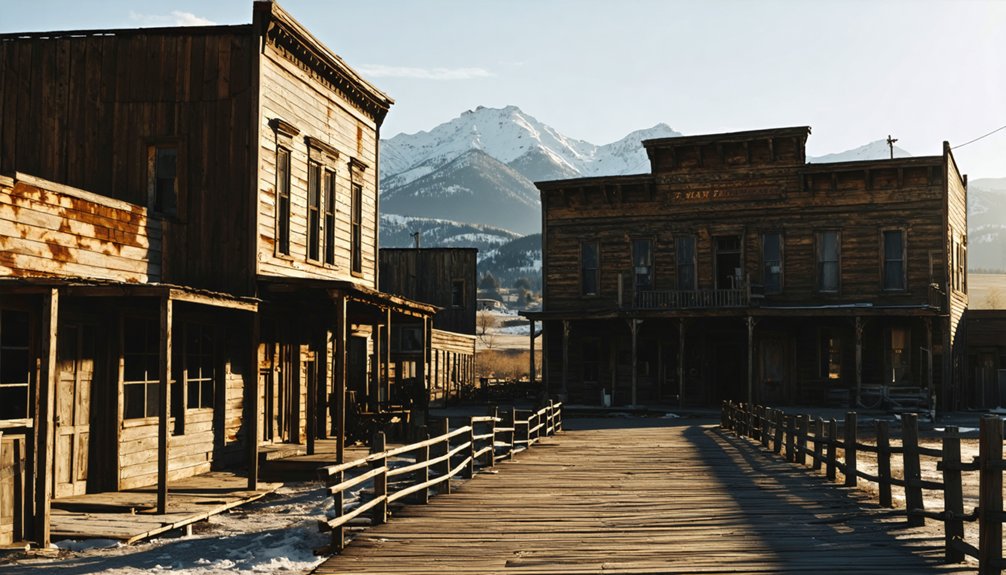
You’ll discover Montana’s most famous ghost towns include Bannack, the state’s first territorial capital established in 1862 with over 5,000 residents, and Garnet, a well-preserved mining town founded in 1895 that once housed nearly 1,000 people. Other notable sites are Beartown, notorious for the lawless “Beartown Roughs” gang, and Elkhorn, a picturesque silver boom town that still maintains about ten residents today. Each location offers unique insights into Montana’s explosive mining era and boom-bust cycles that shaped the American West.
Key Takeaways
- Bannack, Montana’s first territorial capital established in 1862, preserves 60 structures from the gold rush era.
- Garnet peaked at 1,000 residents in 1895 after gold discovery but gradually abandoned by 1948.
- Beartown yielded an estimated $30 million in gold but was notorious for lawlessness and violence.
- Castle Town flourished during the 1880s silver boom before declining after the 1893 Silver Panic.
- Over 300 ghost towns exist throughout Montana, many featuring preserved buildings, churches, and mining infrastructure.
Bannack: Montana’s Former Capital and Premier Mining Town
The glint of gold in Grasshopper Creek transformed a remote Montana valley into the territory’s first capital city.
You’ll discover Bannack history began in 1862 when John White’s party struck gold, creating a boomtown that swelled from 400 to 5,000 residents within months. Montana Territory’s first governor, Sidney Edgerton, established his government here in 1864 before the capital moved to Virginia City’s richer goldfields.
Today, you can explore sixty preserved structures showcasing authentic Bannack architecture from the 1860s mining era.
Sixty authentic 1860s structures stand frozen in time, offering visitors an unparalleled glimpse into Montana’s gold rush architecture.
The state acquired this ghost town in 1954, maintaining buildings with original furnishings and mining equipment scattered throughout. The town’s infrastructure once included three hotels, a Methodist church, a schoolhouse, and numerous businesses serving the thriving mining community. The arrival of the railroad bypass in the 1880s ultimately sealed the town’s fate as residents abandoned their claims for more prosperous ventures.
You’re walking through Montana’s best-preserved monument to frontier ambition, where territorial politics mixed with vigilante justice in America’s wildest chapter.
Garnet: High-Altitude Gold Rush Town in the Garnet Mountains
When you visit Garnet, you’ll discover Montana’s best-preserved ghost town perched at 6,000 feet in the Garnet Mountain Range, where Sam Ritchey’s 1895 discovery of a rich gold vein in the Nancy Hanks mine sparked a boom that attracted nearly 1,000 residents.
You can explore the remnants of this high-altitude community that thrived until a devastating 1912 fire destroyed the business district, though many original buildings survived the town’s gradual abandonment by 1948. What set Garnet apart was its emphasis on family-oriented community, with a thriving schoolhouse that served over 40 students and social activities that included dinner parties and dances.
You’ll find that Garnet’s remote mountain location both preserved its structures from vandalism and created harsh winter conditions that shaped how miners lived in sturdy log cabins during the town’s productive years. The town featured an impressive array of amenities including four stores, four hotels, and thirteen saloons to serve its growing population.
Gold Discovery and Boom
Although California’s gold fields had largely played out by the 1860s, determined miners didn’t abandon their dreams of striking it rich. They migrated north to Montana’s Garnet Mountains, initially using simple panning methods before advancing to rockers and sluice boxes as easily accessible gold disappeared.
By 1870, placer mining had become unprofitable, and poor roads prevented development of promising quartz veins.
The 1893 Sherman Silver Purchase Act repeal triggered a regional panic, closing silver mines and displacing thousands of miners who returned to gold mining.
This crisis sparked Garnet’s true boom when the Nancy Hanks mine revealed a major vein in 1895. Hard rock mining techniques replaced placer methods, transforming the settlement into a thriving ghost town with nearly 1,000 residents by the decade’s end. Dr. Armstead Mitchell established the town with a stamp mill, providing the infrastructure needed for processing the newly discovered ore. The town’s name reflected the presence of garnet sand in the local geological formations, which miners would later recognize as valuable for industrial abrasive applications.
Winter Access and Cabins
Today’s thriving ghost town transforms into an isolated winter wonderland that requires serious commitment to reach.
Winter logistics demand snowmobiles, cross-country skis, or snowshoes to traverse the 11-mile snow-covered route when wheeled vehicles can’t access the 6,500-foot elevation from December 15 to April 30.
Cabin experiences offer authentic overnight stays in two restored miner buildings heated by wood stoves and lit by propane lamps.
You’ll haul your own supplies to these rustic accommodations that lack electricity and plumbing but provide outhouses and potable water nearby.
The BLM Missoula office handles reservations at (406) 329-3914 for stays between December 1 and April 30, letting you sleep where original miners once rested.
Winter caretakers maintain the property during snow season but focus on preservation rather than conducting guided tours.
The demanding winter journey effectively filters out casual tourists, creating a more serene and authentic experience for dedicated visitors who make the effort.
Beartown: Home of the Notorious Beartown Roughts Gang
Deep in Montana’s Garnet Range, at an elevation of 4,590 feet, sits the vanished ghost town of Beartown—once home to the most notorious gang of miners in the territory.
When gold was discovered in Bear Gulch in October 1865, 5,000 prospectors swarmed the area within weeks. Beartown history reflects the raw essence of the Wild West, where the “Beartown Roughs” earned their reputation as Montana’s toughest mining camp during the 1860s.
Within weeks of the 1865 gold strike, Bear Gulch transformed into Montana’s most lawless mining camp, home to the infamous Beartown Roughs.
The Beartown lifestyle embodied frontier lawlessness. Miners labored in knee-deep underground water while saloons, gambling houses, and stores sprouted overnight. The town even sought Montana’s capital status during its prosperous peak.
Whiskey served as anesthetic for medical emergencies, and violence was commonplace. Unlike family-oriented camps, Beartown attracted hard men seeking quick fortunes. The camp’s incredible productivity yielded an estimated $30,000,000 in gold over its fifteen-year operation.
Taft: America’s Self-Proclaimed Wickedest City
Twenty-seven saloons and 500 prostitutes served a population where men outnumbered women three to one—welcome to Taft, Montana, America’s self-proclaimed “Wickedest City.”
Founded in 1906 by liquor dealers who arrived ahead of railroad construction crews, this lawless camp emerged along the Montana-Idaho border as a base for the Chicago, Milwaukee & St. Paul Railroad’s Pacific extension.
Taft history reveals a town born from necessity and fueled by vice. Railroad workers endured brutal conditions building the St. Paul Pass Tunnel, seeking escape in alcohol and gambling.
Taft nightlife dominated the settlement—no church, library, or school existed, just bars lined with dance hall girls and open gambling tables.
The town’s murder rate exceeded New York City’s, with 72 men dying violently on Montana’s side alone.
Taft’s reign ended August 20, 1910, when flames consumed everything.
Elkhorn: Picturesque Western Town With Preserved Fraternity Hall
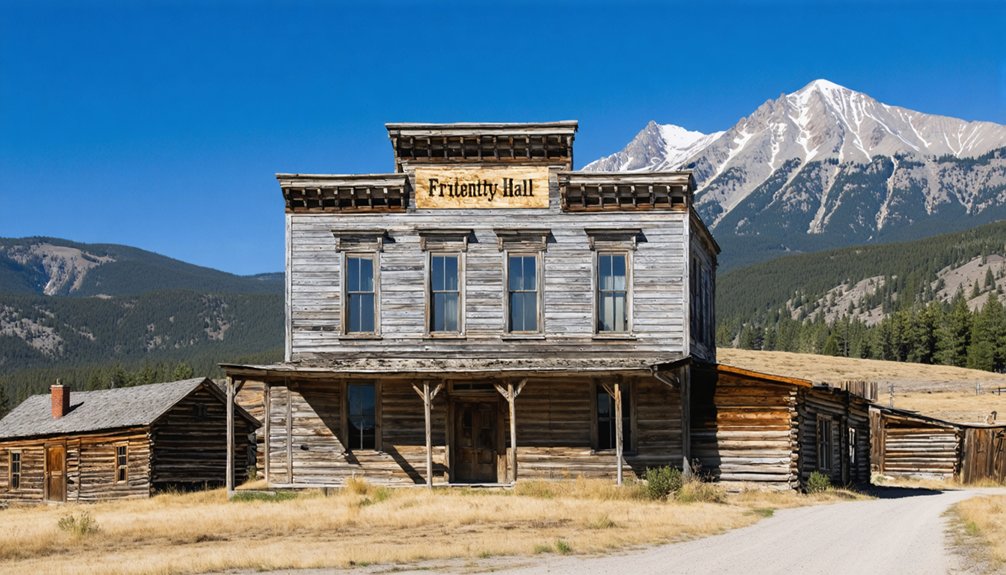
Unlike the lawless chaos of Taft, Elkhorn emerged as a family-centered silver mining town that welcomed European immigrants and children alongside fortune-seeking miners. Founded in 1872 around Anton Holter’s silver claim, Elkhorn history includes a peak population of 2,500 residents during the 1878 silver boom triggered by the Bland Allison Act.
You’ll find Elkhorn architecture remarkably preserved in Fraternity Hall and Gillian Hall, Montana’s smallest state park. These structures retain original fixtures from the boom era.
However, tragedy struck when diphtheria killed 20% of residents during the harsh 1888-1889 winter, with dozens of children buried in the hillside cemetery.
Today, you can visit this picturesque ghost town one hour south of Helena, where about ten residents maintain this historical treasure.
Castle Town: Silver Boom Settlement With Historic Railway Connections
Castle Town’s silver boom began when Hanson H. Barnes discovered silver in 1882 on the Castle Mountains’ southern flank.
You’ll find this mining history started with the North Carolina Mine in 1884, followed by F.L. “Lafe” Hensley’s development of the Yellowstone and Cumberland mines. Within seven years, 991 claims were filed, and Castle Town’s population peaked over 2,000 residents by 1891.
The town featured schools, merchants, fraternal organizations, seven brothels, and fourteen saloons. Even Calamity Jane briefly attempted opening a restaurant here before fleeing debtor charges.
However, economic decline struck with the 1893 Silver Panic, closing mines despite significant production. High transportation costs and delayed railroad connections sealed the town’s fate.
The last residents departed in the late 1930s, leaving only ruins near White Sulphur Springs.
Exploring Montana’s Abandoned Milwaukee Road Ghost Towns
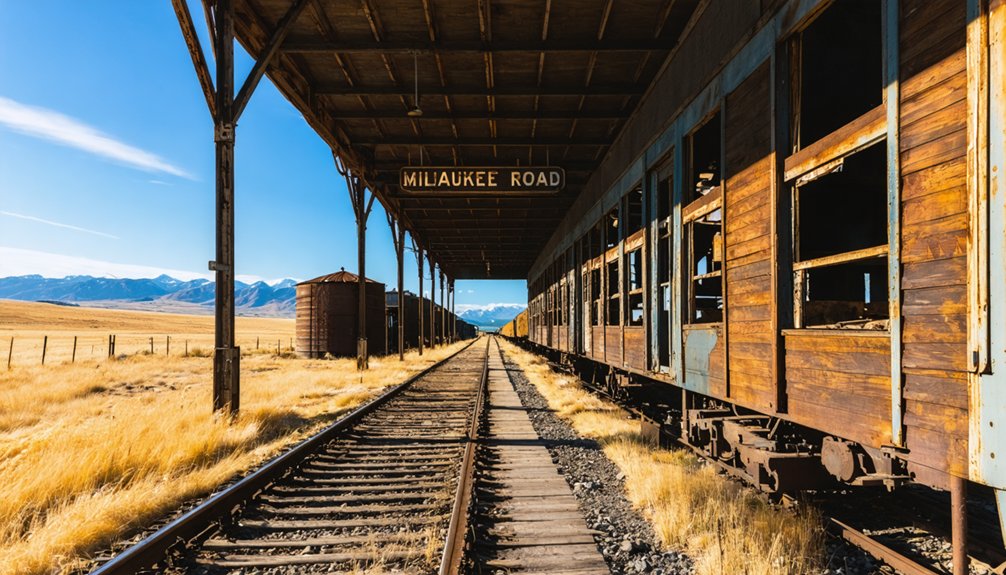
The 1980 abandonment of the Milwaukee Road railroad created a trail of ghost towns across eastern and central Montana, transforming once-thriving communities into silent reminders of the state’s transportation history.
You’ll discover fascinating Lennep history at the foot of the Castle Mountains, where Trinity Lutheran Church—Montana’s oldest Lutheran church built in 1914—still holds twice-monthly services. The general store and schoolhouse stand as weathered sentinels of this former rail stop named after a German town.
Barber Town presents another compelling destination, founded in 1910 in the Musselshell River Valley. You can explore the National Register-listed Bokman store and see a Milwaukee Road engine still visible at the site.
Highway relocations accelerated these communities’ decline, leaving grain elevators, churches, and stores as primary remnants of Montana’s railroad era.
Treasure Hunting and Local Folklore in Ghost Town Country
You’ll find Montana’s ghost towns aren’t just abandoned settlements—they’re treasure hunting destinations steeped in local folklore and legends of buried fortunes.
Among the best ghost towns in Montana, you can explore remnants of the past where history comes alive through crumbling facades and eerie landscapes. Each location offers a unique glimpse into the lives of pioneers who sought fortune and adventure, only to leave their dreams behind. As you wander through these silent streets, the stories of hope, hardship, and mystery linger in the air, captivating visitors and preserving the spirit of the Wild West.
Just a short drive from the city, ghost towns near Missoula Montana invite more adventurous souls to uncover their secrets. Each site offers not only a haunting look at history but also breathtaking views of the surrounding landscapes, making the journey truly unforgettable. As you explore these abandoned locales, you may even stumble upon artifacts that tell tales of the individuals who once called these places home.
Modern adventurers continue searching for Beartown’s legendary five-pound baking can filled with gold, supposedly buried by a Chinese prospector after the town’s 1866 mining boom.
These mining camp stories reflect documented patterns where over 300 ghost towns across Montana harbor tales of lost wealth from the state’s gold and silver rushes spanning the late 1850s to early 1900s.
Beartown’s Buried Gold Legend
Legends of buried treasure swirl around Beartown‘s dramatic rise and fall in Montana’s Garnet Range, where prospectors extracted an estimated $30 million in gold from Bear Gulch between 1865 and 1870.
You’ll find these Beartown legends compelling because the boom town vanished almost as quickly as it appeared, leaving countless stories of buried treasures hidden in the wilderness.
When 5,000 miners flooded the area after gold’s discovery in October 1865, fortunes were made overnight.
The camp’s notorious “Beartown Roughs” and sudden abandonment by 1870 fuel speculation about cached gold that never made it out.
- Secret Gulch bears the ominous name “Stay Out!” along Bear Gulch Road
- Gold nuggets discovered in First Bank Western Montana’s iron safe after 1921
- Mysterious 1852 journal entry noting “Gold hunting. Found some” in nearby Bitterroot area
- No expensive machinery required for placer mining made quick strikes possible
- Rapid boom-and-bust cycle left little time for organized gold removal
Modern Treasure Hunter Adventures
Anyone with a metal detector and treasure-hunting ambition can explore Montana’s ghost town country, where documented caches worth millions still await discovery.
You’ll find modern legends emerging alongside historical treasures like Fleming’s $4 million poker gold near Neihart or Cyrus Skinner’s $2.5 million outlaw loot at Hell Gate Ronde.
The Dale brothers continue pursuing their family’s Bear Gulch mine legend worth $20 million, while Garnet’s abandoned cabins conceal resident caches totaling $500,000.
Today’s treasure hunting scene includes Justin Posey’s 2025 hunt offering over $1 million, inspired by Forrest Fenn’s decade-long Rocky Mountain quest.
Montana’s remote terrain, rich boomtown history, and outlaw heritage make it prime territory for boots-on-ground exploration.
You’re free to chase these documented fortunes across the state’s ghost town landscape.
Mining Camp Fortune Tales
Where documented mining fortunes intersect with frontier folklore, Montana’s ghost towns harbor treasure tales that blend historical fact with enduring mystery.
You’ll discover mining camp legends spanning from Beartown’s rumored million-dollar cache buried by a Chinese prospector in 1866, to Pardee’s documented half-million silver profits from Iron Mountain Mine.
These treasure hunting tales reflect both actual wealth and supernatural folklore that continues drawing modern adventurers.
- Beartown’s five-pound baking can allegedly contains fortune from $1 million gold and silver yield
- Mystery Camp near Coloma remains enigmatic with scarce records from 1893-1906 operations
- Confederate Gulch features diamond-encrusted rattlesnake guarding hidden treasure in local legend
- Diamond City’s mysterious hovering lights attributed to tragic prospector’s spirit
- Iron Mountain Mine’s documented silver profits represent tangible mining camp success stories
Preservation Efforts: From State Parks to National Registry Buildings
While Montana’s ghost towns face constant threats from weather, vandalism, and natural decay, dedicated preservation efforts have transformed several sites into protected historical treasures.
You’ll find Bannack State Park leading these preservation techniques with its philosophy of “preserved rather than restored, protected rather than exploited.” The Beaverhead County Museum Association’s 1950s donation established this National Historic Landmark, protecting over 50 original 1860s buildings.
Garnet Ghost Town represents collaborative preservation between the BLM and Garnet Preservation Association, maintaining authentic structures through careful stabilization.
Virginia City operates as a living history museum, demonstrating the cultural significance of active preservation.
Meanwhile, Elkhorn and Granite ghost towns achieve protection through Montana’s state park system, ensuring public access while preventing commercial exploitation of these irreplaceable historical sites.
Planning Your Montana Ghost Town Adventure
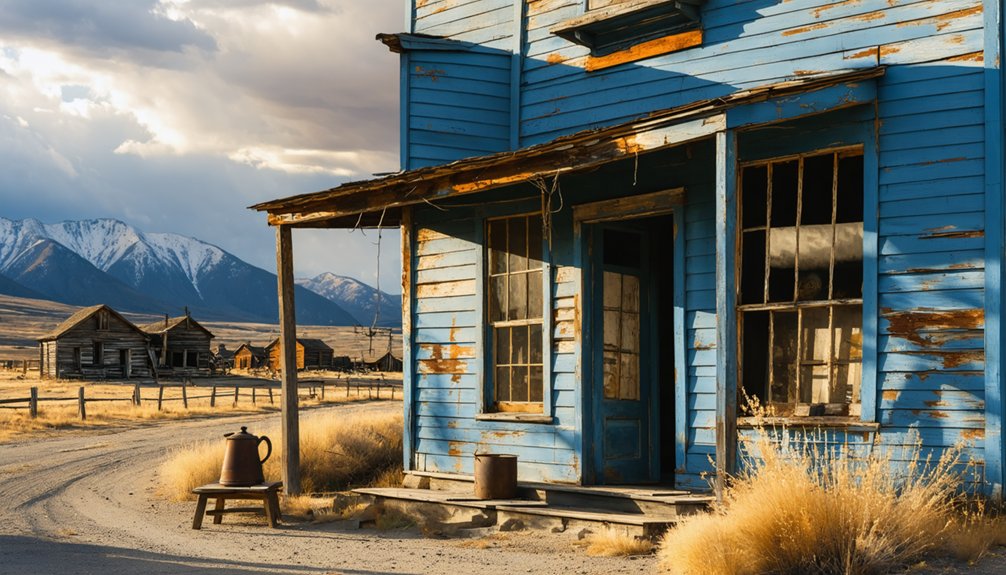
Before you commence your Montana ghost town journey, you’ll need to understand that each site presents unique access challenges and seasonal considerations.
Garnet requires a high-clearance 4×4 vehicle and closes during winter months, while Virginia City offers year-round paved access. Summer provides ideal conditions for ghost town photography across all locations, with Bannack State Park facilities fully operational and Granite Ghost Town accessible despite its high elevation.
Essential planning considerations include:
- Check road conditions – Garnet’s 11-mile backcountry route demands proper vehicle preparation
- Pack weather-appropriate gear – Mountain elevations create unpredictable conditions
- Respect historical preservation – Follow Leave No Trace principles at all sites
- Plan seasonal timing – June through November maximizes site accessibility
- Verify facility hours – State park visitor centers operate on seasonal schedules
Frequently Asked Questions
Are Ghost Towns Safe to Visit With Children and Pets?
Ghost town safety varies considerably, but you’ll face real structural, wildlife, and health hazards with children and pets. Choose well-maintained sites like Bannack for safer family friendly activities over remote, unmanaged locations.
What Photography Equipment Works Best in Old Mining Town Buildings?
You’ll need tripod stability for long exposures, lens selection favoring wide-angle options, and protective gear. Choose mirrorless cameras for portability, fast apertures for low light, and sturdy carbon fiber tripods for sharp shots.
Can You Legally Take Artifacts or Souvenirs From Ghost Towns?
No, you can’t legally take artifacts from ghost towns. Artifact preservation laws protect these items, and there are serious legal implications including federal charges for removing historical objects from protected sites.
Which Ghost Towns Offer the Best Camping Facilities Nearby?
Bannack State Park offers Montana’s best ghost town camping with 24 developed sites. You’ll find essential camping gear amenities like toilets and water, plus nearby attractions including historic buildings and interpretive trails for exploration.
Do Any Ghost Towns Have Cell Phone Service or Wifi?
You’ll find ghost towns like digital deserts—most lack cell service and wifi availability due to Montana’s remote terrain. Garnet exemplifies this isolation with zero connectivity, while carriers prioritize profitable corridors over abandoned settlements.
References
- https://glaciermt.com/ghost-towns
- https://www.youtube.com/watch?v=BQH5LghhkVs
- https://southwestmt.com/ghosts/ghost-towns/
- https://www.oregonhikers.org/forum/viewtopic.php?t=28842
- https://visitmt.com/things-to-do/ghost-towns
- https://piddlinaround.net/2021/07/22/montanas-first-capital-bannack-mt/
- https://southwestmt.com/specialfeatures/history/bannack/
- https://billingslibrary.org/DocumentCenter/View/5760/OvittMable
- https://www.mtmemory.org/nodes/view/3547
- https://www.distinctlymontana.com/bannack-montanas-best-preserved-ghost-town