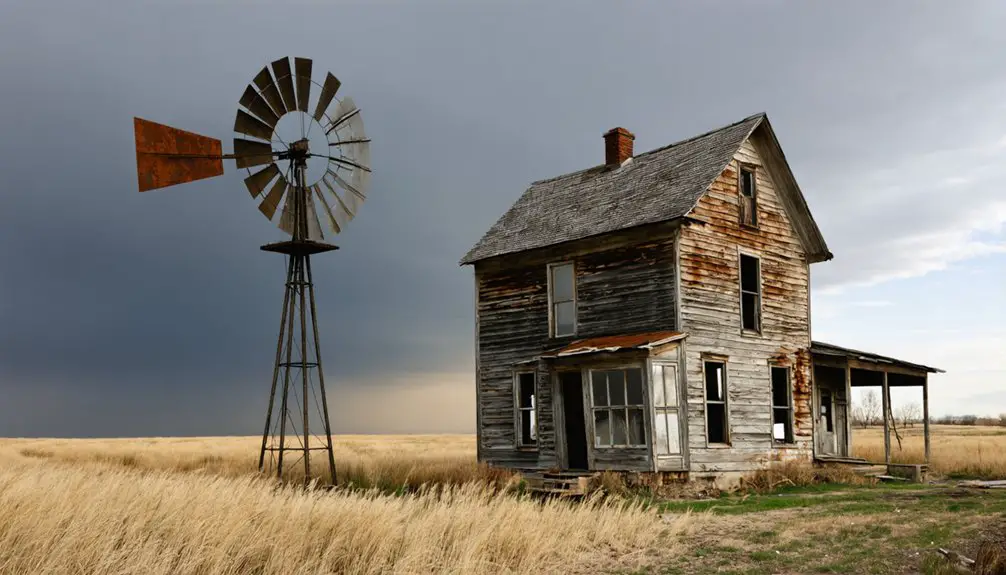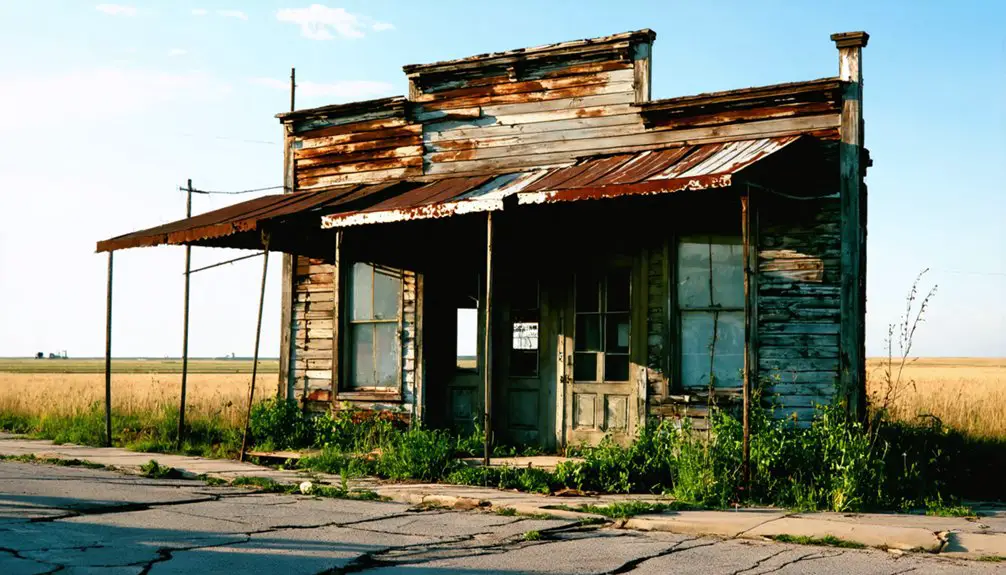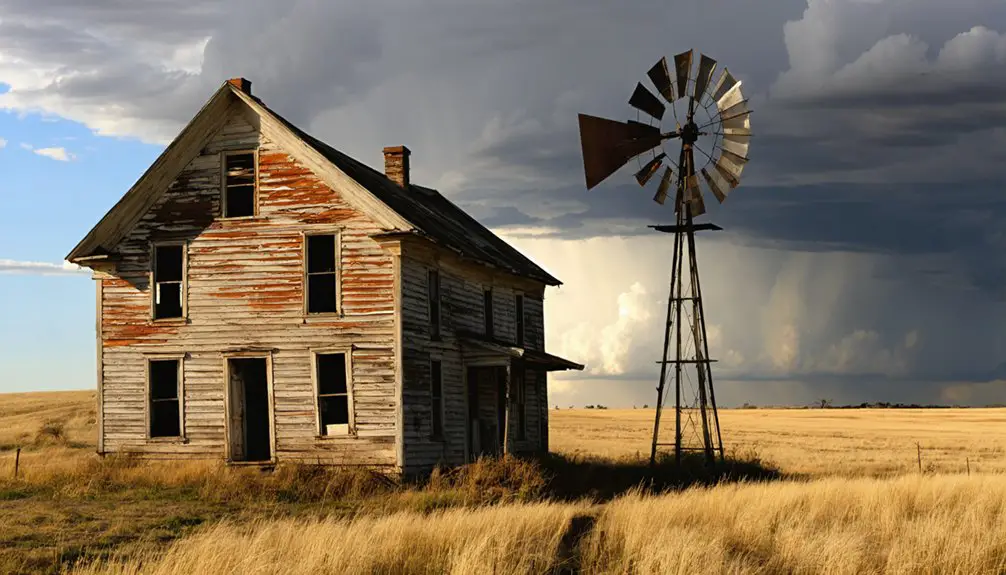
You’ll find Nebraska’s most famous ghost towns scattered across the state’s prairie landscape, each telling unique stories of boom and bust. Antioch once claimed 2,000 residents as the “potash capital” during WWI before economic collapse left only remnants. St. Deroin thrived as a Missouri River trading post until devastating 1911 floods destroyed it completely. Rock Bluff’s educational legacy survives through its preserved one-room schoolhouse, while Fontenelle lost territorial capital status by a single vote. These abandoned settlements reveal fascinating chapters of Nebraska’s pioneering spirit.
Key Takeaways
- Antioch was Nebraska’s “potash capital” with 2,000 residents during WWI before economic collapse ended the boom.
- Fontenelle nearly became territorial capital but lost by one vote and was bypassed by railroads.
- Oreapolis was founded as a strategic river junction gateway but became one of Nebraska’s most spectacular failures.
- Rock Bluff peaked at 200 residents by 1877 before post office closure led to abandonment.
- St. Deroin trading post was devastated by 1911 flooding and 1915 river channel shifts.
Antioch: A Railroad Siding Lost to Time
While most travelers speed past on Highway 2 without a second glance, the scattered ruins near Alliance tell the remarkable story of Antioch, Nebraska’s most dramatic boom-and-bust cycle.
You’re looking at what was once the “potash capital of Nebraska,” a thriving community of 2,000 residents built around wartime necessity.
Hard to imagine that these windswept fields once housed 2,000 people in Nebraska’s unlikely industrial boomtown.
When World War I cut America off from European potash sources, this former railroad siding exploded into Nebraska’s most important potash production center.
The demand for fertilizers and explosives transformed Antioch from obscurity into a bustling industrial hub within months. Potash prices skyrocketed from $8-$10 per ton to as high as $150 per ton during the war.
Yet freedom from wartime constraints spelled doom for this boom-town.
Once European imports resumed, Antioch’s economic foundation crumbled. The last potash plant in Antioch closed in 1921.
Today, you’ll find only a historical marker and crumbling remnants of this fascinating ghost town.
Rock Bluff: Educational Legacy in Cass County
Though most of Cass County’s 51 towns founded in 1854 have vanished without a trace, Rock Bluff’s legacy endures through education rather than industry.
You’ll find this ghost town significance three miles east of Murray, where German settler Benedict Spires established the community on Missouri River bluffs overlooking Rock and Squaw Creeks.
Rock Bluff thrived as a freighting outpost during the 1850s westward expansion, equipping pioneers crossing the plains. The town’s population reached nearly 200 residents by 1877, supporting various businesses including stores, blacksmith shops, and saloons. The community even competed for county seat status with Plattsmouth during its peak years.
However, when the post office closed in 1904 and residents abandoned the town by the 1940s, one structure survived: the one-room brick Naomi Institute schoolhouse.
This educational preservation represents 19th-century rural schooling and serves as the town’s lasting monument, proving that knowledge outlasts commerce in Nebraska’s frontier history.
St. Deroin: Missouri River Trading Post Turned Ghost
You’ll find St. Deroin’s story represents one of Nebraska’s most dramatic transformations from bustling river commerce to complete abandonment.
The community thrived as a Missouri River trading post from the 1840s through the early 1900s, serving the Nemaha Half-Breed Reservation and regional fur trade operations. The town was co-founded in 1854 by Otoe chief Joseph “Chief Otoe” DeRoin, along with Robert Hawke and others who established a store to sell goods to local Otoe Indians.
However, catastrophic flooding in 1911 and the river’s channel shift in 1915 destroyed the town’s economic foundation, leaving behind only a cemetery and scattered legends. Today, the remnants of St. Deroin exist within Indian Cave State Park, which attracts nearly 300,000 visitors annually to explore its 22 miles of trails and historical sites.
Thriving River Trading Hub
The settlement’s historical significance grew when Joseph Deroin established his trading post in 1840, building upon decades of existing commerce.
These operations connected Bellevue’s American Fur Company activities to St. Joseph, Missouri’s expanding trade network.
Jeffrey’s acquisition of first land rights for a person of color in Holt County demonstrates the settlement’s progressive opportunities along this vital transportation corridor. The area became known as Jeffrey’s Point after Deroine sold his squatter’s rights for $600.
Abandoned by River Changes
While trading posts like St. Deroin thrived on Missouri River commerce, you’ll discover that nature’s relentless forces ultimately sealed their fate.
River erosion systematically destroyed the town’s infrastructure through repeated flooding, with the devastating 1911 inundation dealing a crushing blow. However, the death knell came when the Missouri River shifted course by 1915, completely stranding the ferry landing that formed the community’s economic lifeline.
You can trace St. Deroin’s rapid decline through its timeline: ferry operations ceased immediately after the channel change, and the town stood completely uninhabited by 1920.
Today, you’ll find only scattered remnants within Indian Cave State Park—the relocated school building, cemetery graves, and a rebuilt general store overlooking where the river once flowed. The area holds deeper historical significance, as Lewis and Clark established their camp near this very location during their famous expedition in 1804.
Fontenelle: Boom and Bust in the Forest
Among Nebraska’s most compelling ghost town stories, Fontenelle’s rise and fall illustrates how quickly frontier dreams could turn to dust.
You’ll find this settlement emerged when Congress claimed Indian land through the 1854 Kansas-Nebraska Act, attracting settlers who’d purchased twenty square miles for just $100. They’d mistakenly believed the Elkhorn River was navigable.
Settler hardships proved brutal—primitive log houses couldn’t keep out snow, wolves prowled constantly, and violent storms threatened survival.
Educational challenges persisted despite establishing one of the area’s first colleges, where Professor Burt earned $40 monthly until his chemistry experiment sparked a devastating fire.
Fontenelle thrived briefly through university establishment and railroad hopes, even losing territorial capital status by one vote. The community was founded by German immigrants from Quincy, Illinois who formed a joint stock company to establish the settlement. Like nearby Decatur, which was incorporated in 1856 as Nebraska’s second town, Fontenelle represented the ambitious spirit of early Nebraska settlement.
However, when railroads bypassed the town for Fremont, dreams collapsed.
Today, thirty residents inhabit this former boom town.
Belvidere: Oregon Trail Settlement Still Standing

You’ll discover that Belvidere stands apart from Nebraska’s typical ghost towns because it remains an active railroad community with deep Oregon Trail roots.
The town’s survival stems from the Union Pacific Railroad‘s continued operation since 1873, which transformed this former trail stop into a thriving grain transportation hub.
You can still observe the layered history where Oregon Trail foundations may lie beneath a community that celebrates both its pioneer heritage and modern railroad significance.
Oregon Trail Heritage
Because the Oregon Trail carved its path through what’s now Belvidere, Nebraska, this small settlement represents one of the few places where you can still witness physical remnants of America’s greatest westward migration.
You’ll find building foundations from the original Oregon Trail era still visible today, marking where pioneer settlements once thrived along Big Sandy Creek.
The trail’s strategic location provided travelers essential water, wood, and grass while serving as protection from Native American raids.
Later, the same route carried Pony Express riders, freight wagons, and stagecoaches.
You can walk Belvidere’s Main Street where the Oregon Trail merged with the historic Meridian Highway, creating a unique intersection of America’s transportation evolution that few ghost towns can claim.
Railroad Development Impact
When the St. Joseph & Denver City Railroad pushed through Belvidere in 1872, you’re witnessing how railroad expansion transformed Nebraska’s landscape forever.
The ABC Railroad designated this route as their initial Thayer County line, with Belvidere serving as the second stop along their expanding network.
You’ll find that railroad expansion didn’t just connect towns—it created them.
Surveying crews staked new settlements along lengthening corridors, while depot construction provided the first essential linkage between railroads and emerging communities.
This systematic development stimulated agricultural growth throughout the region, as post-transcontinental branchlines prioritized Nebraska’s farming potential.
Belvidere’s railroad heritage spans over 150 years, making it a surviving symbol of how rail development shaped Nebraska’s agricultural economy and settlement patterns from 1872 forward.
Historic Buildings Preserved
While Belvidere’s railroad heritage shaped its growth, the town’s most remarkable achievement lies in preserving its historic structures that span multiple transportation eras.
You’ll discover preservation efforts that transformed a vacant three-story brick school into the cornerstone of an impressive ten-building museum complex spanning eight acres. The architectural significance becomes evident as you explore structures representing different periods of American expansion.
The preserved buildings tell Belvidere’s complete story:
- Three-story brick school – Now anchors the Thayer County Historical Society’s museum complex
- Williamson Gas Station – Strategically positioned at Prairie Crossroads on historic Meridian Highway
- Train Watching Station – Modern addition completed in 2012 with Union Pacific support
- District 10 School House – Known as the “school on the Oregon Trail”
Oreapolis: The Five-Year Wonder of Territorial Nebraska

The ambitious vision of Dr. John Evans created one of territorial Nebraska’s most spectacular failures.
You’ll find Oreapolis history begins on October 30, 1857, when Evans’s Oreapolis Town Company selected the strategic junction of Platte and Missouri Rivers for their gateway to the American West.
Dr. John Evans, the Chicago real estate tycoon who founded Evanston, Illinois, orchestrated bold expansion plans from his Clark Street office.
Exploring Nebraska’s Abandoned Heritage Today
Although Nebraska’s ghost towns vanished decades ago, you can still discover their scattered remains across the prairie landscape through systematic exploration methods. These abandoned settlements offer tangible connections to Nebraska’s pioneering spirit, where over 900 communities once thrived before economic forces reshaped the rural landscape.
Among the most intriguing locations are the abandoned towns in Nebraska, each with its own story of resilience and change. As you wander through these remnants, you might encounter weathered buildings and rusted machinery that hint at the lives once lived there. Exploring these sites not only reveals the challenges faced by settlers but also celebrates their enduring legacy in the Heartland.
Modern explorers can locate these sites through several proven techniques:
- Historic map analysis – Compare current county maps with 1870s-1890s railroad development charts to identify vanished depot locations.
- Aerial reconnaissance – Spot building foundations, old roadbeds, and railroad rights-of-way from overhead photography.
- Ground surveys – Look for isolated grain elevators, graded streets with settler-planted trees, and cemetery markers.
- Documentation research – Consult county histories, newspaper archives, and oral testimonies for precise coordinates.
Historical preservation efforts guarantee these remnants remain accessible for future generations seeking authentic frontier experiences.
Frequently Asked Questions
Are There Any Safety Concerns When Visiting These Ghost Towns?
Yes, you’ll face structural collapse risks, wildlife encounters, and potential human intruders during urban exploration. Historical preservation efforts can’t eliminate decades of deterioration, contamination, and environmental hazards in these abandoned sites.
What Time of Year Is Best for Exploring Nebraska’s Abandoned Settlements?
You’ll find late September through early October offers the best weather for exploring Nebraska’s abandoned settlements. Mild temperatures, minimal rainfall, and accessible dirt roads create ideal conditions for seasonal activities like hiking and photography.
Do You Need Permission to Access Private Property Ghost Town Sites?
Don’t fence yourself in—you’ll need landowner permission for private ghost town sites. Nebraska’s access regulations protect property rights, requiring authorization unless specific exceptions like pioneer cemeteries or enrolled Open Fields programs apply.
exploring nebraska’s ghost towns can reveal hidden stories and artifacts from the past, making it an adventurous journey for history enthusiasts. As you traverse the abandoned streets, be prepared to encounter remnants of once-thriving communities, each with its own unique narrative. Always remember to respect the land and its owners while indulging in this captivating exploration.
Which Ghost Towns Have the Most Intact Original Buildings Remaining Today?
You’ll find Nysted and Roscoe contain the most intact abandoned architecture from their early 1900s origins. Their preserved buildings demonstrate exceptional historical significance, with complete structures including churches, halls, and commercial buildings surviving Nebraska’s rural decline.
How Do Ghost Town Rating Scales Determine Preservation Levels?
You’ll find that rating criteria assess structural integrity, historical authenticity, and architectural completeness. Preservation standards evaluate materials’ condition, original design retention, and environmental impact to determine each ghost town’s conservation priority level.
References
- https://www.ghosttowns.com/states/ne/ne.html
- https://history.nebraska.gov/wp-content/uploads/2017/12/doc_publications_NH1937GhostTowns.pdf
- https://www.youtube.com/watch?v=l3s2qhSxis8
- https://kids.kiddle.co/List_of_ghost_towns_in_Nebraska
- https://www.onlyinyourstate.com/trip-ideas/nebraska/ne-ghost-towns-road-trip
- https://freepages.rootsweb.com/~gtusa/history/usa/ne.htm
- https://visitnebraska.com/trip-idea/explore-7-authentic-ghost-towns-nebraska
- https://history.nebraska.gov/finding-nebraskas-ghost-towns/
- https://history.nebraska.gov/marker-monday-antioch-potash-boom-town/
- https://www.onlyinyourstate.com/state-pride/nebraska/fascinating-highway-ruins-ne