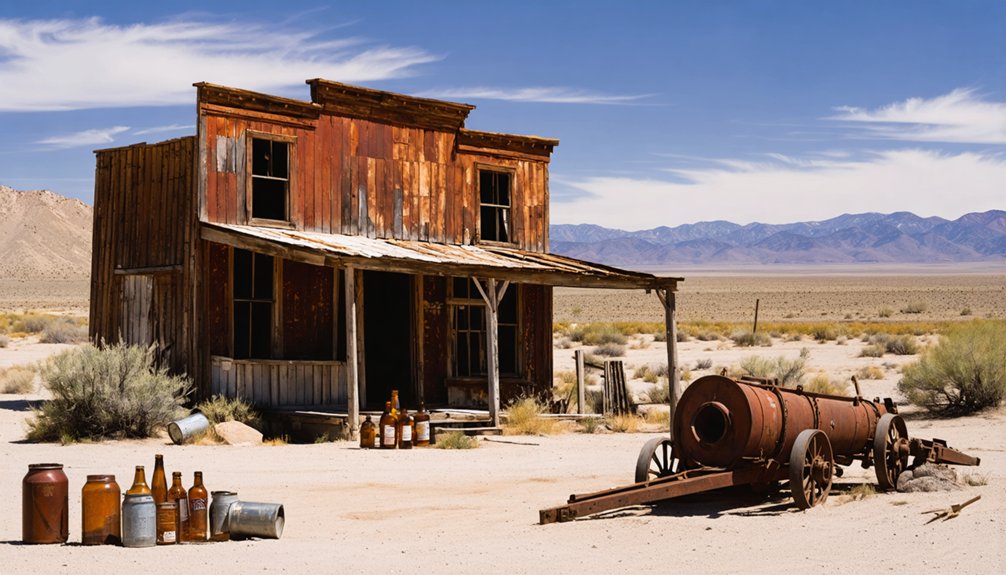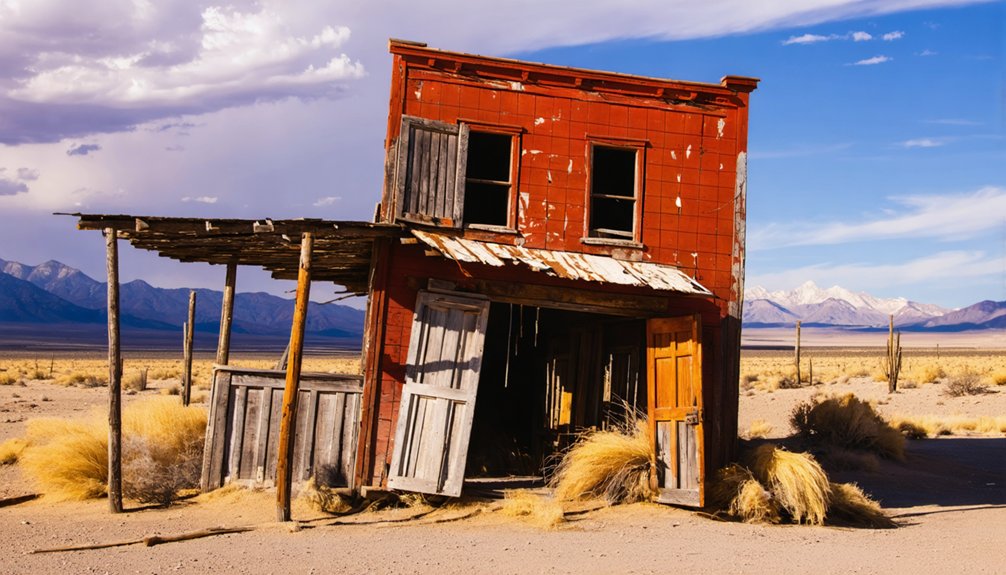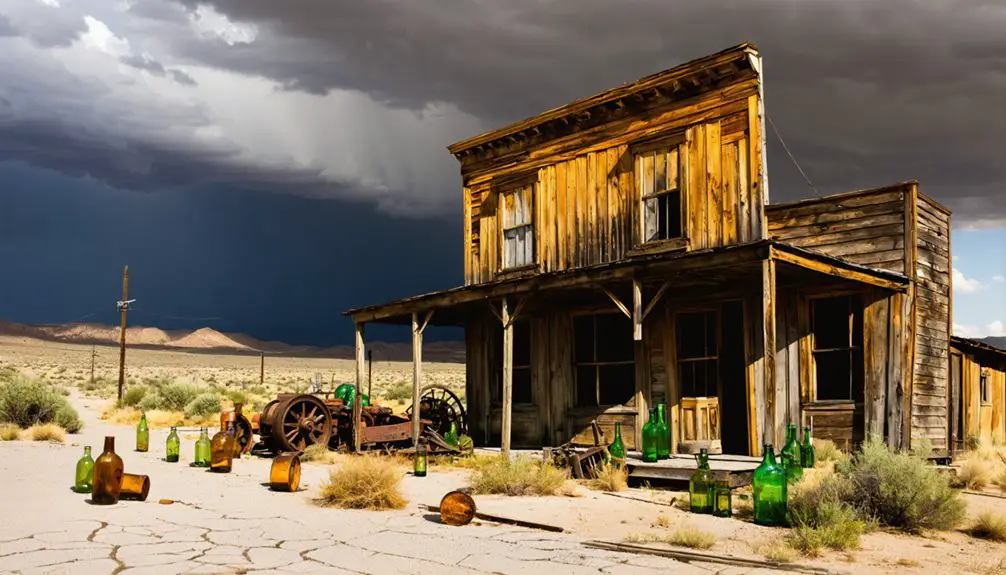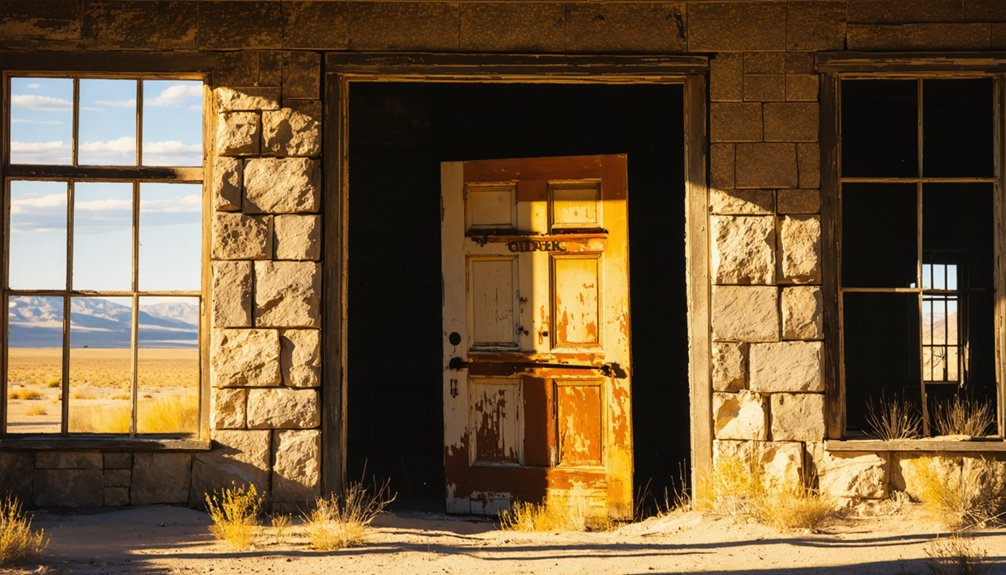
You’ll find Nevada’s most famous ghost towns scattered across the desert, where gold and silver rushes created thriving communities before economic collapse left haunting ruins. Rhyolite stands as the state’s most photographed ghost town with its crumbling bank and bottle house, while Goldfield once housed 30,000 residents and now features the allegedly haunted Goldfield Hotel. Jarbidge represents the last gold rush frontier, and Belmont showcases 150 years of silver mining heritage with its historic courthouse still standing today.
Key Takeaways
- Rhyolite, established in 1904, became Nevada’s most photographed ghost town with iconic ruins including Cook Bank and Bottle House.
- Goldfield peaked as Nevada’s largest settlement in 1906 with 30,000 residents and features the reportedly haunted Goldfield Hotel.
- Jarbidge represents Nevada’s last gold rush frontier from 1909, producing over 200,000 ounces of gold between 1919-1921.
- Belmont showcases 150 years of silver mining heritage, producing $15 million in ore and featuring a historic courthouse.
- Goodsprings, Nevada’s oldest ghost town near Las Vegas, extracted $30 million in precious metals and maintains the historic Pioneer Saloon.
Rhyolite: Nevada’s Most Photographed Ghost Town
In Nevada’s desolate landscape near the California border, Rhyolite stands as the state’s most photographed ghost town, its skeletal remains telling the story of one of the American West’s most dramatic boom-and-bust cycles.
You’ll discover Rhyolite history began in 1904 when prospectors struck gold, transforming empty desert into a thriving city of 5,000 residents within months. The town boasted 50 saloons, three banks, and modern amenities including electricity and ice plants.
However, the 1907 financial panic and depleting ore reserves triggered rapid decline. By 1920, only 14 residents remained. The Bullfrog Mining District produced $1,687,792 between 1907 and 1910, equivalent to over $56 million in today’s currency. Three railroads connected the bustling mining town to major regional centers including Tonopah, Goldfield, and Las Vegas.
Today’s Rhyolite attractions include the iconic Cook Bank ruins, restored Bottle House, and crumbling jail, drawing photographers and freedom-seekers exploring America’s untamed past.
Goldfield: From Boom to Haunted Ruins
While Rhyolite captured photographers’ attention, Goldfield earned the title “Greatest Gold Camp Ever Known” through sheer scale and spectacle.
You’ll discover a town that exploded from nothing to Nevada’s largest settlement by 1906, housing 30,000 fortune-seekers after 1902’s gold strike near Columbia Mountains. The mines churned out $10,000 daily, supporting five banks and two stock exchanges.
You can still explore the surviving 1907-1908 stone structures, including the luxurious Goldfield Hotel with its gilded columns and crystal chandeliers. The town also hosted the Gans-Nelson Championship boxing match in 1906, drawing over 80,000 spectators to an 8,000-seat arena built specifically for the fight.
However, Economic Decline struck hard after 1910 labor disputes and mine failures reduced the population to 1,500. Catastrophic fires and a major flood in 1913 further devastated the town, followed by another destructive flood and fire in 1923 that destroyed 53 city blocks.
Economic decline devastated Goldfield as labor strikes and mining failures slashed the booming population from 30,000 to merely 1,500 residents.
Today’s 200 residents live among ruins where Goldfield Hauntings at the hotel attract paranormal investigators seeking spirits from the town’s violent past.
Jarbidge: The Last Gold Rush Frontier
Just as Nevada’s gold fever reached its twilight years, prospector David Bourne made a discovery near the Jarbidge River in 1909 that would spark the state’s final major gold rush.
You’ll find Jarbidge history marked by extraordinary claims—initial reports boasted $27 million in visible gold ore from Bourne’s North Star claim.
The rush exploded when John Escalon found another rich ledge, swelling the remote camp’s population to 2,000 by 1911.
Gold mining here defied expectations, producing more ore than any Nevada camp during 1919-1921. Elkoro Mining Company’s 100-ton mill and electric power enabled serious extraction of over 200,000 ounces. The Jarbidge mountain range was first prospected from the late 1860s, with early gold and silver deposits discovered near the Bruneau River decades before Bourne’s famous strike.
The boom couldn’t last forever, and mining operations ceased completely in 1932 as the easily accessible gold played out.
Today’s ghost town stands as evidence to miners’ tenacity, where freedom-seeking prospectors braved harsh winters for one last shot at fortune.
Belmont: Central Nevada’s 150-Year-Old Silver Legacy
You’ll discover Belmont’s remarkable silver legacy began in 1865 when prospectors struck rich ore near Tonopah, transforming a tent camp into central Nevada’s most significant mining center.
The town’s $15 million in lifetime ore production funded impressive infrastructure, including the historic courthouse that served as Nye County’s seat from 1867 to 1905. At its peak in 1867, Belmont supported a thriving population of 2,000 residents drawn by the silver rush.
The settlement thrived at 7,400 feet elevation, where a year-round spring had previously served as a gathering site for Shoshone Indians conducting rabbit drives and celebrations.
Today, you can explore the surviving courthouse alongside haunting brick walls and structural ruins that chronicle 150 years of boom, bust, and Nevada’s enduring silver heritage.
Silver Strike History
When prospectors struck silver ore in Nye County during 1865, they unknowingly launched what would become Central Nevada’s most significant mining legacy.
You’d have witnessed an extraordinary rush as miners abandoned Austin and other camps, drawn by surface ores valued at an astounding $3,000 per ton.
The silver strike created three defining characteristics of boomtown culture:
- Explosive Growth – Prospectors flooded in during 1866, establishing the Silver Bend district.
- Massive Wealth – High-grade silver chloride deposits averaged 25 ounces per ton.
- Regional Dominance – Belmont controlled Nye County’s silver mining from 1865 to 1889.
You’ll find this wasn’t just another mining camp.
Between 1866 and 1887, these deposits generated an estimated $15 million in total production, making Belmont the cornerstone of Nevada’s early silver mining empire. By 1867, Belmont had gained enough prominence to become the Nye County seat, reflecting its political and economic importance in the region. The water table ultimately limited early mining operations as most historical workings focused on shallow underground extraction above this natural barrier.
Courthouse and Ruins
Belmont’s architectural centerpiece stands as a tribute to the town’s former prominence—the two-story brick courthouse that Carson City architect J.K. Winchell designed in 1875.
You’ll discover this $3,400 structure, completed on July 4, 1876, served as Nye County’s judicial hub for thirty years until the county seat moved to Tonopah in 1905.
The courthouse architecture showcases immaculate 1870s craftsmanship, with its original roof surviving until recent decades.
You can explore the basement jail where vigilante justice occurred in 1874, though the cells were later stripped and relocated to Gabbs.
Today, you’ll find ongoing restoration efforts by Brett Perchetti and Friends of the Belmont Courthouse.
This nonprofit organization protects the structure’s historical significance while offering guided tours from May through September weekends.
Nelson: Southern Nevada’s Golden Mining Heritage
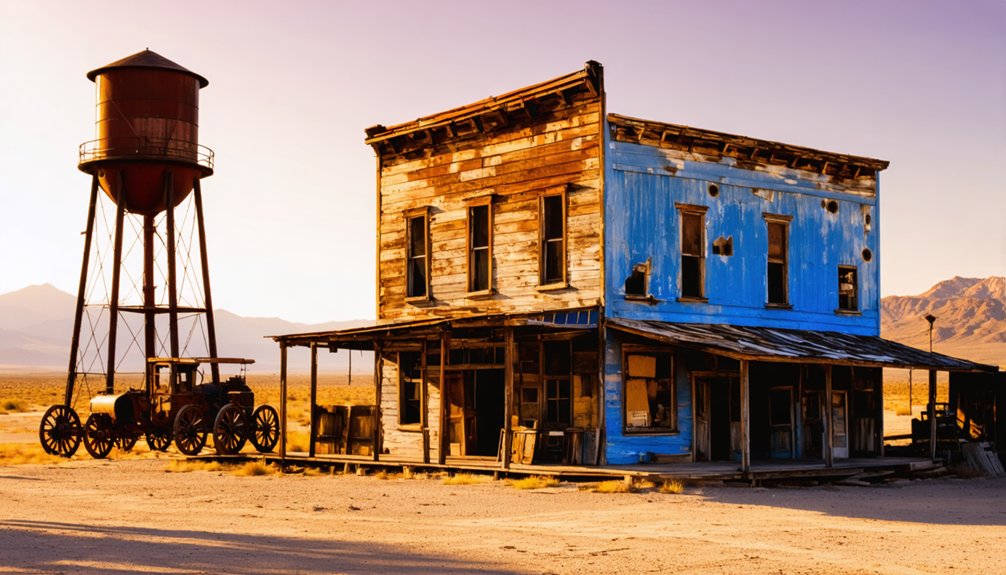
You’ll find Nelson’s golden legacy anchored by the legendary Techatticup Mine, which operated from 1861 through the early 1940s and extracted several million dollars in precious metals from southern Nevada’s most successful gold region.
This former Eldorado Canyon settlement represents the state’s first major gold rush, producing an estimated $10 million in gold between the mid-1860s and 1900 before evolving into a preserved ghost town attraction.
Located within easy driving distance of Las Vegas, Nelson offers you accessible exploration of authentic mining heritage through guided underground tours and restored historical structures.
Historic Techatticup Mining Operations
Deep within Eldorado Canyon’s rugged walls lies the legendary Techatticup Mine, Nevada’s most notorious and profitable mining operation that shaped Southern Nevada’s golden heritage from 1861 to 1941.
You’ll discover how this principal mine established the Techatticup Legacy through revolutionary mining techniques that extracted $10 million in precious metals from the rich Salvage Vein.
The operation’s remarkable scale included:
- Advanced processing infrastructure – A fifteen-stamp mill constructed in 1883 maximized ore extraction efficiency.
- Multi-metal production – Gold, silver, copper, and lead ore generated massive revenues exceeding $25 million by 1872.
- Strategic revival periods – Railroad arrival in 1905 and 1930s military contracts sustained operations through changing markets.
Today, you can explore 500 feet of restored tunnels, witnessing firsthand the engineering prowess that defined Nevada’s mining frontier.
Eldorado Ghost Town Legacy
While Spanish explorers first glimpsed Eldorado Canyon’s mineral potential in 1775, it wasn’t until the 1860s mining boom that Nelson emerged as Southern Nevada’s most legendary gold camp.
You’ll discover that Eldorado mining operations extracted $10 million in gold between 1864-1900, making this the region’s most successful mining district. The lawless frontier attracted Civil War deserters and claim jumpers who settled disputes with daily gunfights, far from any sheriff’s jurisdiction.
Today, you can explore the Paiute heritage that predates European settlement, when Native Americans mined turquoise from these canyons.
The restored Techatticup Mine site preserves this rich history, allowing you to walk through authentic mining structures and experience the freedom-seeking spirit that drove thousands to chase golden dreams in Nevada’s unforgiving desert.
Las Vegas Proximity Access
Just forty-five minutes south of Las Vegas, Nelson stands as the most accessible authentic ghost town experience in Nevada, bridging the gap between modern entertainment and frontier history.
Exploring the best ghost towns in Nevada offers a glimpse into the state’s rich mining history and the stories of those who once called these now-silent places home. From Rhyolite’s intriguing ruins to the quaint charm of Virginia City, each town showcases a unique character steeped in the past. Visitors can immerse themselves in tales of prosperity and decline, making these historical sites a fascinating journey through time.
In addition to the allure of ghost towns, annual events in Virginia City attract visitors year-round, providing lively celebrations that honor the town’s storied past. Activities such as the Virginia City Outhouse Races and the Nevada Day Parade bring the community together, showcasing local culture and traditions. As visitors stroll through the historic streets, they can enjoy live music, artisan markets, and reenactments that bring history to life.
You’ll find this preserved mining camp nestled in Eldorado Canyon, forty-four miles from the Strip’s neon lights.
Your ghost town accessibility options include:
- Self-guided exploration of restored structures and mining equipment scattered throughout the canyon
- Professional Las Vegas tours through Eldorado Canyon Mine Tours offering historical context and safety
- Underground mine experiences where you’ll descend into the actual Techatticup Mine workings
The Werly family’s 1994 restoration transformed this $10-million-producing mining district into Nevada’s premier heritage tourism destination.
You’re experiencing genuine frontier architecture without sacrificing modern convenience, making Nelson the perfect escape from urban constraints.
Goodsprings: Home to Nevada’s Oldest Saloon
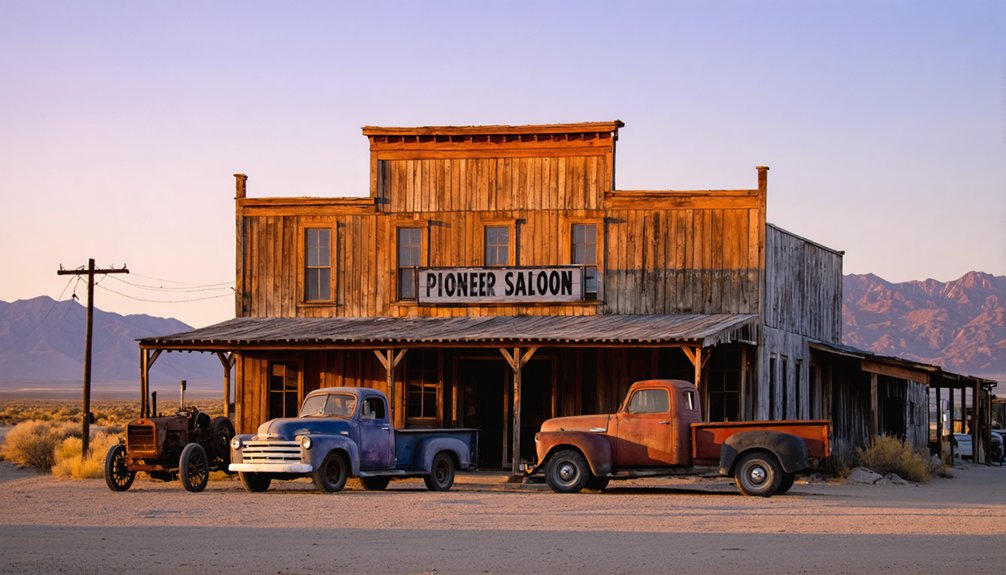
Among Nevada’s most storied ghost towns, Goodsprings stands as a symbol of the boom-and-bust cycles that defined the American West.
You’ll discover a settlement that once rivaled Las Vegas, boasting 800 residents during its 1900s mining heyday. The Yellow Pine Mining District extracted over $30 million in precious metals, fueling unprecedented prosperity.
Pioneer Saloon anchors Goodsprings History as Nevada’s oldest operating saloon, featuring bullet holes from a deadly 1915 card game and the original Brunswick cherry wood bar.
You can explore where Clark Gable waited after Carole Lombard’s tragic 1942 plane crash.
Though mining ceased by 1934, today’s 200 residents maintain this functioning ghost town through preservation efforts, keeping alive the spirit of western independence.
Exploring Nevada’s Ghost Town Trail
Beyond the preserved remnants of individual settlements, Nevada’s ghost town trail offers you extensive exploration routes that connect dozens of abandoned sites across the state’s vast desert landscapes.
Modern resources make ghost town exploration accessible through thorough mapping systems and detailed trail guides.
Your journey benefits from three essential navigation tools:
- Interactive digital maps displaying over 800 ghost towns across Nevada and California with historical documentation and photographic records
- Detailed atlases covering 725 abandoned sites including mining camps, stage stations, and emigrant trails with precise GPS coordinates
- Historical route mapping featuring California Trail, Spanish Trail, and Pony Express stations with downloadable Google Earth files
These abandoned sites connect through established emigrant routes like the Forty-Mile Desert crossing and Applegate-Lassen Cutoff, creating extensive exploration networks for independent desert adventurers.
Frequently Asked Questions
What Safety Precautions Should Visitors Take When Exploring Abandoned Mine Shafts?
Better safe than sorry—don’t explore abandoned mine shafts at all. Mine safety experts warn exploring hazards include lethal falls, structural collapse, unstable explosives, and toxic gases. You’ll face criminal trespassing charges while risking your life unnecessarily.
Are There Camping Facilities Available Near Nevada’s Ghost Towns?
You’ll find diverse camping options near Nevada’s ghost towns, from developed RV parks with full hookups to free dispersed camping on BLM land, with varying camping regulations and access to fascinating nearby attractions.
Which Ghost Towns Are Accessible by Regular Passenger Vehicles Versus 4WD?
You’ll find accessible routes to Goodsprings, Nipton, Calico, Pioche, and Rhyolite using regular cars on paved highways. Vehicle recommendations include 4WD for Bonnie Claire, Blair, Cherry Creek, and Warm Springs requiring unpaved desert roads.
What’s the Best Time of Year to Visit Nevada’s Ghost Towns?
Spring’s absolutely perfect for ghost town exploration! You’ll find the best months are March through May, when comfortable temperatures and seasonal events like wildflower blooms create ideal conditions for discovering Nevada’s abandoned treasures.
Do Any Ghost Towns Require Entrance Fees or Guided Tours?
Yes, entrance policies vary considerably across Nevada’s ghost towns. You’ll pay $1-10 at Nelson, $5-10 at Berlin-Ichthyosaur State Park, while Rhyolite offers completely free access. Tour availability ranges from required reservations to self-guided exploration.
References
- https://www.visittheusa.com/experience/6-nevada-ghost-towns-explore-if-you-dare
- https://www.atlasobscura.com/things-to-do/nevada/ghost-towns
- https://pinatravels.org/ghost-towns-near-las-vegas/
- https://www.smithsonianmag.com/sponsored/nevadas-living-and-abandoned-ghost-towns-180983342/
- https://travelnevada.com/ghost-town/
- https://www.tripadvisor.com/Attractions-g28949-Activities-c47-t14-Nevada.html
- https://nvtami.com
- https://forgottennevada.org/sites/newlist.html
- https://nvtami.com/2025/01/27/rhyolite-ghost-town-nevadas-diamond-in-the-desert/
- https://www.nvexpeditions.com/nye/rhyolite.php