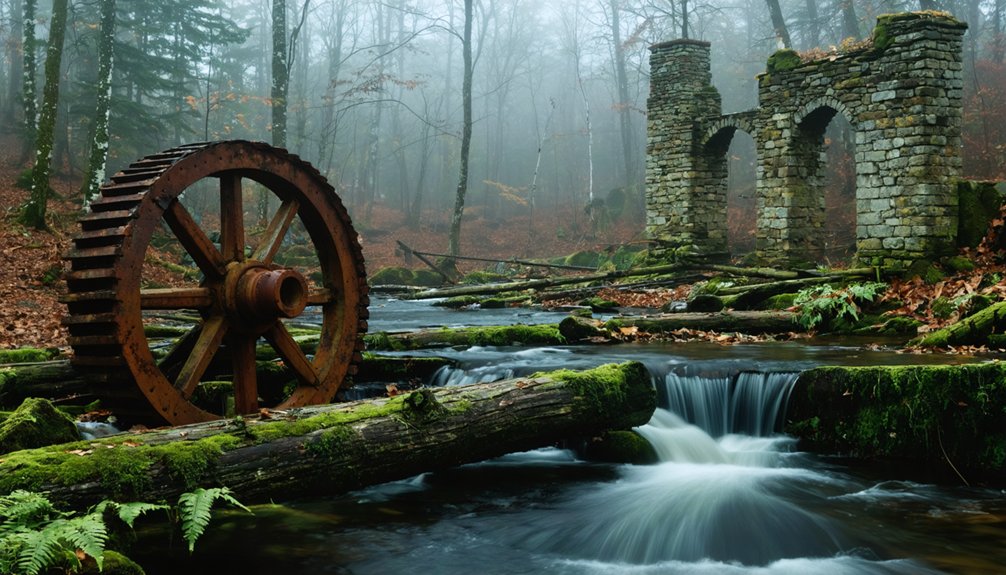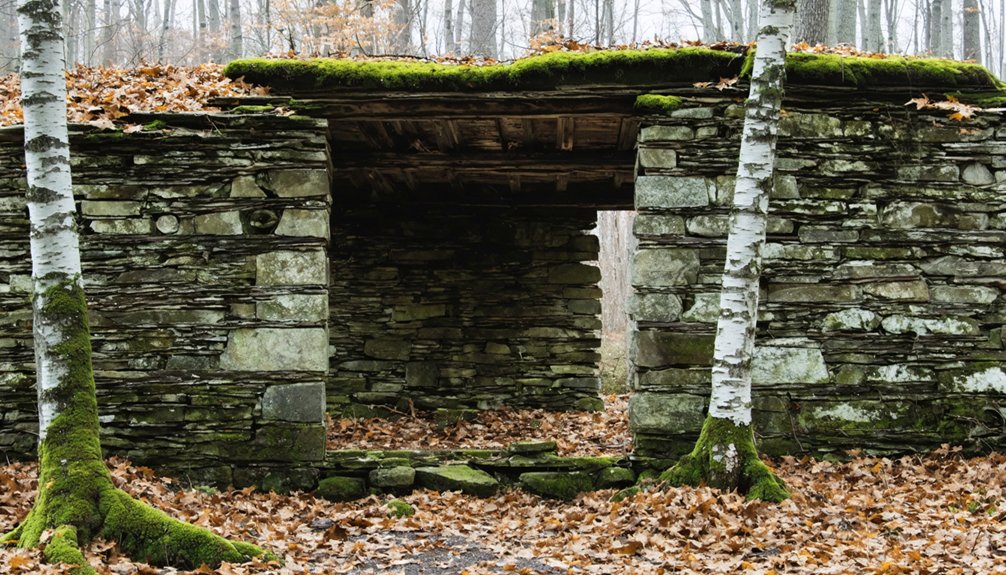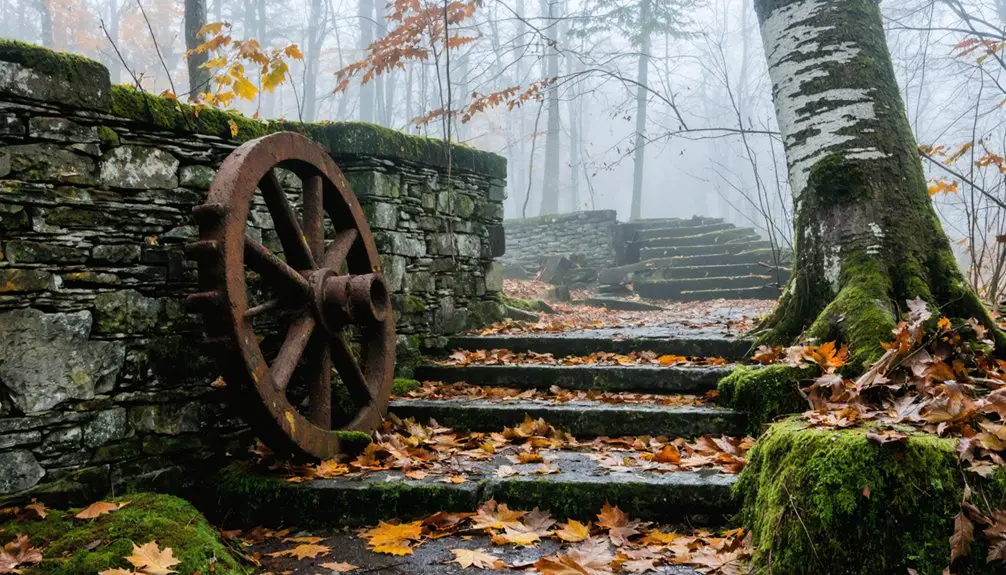
You’ll find New Hampshire’s most famous ghost towns scattered across its mountains and forests, each with unique histories tied to logging and agriculture. Beebe River thrived from 1917 with 230 workers before abandonment, while Zealand operated from 1880 until devastating fires in the 1890s. Livermore Mills housed 200 residents until flooding in 1927, and East Weare disappeared under the Everett Flood Control Project in 1960. These preserved sites offer hiking trails and historical markers that reveal fascinating stories of vanished communities.
Key Takeaways
- Beebe River was a thriving logging community established in 1917, employing 230 workers before becoming abandoned ruins.
- Zealand, founded in 1880, featured a 10-mile railway and employed 250 workers until devastating fires caused abandonment.
- Livermore Mills peaked at 200 residents by 1900 but closed permanently in 1928 after fires and floods.
- Monson was New Hampshire’s first inland colony from the 1730s, abandoned in 1770 due to political discord.
- East Weare was an agricultural community with 60 families until claimed by flood control project in 1960.
Beebe River: A Lost Logging Community in the White Mountains
When you venture into the White Mountains today, you’ll find few traces of Beebe River, once a thriving logging community that emerged from a massive land deal in 1917.
Publishers Paper Company sold the 22,000-acre tract to Parker-Young Company, who built a complete village and sawmill where the Pemigewasset and Beebe rivers meet. You can imagine how ambitious this operation was—over 25 miles of railroad tracks, twelve logging camps, and a double-band sawmill that employed 230 workers at its peak.
The community’s logging practices initially focused on spruce for World War I airplane manufacturing, later shifting to hardwood bobbin production under Draper Corporation. The village itself included 18 houses, a boarding house, general store, school, and recreational facilities, designed as a model utopian community with modern conveniences for the mill workers. Today, scattered logging artifacts like ax heads and bed frames remain as silent witnesses to this once-bustling industrial community.
Zealand: James Everell Henry’s Abandoned Lumber Empire
Although James Everell Henry had already established successful water-powered mills at Lower Falls of Ammonoosuc in Crawford Notch, he recognized Zealand Valley’s vast timber potential and founded his most ambitious logging enterprise there in 1880.
You’ll find this company town once employed 250 workers and featured a 10-mile railway transporting lumber. Henry’s operation served two logging railroads until exhausting the valley’s mature trees by the early 1890s.
Disaster struck when major fires in 1886 and 1897 destroyed standing timber and mill buildings.
After the Van Dyke operation cleared remaining logs by 1900, Zealand vanished completely. The town was officially abandoned in the late 1890s as the lumber industry moved elsewhere.
The community’s charcoal production was remarkably profitable, with the 1880 census recording $75,000 worth of charcoal sold that exceeded even lumber sales.
Today, you’ll discover only ghostly remnants within White Mountain National Forest—scattered foundations, abandoned railway tracks, and mill ruins at Zealand Campground preserve this remarkable logging legacy.
Livermore Mills: The Vanished Sawmill Town Near North Conway
Just three decades after Zealand’s founding, the Saunders family established another ambitious logging venture in 1876 when Daniel and Charles Saunders created Livermore Mills for the Grafton County Lumber Company.
You’ll find this ghost town‘s remains near Bartlett, where Harvard-educated Daniel led operations until his death. The community peaked at 200 residents by 1900, featuring a sawmill, school, company store, and railroad connection.
Disaster struck repeatedly—mills burned in 1876 and 1920, then the devastating 1927 flood destroyed everything.
A series of catastrophic fires and floods sealed the doomed town’s fate within just seven years.
Charles’s death after the 1925 fire left inexperienced management. Mills closed permanently in 1928, and the charter was revoked in 1951.
Today, you can explore overgrown foundations and scattered debris via Sawyer River Road, experiencing powerful ghost town nostalgia while reflecting on New Hampshire’s rich logging heritage. The dramatic red brick powerhouse remains stand as one of the most striking remnants visible among the ruins. Livermore holds the distinction of being New Hampshire’s smallest town, with a current population of just two residents according to the 2020 census.
East Weare: A Once-Thriving Village Lost to Time
Unlike the remote logging camps that dotted New Hampshire’s mountains, East Weare thrived as an agricultural community where over 60 families built their lives around farming, lumbering, and local crafts in the heart of Weare township.
You’d have found a self-sufficient village bustling with activity, complete with its own toy shop serving the close-knit community.
The village featured essential infrastructure including a train depot, churches, school, post office, and various mills that served the surrounding farming families.
The flood impact came suddenly in 1960 when the Everett Flood Control Project claimed the entire settlement.
Government officials hammered condemned notices onto occupied homes while heavy trucks terrorized residents extracting gravel along Route 77.
Contractors systematically dismantled, relocated, or burned houses as families scattered that June.
Today, New Hampshire Historical Marker No. 143 commemorates this sacrifice, ensuring East Weare’s story survives beneath the waters. The marker stands as one of several historical markers throughout New Hampshire that preserve the stories of communities lost to time and changing circumstances.
Monson: The Mysterious 19th Century Settlement
While most New Hampshire ghost towns succumbed to economic forces or natural disasters, Monson’s demise stemmed from its residents’ inability to govern themselves effectively.
You’ll discover that this 1730s settlement, New Hampshire’s first inland colony, collapsed within forty years due to political discord. The inhabitants couldn’t agree on a meeting house location, never built schools or churches, and eventually shifted their trade to neighboring Hollis and Milford.
Monson’s abandonment occurred in 1770 when the charter was repealed, absorbing the failed town into surrounding communities. The charter was repealed just before the American Revolution, leaving behind only stone walls and foundation remnants.
Today, you can explore the preserved 200-acre site thanks to Historic Preservation efforts by the Society for Protection of New Hampshire Forests. The Gould House museum and marked cellar holes tell stories of families like the Nevins and Baileys who once called this mysterious settlement home. Visitors can follow hiking trails that wind through the historic park, connecting the various homestead ruins scattered throughout the forested landscape.
Old Hill Village: Rural Remnants of New Hampshire’s Past
You’ll discover Old Hill Village’s origins trace back to 1754 when settlers founded New Chester along the Pemigewasset River, creating a thriving community that survived devastating floods for over 180 years before the federal government relocated the entire town in 1941.
Today, you can explore concrete foundations, mill cellars, and bridge abutments that mark where homes, businesses, and the railroad once stood before Franklin Falls Dam claimed the original settlement.
You’ll find historical plaques and overgrown streets accessible through Needleshop Brook Recreation Area, where trails guide you past the remnants of this sacrificed village.
Village Origins and History
Since the Masonian proprietors granted territory to 87 proprietors on September 14, 1753, the area that would become Old Hill Village has witnessed nearly three centuries of New England settlement history.
You’ll discover that these proprietors, mostly from Chester, originally named their new territory New Chester. The settlement growth began in earnest when Carr Huse established his homestead in 1767, creating an intervale farm that his family maintained until 1885.
Captain Cutting Favour made concurrent settlements within present Hill limits. The town’s historical significance deepened when inhabitants petitioned for incorporation, achieving town status on November 20, 1778.
You can trace the community’s evolution through its 1837 renaming to Hill, honoring Governor Isaac Hill, marking its transformation from colonial outpost to established New England township.
Remaining Structures and Artifacts
As you explore Old Hill Village today, remnants of its industrial past emerge through scattered foundations and cellar holes that mark where a thriving community once stood.
You’ll discover the expansive foundation of an old mill along Needle Brook trail, connected to multiple cellar holes from worker houses that lined Jacques Road. Foundation remnants from the carding shop, destroyed in the catastrophic 1824 flood, remain visible on the street’s west side.
Historical artifacts tell compelling stories throughout the site. You can examine wooden stave water pipes with metal bands near the village entry, and collected artifacts gathered from former shops and homes.
Bridge abutments mark where crossings once spanned the Pemigewasset River, while sidewalk remnants and preserved roadbeds allow you to walk the same paths residents traveled centuries ago.
Accessing the Site
To reach Old Hill Village, you’ll find the primary entry point at the Needleshop Brook Recreation Area, also known as the Needle Brook trailhead, located in Hill, Merrimack County.
Free parking makes site accessibility straightforward year-round, with no entry fees required.
You’ll follow the former Route 3A, now a shared trail accommodating snowmobiles and dogsleds. The main pathway traces old Main Street’s tree-lined route along the Pemigewasset River’s contour.
Historical markers guide your visitor experience, identifying former stores, hotels, and the railroad depot locations.
Plan approximately two hours exploring the mill foundations and connecting cellar holes via the Needle Brook trail.
Stay alert for seasonal snowmobile activity and fluctuating river levels.
You can extend your visit by combining the ghost town exploration with nearby Franklin Falls Dam.
Exploring New Hampshire’s Ghost Town Legacy Today
You can visit New Hampshire’s ghost towns today through established hiking trails, historical markers, and preserved sites that document these vanished communities.
exploring connecticut’s abandoned towns can provide a unique glimpse into the state’s rich history. Each location tells a story of the past, offering remnants of architecture and landscapes that once thrived. As you wander through these forgotten places, you’ll encounter artifacts and tales that connect you to the lives of those who once called them home.
State marker programs like No. 143 at East Weare and No. 233 at Zealand provide educational access to logging and settlement histories, while places like Livermore offer hiking opportunities to moss-covered mill foundations.
These preservation efforts guarantee you’ll find both outdoor museums like Monson’s colonial settlement and forest-reclaimed sites like Thornton Gore’s overgrown farmsteads.
Historical Preservation Efforts
The community involvement proved decisive.
State archeologist Gary Hume validated the site’s archaeological merits, while the Society for the Protection of New Hampshire Forests purchased 200 acres. The Dickermans donated an additional 125 acres.
Key organizations including New Hampshire Division of Historical Resources, Inherit New Hampshire, and locals from Hollis and Milford joined the Friends of Monson group.
Today, you’ll find preserved stone foundations, restored roads, and the 1756 Gould House museum protecting this abandoned settlement’s legacy.
Modern Exploration Opportunities
Modern urban exploration opportunities include:
- Russell-Colbath House on Kancamagus Highway – featuring an ADA-friendly trail and cemetery.
- Monson Center – accessible via dirt roads spanning 17,000 acres with hand-drawn archaeological maps.
- Crawford Notch State Park – displaying historic markers and pet cemeteries.
These sites offer historical significance through physical imprints of vanished settlements, rewarding your freedom to explore New Hampshire’s forgotten past.
Frequently Asked Questions
Are There Any Ghost Towns in New Hampshire That Visitors Can Legally Explore?
Like scattered breadcrumbs through time’s forest, you’ll discover hidden gems at Monson Center’s 200-acre preserve, Old Hill Village’s seasonal access, and Livermore’s hiking trails—all offering legal exploration of New Hampshire’s historical significance.
What Safety Precautions Should Be Taken When Visiting Abandoned New Hampshire Settlements?
You’ll need essential safety gear like sturdy boots and flashlights when exploring. Always secure proper property access permissions first, watch for structural hazards including unstable foundations, and travel with companions while informing others of your plans.
Do Any New Hampshire Ghost Towns Have Reported Paranormal Activity or Hauntings?
You’ll find ghost hunters love claiming paranormal investigations reveal historical hauntings, but New Hampshire’s documented ghost towns lack verified supernatural reports. Primary sources focus on economic decline, fires, and abandonment—not spirits seeking eternal property tax relief.
Which Ghost Towns Offer the Best Preserved Buildings or Structures to See?
You’ll find Monson offers the best preservation with its 1756 J. Gould House museum and standing stone walls. It’s considered New Hampshire’s most historically significant archeological site, featuring restored colonial architecture and interpretive trails.
Are Guided Tours Available for Exploring New Hampshire’s Most Famous Ghost Towns?
Ironically, you’ll find more ghost town tours in tourist brochures than reality. New Hampshire’s abandoned settlements offer no organized ghost town tours, leaving you free to explore their historical significance through self-guided adventures and hiking trails.
References
- https://kids.kiddle.co/List_of_ghost_towns_in_New_Hampshire
- https://www.nhmagazine.com/the-most-haunted-places-in-new-hampshire/
- https://www.youtube.com/watch?v=ajWEUfuP4g8
- https://www.onlyinyourstate.com/experiences/new-hampshire/ghost-towns-nh
- https://www.visitwhitemountains.com/blog/post/spooky-stories-ghost-towns-and-historic-haunted-spots/
- https://www.whitemountainhistory.org/abandoned-towns
- https://freepages.history.rootsweb.com/~gtusa/usa/nh.htm
- https://www.laconiadailysun.com/community/outdoors/following-the-beebe-river/article_5ddcc012-92a7-11e9-a3b2-5bee7698d29f.html
- https://www.scenicnh.com/blog/2015/08/historic-logging-camps-white-mountains/
- https://www.scenicnh.com/blog/2018/04/beebe-river-railroad/