You’ll discover New York’s most haunting ghost towns scattered across the state, each abandoned for different tragic reasons. Doodletown in Bear Mountain State Park was seized by the government in 1964, forcing out 300 residents. Love Canal became America’s first Superfund site after toxic waste contamination. North Brother Island houses crumbling medical facilities, while Tahawus marks two failed mining ventures in the Adirondacks. These forgotten communities reveal fascinating stories of economic collapse, environmental disasters, and the forces that shape abandoned places throughout history.
Key Takeaways
- Doodletown in Bear Mountain State Park was established in 1762 and abandoned in 1965 after government buyouts.
- Love Canal became America’s first Superfund site after toxic waste contamination forced evacuation of over 800 homes.
- North Brother Island housed a quarantine hospital from 1885-1964 and is now a protected wildlife habitat.
- Tahawus was an Adirondack mining town abandoned twice, finally closing in 1989 due to ore depletion.
- Pottersville was a lumber settlement destroyed by natural disasters and fires in the 1920s after mill closure.
Doodletown: The Lost Village of Bear Mountain State Park
Deep in the Hudson Valley’s Bear Mountain State Park lies the remnants of Doodletown, a vanished community that thrived for over two centuries before succumbing to government acquisition.
You’ll discover Doodletown history dating to 1762 when the June family purchased 72 acres from land originally acquired from Haverstraw Indians. The settlement peaked around 300 residents by 1945, sustaining itself through mining, logging, and tourism near Bear Mountain.
However, the Palisades Interstate Park Commission‘s expansion plans spelled doom. Despite resident resistance, the state forced buyouts in 1964. The last resident, Clarence June Jr., departed January 16, 1965.
The town’s name derives from the Dutch word “Doddel,” meaning Dead Valley rather than from British troops as commonly believed. Today, you can explore Doodletown trails where foundations, crumbling roads, and trail markers tell the story of this lost village that nature’s slowly reclaiming. Two active cemeteries preserve the final traces of the families who once called this mountain hamlet home.
Love Canal: Environmental Disaster Turned Ghost Neighborhood
When William Love envisioned his ambitious canal project in 1894 to harness Niagara Falls’ power for electricity generation, he couldn’t have imagined the environmental catastrophe that would emerge decades later.
By 1910, construction halted, leaving a partial ditch that became a toxic dumping ground.
From 1942 to 1953, Hooker Chemical Company buried 21,800 tons of hazardous waste, creating Love Canal’s toxic legacy. The company later sold the contaminated land to the Niagara Falls School Board with warnings included in the property deed. Community activist Lois Gibbs led residents in raising awareness about the health crisis and demanding government action.
The disaster unfolded when heavy rains in 1975-1976 caused buried chemicals to surface:
- 248 separate chemicals emerged, including 60 kg of deadly dioxins
- Chemical burns scarred children playing in contaminated areas
- Miscarriage rates increased 1.5 times among local women
- Over 800 homes required evacuation after the 1978 emergency declaration
This ghost neighborhood sparked America’s first Superfund site designation.
North Brother Island: From Medical Facility to Nature’s Reclamation
Hidden in the treacherous currents of the East River between the Bronx and Rikers Island, North Brother Island stands as one of New York’s most haunting abandoned places—a 20-acre monument to medical history now reclaimed by nature.
You’ll find ruins of Riverside Hospital, built in 1885 as a quarantine facility for typhus, tuberculosis, and smallpox patients. The island witnessed tragedy when the PS General Slocum steamship beached here in 1904, killing over 1,000 passengers.
It housed notorious Typhoid Mary and served veterans’ families post-WWII before closing in 1964. The island later reopened in the 1950s as a pioneering drug rehabilitation center for adolescent addicts before its final abandonment.
Today, this abandoned hospital site thrives as conservation land, where black-crowned night herons nest among crumbling buildings. Access remains strictly controlled, with visitation permitted only in autumn for academic research purposes. Nature restoration has transformed medical ruins into protected wildlife habitat, creating an forbidden sanctuary.
Tahawus: The Mining Town That Shaped Presidential History
Along the Upper Hudson River’s remote banks, Tahawus stands as New York’s most historically significant ghost town—a place where presidential destiny intersected with industrial ambition in the Adirondack wilderness.
Where presidential fate and industrial dreams collided in the remote Adirondack wilderness, creating New York’s most haunting ghost town.
You’ll discover a settlement born from iron ore in 1826, where Archibald McIntyre and David Henderson established what became the Adirondacks’ first industrial community. The village featured comprehensive infrastructure including 16 dwellings, farms, blast furnaces, and even the region’s first organized state bank.
After abandonment in 1858, the Preston Ponds Club transformed it into an exclusive Presidential retreat.
Tahawus legacy includes these pivotal moments:
- Theodore Roosevelt’s fateful 1901 visit during his Mount Marcy expedition
- Presidential succession announcement following McKinley’s assassination
- WWII titanium mining revival supporting wartime production
- Final abandonment in 1989 after ore depletion
Today, you can explore preserved blast furnaces and MacNaughton Cottage, where Roosevelt received news that changed American history forever. The Open Space Institute now manages the historic tract, preserving this remarkable piece of Adirondack heritage for future generations.
Pottersville: Where Natural Disaster Met Human Tragedy
Deep within the Vernooy Kill State Forest, the ghost town of Pottersville stands as a stark reminder of how quickly prosperity can turn to tragedy.
Francis Potter established this lumber mill settlement in the early 1900s, creating homes and livelihoods for entire families. When Potter died, the mill closed, forcing residents to abandon their community.
The 1927 flood devastated what remained, followed by fires that sealed Pottersville’s fate. The town’s haunted history grew darker with concentrated murders, including a family annihilation-suicide and public hangings. Among the most disturbing incidents was a murder-suicide that involved an entire family, adding to the town’s grim legacy.
Today, you’ll find crumbling foundations scattered through the forest, while ghostly legends persist among visitors who report paranormal encounters after dark. The Open Space Institute has demolished most of the remaining ruins, leaving even fewer traces of the once-thriving community. The state repossessed the area in 1998, preserving this monument to nature’s power over human ambition.
Parksville: Sullivan County’s Hidden Vacation Resort Ruins
The transformation from swampland to Sullivan County’s premier vacation destination defines Parksville’s remarkable journey through American history.
You’ll discover how William Parks built mills that cultivated this community in the early 19th century, giving the town its name. When the Ontario & Western Railway arrived in the late 1800s, it revolutionized access to the Catskills and transformed Parksville into a thriving resort destination.
Parksville history reveals four distinct phases:
- Early Settlement – New England migrants established mills and tanneries
- Railway Boom – O&W transformed farming community into vacation spot
- Peak Prosperity – Over 100 hotels served city dwellers pre-Great Depression
- Decline – Great Depression and railway closure created today’s ghost town
Now you’ll find quiet roads and abandoned hotels marking this Borscht Belt legacy.
The Rise and Fall of New York’s Abandoned Communities
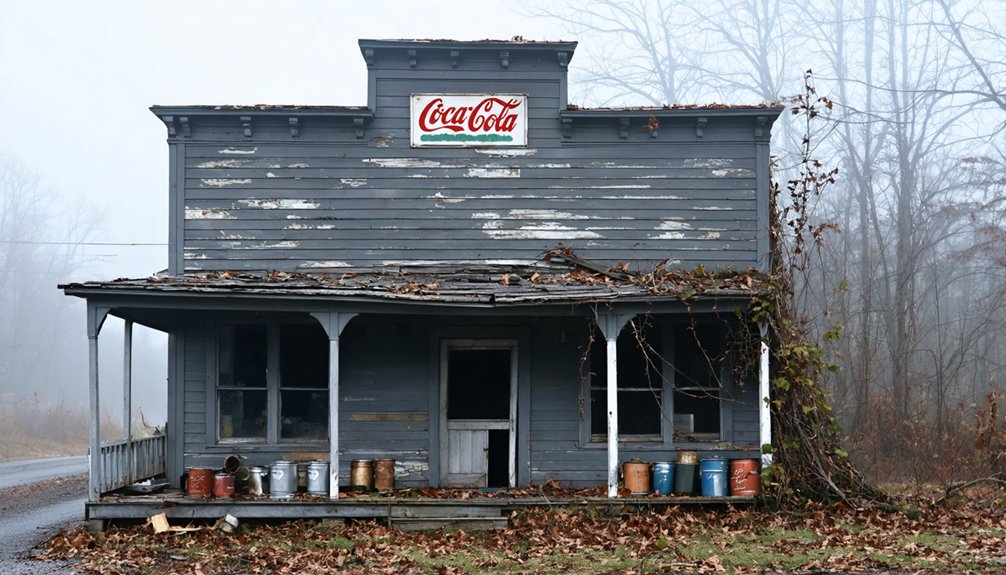
Parksville represents just one example among dozens of communities across New York State that experienced dramatic population booms followed by complete abandonment.
You’ll find Doodletown’s abandoned architecture scattered throughout Bear Mountain State Park, where 70 home foundations mark a settlement that housed 300 residents by 1945. The Palisades Interstate Park Commission systematically acquired this hamlet for ski slopes that never materialized, condemning remaining homes by 1962.
In the Adirondacks, Tahawus tells similar historical narratives of boom and bust, abandoned twice after failed mining ventures before its final closure in 1989.
Love Canal’s toxic contamination forced complete evacuation, creating another chapter in New York’s legacy of forsaken communities that once thrived with human ambition.
Exploring the Remnants: What Visitors Can See Today
While nature steadily reclaims these forgotten settlements, concrete evidence of their former inhabitants remains scattered across New York’s landscape for determined explorers to discover.
You’ll find ghostly architecture emerging from overgrown trails, revealing stories of communities lost to time.
Your exploration opportunities include:
- Doodletown’s concrete stairs – marking former house locations along hiking paths from Route 9W
- Tahawus mining structures – industrial ruins and worker housing foundations in the Adirondacks
- Nevele Grand’s decay – luxury hotel wreckage and graffiti-covered buildings since 2009
- Benson Mines’ equipment – rusted machinery and collapsed ore extraction structures
You’ll discover hidden artifacts around Onondaga Lake’s shoreline and stone foundations throughout these sites.
Each location offers tangible connections to New York’s abandoned past, accessible through hiking trails and Adirondack road routes.
Historical Significance of New York’s Ghost Towns
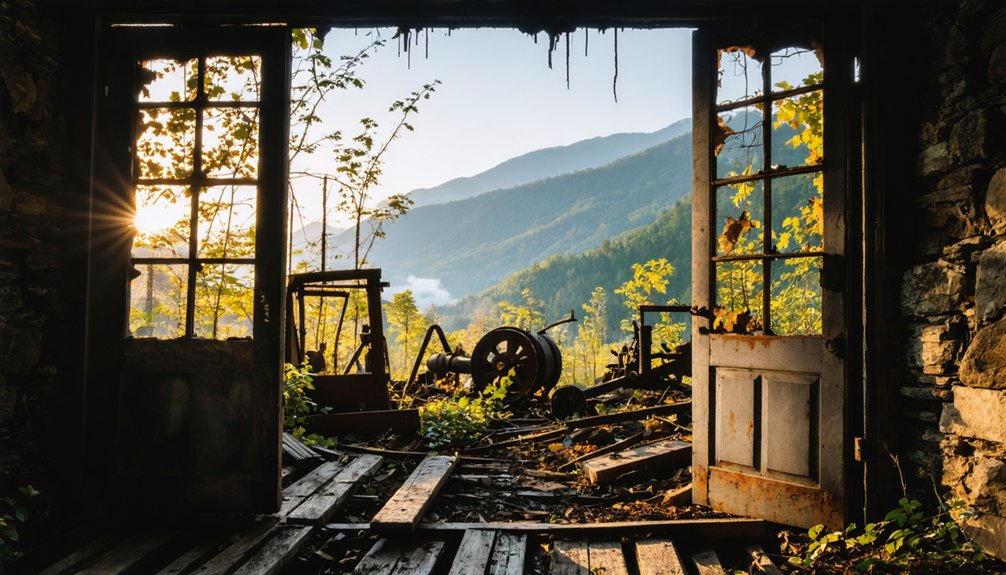
These towns reveal the economic impact of eminent domain abuse, where residents received below-market compensation and faced evacuation without appeal options.
Residents lost homes and livelihoods through government seizures offering pennies on the dollar with zero recourse for appeals.
Doodletown’s transformation from thriving settlement to state park demonstrates how government expansion displaced established communities.
The $15 grave disinterment fees and fixed city-set sums highlight systematic injustices against rural populations.
You’ll find these ghost towns preserve evidence of unchecked governmental power over individual property rights.
Preservation Efforts and Future of These Forgotten Places
Although these ghost towns represent tragic displacement, modern preservation efforts have transformed many sites into protected spaces that honor their historical legacy.
You’ll find extensive preservation strategies protecting water quality around Ashokan Reservoir while maintaining public access for recreation. State acquisition and nonprofit community engagement have revitalized formerly abandoned locations into educational destinations.
Current preservation initiatives include:
- Tahawus – Open Space Institute retained historic structures like the massive furnace, creating accessible trails with educational signage since 2003
- Frontier Town – $32 million state investment transforming abandoned amusement park into “Gateway to the Adirondacks” tourism hub
- Doodletown – Friends of Doodletown nonprofit maintains hiking access to visible foundations and concrete stairs
- Camp Santanoni – Nature Conservancy partnership transferred site to state Forest Preserve protection
Frequently Asked Questions
Are There Any Ghost Towns in New York That Are Still Inhabited?
Time’s erased inhabited ruins from New York’s ghost towns completely. You won’t find residents in Tahawus or Doodletown—they’re empty shells despite their historical significance. These abandoned settlements offer freedom to explore without encountering any current inhabitants whatsoever.
What Safety Precautions Should Visitors Take When Exploring These Abandoned Sites?
You’ll need essential exploration gear including respirators, flashlights, and protective clothing. Follow safety guidelines: obtain permission first, never explore alone, test structural stability, maintain clear exit paths, and wash thoroughly afterward.
Can You Legally Camp Overnight in New York’s Ghost Towns?
You can’t legally camp on private property ghost towns without permission, but 80% of New York’s abandoned settlements sit on state lands where camping regulations allow backcountry camping, preserving ghost town history through responsible exploration.
Exploring abandoned towns in upstate New York offers a unique glimpse into the past, as many structures remain untouched since their abandonment. Enthusiasts can discover fascinating stories and remnants of life from centuries ago, all while respecting the natural environment. Remember to tread lightly and leave no trace to ensure these historical sites remain intact for future generations to explore.
Which Ghost Town Is Easiest to Reach by Public Transportation?
You’ll find 91st Street Station most accessible for urban exploration via public transport access. Simply ride the 1 train between 86th and 96th streets—you’ll see the illuminated abandoned platform through windows without special maneuvers required.
Are There Guided Tours Available for Any of These Locations?
No formal ghost tours operate at these locations, though you’ll discover their historical significance independently. You’re free to explore Doodletown and Tahawus via self-guided trails, while North Brother Island remains completely restricted to public access.
References
- https://www.onlyinyourstate.com/experiences/new-york/ghost-towns-ny
- https://943litefm.com/abandoned-ghost-towns-new-york/
- https://lite987.com/11-ghost-towns-new-york-state/
- https://www.youtube.com/watch?v=Bv0fk_AeWpM
- https://www.atlasobscura.com/things-to-do/new-york-state/abandoned
- https://www.youtube.com/watch?v=Nw2j2-YSknU
- https://visitadirondacks.com/fall/abandoned-places-ghost-towns
- https://hauntedhistorytrail.com
- https://midatlanticdaytrips.com/2022/06/doodletown/
- https://www.atlasobscura.com/articles/new-york-ghost-town-growing-graveyards