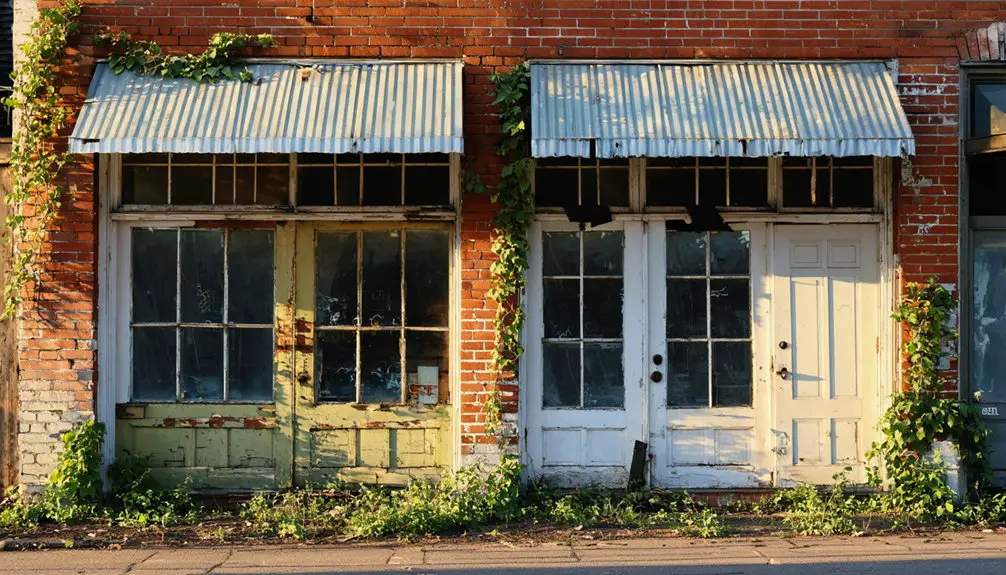
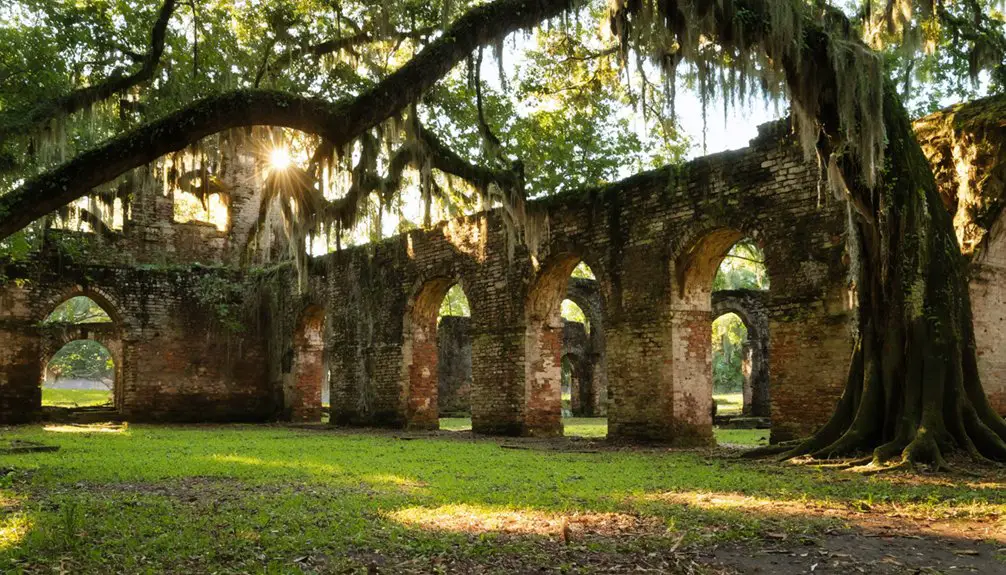
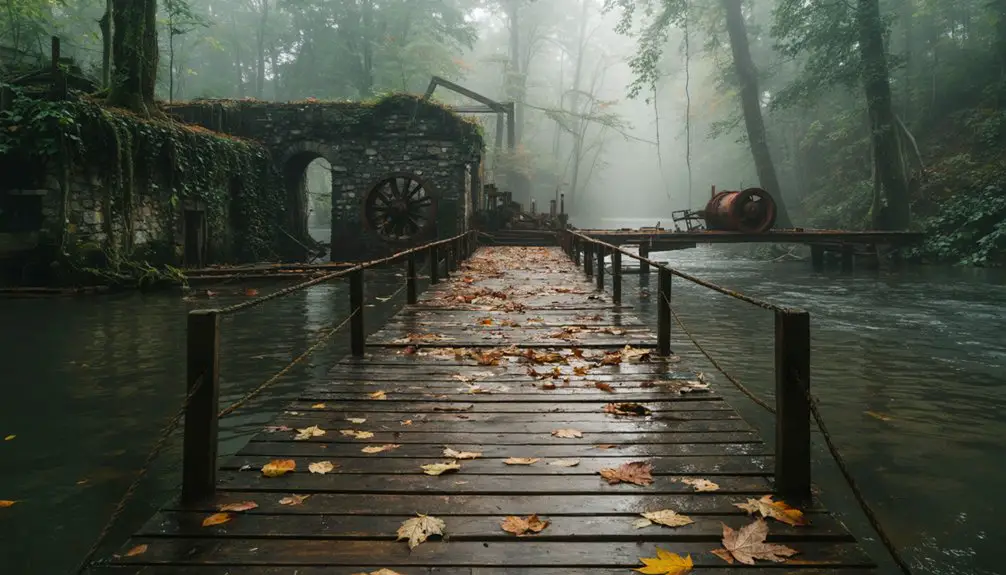
You’ll find North Carolina’s most famous ghost towns scattered from the coast to the mountains, each with unique stories of rise and abandonment. Brunswick Town served as the colonial capital before British forces burned it in 1776, while the mysterious Roanoke Colony vanished completely by 1590. Buffalo City thrived as a logging hub until 1954, and Henry River Mill Village gained modern fame as District 12 in The Hunger Games. These preserved sites offer fascinating glimpses into the state’s complex past.
Key Takeaways
- Roanoke Colony – America’s first English settlement (1587) where 115 colonists mysteriously vanished, leaving only “Croatoan” carved in a tree.
- Brunswick Town – North Carolina’s former capital (1743-1770) with preserved colonial ruins including St. Philips Church and Confederate fortifications.
- Henry River Mill Village – Famous as District 12 filming location in The Hunger Games, now listed on National Register of Historic Places.
- Diamond City – Coastal town destroyed by catastrophic hurricanes in 1899, with cemetery and home remnants still visible at Shackleford Banks.
- Buffalo City – Logging boom town founded by Russian immigrants in 1888, later turned to bootlegging before complete abandonment in 1954.
Brunswick Town: From Colonial Capital to Revolutionary War Ruins
When Colonel Maurice Moore established the first permanent European settlement on the Lower Cape Fear River in 1725, he couldn’t have predicted that his 1,500-acre grant would become one of North Carolina’s most significant colonial capitals.
Named after George I, Brunswick Town served as North Carolina’s de facto capital from 1743-1770 when royal governors resided at nearby Russellborough plantation.
Brunswick Town held the distinction of North Carolina’s unofficial capital for nearly three decades during the height of royal colonial rule.
You’ll discover this bustling port exported tobacco, lumber, and naval stores throughout the colonial period.
The town’s prosperity attracted merchants and planters until the Revolutionary War devastated everything.
British forces partially burned Brunswick in 1776, leaving behind ruins where you can now explore preserved colonial architecture and revolutionary artifacts. The surviving ruins include St. Philips Church with its distinctive thick brick walls. Confederate forces later built earthen fortifications over parts of the original town during the Civil War.
Today’s archaeological excavations reveal the dramatic rise and fall of this once-thriving political center.
Buffalo City: The Lost Logging Community of Great Dismal Swamp
While Brunswick Town’s ruins tell the story of colonial politics and revolutionary destruction, North Carolina’s swamplands hide an entirely different kind of lost settlement.
You’ll find Buffalo City‘s story begins in 1888, when Buffalo City Mills purchased over 100,000 acres in Dare County for massive timber operations. They imported Russian immigrants and African American laborers who built a thriving community from scratch in the swamps, creating the region’s largest logging operation by 1900.
When timber declined after WWI, residents embraced bootlegging during Prohibition. The town’s isolation and waterways made it perfect for moonshine culture, earning it a reputation as the world’s moonshine capital. Moonshiners used trotlines to hide whiskey jugs from federal revenuers patrolling the waterways.
Like other lost North Carolina towns, Buffalo City faced the challenge of grave relocation when its final remnants were abandoned, similar to how Buffalo in Whiteside Valley had to move its cemetery before Lake Lure’s creation.
This logging legacy ended completely by 1954, leaving nothing but memories in what’s now Alligator River National Wildlife Refuge.
Henry River Mill Village: Hollywood’s Dystopian District 12
You’ll recognize Henry River Mill Village as the fictional District 12 from The Hunger Games (2012), where its abandoned textile mill houses provided the perfect dystopian backdrop for the blockbuster film.
The village’s Hollywood fame sparked renewed interest in preserving this authentic piece of Southern industrial history, leading to its addition to the National Register of Historic Places on May 9, 2019. Workers once lived in 35 worker homes that housed families employed at the cotton mill until its closure in the 1960s. The Calvin Reyes family purchased the property in 2017 and now welcomes tourists from around the world to explore this unique destination.
You can visit this remarkable site that bridges entertainment and historical preservation, offering both a glimpse into North Carolina’s textile past and a connection to modern cinema.
Hunger Games Filming Location
The Henry River Mill Village transformed from a forgotten North Carolina ghost town into Hollywood’s vision of dystopian District 12 when filmmakers selected it as the primary filming location for the first Hunger Games movie.
You’ll find that this abandoned textile mill village perfectly embodied Katniss Everdeen’s impoverished home district without requiring extensive set construction. The crumbling worker houses, deteriorating company store, and desolate industrial remnants created an authentic post-apocalyptic atmosphere that captivated audiences worldwide.
Hollywood’s choice proved prescient – the village’s isolation and decay naturally resembled the oppressive coal-mining district described in Suzanne Collins’ novels. The village was originally established in 1905 by the Aderholdt and Rudisill families who founded the Henry River Manufacturing Company for cotton yarn production.
The mill operations initially relied on water power before later transitioning to steam and electricity as technology advanced. Following the film’s success, Henry River Mill Village gained national recognition, earning placement on the National Register of Historic Places on May 9, 2019, cementing its cultural significance beyond North Carolina’s textile heritage.
Historic Preservation Efforts
Despite its Hollywood fame, Henry River Mill Village‘s preservation journey began long before cameras rolled, tracing back to 1905 when the Aderholdt and Rudisill families established this textile community on a 1,500-acre tract along the Henry River.
You’ll find that serious heritage conservation efforts started after new owners purchased the abandoned village in 1976, committing to preserve as much as possible despite the devastating 1977 lightning fire.
Today’s preservation strategy emphasizes authenticity—you won’t find modern utilities restored to the remaining structures.
The owners balance community engagement through limited Saturday visits and special events while maintaining safety protocols due to deteriorating floors. Of the approximately 35 original worker cottages built for the textile community, 20 still stand today as testament to the village’s industrial heritage.
Plans for the community include transforming the company store into a restaurant and creating a museum to showcase the village’s textile manufacturing history.
Their vision keeps tangible history accessible through sight, touch, and sound, earning National Register recognition in 2019.
Diamond City: Hurricane-Devastated Fishing Village of the Outer Banks
You’ll find Diamond City’s tragic end began with the catastrophic San Ciriaco Hurricane that struck Shackleford Banks on August 18, 1899, forcing the complete evacuation of this once-thriving fishing community of nearly 500 residents.
The devastating storm rendered the area uninhabitable by destroying the maritime forest and burying the settlement under encroaching sand, marking the final blow after previous hurricanes in 1878, 1879, and 1897 had already weakened the community.
1899 Hurricane Destruction
When Cape Lookout Lighthouse‘s distinctive black-and-white diamond pattern inspired Joe Etheridge to suggest the name “Diamond City” around 1885, residents couldn’t have predicted that devastating hurricanes would soon transform their thriving community into North Carolina’s most famous weather-related ghost town.
Hurricane impacts began battering Cape Banks through a relentless series of storms in 1878, 1879, and 1897. However, the community’s resilience kept Diamond City functioning until 1899’s catastrophic double strike.
The San Ciriaco Storm on August 18, 1899—the strongest hurricane landfall on the Outer Banks since—swept away the large protective dune that had shielded the settlement. Maritime forests declined rapidly as sand encroached over the greenery, rendering the area uninhabitable.
Coastal Ruins Today
Today, Shackleford Banks remains largely undeveloped as part of Cape Lookout National Seashore, where visitors can explore the haunting remnants of Diamond City’s former glory.
You’ll find traces of at least five cemeteries scattered across the windswept landscape, though most bodies were relocated when families departed between 1899 and 1902. The maritime history echoes through foundation remnants and scattered debris from homes that once housed 500 residents.
You can only reach this coastal heritage site by boat or ferry, maintaining its wild isolation. Walking these banks, you’ll discover where residents once salvaged shipwrecked lumber and built thriving fishing communities.
The Cape Lookout Lighthouse still stands nearby, its black and white diamonds inspiring the settlement’s final name.
Roanoke Colony: America’s Most Mysterious Lost Settlement
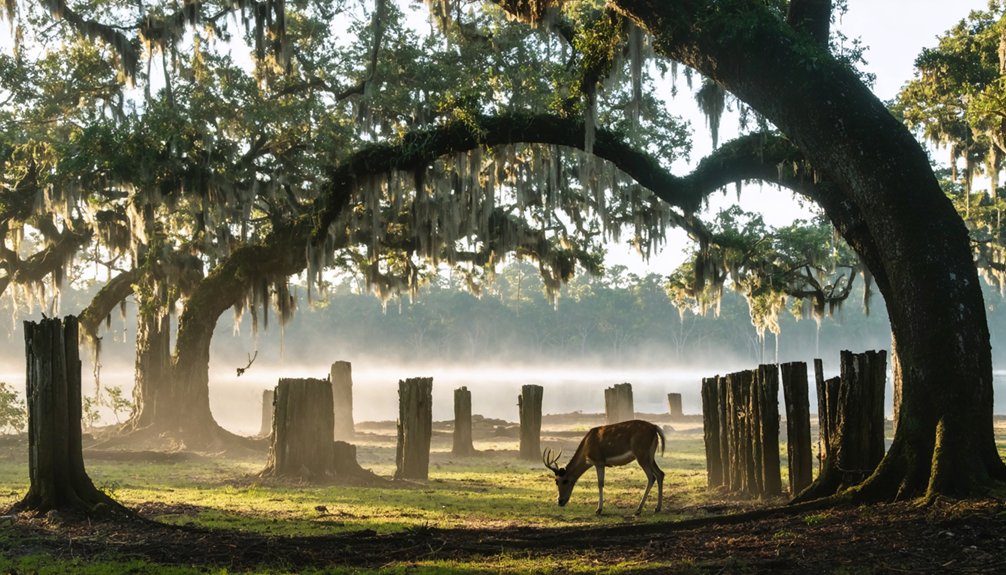
While North Carolina hosts numerous abandoned settlements, none captures the imagination quite like the Roanoke Colony, America’s first English settlement that vanished without a trace.
You’re standing where 115 colonists mysteriously disappeared between 1587 and 1590, leaving only the word “Croatoan” carved into a tree.
Sir Walter Raleigh’s ambitious venture began in 1585, but the second attempt under John White’s leadership became the ultimate Roanoke mystery.
When White returned from England in 1590, he found dismantled houses but no distress signals. The Lost colonists likely relocated during the severe 1587-1589 drought, possibly assimilating with the Roanoke-Hatteras Tribe on Croatoan Island.
- First English child born in America (Virginia Dare) lived here
- Extreme drought lasting three years contributed to abandonment
- “Croatoan” inscription remains the only clue to their fate
- Modern archaeological efforts continue searching for answers
Mortimer: The Mill Town Destroyed by Flood
Deep in North Carolina’s western highlands lies Mortimer, a demonstration of nature’s devastating power over human ambition. Ritter Lumber Company founded this mill town in 1904, rapidly building state-of-the-art facilities and housing for 800 workers.
You’ll find this wasn’t just another company town—it featured modern amenities like electricity, plumbing, and even a motion-picture facility.
Disaster struck in 1916 when fire and flood devastated the community, killing 80 people and forcing Ritter Lumber’s abandonment. Community resilience emerged when Cotton Mills Company revived operations in 1922, with FDR’s Civilian Conservation Corps later rebuilding infrastructure.
However, a second catastrophic flood in 1940 permanently ended Mortimer’s story.
Today, you can explore its ruins within Pisgah National Forest, where collapsed buildings and rusted machinery tell tales of ambition meeting nature’s fury.
Exploring North Carolina’s Abandoned Places: What Visitors Can Expect
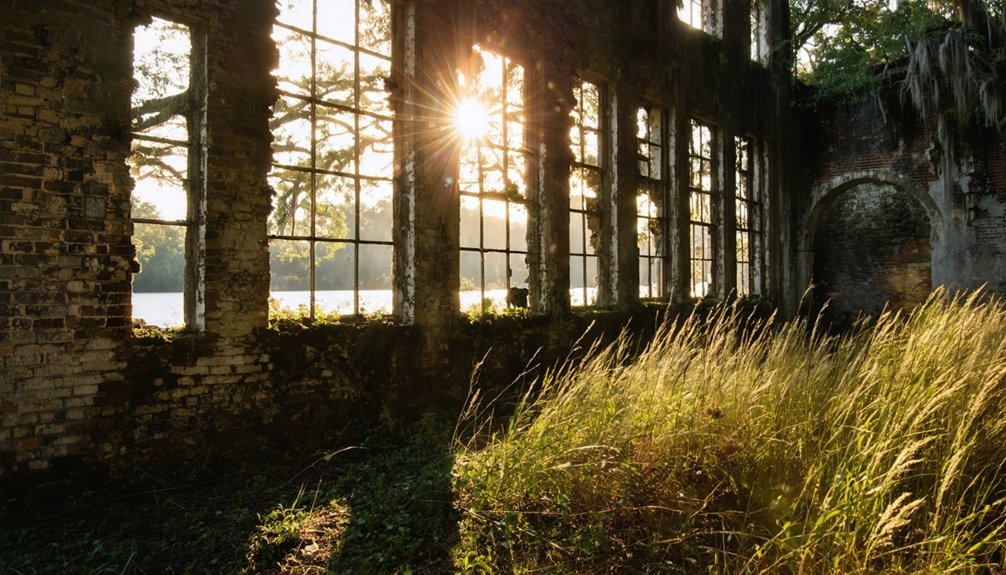
Mortimer’s story represents just one chapter in North Carolina’s collection of abandoned places that continue to captivate modern explorers.
You’ll discover diverse experiences across the state’s forgotten locations, from guided tours through Henry River Mill Village’s Hunger Games filming locations to ferry rides accessing Cape Lookout’s preserved fishing village. Each site offers unique glimpses into historical narratives spanning cotton mills, coastal communities, and frontier settlements.
The abandoned architecture reveals different preservation states—some locations like Fort Dobbs feature reconstructed buildings with interactive exhibits, while others like Umstead Park’s ruins showcase nature’s reclamation process.
You can explore overgrown graveyards, peer through empty windows revealing past inhabitants’ belongings, or walk among weathered stone walls.
- Book official tours for structured historical experiences
- Respect private property boundaries and access restrictions
- Visit during appropriate seasons for ferry-accessible locations
- Prepare for varying terrain from wooded trails to coastal environments
Preservation Efforts and Historical Significance of These Ghost Towns
As North Carolina’s ghost towns face threats from development and natural decay, preservation efforts have emerged to protect their historical significance for future generations.
Efforts to document abandoned sites in North Carolina have also gained traction, drawing attention from historians and enthusiasts alike. These locations serve as reminders of the state’s rich past and the stories that shaped its communities. By focusing on the preservation of these sites, advocates hope to revitalize interest in North Carolina’s historical narrative.
You’ll find remarkable community resilience in places like Cataloochee Valley, where the National Park Service preserved buildings as time capsules after relocating 1,200 residents in the 1930s.
The Southern Appalachian Highlands Conservancy purchased Lost Cove’s 95-acre portion in 2012, transferring it to Pisgah National Forest for permanent protection.
Coleridge earned National Register status in 1976 as the best-preserved textile mill village example.
These efforts safeguard cultural heritage representing Civil War-era settlements, thriving agricultural communities, and industrial textile operations that shaped Appalachian identity and mountain independence.
Frequently Asked Questions
Are There Any Other Notable Ghost Towns in North Carolina Not Mentioned Here?
Yes, you’ll find Portsmouth Village on the Outer Banks, Henry River Mill Village, and Buffalo City in the Great Dismal Swamp. Their historical significance drives preservation efforts protecting these abandoned communities from complete decay.
What Safety Precautions Should Visitors Take When Exploring These Abandoned Sites?
You’ll need proper safety gear including sturdy boots, flashlights, and first aid supplies. Maintain wildlife awareness for snakes and insects. Check permissions first, avoid unstable structures, and never explore alone in these remote locations.
Do Any of These Ghost Towns Have Reported Paranormal Activity or Hauntings?
You’ll find haunted legends surrounding Brunswick Town, where visitors report unseen presences watching them. Roanoke Colony’s mysterious disappearance fuels ghostly encounters stories, while these sites’ tragic histories naturally generate paranormal activity reports from explorers.
Which Ghost Towns Require Special Permits or Guided Tours to Visit?
You’ll need special permits for Lost Cove’s guided exploration and Lower Ghost Town’s climbing access. Buck Mountain requires development permits. Most national forest ghost towns mandate permit requirements for groups exceeding seventy-five people or commercial activities.
What’s the Best Time of Year to Visit North Carolina’s Ghost Towns?
You’ll find autumn offers the best ghost town exploration with comfortable seasonal weather in the 50s-60s. The brilliant autumn foliage creates stunning backdrops while cool temperatures let you hike extensively without crowds or extreme heat.
References
- https://www.onlyinyourstate.com/experiences/north-carolina/nc-ghost-towns
- https://kids.kiddle.co/List_of_ghost_towns_in_North_Carolina
- https://www.youtube.com/watch?v=iWhjTfCyUpY
- https://www.visitnc.com/list/ncs-mysterious-disappearances-and-abandoned-places
- https://www.atlasobscura.com/things-to-do/north-carolina/ghost-towns
- https://www.ncpedia.org/brunswick-town
- https://www.wherethedogwoodblooms.com/brunswick-town/
- https://americannomadtraveler.com/2025/04/29/brunswick-town-nc-revolutionary-history/
- https://en.wikipedia.org/wiki/Brunswick_Town
- https://pastlanetravels.com/colonial-ruins-of-brunswick-town-nc/