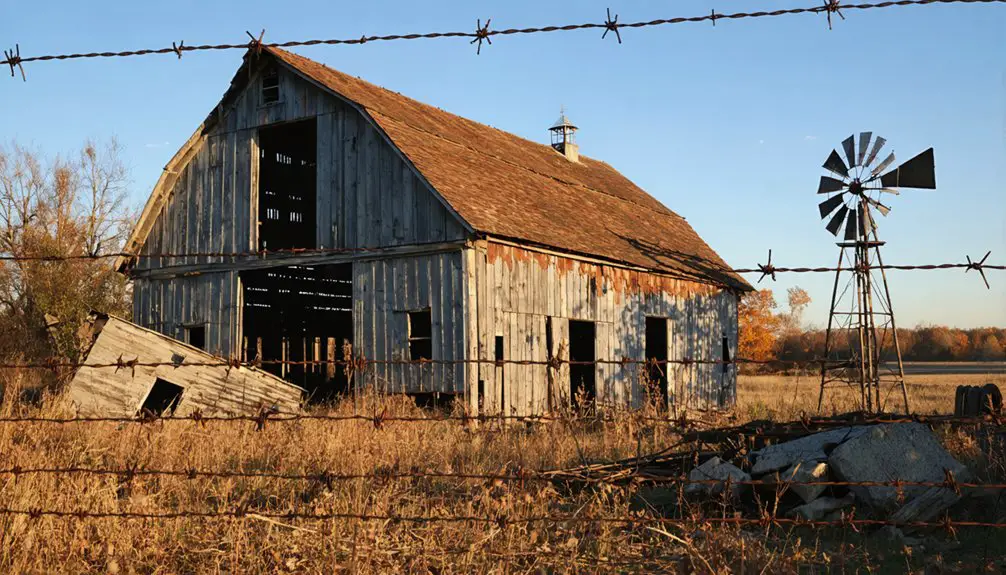
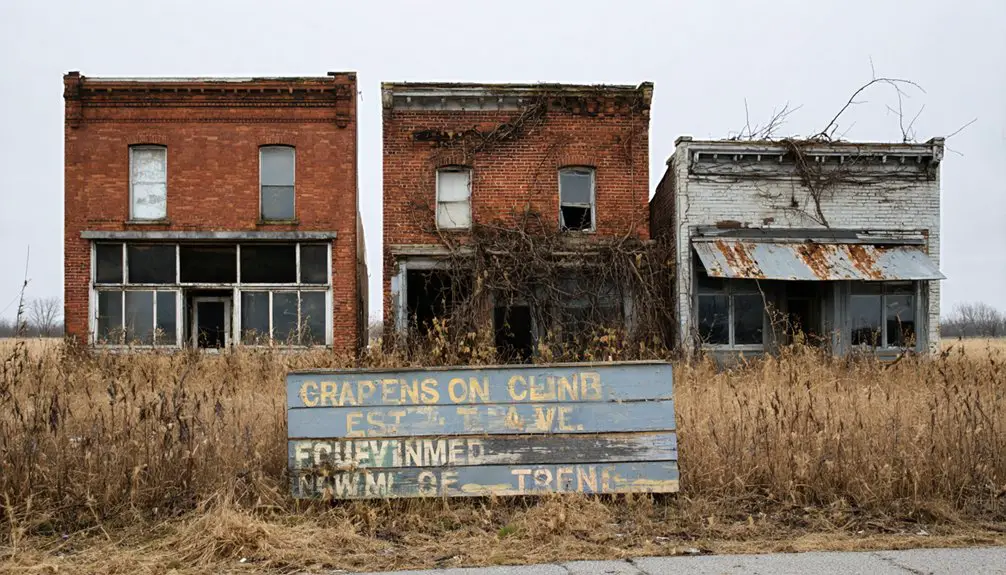
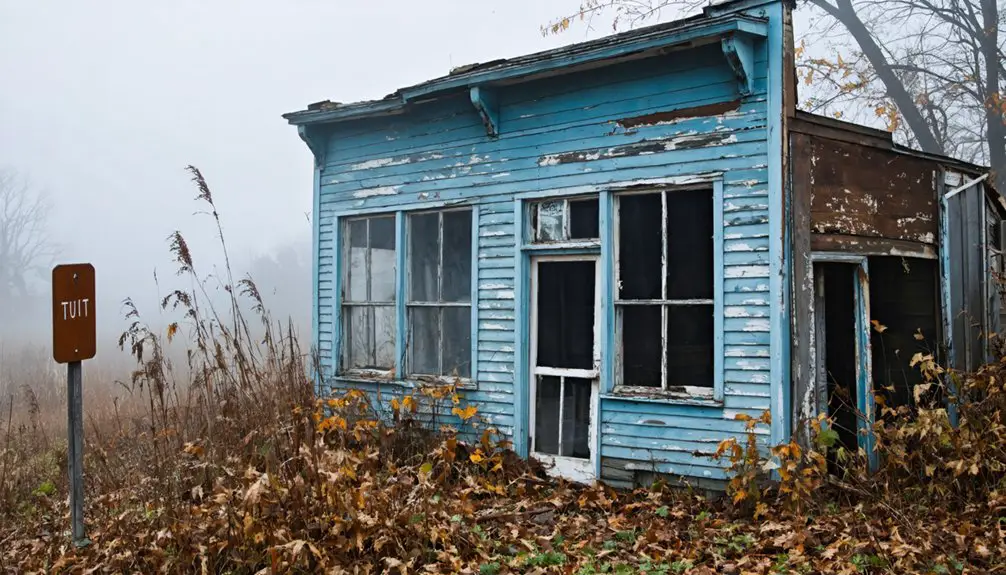
You’ll find Ohio’s most famous ghost towns scattered across the state’s southeastern region, where coal mining and railroad industries once thrived. Moonville stands out as the most haunted, with its tunnel witnessing 27 deaths since 1856. Helltown earned notoriety when the government seized an entire community in the 1970s for parkland. San Toy housed nearly 1,000 coal miners before violent labor disputes emptied it in 1924. These abandoned settlements reveal fascinating stories of prosperity turned to ruin.
Key Takeaways
- Moonville – A haunted railroad town established in 1856, abandoned by the 1940s with 27 documented deaths at its tunnel.
- Helltown – Boston Village was acquired by the government in the 1970s for Cuyahoga Valley National Park, creating Ohio’s most notorious ghost town.
- San Toy – A coal mining boomtown established in 1900 that peaked at 1,000 residents before violent labor disputes in 1924.
- Claylick – A town completely erased by devastating floods in 1919 and 1959, later submerged under Dillon Dam reservoir waters.
- Haydenville – Ohio’s last company-owned town from 1852, now on the National Register preserving authentic coal mining heritage and architecture.
Moonville: The Haunted Railroad Town
When the Cincinnati and Marietta Railroad established Moonville Station around 1856, they created what would become one of Ohio’s most notorious ghost towns.
You’ll find this abandoned settlement in Hocking Hills, where coal mining operations once sustained 100 residents until the last family departed in 1947.
The narrow Moonville Tunnel became a death trap where an estimated 27 people died, including engineer Theodore Lawhead in an 1880s collision and a brakeman crushed in 1859.
These tragedies spawned enduring Moonville legends that continue today. The haunted history includes sightings of Lawhead’s ghost carrying a lantern through the tunnel and the murdered town bully “Baldie” lurking above. The town’s supernatural reputation draws thousands of visitors to the annual Midnight at Moonville festival each October, celebrating both ghost stories and Appalachian heritage.
You can explore the remaining tunnel, cemetery, and foundations along the converted Moonville Rail Trail. The area also featured a school and depot that served the thriving railroad community during its peak years.
Helltown: Ohio’s Most Notorious Abandoned Settlement
Though settlers established Boston Village in 1806 as Summit County’s first community, the area you’ll encounter today bears little resemblance to its prosperous past.
What remains of Summit County’s oldest settlement tells a haunting story of abandonment and decay.
The Ohio & Erie Canal and mills once sustained thriving neighborhoods until the 1970s, when government agents acquired properties for Cuyahoga Valley National Park through questionable tactics later deemed illegal.
You’ll find boarded houses and burned foundations scattered throughout the overgrown landscape. These abandoned remnants spawned numerous Helltown legends, including tales of Satanist churches, mutant snakes from chemical spills, and haunted school buses. The Boston Cemetery lies deep within the area, where local folklore tells of a ghost waiting on a bench for his family to return.
While investigations debunked these supernatural claims—revealing architectural features mistaken for occult symbols and practical road closures—the eerie atmosphere persists. Residents experienced emotional devastation as they lost their homes and belongings when the National Park Service destroyed structures to create natural areas.
The settlement’s transformation from Boston Mills to “Helltown” demonstrates how forced displacement can birth enduring folklore.
Claylick: Washed Away by Devastating Floods
You’ll find Claylick’s story among Ohio’s most dramatic town disappearances, where two catastrophic floods in 1919 and 1959 completely erased this Licking County settlement from existence.
The town sat at the dangerous intersection of Claylick and Licking River, making it vulnerable to the devastating water events that would ultimately destroy every structure and force final evacuation of all residents.
Today, you can’t visit any remnants of Claylick because the subsequent Dillon Dam project permanently submerged the entire townsite under controlled reservoir waters. This complete removal reflects how natural disasters and infrastructure projects can erase communities from the landscape, leaving only historical records of their existence.
Similarly, Ohio’s Utopia settlement faced flood destruction in December 1847 when leaders ignored local warnings and moved their town hall to the river’s edge just days before catastrophic flooding swept many residents away.
Historic Town Before Floods
Before devastating floods transformed it into Ohio’s most tragic ghost town, Claylick thrived as a bustling community at the strategic junction of Claylick Creek and the Licking River in Licking County.
You’d have found one of the region’s largest settlements here, where established buildings and residences dotted the landscape. The town’s historic significance stemmed from its advantageous position along these waterways, which initially fueled its development and growth.
Residents built their lives around the natural creek and river features that would later prove catastrophic. The community’s population and infrastructure reached their peak before the first devastating flood struck in 1919.
Despite the low-lying terrain’s inherent flood risks, Claylick’s community resilience allowed it to recover and continue functioning as a thriving settlement until nature ultimately claimed victory. The town faced a second devastating flood in 1959 that completed its destruction, with the subsequent Dillon Dam floodplain project ensuring Claylick would never be rebuilt. Ohio has a long history of devastating floods, with the Great Flood of 1913 serving as the most catastrophic example in the state’s recorded history.
Double Disaster and Demolition
While Claylick had weathered minor flooding throughout its history, the catastrophic flood of 1919 marked the beginning of the town’s ultimate demise. The Licking River’s overflow devastated structures and displaced residents, setting a precedent for future vulnerability.
Despite attempts at town resilience, the 1959 flood delivered the final blow, surpassing all historical records in the region. Emergency services were completely overwhelmed by the unprecedented scale of destruction across the area.
The destruction unfolded through these devastating stages:
- 1919 flood destroyed majority of downtown buildings and infrastructure
- Forty years of struggling rebuilding efforts proved insufficient
- 1959 flood completed what the first disaster had begun
- Dillon Dam project required complete town clearance for flood mitigation
- Final demolitions eliminated all remaining structures permanently
Similar catastrophic flooding occurred throughout Ohio during this era, with the 1913 flood claiming nearly 500 lives statewide and completely erasing entire communities from existence. Unlike single-disaster abandonments, Claylick’s double devastation created insurmountable challenges, transforming this once-thriving community into Ohio’s most flood-ravaged ghost town.
San Toy: Rise and Fall of a Coal Mining Community
You’ll find San Toy’s story mirrors the explosive growth and violent collapse that defined Ohio’s coal mining era from 1870 to 1925.
This Perry County town reached nearly 1,000 residents during its peak years, but earned notoriety as the most violent of Ohio’s short-lived coal communities due to dangerous working conditions and bitter labor disputes.
Today, you can explore the eerie remnants of this once-thriving settlement, including the old jailhouse and collapsed mine entrances that mark its turbulent mining legacy.
Coal Boom Peak Years
When the Sunday Creek Coal Company established San Toy in 1900, they created what would become one of Ohio’s most notorious coal mining boomtowns in the northern reaches of the Hanging Rock Region.
You’d witness the economic impacts of coal prosperity as San Toy’s population exploded to nearly 1,000 residents. The thriving community developed essential community structures that defined successful mining towns:
- Hospital providing medical care for dangerous mining work
- Theater offering entertainment for hardworking miners
- Jail positioned at Santoy Road and Highway 452 intersection
- Dense worker housing supporting active mining shafts
- Law enforcement maintaining order in the rough environment
The town’s wild west atmosphere embodied southeastern Ohio’s coal boom mentality.
Sunday Creek Coal Company’s investments created jobs that became central to community prosperity throughout the early 1900s, establishing San Toy as a roller coaster economy until the pre-1920s decline.
Labor Disputes and Violence
As San Toy’s reputation for lawlessness grew throughout the early 1900s, the mining community earned notoriety as Ohio’s most violent and colorful coal town.
You’d find yourself in what locals described as a “wild west” environment in southeastern Ohio, where maintaining law and order proved challenging in this densely populated area. The town’s old jailhouse at the intersection of Santoy Road and Township Highway 452 stood as a monument to these lawless mining days.
Labor strikes and violent clashes reached their peak in 1924 when disgruntled workers pushed a cart of flaming logs into the mine shaft during a heated labor dispute.
This destructive act destroyed the mine, hospital, and theater, marking the climax of years of mounting labor tensions that would ultimately seal the town’s fate.
Visible Ruins Today
Today, San Toy’s remnants tell the story of Ohio’s turbulent coal mining past through scattered ruins and crumbling foundations hidden within Perry County’s wooded landscape.
You’ll discover ghostly remnants of what once housed nearly 1,000 residents during the Hocking Valley coal boom. These weathered structures serve as silent witnesses to Ohio’s mining history.
When you explore the area, you’ll find:
- The old jailhouse standing as the most recognizable structure
- Collapsed mine entrances scattered throughout the woods
- Crumbling foundations marking former residential areas
- Remnants of roads that once connected the bustling community
- Scarred hillsides still bearing evidence of extensive clear-cutting operations
These eerie remains offer tangible connections to San Toy’s lawless mining days before its official abandonment in 1931.
Sprucevale: Canal Era Remnants and Gretchen’s Lock
Deep within what’s now Beaver Creek State Park, the remnants of Sprucevale tell the story of Ohio’s ambitious but ultimately failed canal era.
You’ll find traces of this 1837 settlement established by the Hambleton brothers along the Sandy and Beaver Canal, which suffered from chronic water shortages despite twenty years of construction.
While exploring Sprucevale history, you can discover Gaston’s Mill-Lock No. 36 and Hambleton Mill remnants scattered through the eastern Ohio woods.
The most intriguing feature remains Gretchen’s Lock, where local legend speaks of Gretchen’s ghost haunting the canal network.
This paranormal tale, documented in “Haunted Ohio,” connects you to the broader ghost stories emerging from Ohio’s deserted canal towns, making Sprucevale a compelling destination for both history enthusiasts and paranormal investigators seeking authentic frontier experiences.
Haydenville: Forgotten Mining Heritage in Hocking Hills
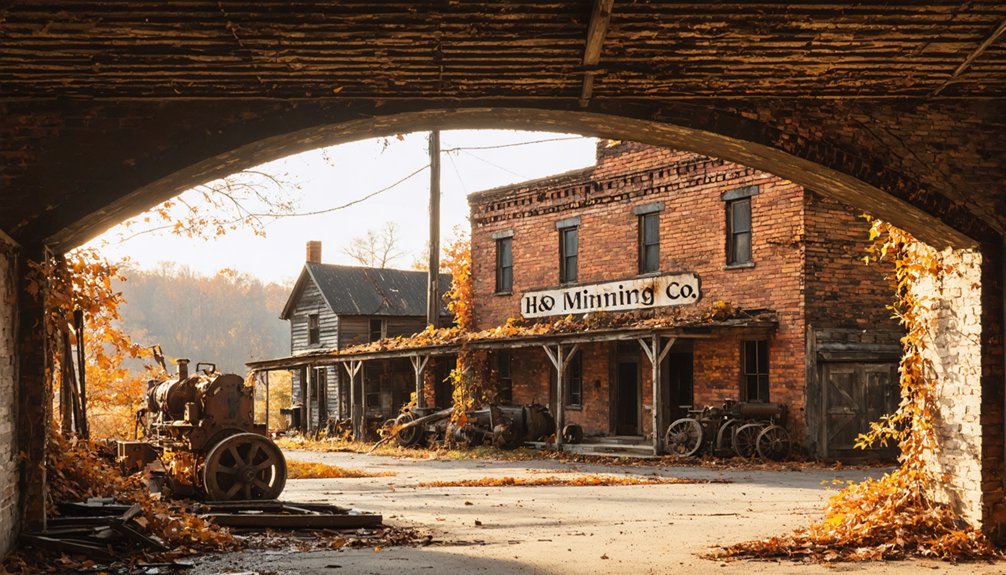
Nestled in the scenic Hocking Hills, Haydenville stands as Ohio’s last company-owned town, where Peter Hayden’s 1852 vision created a unique industrial community originally known as Hocking Furnace.
Ohio’s last company-owned town preserves Peter Hayden’s 1852 industrial vision in the beautiful Hocking Hills region.
This remarkable settlement showcases authentic mining heritage through its perfectly preserved company town architecture.
You’ll discover Haydenville history through:
- Coal mining operations that dominated the Hocking Valley industry
- Fire clay extraction for manufacturing bricks and ceramic tiles
- Company-owned housing where workers lived in industrial-designed homes
- The eerie Haydenville Tunnel offering atmospheric railroad remnants
- Historic brick structures built entirely from company-produced materials
The Haydenville Mining and Manufacturing Company controlled everything until operations ceased in 1964.
Now listed on the National Register of Historic Places, you can explore this forgotten mining legacy that perfectly captures Ohio’s industrial past.
Exploring Ohio’s Abandoned Railroad Communities
You’ll discover Ohio’s railroad ghost towns scattered across counties where coal mining and transportation once thrived from the 1850s through the mid-20th century.
These abandoned communities like Moonville, Oreton Station, and stops along the Millersburg Branch offer tangible remnants of America’s industrial railroad era, including sealed tunnels, overgrown tracks, and crumbling station foundations.
You can still access many of these forgotten rail corridors today, where deteriorating infrastructure tells the story of towns that vanished when the trains stopped running.
Moonville’s Haunted Rail Legacy
Among Ohio’s most haunting railroad relics, Moonville stands as a monument to the boom-and-bust cycle that shaped countless mining communities across the Hocking Hills.
You’ll discover a place where railroad history intersects with persistent legends of ghostly encounters spanning over a century.
The Cincinnati and Marietta Railroad’s single track created deadly conditions through this isolated terrain.
You can trace the tragic timeline:
- 27 documented deaths along the tracks from 1856-1960
- Head-on collision killing Engineer Theodore Lawhead in the 1880s
- 1859 brakeman crushed beneath train wheels
- Heavy woods muffling train sounds, surprising pedestrians
- Phantom trainmen causing emergency stops until 1981
Today, you’ll find only the tunnel remains, where visitors report lantern-carrying spirits of railroad workers who met their fate on these dangerous tracks.
Railroad Infrastructure Remains Today
Across Ohio’s landscape, remnants of over 4,000 miles of abandoned railroad infrastructure tell the story of communities that once thrived around coal mining, quarrying, and freight transportation.
You’ll discover railroad relics in Negley, where the Youngstown & Southern Railroad’s Smith’s Ferry Branch terminated at a coal camp. The Powers Mining Company’s 1867 store, once the world’s largest, now houses antiques among infrastructure remnants.
Near Cleveland, you can explore the defunct Euclid line that hauled bluestone from 1883-1967, connecting quarries to the Nickel Plate Road.
The Hudson-Columbus route, abandoned after 1969 flooding, showcases Pennsylvania Railroad history. In the Overton valley, Baltimore and Ohio’s Millersburg Branch offers century-old relics.
These abandoned networks represent Ohio’s dramatic rail reduction since the 1920s, leaving ghost towns scattered across forgotten corridors.
Accessing Abandoned Train Routes
While many abandoned railroad routes have become inaccessible due to private ownership and development, several Ohio ghost towns still offer entry points for exploring their rail heritage.
You can trace these historical corridors that once connected thriving communities to major transportation networks.
Access points for exploring paths include:
- Negley’s former rail terminus – Now integrated into the antique store property where Smith’s Ferry Branch terminated
- Euclid Creek watershed trail – Follow the natural corridor near Nine-Mile Creek and Green Road
- Hudson-Columbus PRR corridors – Remnants accessible through former Pennsylvania Railroad right-of-way
- Bradford’s rail-influenced streets – Historical markers guide you through Darke County’s railroad heritage
- Fostoria’s intersection points – Multiple historical rail paths visible within current town layout
These routes reveal the historical significance of Ohio’s railroad-dependent communities.
Natural Disasters That Erased Entire Towns
Ohio’s geography has made many settlements vulnerable to catastrophic flooding, and several thriving communities disappeared entirely when rivers reclaimed the land.
You’ll find Claylick was one of the largest towns destroyed this way—floods struck in 1919 and 1959 before the Dillon Dam project completed its erasure.
Atwood faced abandonment when flood control efforts required building Atwood Lake directly over the townsite.
Flood control projects sometimes sacrifice entire communities, with towns deliberately submerged beneath new reservoirs to protect distant settlements downstream.
Elk Lick vanished beneath William H. Harsha Lake’s waters when engineers constructed the dam for flood management.
Utopia represents a different tragedy—founded as an ambitious social experiment, repeated floods broke settlers’ spirits and drove them away permanently.
Despite modern flood control systems, these stories demonstrate how community resilience means nothing against nature’s overwhelming power when rivers decide to reclaim their territory.
Coal Mining Ghost Towns Across Southeast Ohio

When coal companies discovered rich veins beneath southeast Ohio’s rolling hills in the late 1800s, they built entire communities around their mining operations.
These coal mining settlements transformed from bustling towns into ghost towns when the resources dried up or market demands shifted.
You’ll find remnants of over 50 communities scattered across Athens, Hocking, Perry, and Morgan counties:
- Moonville – Railroad-dependent town abandoned by the 1940s, leaving only a tunnel and ghostly legends
- San Toy – Nearly 1,000 residents fled after a violent 1924 labor dispute destroyed key buildings
- Orbiston – Iron furnace town that declined with the industry by 1915
- Olive Furnace – Coal and iron community spanning 3,600 acres
- Vinton Furnace – Stone remnants hidden in protected forest
These ghost towns represent Ohio’s industrial heritage frozen in time.
Visiting Ohio’s Most Accessible Ghost Town Sites
Where can you explore Ohio’s ghost towns without venturing deep into remote wilderness? Several abandoned settlements offer convenient access for ghost town exploration while maintaining their historical significance.
Local guides often organize special ghost towns of Ohio events that highlight the unique stories behind these forgotten places. Participants can engage in historical reenactments, guided tours, and photography excursions, all designed to bring the past back to life. Whether you’re a history buff or simply looking for a new adventure, these events provide a captivating way to experience Ohio’s hidden heritage.
Boston Mills in Cuyahoga Valley National Park provides the easiest access via park roads. You’ll find remnants of this 1806 mill town at Boston Mills Road and Main Street, including the Boston Community Church.
Sprucevale offers roadside access on Sprucevale Road in Columbiana County. This 1835 canal town features visible lock ruins, particularly the famous Gretchen’s Lock.
Shaker Village sits along Oxford Road in Hamilton County, where you can explore ruins on foot from the roadside.
Meanwhile, Fallsville requires a short hike from Careytown Road’s gravel parking area to reach its waterfall and town remnants.
Frequently Asked Questions
Are There Any Guided Tours Available for Ohio’s Ghost Towns?
Like scattered breadcrumbs through history, you’ll find limited guided exploration options. Ohio Ghost Town Exploration Co researches abandoned settlements but doesn’t offer specific tours, leaving you to discover their historical significance independently.
What Safety Precautions Should Visitors Take When Exploring Abandoned Sites?
You’ll need essential safety gear including first-aid kits, durable boots, and cell phones for urban exploration. Travel in groups of three, test structural stability, avoid trespassing, and watch for wildlife threats.
Do Any of These Ghost Towns Have Camping or Overnight Accommodations Nearby?
You’ll find fantastic camping options near all four ghost towns. Wayne National Forest offers free dispersed camping by Moonville, while Dillon State Park surrounds Claylick. Nearby lodging ranges from primitive sites to full hookups.
Which Ghost Towns Are Best for Photography and Paranormal Investigations?
Moonville’s tunnel offers prime photography tips with documented anomalies, while Ash Cave combines natural beauty with ghost sightings. You’ll need standard paranormal equipment like cameras and EMF detectors for effective investigations.
Are There Entrance Fees or Permits Required to Visit These Locations?
You’ll find absolutely zero entrance regulations or permit requirements at these abandoned sites! All four ghost towns offer completely free access through state forests and national parklands, letting you explore Ohio’s forgotten history unrestricted.
References
- https://kids.kiddle.co/List_of_ghost_towns_in_Ohio
- https://en.wikipedia.org/wiki/List_of_ghost_towns_in_Ohio
- https://www.onlyinyourstate.com/trip-ideas/ohio/road-trip-ghost-towns-oh
- https://www.youtube.com/watch?v=QWTtG6njIDs
- https://hockingvacations.com/blog/exploring-the-ghost-towns-of-ohio-unearthing-forgotten-histories
- https://wrkr.com/ohio-ghost-towns/
- https://www.atlasobscura.com/things-to-do/ohio/abandoned
- https://www.ideastream.org/2023-10-12/how-the-ghosts-of-moonville-are-keeping-the-towns-history-alive
- https://digging-history.com/2013/11/13/ghost-town-wednesday-moonville-ohio/
- https://www.ohiotraveler.com/moonville-its-a-ghost-town/