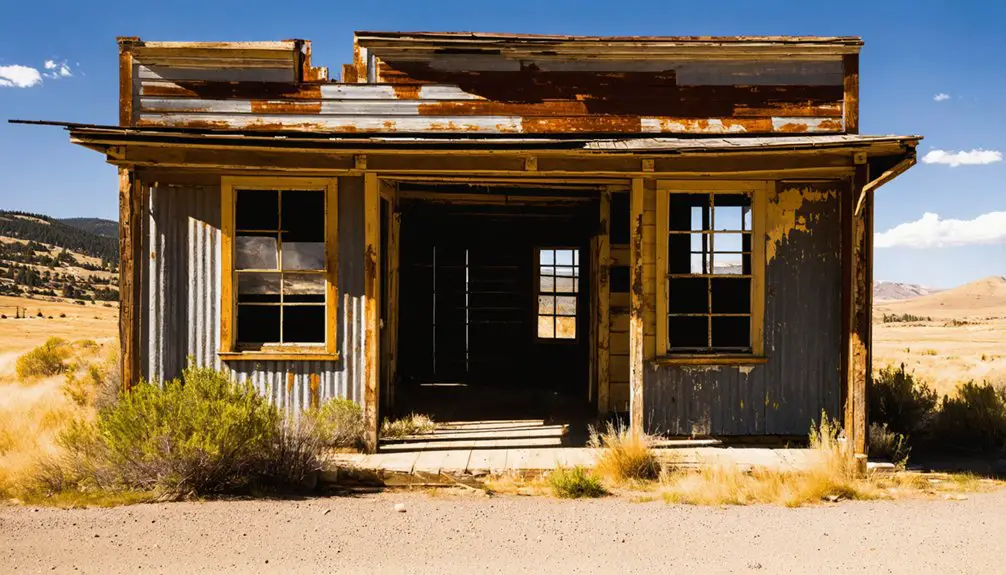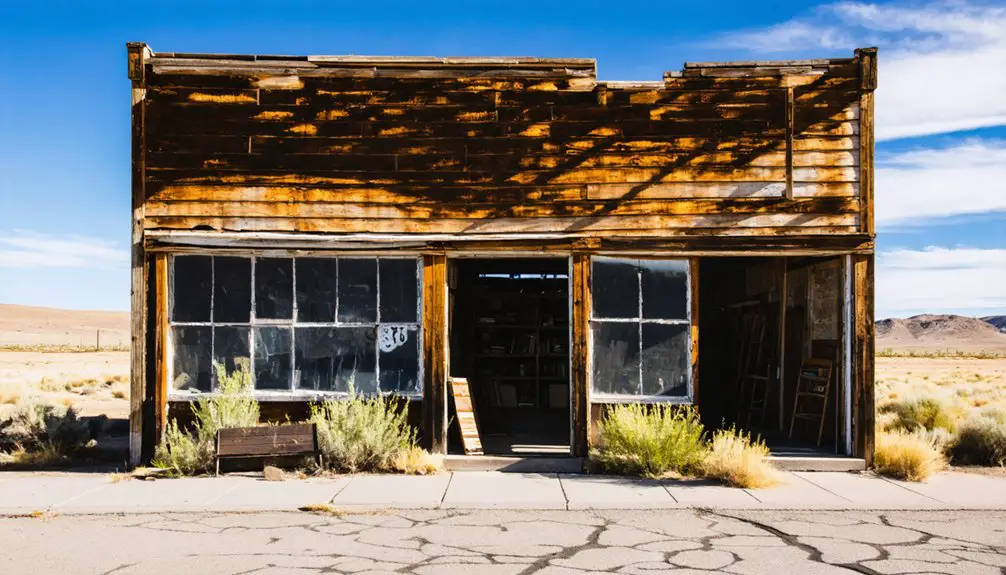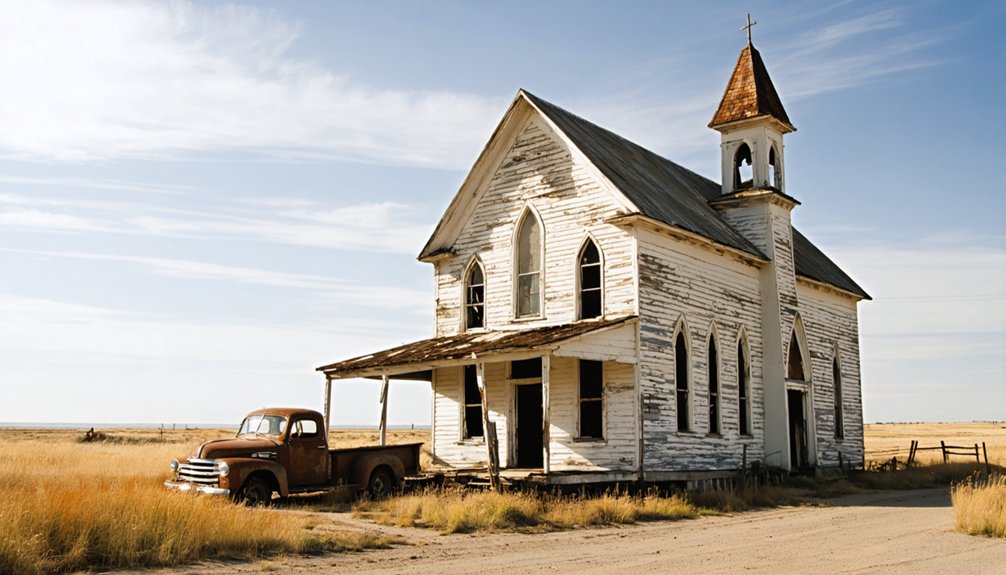
You’ll find Oregon’s most famous ghost towns scattered across the state’s high desert and mountain regions, each telling unique stories of boom and bust. Shaniko, once the “Wool Capital of the World,” peaked at 600 residents in 1910, while Sumpter’s gold dredge extracted millions in treasure. Golden banned saloons to attract respectable families, and Buncom preserves Chinese mining heritage through community festivals. These weathered remnants offer glimpses into Oregon’s frontier past and the economic forces that shaped entire communities.
Key Takeaways
- Shaniko was Oregon’s “Wool Capital of the World” with 600 residents in 1910, featuring preserved jail, schoolhouse, and reopened hotel.
- Sumpter boomed during gold rush era with 2,000 fortune-seekers by 1897, offering visitors gold panning and historic dredge exploration.
- Golden was a unique family-friendly mining town that banned saloons, preserving four original structures including Ruble’s 1892 church.
- Buncom began as Chinese mining settlement in 1851, now maintained by historical society with annual Wild West festivals.
- Hardman merged four agricultural settlements but declined after Highway 97 bypass, with approximately 20 residents maintaining its legacy.
Shaniko: The Wool Capital That Time Forgot
Thirty-six miles north of Madras in Oregon’s high desert, Shaniko stands as one of the state’s most compelling ghost towns—a place where the echoes of wool wagons and steam trains still seem to drift through the sagebrush.
You’ll discover a town that once claimed the title “Wool Capital of the World” during its early 1900s heyday, when millions of pounds of wool flowed through its railroad depot.
At its peak in 1910, you’d have found yourself among 600 residents in Oregon’s fifth-largest city in Wasco County.
At its peak in 1910, Shaniko bustled with 600 residents as Oregon’s fifth-largest city in Wasco County.
The Columbia Southern Railroad made Shaniko’s wool production boom possible until the Oregon Trunk Railway bypassed it in 1911. The town experienced a revival in the 1920s and 30s due to road construction that brought new life to the area.
During its prosperous years, the community supported two newspapers that documented the bustling frontier life and commercial activities of this thriving wool center.
Today, you’ll walk through this authentic ghost town where surviving structures like the jail, schoolhouse, and recently reopened Shaniko Hotel preserve its frontier legacy.
Sumpter: Where Gold Rush Dreams Live On
Deep in Oregon’s Blue Mountains, Sumpter emerges from the high desert landscape as a tribute to the relentless pursuit of gold that shaped the American West.
You’ll discover a town born from 1862 gold strikes by California prospectors who refused to settle for fool’s gold. By 1897, railways brought 2,000 fortune-seekers to this remote valley.
The massive Sumpter Valley Dredge tells the real story—dredge operations that processed over 7 yards of earth per minute, running 24/7 for decades. Three dredges operated continuously in the valley from 1913 to 1954, traveling over 8 miles and extracting $10 to $12 million in gold before the final operation closed with over $100,000 in debt.
You can explore this engineering marvel that extracted $4.5 million in gold, witness the 72-bucket system that carved through bedrock, and try gold panning yourself. The dredge’s operation left behind distinctive piles of debris tailings scattered throughout Sumpter Valley.
Here, gold preservation isn’t just about artifacts—it’s about preserving the audacious spirit that built America.
Golden: A Hidden Gem in Southern Oregon
While Sumpter’s massive dredging operations carved through the Blue Mountains, Southern Oregon’s Rogue River Valley harbored its own remarkable mining settlement.
You’ll find Golden tucked along Coyote Creek, where Reverend William Ruble transformed a rough 1840s mining camp into a family-oriented community by 1890.
Unlike typical boom towns, Golden banned saloons, attracting families seeking respectable frontier life. The town flourished with 150 residents, operating a church, school with 36 students, and general store.
Hydraulic mining operations pumped water through a 2.5-mile pipeline, extracting $1.5 million in gold from the creek’s banks. The Ruble family innovated mining techniques with their hydraulic elevator, which helped extract gold more efficiently from the creek beds.
When mines depleted within twenty years, single miners abandoned this dry town for rowdier settlements. Golden’s distinction from other mining communities was its complete lack of saloons, which set it apart as a temperance settlement in the rough frontier landscape.
Today, you can explore four original structures at this Oregon State Heritage Site, including Ruble’s 1892 church.
Buncom: Preserving Wild West Heritage Through Community Spirit
You’ll find Buncom’s mining legacy stretching back to 1851 when Chinese miners first established this camp following gold discoveries in Jacksonville and Sterling Creek.
The settlement evolved from a simple mining outpost into a ranching hub that supported the broader Jackson County community until stage travel ended and abandonment occurred by 1918. Located 20 miles southwest of Medford, Oregon, the ghost town sits at the corner of Sterling Creek Road and Little Applegate Road.
The area was built on the traditional lands of the Athapaskan Dakubetede people, whose village was destroyed by white militia during the Rogue River Wars.
Today, you can witness how the Buncom Historical Society‘s annual May fundraising festival celebrates this Wild West heritage while generating essential funds to preserve the three remaining twentieth-century structures that survived relocation and wildfire destruction.
Mining History Legacy
Although gold discoveries along Sterling Creek in 1851 launched Buncom’s mining legacy, the town’s true historical significance lies in its preservation of multicultural Wild West heritage through dedicated community efforts.
You’ll discover how Chinese miners pioneered innovative mining techniques after moving downstream from Sterlingville, establishing the five-mile Gin Lin Ditch for hydraulic operations that continued into the 1870s.
The cultural impact extended beyond gold extraction—miners also extracted chromite and cinnabar, while the community evolved into a supply hub serving diverse settlers throughout Little Applegate Valley. The town once thrived with essential frontier businesses including a saloon, general store, post office, and stagecoach stop that connected remote mining communities.
Today’s preservation efforts honor this multicultural legacy, maintaining three original structures that represent the hardships and triumphs of early Southern Oregon’s mining frontier and its lasting influence on regional development. The Buncom Historical Society, formed in 1991, has restored building roofs and porches to ensure these remnants of the Old West survive for future generations.
Annual Festival Fundraising
Since the 1980s, Buncom Day has transformed this sleepy ghost town into a bustling celebration that draws hundreds of visitors to the remote Applegate Valley each summer.
You’ll discover creative fundraising strategies that preserve Oregon’s Wild West heritage through pure community engagement. The Buncom Historical Society orchestrates this annual event to generate essential funds for maintaining the town’s three remaining historic structures.
You can participate in unique activities like chicken poop gambling, where you’ll bet on numbered squares beneath live chickens. The repeated parade format, ghost hunting tours with recorded voices, and local author book signings create multiple revenue streams.
Every dollar raised directly supports building preservation and historical documentation efforts, ensuring future generations can experience authentic frontier history through grassroots community dedication.
Hardman: Eastern Oregon’s Agricultural Ghost Town
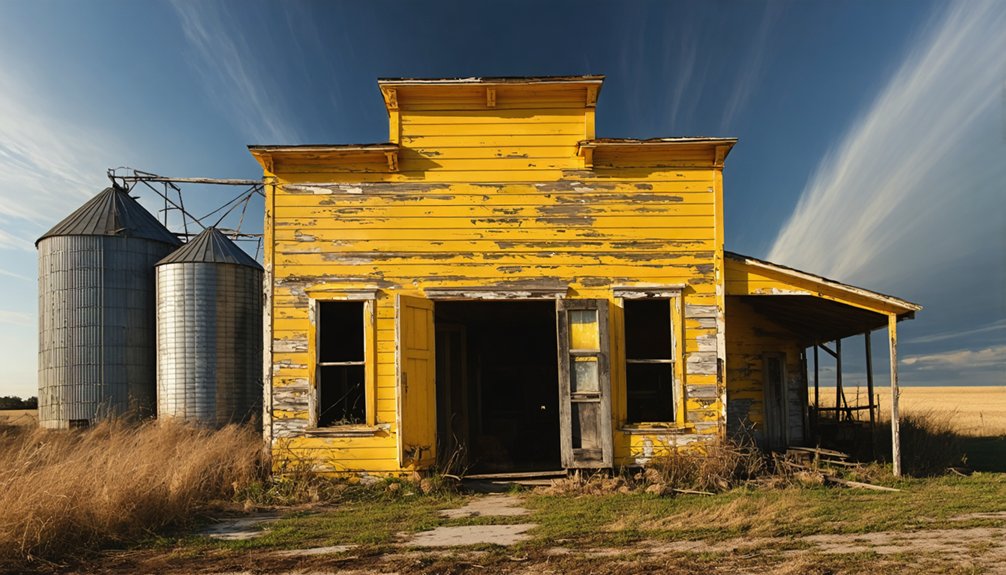
You’ll find Hardman perched on a high plateau in north-central Oregon’s Morrow County, where the merger of Raw Dog and Yellow Dog created an agricultural hub that thrived around the turn of the century.
This former stagecoach stopping point once boasted three general stores, two hotels, and even a racetrack before sheep market hardships and Highway 97’s construction in 1917 bypassed the community entirely.
Today, you can explore this semi-ghost town where approximately 20 residents maintain the legacy of what was once Eastern Oregon’s prime farming and rangeland settlement.
Agricultural Heritage and History
The convergence of four small settlements in eastern Oregon’s wheat country created one of the state’s most authentic agricultural ghost towns.
You’ll discover how Dairyville, Dogtown, Raw Dog, and Yellow Dog merged around David N. Hardman’s 1878 arrival, establishing farming practices that defined the region’s character. The community’s big mill became central to local wheat processing, drawing farmers from miles around who needed their grain ground and supplies replenished.
At 3,600 feet elevation near the Blue Mountains, Hardman demonstrated remarkable community resilience through agricultural prosperity.
Transportation Hub Decline
While Hardman’s agricultural success drew settlers and established the community, its strategic position as a transportation hub ultimately determined both its rise and fall.
You’ll find that Hardman once thrived as the essential stopover between the Columbia River and interior points, where stagecoaches merged the Raw Dog and Yellow Dog towns around 1900. Teams hauling wood from the Blue Mountains and freight from railways passed directly through town, supporting hotels, livery stables, and businesses.
However, transportation shifts proved devastating. Highway 97’s creation in 1917 bypassed Hardman entirely, while World War rationing crippled local milling operations.
The combination of improved highways and wartime constraints triggered economic decline that couldn’t be reversed. By 1968, even the post office closed, completing Hardman’s transformation from bustling hub to ghost town.
Galena: Grant County’s Historic Mining Remnant
Nestled twenty miles from Austin Junction in Oregon’s Blue Mountains, Galena stands as one of Grant County’s most compelling historic mining remnants.
You’ll discover this remote settlement along the Middle Fork John Day River, accessible via U.S. Route 20’s winding path through Malheur National Forest.
Originally called Susanville after early inhabitant Susan Ward, the camp emerged following gold discoveries on July 4, 1862.
Mining techniques evolved from initial placer operations to sophisticated lode deep shaft excavations throughout the 1860s-1940s.
The town’s historic significance grew as miners extracted galena ore, prompting the name change when the post office relocated in 1901.
Federal Public Law 208 ended gold operations in 1942, transforming this viable community into today’s atmospheric ghost town surrounded by abandoned homesteads and weathered structures.
Planning Your Oregon Ghost Town Adventure
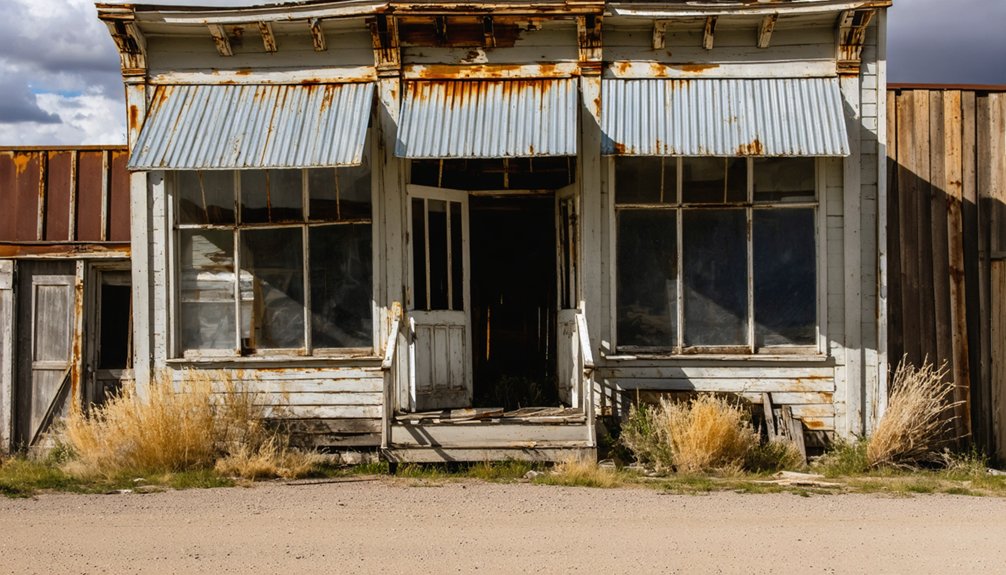
How can you maximize your Oregon ghost town exploration while traversing remote terrain and seasonal challenges?
Start your road trip planning by downloading ghost town maps with 1900 overlays aligned to modern roads. Summer’s your best bet for accessing preserved sites like Shaniko, where the hotel and jail remain intact.
You’ll find three main routes: Eastern Oregon covers Shaniko, Condon, and Hardman; Southeastern backroads include Danner and Rome; Southern Oregon features Buncom and Golden.
Pack for desolate stretches with no services, especially around Arock and Riley. Use Google Maps overlays to locate these remnants efficiently.
Avoid winter for remote southeastern stretches, but spring works well for woodland heritage sites like Golden.
Photography Tips for Capturing Historic Ruins
Your camera becomes a time machine when documenting Oregon’s weathered ghost towns, but capturing their haunting beauty requires specific techniques to overcome challenging conditions.
Urban exploration photography demands patience and proper equipment to reveal these forgotten settlements’ stories.
Essential gear for ghost town photography includes:
- Telephoto zoom lens (70-200mm) – isolates architectural details and crops out modern distractions
- Sturdy tripod – enables long exposures in dimly lit structures and abandoned buildings
- ND grad filters – controls dramatic sky exposure and enhances moody atmospheres
- External light sources – illuminates dark interiors without damaging historical preservation efforts
Focus on weathered textures, peeling paint, and crumbling foundations rather than complete structures.
Shoot during overcast days to avoid harsh shadows, and respect site regulations while documenting these fragile remnants of Oregon’s mining and logging heritage.
Frequently Asked Questions
Are These Ghost Towns Safe to Visit With Children?
You’d rather navigate parenthood’s daily hazards than Oregon’s ghost town safety nightmares. Children exploration becomes Russian roulette with unstable structures, wildlife encounters, and that charming 100% murder rate statistic from Millican’s bloody past.
What Are the Best Months to Visit Oregon Ghost Towns?
You’ll find the best seasons are late spring through early fall, with July offering ideal weather for exploration. Visit April through September when businesses operate, or choose September for fewer crowds while maintaining warm conditions.
Do Any of These Towns Have Restrooms or Visitor Facilities?
You’ll find excellent restroom availability and visitor amenities at Fort Rock Ghost Town, including flush toilets, interpretive trails, and a visitor center. Champoeg offers multiple restroom facilities, while most other ghost towns lack modern conveniences.
Can You Camp Overnight in or Near These Ghost Towns?
You can camp near ghost towns on Oregon’s 2.5 million acres of state forest land without overnight permits. However, camping regulations require staying 25 feet from water sources and following 14-day limits within designated areas.
Are There Guided Tours Available for Multiple Ghost Towns?
You’ll find guided history tours through local tour operators for eastern Oregon’s ghost town clusters like Shaniko, Hardman, and Condon, offering GPS-supported driving tours that connect multiple abandoned settlements in single expeditions.
References
- https://en.wikipedia.org/wiki/List_of_ghost_towns_in_Oregon
- https://www.visitoregon.com/oregon-ghost-towns/
- https://www.deviantart.com/austinsptd1996/journal/Six-Iconic-Ghost-Towns-Within-Oregon-1109696435
- https://thatoregonlife.com/2016/04/road-trip-ghost-towns-eastern-oregon/
- https://www.pdxmonthly.com/travel-and-outdoors/oregon-ghost-towns
- http://www.photographoregon.com/ghost-towns.html
- https://traveloregon.com/things-to-do/culture-history/ghost-towns/
- https://www.pinesnvines.com/adventures/oregons-coolest-ghost-town
- https://traveloregon.com/things-to-do/culture-history/ghost-towns/shaniko-ghost-town/
- https://www.oregonencyclopedia.org/articles/shaniko/