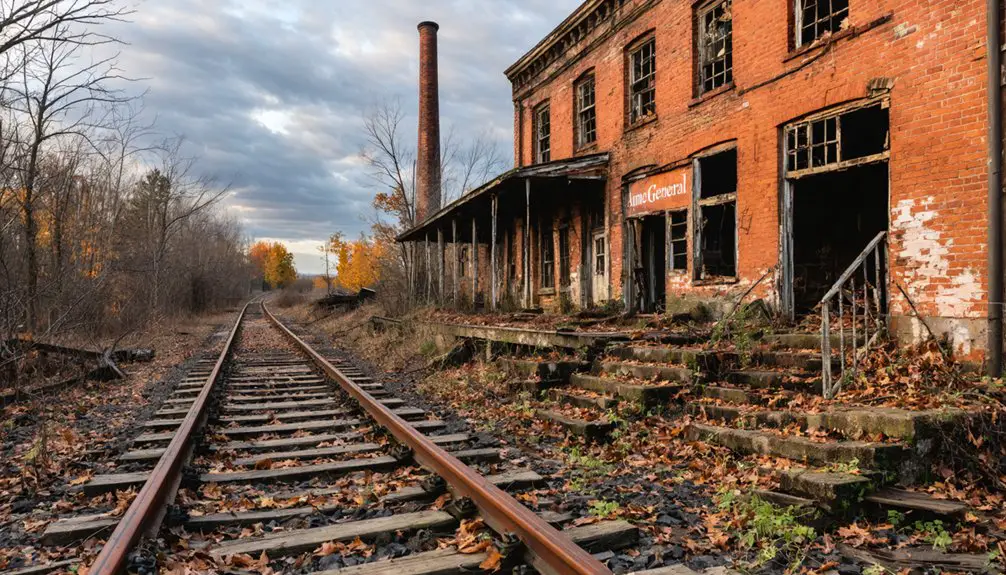
You’ll find Pennsylvania’s most famous ghost towns scattered across regions once dominated by coal and oil extraction. Centralia’s underground coal fire has burned since 1962, reducing its population from 1,500 to just five residents. Pithole experienced America’s fastest boom-and-bust cycle, growing to 20,000 residents in 1865 before collapsing within 500 days. Other notable abandoned settlements include Rausch Gap, Yellow Dog Village, and Scotia—all remnants of Carnegie’s industrial empire that shaped the state’s mining legacy and offer fascinating glimpses into America’s forgotten past.
Key Takeaways
- Centralia’s underground coal fire has burned since 1962, creating toxic fumes and reducing population from 1,500 to five residents.
- Pithole boomed to 20,000 residents during 1865 oil rush but collapsed within 500 days due to fires and falling prices.
- Rausch Gap was a coal mining town from 1828-1930, now featuring accessible ruins and foundations along Stony Valley Rail-Trail.
- Yellow Dog Village and Scotia were company towns for limestone and iron ore mining, abandoned after operations ceased in mid-1900s.
- Eckley Miners’ Village peaked at 1,000 coal mining residents and was preserved as a historical site after Hollywood filming.
Centralia: The Town Above an Underground Inferno
On May 27, 1962, borough personnel in Centralia ignited what would become one of America’s most notorious environmental disasters when they set fire to trash in a municipal waste disposal area near the Independent Order of Odd Fellows Cemetery.
The flames reached an underground coal seam through an unsealed opening, creating fire hazards that would plague the town for decades.
The coal mining fire spread through the Buck Mountain coal bed, reaching depths of 300 feet across 3,700 acres.
You’ll find this inferno burns along four branches spanning six square miles, advancing 75 feet annually.
Toxic sulfurous fumes and carbon monoxide poisoned the air while sinkholes swallowed homes.
Failed extinguishment attempts couldn’t stop the blaze that’s projected to burn for 250 years, forcing residents to abandon their community. The state government condemned the city in 1992 due to ongoing safety concerns. The town’s population plummeted from 1,500 residents in the 1980s to just five people by 2017.
Pithole: From Oil Boom to Bust in Record Time
You’ll discover America’s most dramatic boom-and-bust story in Pithole, a Pennsylvania oil town that rose from farmland to a city of 20,000 residents in just months during 1865.
The discovery of the Frazier Well triggered an unprecedented oil rush that created the nation’s third-busiest post office and daily production exceeding 5,000 barrels. The boomtown featured an impressive infrastructure including 54 hotels, churches, a daily newspaper, and even a 1,100-seat theater. Oil field workers earned such significant wages that a simple meal cost $4, equivalent to about $60 in today’s currency.
Yet this remarkable prosperity lasted only about 500 days before collapsing oil prices, devastating fires, and pipeline competition reduced the thriving metropolis to virtual abandonment by 1870.
America’s First Oil Boom
While the Civil War raged across America, oil discoveries along Pennsylvania’s remote creeks would soon create the nation’s first petroleum boomtown that defied all logic and reason.
Following the 1859 Drake Well at Titusville, you’d witness veterans flooding into the Allegheny River Valley with savings burning holes in their pockets. The oil discovery at Pithole Creek in 1865 released unprecedented wealth-seeking as prices peaked at $14 per barrel.
You’d see the Frazier Well’s initial 250 barrels daily skyrocket to 1,200 barrels by June. The economic impact was staggering—Ian Frazier pocketed $250,000 quickly while national newspapers spread “black gold” fever nationwide.
By May 1865, Pithole had exploded into a bustling hub featuring 57 hotels and a busy post office to accommodate the massive population surge. The remarkable transformation from dense forest to bustling city occurred within just three months.
Returning Confederate and Union soldiers alike chased fortunes in Pennsylvania’s oil-soaked valleys.
Rapid Rise and Fall
When the Frazier Well struck oil in January 1865, flowing 250 barrels per day from the Venango Third Sand, few could’ve predicted the meteoric rise and catastrophic fall that would define Pithole’s brief existence.
The economic impact was staggering. Production soared to 1,200 barrels daily by June, attracting Civil War veterans with fresh savings. Oil prices at $8 per barrel fueled massive speculation, generating hundreds of thousands in transactions. At its peak, the town was producing over 5,000 barrels of oil daily.
Community transformation happened virtually overnight. You’d witness 15,000-20,000 residents flooding in, constructing 54 hotels, churches, and Pennsylvania’s third busiest post office. The 90-acre town bustled with 3,000 teamsters hauling oil.
Then collapse struck swiftly. Oil prices plummeted to $1.35, devastating fires destroyed wells, and pipeline construction eliminated teamster jobs. By 1877, the town’s remaining land was sold at sheriff’s sale, marking the final chapter of this spectacular boom-and-bust cycle.
Rausch Gap: Coal Mining Legacy in the Wilderness
You’ll find Rausch Gap nestled in Cold Spring Township, where Dr. Benjamin Kugler established this coal mining town in 1828 that would grow to house 1,000 residents by 1860.
You can access the abandoned settlement today via the Stony Valley Rail-Trail, which follows the same railroad route that once brought prosperity to this wilderness community.
You’ll discover remnants of foundations, a cemetery, and other ruins that mark what was once the largest mining town in St. Anthony’s Wilderness before its decline in the early 1900s. The nearby Lincoln Colliery, established in 1869, was one of the most extensively mined operations in the southern coal fields until its abandonment in 1930. The Stoney Creek Rail Trail now provides modern visitors with convenient access to explore these fascinating historical remnants.
Mining Town Origins
Deep in Pennsylvania’s St. Anthony’s Wilderness, you’ll discover where industrial ambition carved civilization from untamed mountain terrain. Dr. Benjamin Kugler of Philadelphia founded this remote settlement, bringing coal mining techniques that would transform Sharp Mountain’s southern slopes.
The town’s origins trace back to 1828, though anthracite mining began during the 1810s for local use. You can trace the community’s industrial heritage through its strategic location where Rausch Creek cuts through the mountain into Stony Creek.
By 1836, full-scale operations shipped coal beyond local markets. The nearby Lincoln Colliery became one of the southern coal fields’ most extensively mined sites.
What started as wilderness exploitation evolved into a thriving community of 1,000 residents by 1860, representing Pennsylvania’s industrial expansion into previously inaccessible regions.
Wilderness Trail Access
Although Rausch Gap vanished nearly a century ago, you can still reach this forgotten coal town by following the Stony Valley Rail-Trail through St. Anthony’s Wilderness.
This Wilderness Trail follows the original railroad path that once carried coal from the mountains to the Susquehanna River. You’ll discover the Historical Significance of this site as you hike through Cold Spring Township, where dug-out basements and rock foundations mark where 1,000 residents once lived.
The trail’s coordinates at 40°29′58″N 76°35′52″W place you on Sharp Mountain’s southern slopes, where Rausch Creek cuts through the mountain. You can explore the southeast corner for additional remnants or continue four miles to Gold Mine village, another abandoned settlement surrounded by unspoiled forest.
Cemetery and Ruins
Where Rausch Creek cuts through Sharp Mountain’s southern slopes, stone foundations and excavated basements mark the locations where nearly 1,000 residents once called this coal mining town home.
You’ll find the most accessible ruins exploration opportunities in the southeast corner, where the softer terrain allowed miners to dig proper basements unlike the rockier abandoned sites nearby. Rock foundations from company houses dot the landscape, telling stories of families who lived here during Rausch Gap’s peak between 1830 and 1910.
The cemetery significance extends beyond individual graves to represent the entire coal mining legacy preserved within St. Anthony’s Wilderness.
You can follow the Stony Valley Rail-Trail to reach these remnants, where dug-out areas and foundation stones create an outdoor museum of Pennsylvania’s industrial past.
Yellow Dog Village: Pennsylvania’s Best-Preserved Abandoned Settlement
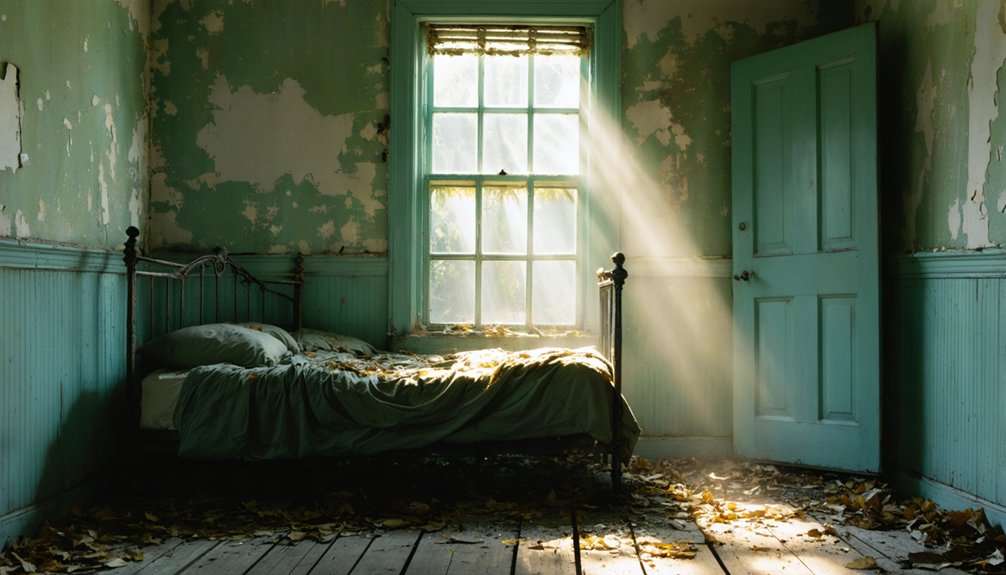
When Pittsburgh Limestone Company broke ground in 1912, they weren’t just building another mining operation—they were creating what would become Pennsylvania’s most well-preserved ghost town.
Yellow Dog Village housed limestone workers and their families on 50 acres near Worthington, Armstrong County. The community’s name came from “yellow dog contracts” that prohibited unionization, a term workers embraced with pride.
This company town demonstrated remarkable community resilience, thriving for decades with 26 buildings, a chapel, store, and recreational facilities.
After mines closed in the 1950s, the village declined gradually until abandonment in the early 2000s.
- Manager’s mansion crowns the hillside overlooking worker homes
- Original basement pantries remain intact in several houses
- Village park features playground and baseball field by Buffalo Creek
- Crumbling streets weave through moss-covered rooftops and wild vegetation
- Current preservation efforts offer guided tours highlighting the settlement’s historical significance
Scotia: Carnegie’s Company Town With a Dark Past
Deep in Centre County’s forests, the remnants of Scotia tell a story that began with Andrew Carnegie’s ambitious vision and ended in abandonment.
You’ll find this ghost town’s Scotia history rooted in Carnegie’s 1880 purchase of Centre County land for iron ore mining. Within two years, he’d built a complete company town housing nearly 400 residents by the late 1880s.
The Carnegie legacy here included homes, a church, company store, and railroad station serving the massive ore washing operations. Steam shovels extracted ore transported via five-mile rail spur to Pittsburgh’s furnaces.
However, Carnegie’s 1899 sale marked the beginning of decline. Operations ceased by 1911, and families abandoned their homes shortly after.
Today, you can explore concrete ruins and ore washer towers on State Game Lands 176.
Eckley Miners’ Village: Hollywood’s Saving Grace
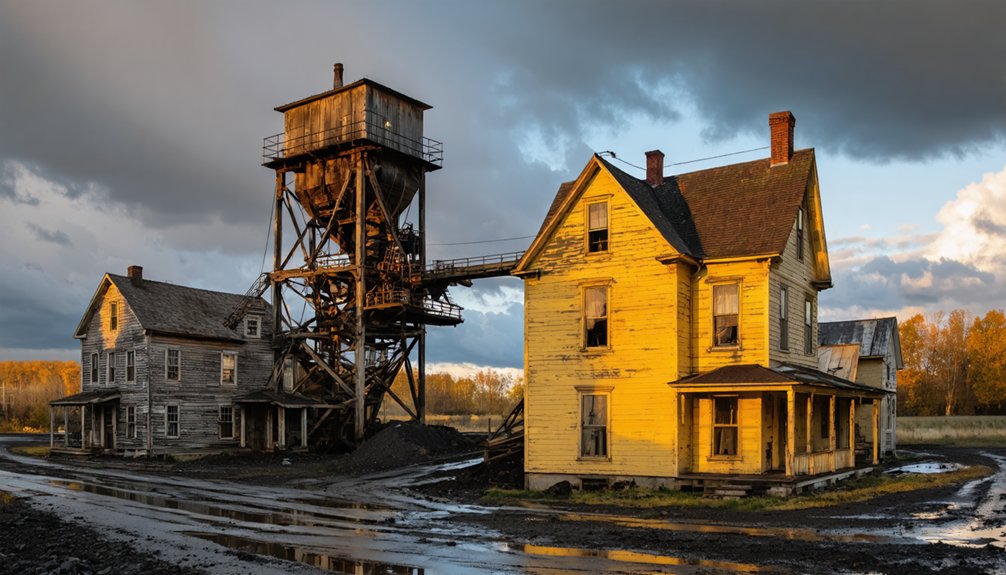
Hollywood’s intervention saved Eckley Miners’ Village from complete destruction, but its story began long before cameras rolled through its streets.
Originally called Shingletown, this Pennsylvania community transformed when Sharpe, Weiss, and Company leased 1,500 acres in 1854 for coal mining operations. You’ll discover Eckley history that spans from rural forest settlement to thriving industrial patch town housing 1,000 residents by its peak.
The village declined as strip mining replaced underground operations, leaving buildings abandoned.
Then Paramount Pictures arrived in 1970 to film “The Molly Maguires,” starring Sean Connery. Rather than demolish their movie set, Paramount donated the entire village to Pennsylvania for just $1, preserving this authentic coal mining community for future generations to explore.
- 130 laborers’ houses built by 1860 for Welsh, German, and Irish immigrants
- Double homes housed up to 30 people including boarders
- Four town bands entertained residents with the 1890 band practice house
- Sharpe House served as the founder’s mansion with servant quarters
- Village shipped 2,000 tons of anthracite coal in its first operational year
Exploring Pennsylvania’s Abandoned Mining Heritage
Why did Pennsylvania’s mining communities vanish so completely from the landscape?
You’ll discover abandoned industries scattered across the state tell stories of boom-and-bust cycles that defined America’s industrial backbone. Pennsylvania’s mining heritage reveals how single-industry towns couldn’t adapt when resources depleted or demand shifted.
Centralia’s underground coal fire since 1962 forced out 1,100 residents, leaving only five by 2010. The blaze still burns across eight square miles underground.
A decades-old underground fire transformed a thriving mining town of over 1,000 into a near-ghost town with five stubborn holdouts.
Wehrum’s coal patch housed hundreds of miners before mid-1900s abandonment left wooded ruins with intact coke ovens.
Rausch Gap’s iron furnace operations ended in the early 1900s when industrial shifts eliminated demand.
These ghost towns represent freedom from corporate dependence but also warn about economic vulnerability when communities rely on exhaustible resources.
What Makes Pennsylvania’s Ghost Towns Unique
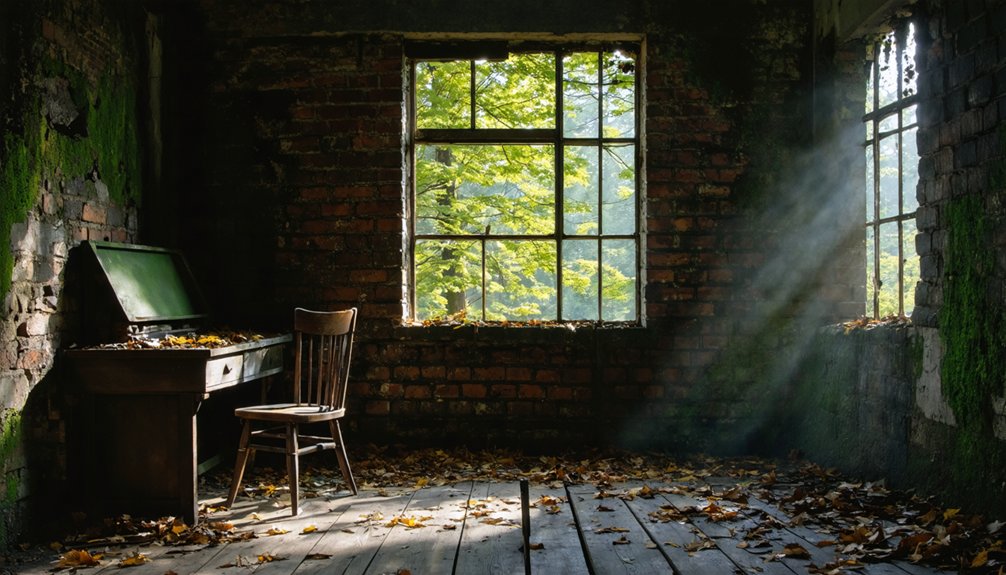
Pennsylvania’s ghost towns stand apart from abandoned settlements elsewhere through their extraordinary diversity of industrial origins and environmental circumstances.
Some of these locations offer unique properties in Pennsylvania towns that attract both history enthusiasts and prospective homeowners. From charming historic architecture to extraordinary landscapes, each town tells its own story waiting to be explored. This makes them not only fascinating tourist destinations but also potentially lucrative investments for those looking to revitalize the area.
You’ll discover communities shaped by coal mining, oil booms, nuclear power development, and even government seizure during wartime. This ghost town significance extends beyond typical urban decay patterns found in other regions.
- Underground coal fire in Centralia continues burning since 1962, creating toxic smoke emerging from ground cracks
- Big Mine Run Geyser represents Pennsylvania’s only geyser, formed by pressure from abandoned coal mines
- Rapid boom-bust cycles like Pithole City’s transformation from oil discovery to major settlement within months, then complete abandonment
- Government intervention exemplified by Alvira’s seizure for munitions bunkers and Frick’s Lock’s nuclear plant relocation
- Preserved accessibility through sites like Eckley Miners’ Village maintaining historical integrity
Frequently Asked Questions
Are There Guided Tours Available for Pennsylvania’s Abandoned Ghost Towns?
Yes, you’ll find guided tours available for Pennsylvania’s abandoned ghost towns. You can explore Yellow Dog Village’s historical significance through bookable tours, plus scenic bike tours along Ghost Town Trail showcasing mining heritage.
What Safety Equipment Should Visitors Bring When Exploring These Sites?
You’ll need essential safety gear including sturdy boots, gloves, protective clothing, flashlights with backup batteries, and a thorough first aid kit. Don’t forget face masks for hazardous materials and self-defense items.
Which Ghost Towns Require Special Permits or Permission to Visit?
You’ll need permission for Yellow Dog Village through direct farm contact and Hill View Manor’s structured tours. Pithole City and Ghost Town Trail sites don’t require permits, reflecting varying visitation regulations based on each location’s historical significance.
What’s the Best Time of Year to Visit Pennsylvania’s Ghost Towns?
Like nature’s perfect backdrop, mid-October offers you peak autumn colors highlighting Pennsylvania’s ghost towns’ historical significance. You’ll find fewer crowds, mild temperatures, and vibrant foliage framing abandoned structures, creating ideal photographic conditions for exploring these forgotten settlements freely.
Are There Any Hotels or Camping Options Near These Abandoned Settlements?
You’ll find hotels in nearby towns like Pottstown and Oil City, plus camping at French Creek and Oil Creek State Parks. Make camping reservations early, as basic hotel amenities vary widely near these remote locations.
References
- https://uncoveringpa.com/ghost-towns-in-pa
- https://www.atlasobscura.com/things-to-do/pennsylvania/ghost-towns
- https://www.youtube.com/watch?v=yxFuqGq-FJ8
- https://pabucketlist.com/road-tripping-to-the-best-abandoned-places-in-pennsylvania/
- https://kids.kiddle.co/List_of_ghost_towns_in_Pennsylvania
- http://freepages.rootsweb.com/~gtusa/history/usa/pa.htm
- https://en.wikipedia.org/wiki/Centralia_mine_fire
- https://www.britannica.com/video/coal-mine-fire-Pennsylvania-Centralia/-207717
- https://www.environmentandsociety.org/tools/keywords/centralia-mine-fire
- https://files.dep.state.pa.us/mining/Abandoned Mine Reclamation/AbandonedMinePortalFiles/Centralia/CentraliaFrequentlyAskedQuestions.pdf