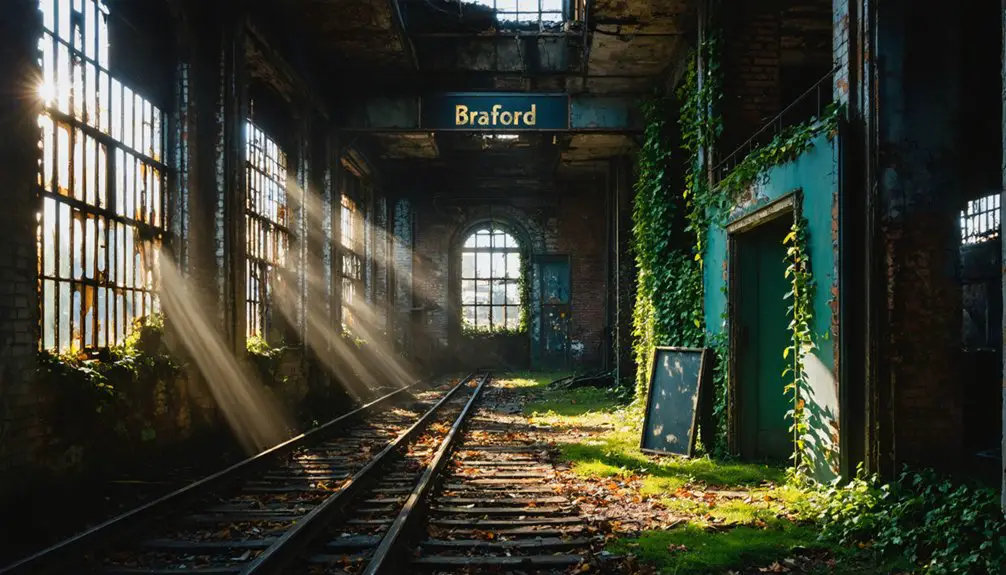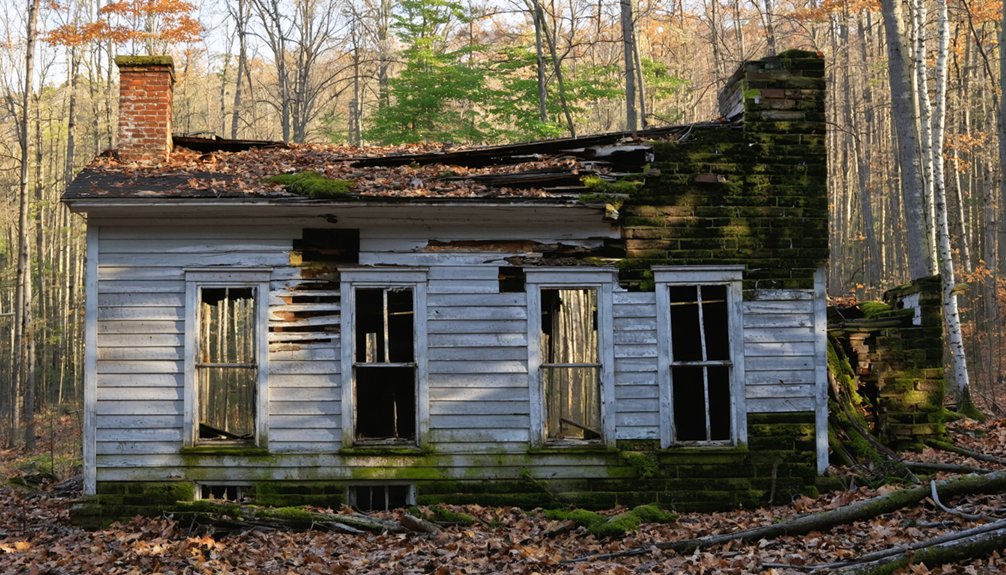
You’ll discover Rhode Island’s most haunting ghost towns scattered across the Ocean State’s forgotten landscapes. Hanton City, established in the 1730s, sheltered colonial tanners before abandonment around 1900, while Napatree Point‘s summer cottages vanished during 1938’s devastating hurricane. The Ramtail Factory‘s textile mill burned in 1873, leaving behind reports of midnight bell tolls and glowing apparitions. Rocky Point Amusement Park‘s rusted rides decay along Warwick’s shoreline, and Fort Wetherill’s military ruins span conflicts from the Revolutionary War through WWII. These atmospheric locations hold deeper secrets within their crumbling foundations.
Key Takeaways
- Hanton City was a thriving 1730s colonial settlement that became abandoned around 1900 after overgrowth made it uninhabitable.
- Napatree Point’s summer cottage community was destroyed by the devastating 1938 hurricane, killing fifteen residents and leaving ruins.
- Ramtail Factory, a textile mill founded in 1813, burned down in 1873 but remains famous for ghost sightings.
- Rocky Point Amusement Park operated for 150 years before closing in 1995, leaving decaying rides and entertainment structures.
- Fort Wetherill served as a military installation from 1776 through World War II before abandonment in 1946.
Hanton City: A Colonial Settlement Lost to Time
When you explore the dense woodlands of Smithfield, Rhode Island, you’ll discover stone foundations and crumbling walls that mark the remnants of Hanton City—a mysterious colonial settlement that vanished over a century ago.
Hanton City history reveals English families like the Paines, Hantons, and Shippees established this community in the 1730s, possibly receiving land as payment for King Philip’s War service. The settlement thrived as a hub for tanners and boot makers who utilized local resources.
However, Hanton City legends suggest darker possibilities—perhaps it sheltered Loyalists fleeing the Revolution or served as refuge for runaway slaves. Some theories even propose the isolated community housed lepers or outcasts seeking separation from mainstream society.
After the last Hanton family member died around 1900, the settlement was abandoned. The area became uninhabitable due to overgrowth and swampy conditions that eventually reclaimed the land.
Today, you can walk the Hanton City Trail and visit Alfred Smith Cemetery, where mysterious stone remnants whisper tales of Rhode Island’s forgotten past.
Napatree Point: Hurricane-Devastated Coastal Community
Unlike Hanton City’s woodland mysteries, Napatree Point tells a story written in salt spray and storm surge along Rhode Island’s exposed coastline.
You’ll discover Napatree history began with Dutch trader Adriaen Block’s 1614 observation of its “nap of trees,” though the Great Gale of 1815 stripped away that forest forever.
Fort Mansfield rose here in 1902, housing 228 soldiers and massive cannon batteries until a fatal design flaw led to its 1907 decommissioning. The fort’s quiet atmosphere creates an eerie contrast to the bustling military installations found elsewhere along New England’s coast.
By 1938, thirty-nine summer cottages crowned the dunes until September’s hurricane swept them into Little Narragansett Bay, killing fifteen residents. The storm also caused Sandy Point to separate from Napatree and begin its northward migration.
Today, coastal erosion continues reshaping this abandoned peninsula, where crumbling concrete gun emplacements stand as monuments to nature’s relentless power over human ambition.
Ramtail Factory: The Haunted Textile Mill
Deep within Foster’s woodlands, where the Ponangansett River once powered Rhode Island’s most notorious textile mill, you’ll find the skeletal remains of Ramtail Factory—a place so thoroughly cursed that the 1885 state census officially designated it as haunted, the only such listing in Rhode Island’s records.
Founded in 1813 by William Potter and Peleg Walker, this woolen mill’s haunted history began when Walker, the cranky night watchman, was found hanging from the bell rope in 1822 after a bitter ownership dispute. The factory earned its distinctive name from the wool clipping process that gave raw fleece its characteristic appearance. Walker’s cryptic final words promised he would keep the mill key from a “dead man’s pocket.”
Workers fled immediately, abandoning their village homes. The mill burned in 1873, yet ghost sightings persist. Visitors report midnight bell tolls, glowing figures among trees, and machinery running against the river’s flow—manifestations of Walker’s restless spirit still patrolling his cursed domain.
Rocky Point Amusement Park: Decaying Entertainment Ruins
Along Warwick’s windswept shoreline, where the Narragansett Bay once echoed with carousel music and children’s laughter, Rocky Point Amusement Park‘s concrete foundations and rusted infrastructure tell the story of New England’s most beloved seaside attraction.
You’ll discover remnants of the 13-story Freefall and Corkscrew Loop Roller Coaster scattered among overgrown pathways where families once strolled. The abandoned rides bear witness to 150 years of entertainment history, from Captain William Winslow’s 1847 shore dinner venture to the park’s 1995 bankruptcy closure. Baseball legends like Babe Ruth once graced the grounds when the park hosted its own stadium from 1891 to 1917.
These decaying structures hold profound historical significance as the Narragansett tribe’s former summer grounds transformed into a working-class paradise that survived two devastating hurricanes before ultimately succumbing to financial pressures and changing recreational preferences. Today, visitors can explore the mile-long walking path that weaves through the remnants, offering a haunting glimpse into Rhode Island’s entertainment past.
Fort Wetherill: Military Remnants in Overgrown Ruins
Perched atop Conanicut Island’s hundred-foot granite cliffs, Fort Wetherill‘s crumbling concrete gun emplacements and overgrown artillery positions command a panoramic view of Narragansett Bay’s East Passage, where Revolutionary War patriots first erected earthworks in 1776 to defend Newport Harbor.
You’ll discover fort history spanning multiple conflicts—from British occupation during the Revolution to French reconstruction, then massive Endicott Period expansion with 12-inch disappearing rifles.
Walking through tangled vines reclaiming concrete bunkers, you’re exploring coastal defenses that housed 1,200 soldiers during World War II and later German POWs. The original Fort Dumpling was demolished in 1898 to make way for these modern defenses.
The military abandoned this strategic position in 1946, leaving behind a haunting landscape where freedom fighters once stood guard against tyranny across three centuries. The fort’s transformation into a state park in 1972 preserved these military ruins across 61 acres for public exploration.
Frequently Asked Questions
Are Visitors Legally Allowed to Explore These Abandoned Rhode Island Locations?
Ever wondered about exploration laws? You’re legally permitted to explore these Rhode Island ghost towns through public access points. Urban exploration here’s unrestricted – I’ve researched historical records confirming your freedom to visit these abandoned sites.
What Safety Precautions Should Explorers Take When Visiting These Ghost Towns?
You’ll need sturdy safety gear like boots and flashlights when exploring Rhode Island’s ruins. Always inform emergency contacts of your planned route through sites like Hanton City’s crumbling foundations and overgrown cemetery paths.
Which Rhode Island Ghost Town Is Considered the Most Haunted by Locals?
Like a magnet for supernatural tales, Hanton City’s considered Rhode Island’s most haunted ghost town by locals. Haunted legends surround its mysterious well, while local folklore speaks of plagues and unexplained disappearances haunting these colonial ruins.
Explorers often seek out abandoned places in Rhode Island, drawn by the allure of forgotten history and eerie atmospheres. Each site holds stories waiting to be uncovered, echoing the past with every creak of collapsing structures. Visitors can feel the weight of history in the air, a chilling reminder of the lives once lived within those crumbling walls.
Ghost towns in Rhode Island are not just relics of the past; they are gateways to stories that linger like whispers in the wind. As the sun sets, shadows dance over the remnants of long-abandoned homes, inviting intrepid explorers to delve deeper into their haunting tales. With each step, one can almost hear the echoes of laughter and sorrow that once filled these deserted streets, compelling visitors to reflect on the vibrant lives that once thrived here.
How Do I Get Driving Directions to Each of These Locations?
You’ll find GPS coordinates in archived records work best with driving apps like Google Maps. I’ve discovered entering street addresses first, then following navigation tips to nearby landmarks prevents getting lost on rural backroads.
What’s the Best Time of Year to Visit Rhode Island’s Ghost Towns?
You’ll find fall’s your best bet for exploring Rhode Island’s abandoned sites. Autumn foliage enhances visibility through ruins, temperatures stay comfortable for extended hikes, and summer festivals won’t crowd your solitary discoveries.
References
- https://newenglandwithlove.com/ghost-towns-in-rhode-island/
- https://www.rhodeislandredfoodtours.com/2024/10/28/haunted-sites-of-rhode-island/
- https://www.youtube.com/watch?v=kpy7zlXYrAU
- https://www.rimonthly.com/haunted-places-rhode-island/
- https://providenceghosttour.com/haunted-attractions-rhode-island/
- https://en.wikipedia.org/wiki/List_of_ghost_towns_in_Rhode_Island
- https://weird-island.simplecast.com/episodes/57-ghost-town-hanton-city-ky53imy0
- https://www.youtube.com/watch?v=3bFcmv7IH40
- https://kids.kiddle.co/Hanton_City
- https://www.onlyinyourstate.com/state-pride/rhode-island/hanton-city-lost-town-ri