You’ll find Tennessee’s most famous ghost towns include Elkmont, where wealthy families created exclusive resorts after logging operations ended, and Cades Cove, once home to 685 residents before becoming the Smokies’ largest abandoned settlement. Government projects created others: Old Butler was deliberately flooded in 1948 by TVA’s dam construction, while Wheat vanished during the Manhattan Project’s secret uranium operations, displacing 4,000 residents. These communities reveal fascinating stories of prosperity, displacement, and preservation efforts that shaped Tennessee’s forgotten landscape.
Key Takeaways
- Elkmont transformed from a 1900s logging town to luxury resort before abandonment, with sixteen restored buildings now open for exploration.
- Cades Cove was the Smokies’ largest settlement with 685 residents by 1850 before eventual abandonment after thriving for over a century.
- Old Butler became Tennessee’s only completely submerged incorporated town when TVA flooded it in 1948 for Watauga Dam construction.
- Wheat vanished during the Manhattan Project when 4,000 residents were displaced through eminent domain to create classified Oak Ridge facility.
- Devonia operated as a coal mining camp from 1948-1953 before economic decline led to Trimore Coal Corporation’s closure and abandonment.
Elkmont: From Logging Town to Luxury Resort
For over 8,000 years, humans have made their mark on the land that would become Elkmont, but it wasn’t until the mid-1800s that permanent settlers arrived as hunters, homesteaders, and loggers along the Little River.
You’ll find Elkmont’s logging history began with John L. English’s small-scale operations in the 1880s, which ended after devastating 1899 floods.
The Little River Lumber Company transformed everything in 1901, purchasing 86,000 acres and establishing a company town by 1907-1908. A railroad connection to Knoxville was constructed to transport the harvested logs from the remote mountain location.
What’s remarkable is the resort transformation that followed—wealthy Knoxville families discovered this remote location, creating the Appalachian Club and Wonderland Club. The name Elkmont represents one of several distinct places across different regions, though this Tennessee location holds particular historical significance as both a logging community and resort destination.
Cades Cove: The Smokies’ Largest Abandoned Settlement
While Elkmont’s transformation from logging camp to luxury retreat captured the attention of Tennessee’s elite, another settlement in the Smokies tells a different story—one of agricultural prosperity spanning over a century before eventual abandonment.
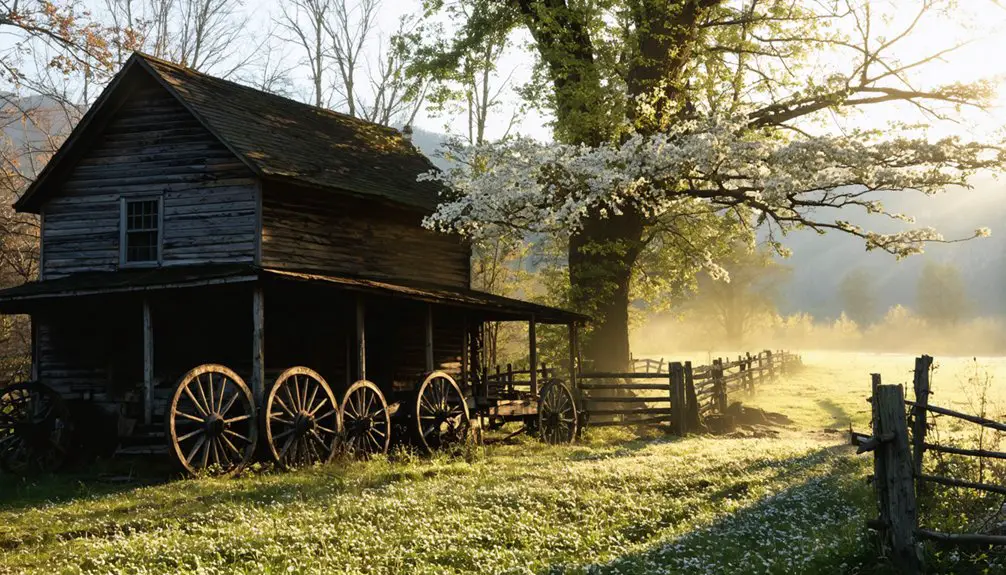
Cades Cove history begins with Cherokee heritage, as the tribe established “Tsiya’hi” or “Otter Place” by 1797 along Cove Creek flats.
After the 1819 Treaty of Calhoun ended Cherokee claims, John Oliver and Lurena Frazier Oliver arrived in 1818 as the first permanent Euro-American settlers.
They’d endure a harsh winter with Cherokee assistance before establishing what became Tennessee’s most prosperous mountain community. By 1850, the flourishing settlement supported 685 residents who built substantial farms and raised large families in this isolated valley. The cove’s success stemmed from its fertile soil created by limestone weathering, which attracted farmers seeking productive agricultural land.
Old Butler: A Town Lost Beneath the Waters
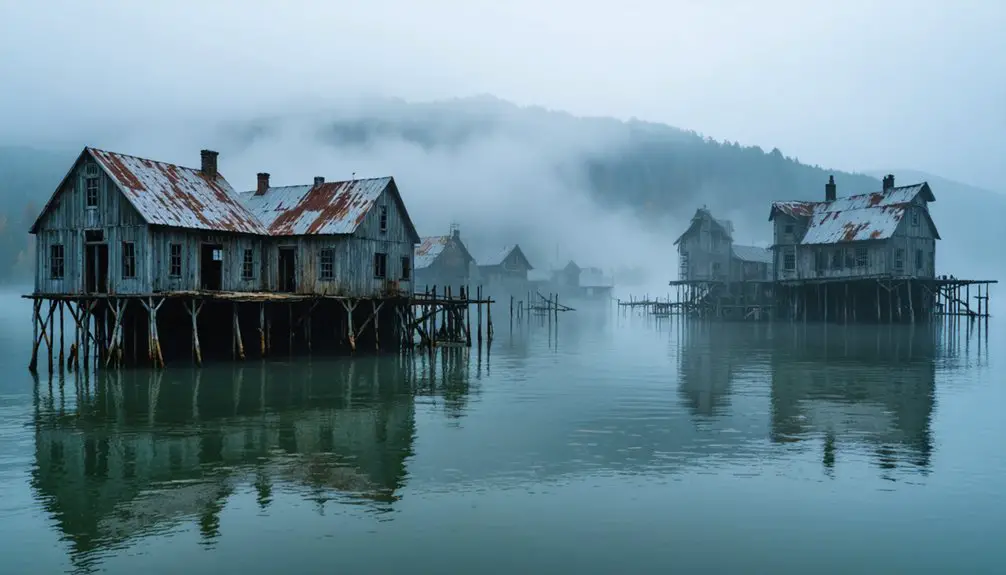
You’ll find Old Butler represents one of Tennessee’s most unique ghost towns, as it wasn’t abandoned by choice but deliberately flooded by the Tennessee Valley Authority in 1948.
The construction of Watauga Dam forced the relocation of 650 families and 175 buildings from their established community to higher ground along the future lake banks. The massive undertaking also required relocating approximately 1,300 graves from the town’s cemeteries before the waters rose.
This federal flood control project made Butler the only incorporated town completely submerged by TVA operations, creating a ghost town that lies forty feet beneath Watauga Lake’s surface. The dam itself stands as TVA’s only earthen dam, making this project uniquely significant in the authority’s construction history.
Relocation and Reservoir Creation
When the Tennessee Valley Authority began constructing Watauga Dam in the 1940s following a devastating flood, the small incorporated town of Old Butler faced an unprecedented fate—complete submersion beneath what would become a 40-foot-deep reservoir.
The relocation impacts affected 650 families who’d built their lives in this valley community, yet their community resilience shone through extraordinary efforts to preserve their town’s essence. According to local folklore, the original flooding may have served an additional purpose beyond flood control, as some residents believed it helped address supernatural threats that had allegedly plagued the old town.
The massive undertaking involved:
- Physical relocation of 175 buildings to 200 acres of secured farmland
- Business transfers by wealthier residents moving stores and establishments
- New Butler establishment completed by 1953 along future lake banks
- Final impoundment in 1948, permanently flooding the original townsite
This remarkable feat earned Butler the nickname “town that wouldn’t drown,” demonstrating how determined communities can triumph over government mandates. The town’s name honored Roderick R. Butler, who had led the 13th Regiment Tennessee Volunteer Cavalry during the Civil War to protect local citizens from Confederate brutality.
Community Displacement and Loss
Although the relocation effort saved Butler’s physical structures, the deeper story reveals a profound community trauma that stretched back to the town’s 1768 founding by John Honeycutt at the confluence of Roan Creek and the Watauga River.
You’ll understand that 650 families didn’t just lose houses—they lost their cultural center, where Watauga Academy had nurtured education and arts since 1871.
The 1989 lake drawdown exposed this wound when hundreds of former residents made emotional pilgrimages to their submerged hometown after forty years.
Community resilience emerged through the Museum of Butler Tennessee, opened in 2000 for historical remembrance. Butler earned recognition as “the town that wouldn’t drown” for its remarkable determination to preserve its legacy despite the flooding.
You can see how this displaced community transformed devastating loss into preservation, ensuring their Watauga Valley heritage wouldn’t vanish completely beneath the waters.
Wheat: The Manhattan Project’s Forgotten Community
You’ll find the remnants of Wheat, a small community that vanished during the Manhattan Project‘s secret uranium enrichment operations in the early 1940s.
The U.S. Army Corps of Engineers displaced approximately 4,000 residents through eminent domain between late 1942 and March 1945, transforming 59,000 acres of rural Tennessee into the classified Oak Ridge facility. The facility’s population peaked at 75,000 in May 1945, making it one of the largest secret cities in American history.
Today, you can still locate the George Jones Church remains, one of the few physical traces of this forgotten wartime community that contributed to America’s atomic bomb development.
Secret Wartime Operations
While most Tennessee ghost towns arose from mining booms or railroad shifts, Oak Ridge emerged from one of history’s most secretive military operations.
You’d find it impossible to believe that 75,000 people once lived in Tennessee’s fifth-largest city, completely unaware they were building atomic bombs.
The wartime legacy reveals staggering operational secrecy:
- Total Information Blackout – Workers didn’t know their true purpose, believing they manufactured war supplies.
- Instant City Creation – 56,000 acres seized through eminent domain, displacing 4,000 residents with minimal notice.
- Code Name Security – Site X operated behind fences as Kingston Demolition Range, later Clinton Engineer Works.
- Manhattan Project Headquarters – General Groves relocated operations from New York to Tennessee’s remote valleys.
These secret operations transformed rural farmland into America’s atomic weapon birthplace.
George Jones Church Remains
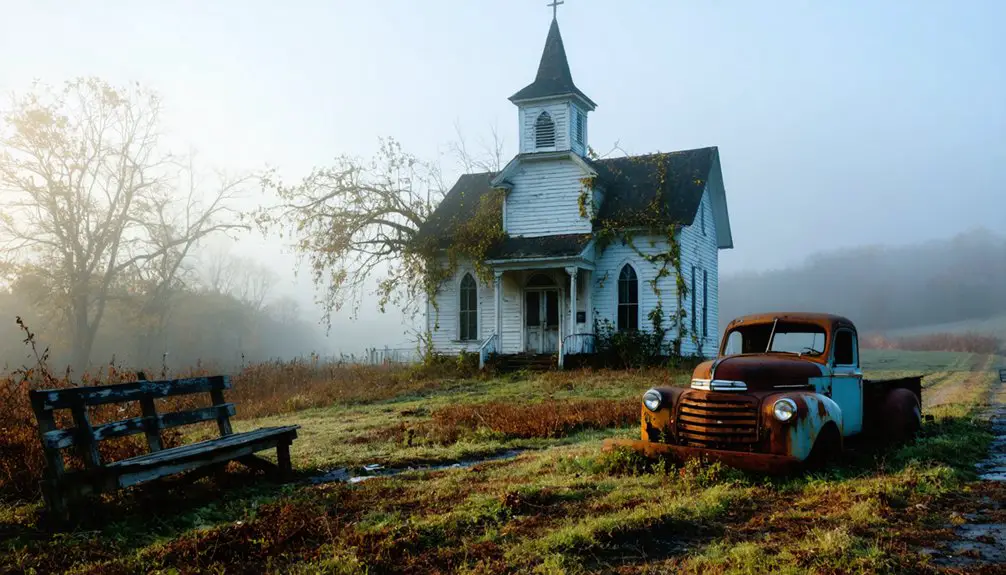
Deep in the shadows of the Manhattan Project’s K-25 uranium enrichment facility stands George Jones Memorial Baptist Church, the sole survivor of Wheat—a thriving Tennessee community that federal agents erased from maps in 1942.
You’ll find this weathered sanctuary where postmaster Henry Franklin Wheat once established his namesake community in 1881, complete with schools, farms, and peach orchards.
The church’s Wheat History began in 1901 when Rev. George Jones donated 250 acres for the new building.
When government agents offered residents $35-45 per acre with two weeks’ notice, they abandoned everything.
Today’s Ghost Stories tell of unrested souls haunting the cemetery’s 90 graves, visitors hearing slave songs from the African Burial Ground, and mistrustful spirits watching from displaced residents’ anger.
Devonia: Coal Mining’s Rise and Fall
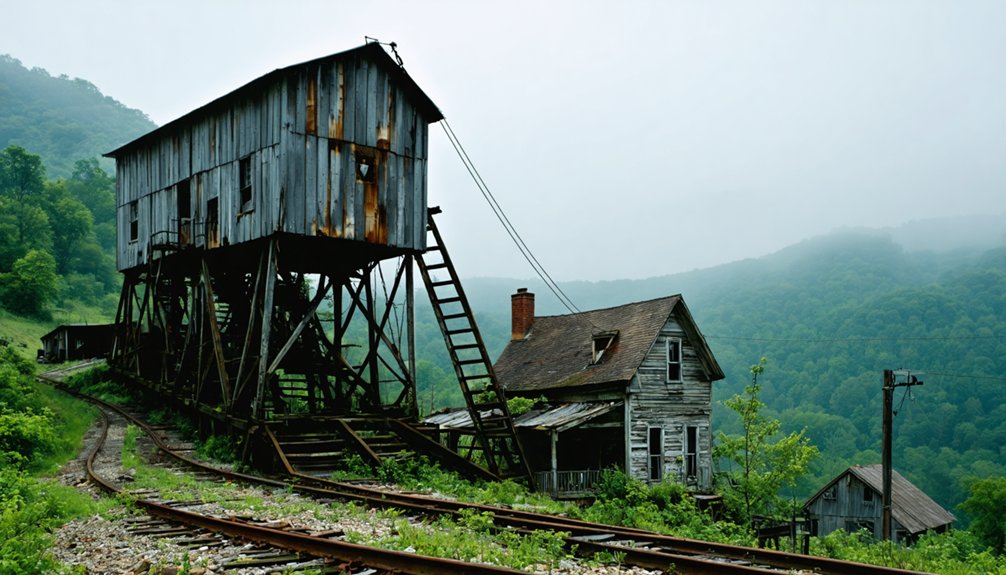
The quiet hills of Anderson County hold the remnants of Devonia, a coal mining camp that rose and fell within the span of just five years during the post-World War II era.
Among Anderson County’s rolling landscape lies the ghost of Devonia, a coal camp that burned bright and brief in postwar America.
You’ll find this former United States Post Office designation, also called Moore’s Camp, represents Tennessee’s brief but intense postwar mining boom. The Trimore Coal Corporation established operations here in 1948, extracting bituminous coal from Cumberland region deposits.
When you explore Devonia’s history, you’ll discover:
- Workers received company scrip valued at 50¢ for camp transactions
- The Baldwin Coal Preparation Plant processed extracted coal
- Mining families lived in company-provided housing and facilities
- Operations connected to growing industrial and railroad demands
Economic decline forced Trimore’s closure in 1953, transforming this bustling camp into another Appalachian ghost town.
Loyston: Sacrificed for Progress and Power
Beneath the tranquil waters of Norris Lake lies Loyston, a Tennessee community that paid the ultimate price for New Deal progress.
You’ll find this Union County settlement’s Loyston history begins in the early 1800s when seventy residents built lives around a foundry and farming community. Originally called Loys Crossroads, it evolved into a thriving hub with churches, schools, and businesses by the 1930s.
Then came the Tennessee Valley Authority‘s Norris Dam project in 1936. You can’t imagine the upheaval as government officials forced entire families from their homes, scattered them across East Tennessee, and submerged their community forever.
The Loyston legacy emerges during droughts when foundations, roads, and remnants surface, reminding visitors that progress sometimes demands devastating sacrifice from those who never consented.
The Role of Government Projects in Creating Ghost Towns
Loyston’s submersion represents just one chapter in a larger pattern of government-mandated displacement across Tennessee. Throughout the 1940s, federal agencies wielded eminent domain to seize private property, erasing entire communities for wartime projects.
Government intervention fundamentally reshaped Tennessee’s landscape through these major initiatives:
- Manhattan Project – Oak Ridge expanded from 1,000 to 75,000 residents while Wheat community vanished entirely for nuclear weapons development.
- TVA Dam Projects – Fontana Dam displaced families across 68,000 acres, while Kentucky Lake flooded Perryville completely.
- Army Corps Dams – Dale Hollow and Cumberland River projects submerged valleys, leaving only school foundations visible during droughts.
- Forced Relocations – Jefferson community was burned and demolished despite reservoirs never reaching projected levels.
The community impact proved devastating as families lost generational lands, often receiving inadequate compensation for their sacrificed heritage.
Preserving Tennessee’s Abandoned Heritage
While government projects erased countless Tennessee communities, preservation efforts have emerged to protect the state’s remaining abandoned heritage from complete disappearance.
You’ll find the most thorough example at Elkmont Ghost Town, where the National Park Service initially planned total demolition after 1992 lease expirations left seventy buildings abandoned.
Heritage preservation advocates successfully challenged these plans, securing National Register listing for historic cottages. Friends of the Smokies established a nine-million-dollar endowment, demonstrating powerful community engagement in protecting Appalachian history.
You can now explore sixteen restored buildings, including the relocated Levi Trentham Cabin and Appalachian Clubhouse.
These efforts prove you don’t have to accept government decisions as final—organized citizens can preserve their cultural legacy.
Frequently Asked Questions
Are There Any Ghost Towns in Tennessee That Visitors Can Legally Camp Overnight?
You can’t legally camp overnight in Tennessee’s ghost towns since camping regulations require designated sites with proper ghost town amenities, which these abandoned locations lack according to state property management archival sources.
Which Tennessee Ghost Towns Are Considered the Most Dangerous to Explore Alone?
You’ll find Tennessee State Prison and Brushy Mountain Penitentiary among the most dangerous locations due to crumbling structures and restricted access. Take essential safety precautions including proper gear and never explore these unstable facilities alone.
What Items Can Legally Be Collected or Taken From Tennessee’s Abandoned Settlements?
You can’t legally take collectible artifacts from Tennessee’s abandoned settlements without landowner permission—it’s a Class A misdemeanor. Legal restrictions protect registered sites completely. Only surface items like bottles require written consent first.
Do Any Tennessee Ghost Towns Still Have Active Cemeteries With Recent Burials?
You’ll find most Tennessee ghost towns maintain only historical cemeteries without active burial sites. These abandoned settlements preserve their historical significance through existing graveyards, but they don’t accommodate new interments in modern times.
Exploring abandoned towns in Tennessee can reveal fascinating stories of the past, as many structures remain standing, offering a glimpse into the life that once thrived there. The architecture often tells a tale of resilience against time, while the quiet streets echo the memories of former residents. Visitors are drawn to these sites not just for their eerie ambience, but also for the unique piece of history they represent.
Among these locations, you’ll discover abandoned towns near Memphis Tennessee that capture the imagination with their intriguing pasts. Each site holds remnants of a vibrant community life, inviting exploration into the stories that shaped them. As you wander through the quiet streets and crumbling facades, you’ll feel a connection to the generations that once called these towns home.
Which Ghost Towns Offer the Best Opportunities for Paranormal Investigation Activities?
Like moths drawn to flame, you’ll find Bell Witch Cave and Elkmont offer prime paranormal hotspots where investigation equipment captures unexplained phenomena. These documented sites provide freedom to explore America’s most authenticated supernatural encounters firsthand.
References
- https://en.wikipedia.org/wiki/List_of_ghost_towns_in_Tennessee
- https://www.onlyinyourstate.com/experiences/tennessee/tn-ghost-towns
- https://www.wanderingsmokymountains.com/smoky-mountain-ghost-towns-in-tennessee/
- https://kids.kiddle.co/List_of_ghost_towns_in_Tennessee
- https://www.tnmagazine.org/19-ghost-towns-in-tennessee-that-are-not-underwater/
- https://freepages.rootsweb.com/~gtusa/history/usa/tn.htm
- https://www.loveproperty.com/gallerylist/91679/tour-the-abandoned-tennessee-ghost-town-where-millionaires-vacationed
- https://en.wikipedia.org/wiki/Elkmont
- https://gatlinburghaunts.com/elkmont-tennessees-ghost-town/
- https://www.visitmysmokies.com/blog/smoky-mountains/about-elkmont-ghost-town/