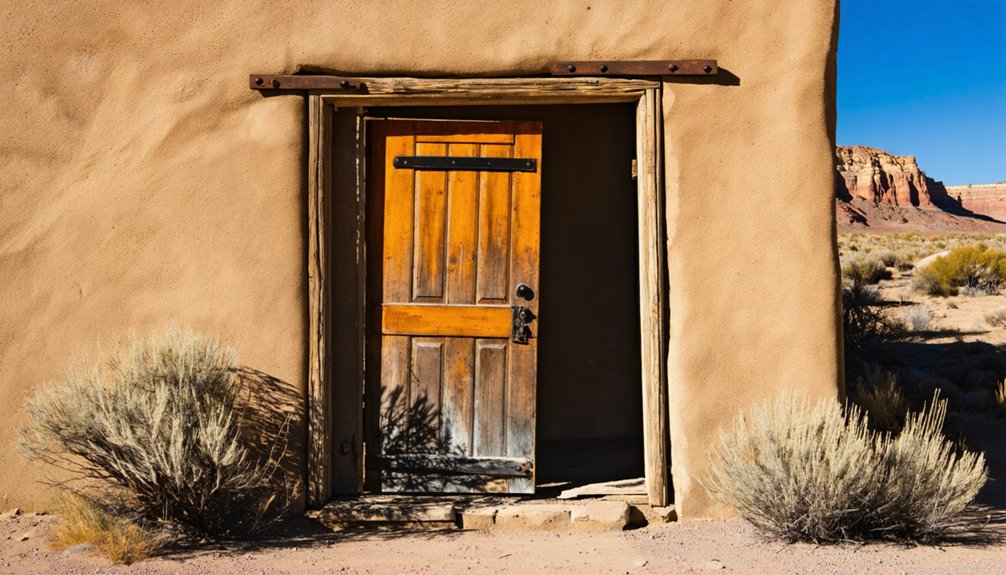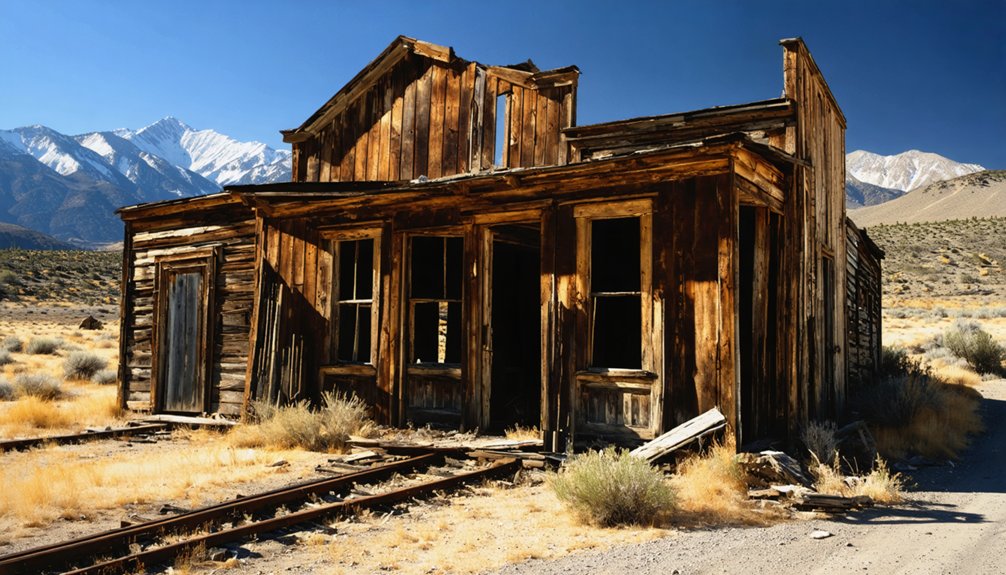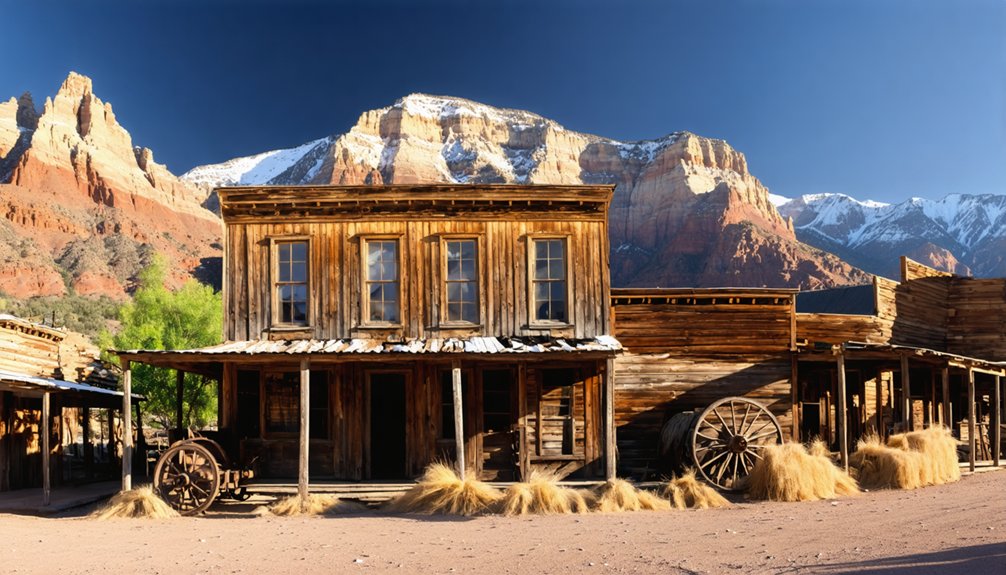
You’ll discover Utah’s most famous ghost towns scattered across its desert landscape, each telling unique stories of boom and bust. Grafton, established in 1859, became the state’s most photographed ghost town after floods and hardships drove out Mormon settlers. Silver Reef defied experts by producing $25 million in silver from sandstone between 1875-1901. Frisco boasted 23 saloons and 6,000 residents during its wild mining heyday, while Sego’s coal operations employed 150 miners by 1928. These haunting remnants reveal fascinating details about Utah’s turbulent frontier past.
Key Takeaways
- Grafton is Utah’s most photographed ghost town, featuring crumbling adobe walls and an 1886 schoolhouse from Mormon pioneer settlement.
- Silver Reef produced $25 million in silver ore from sandstone formations, supporting over 2,000 residents during its mining boom.
- Frisco was a Wild West boomtown with 23 saloons and 6,000 residents before silver mine cave-ins ended operations.
- Old Irontown featured beehive-shaped charcoal kilns and produced seven tons of iron daily until economic forces closed operations in 1876.
- Sego thrived as a coal mining town producing 1,500 tons daily until railroads switched to diesel in the 1950s.
Grafton: A Pioneer Settlement Turned Cinematic Icon
Grafton stands as Utah’s most photographed ghost town, where crumbling adobe walls and weathered wooden structures tell the story of a pioneer settlement that couldn’t overcome nature’s relentless challenges.
You’ll find this cinematic icon nine miles from Zion National Park, where Mormon families established Wheeler in 1859 before floods forced relocation and renaming in 1862.
Pioneer hardships defined Grafton’s existence—repeated flooding destroyed crops, Native conflicts claimed lives during the 1866 Black Hawk War, and limited farmland drove families away. The construction of the Hurricane Canal in 1906 prompted many remaining families to migrate to Hurricane for better agricultural opportunities.
You can explore the 1886 adobe schoolhouse and cemetery containing graves from 1860-1910. The Grafton Heritage Partnership works to preserve and stabilize the remaining structures for future generations.
The town’s featured in films since 1929’s “In Old Arizona” and served as Butch Cassidy’s hideaway.
Ghost sightings persist, including reported apparitions of 1866 accident victims witnessed in 1927.
Silver Reef: Utah’s Sandstone Silver Mining Marvel
While Grafton’s farmers battled floods and failed harvests, prospectors in nearby sandstone formations struck an extraordinary geological discovery that would create Utah’s most unlikely mining boom.
While desperate farmers faced ruin from nature’s wrath, fortune-seekers unearthed silver treasures that defied all geological expectations.
When John Kemple spotted shining streams from overheated rock in 1866, he’d unknowingly discovered silver in sandstone—a geological anomaly that experts deemed impossible.
Silver Reef’s remarkable story includes:
- William Barbee’s 1875 claims on White and Buckeye Reefs that launched the boom
- Over 2,000 residents by late 1870s with nine saloons, opium dens, and a horse track
- $25 million in ore production from 450 mine openings before 1901’s final closure
- Deadly mining conditions causing frequent collapses and two dozen documented fatalities
The town’s Main Street became notorious for shootouts at establishments like The Cosmopolitan Saloon, where gunfights between outlaws and lawmen were commonplace. Today’s silver mining legacy lives through ghost stories including the mysterious Lady in Blue specter and Sister Mary Dominic’s rumored poisoning.
The town transformed from the original name Bonanza City to Silver Reef by February 1877, reflecting the area’s growing reputation as a major silver-producing district.
Frisco: The Wild West Boomtown of Beaver County
The thunderous collapse that shook the ground for miles around Milford on February 12, 1885, marked the beginning of the end for Utah’s most notorious mining boomtown.
You’d find Frisco’s legacy rooted in silver discovery within San Francisco Mountains in 1875, when the Horn Silver Mine attracted over 6,000 residents seeking fortune.
The town’s Wild West lawlessness earned it infamy as the Great Basin’s wildest settlement, featuring 23 saloons and daily murders that filled Boot Hill cemetery. Sheriff William Pearson was hired to restore order and allegedly shot six outlaws on his first night to instill fear in the lawless community.
By 1885, mines had produced over $60 million in precious metals before catastrophic cave-ins halted operations.
Population plummeted from thousands to mere dozens by 1912, leaving behind beehive charcoal kilns and scattered ruins in Beaver County’s juniper hills. Today, these historic charcoal kilns stand as registered landmarks on the National Register of Historic Places, serving as enduring monuments to the town’s industrial heritage.
Old Irontown: Cedar City’s Industrial Mining Legacy
You’ll find Old Irontown twenty-five miles west of Cedar City, where Utah’s ambitious 1868 iron mining venture created the state’s most significant 19th-century industrial operation.
The settlement’s beehive-shaped charcoal kiln stands as the most visible remnant of an enterprise that once produced seven tons of iron daily and supported nearly 100 residents by 1870.
Today’s preserved ruins within Dixie National Forest showcase the Iron Mountain mining complex that shipped iron throughout southern Utah before economic forces shuttered operations in 1876. The community included essential infrastructure such as a boarding house, general store, butcher shop, and post office that served the mining families. The site is located just 35 miles from Zion National Park’s Kolob Canyons entrance, making it an accessible historical detour for visitors exploring southern Utah’s natural attractions.
Iron Mountain Mining Operations
Discovery sparked Utah’s ambitious iron industry when a Mormon scouting party found iron ore deposits in 1849, setting in motion a decades-long effort to establish mining operations in Iron County.
You’ll find Iron Mountain’s mining techniques evolved dramatically from primitive ox-drawn wagon transport to sophisticated railroad operations. The LA&SL Cedar City Branch, completed in 1923, revolutionized ore extraction capabilities.
Major operational milestones include:
- Utah Iron Ore Corporation’s formation (December 24, 1923) launched Desert Mound’s open pit operations.
- Columbia Steel’s acquisition (1925) secured millions of tons of 58% iron hematite reserves.
- World War II peak production saw 1,235,000 tons shipped in 1944 from Pinto Pit.
- Total district output reached 72,136,297 long tons by 1965.
The Ironton plant operated from 1924 to 1966, producing only pig iron that was shipped to blast furnaces in California and Geneva. The operation utilized hot fluids from mid-Tertiary intrusions that formed the high-grade magnetite and hematite deposits throughout the district.
Today, CML Metals Corporation maintains the site in care status, marking the end of active iron ore production.
Beehive Charcoal Oven Heritage
Following the earlier iron ore discoveries, Brigham Young’s ambitious vision for Utah’s iron industry materialized when he dispatched Mormon families to establish the Deseret Iron Company near Cedar City in 1851.
You’ll find the remarkable beehive design kilns that powered this operation, featuring dome-shaped structures with 15-24 foot base diameters and parabolic tops reaching 19-22 feet high.
These ingenious brick ovens used charcoal production methods where juniper and pinyon pine smoldered in oxygen-free environments for 12 days, producing 50 bushels of charcoal per kiln—enough fuel for one ton of iron ore.
Though operations ceased in 1876 due to transportation challenges, you can explore these preserved ruins today through Iron Mission State Park‘s self-guided trail.
Dixie Forest Historical Remnants
- Intact beehive-shaped charcoal kiln – Essential for smelting operations that produced seven tons of iron daily.
- Original arrastra grinding device – Used for processing ore with primitive but effective technology.
- Schoolhouse and foundry foundations – Remnants of community infrastructure supporting 19 families.
- Pioneer cabin ruins – Evidence of domestic life during peak operations when monthly payrolls reached $4,000.
The Union Iron Company’s venture ultimately succumbed to eastern rail competition and shipping costs, leaving behind these preserved remnants accessible via self-guided trails.
Sego: Coal Mining Heritage in Canyon Country
Hidden among the rugged canyon country near the Book Cliffs, Sego emerged from Harry Ballard’s discovery of an anthracite coal seam in the early 1890s on land adjacent to his ranch in Thompson Springs.
You’ll find this coal mining operation began modestly when Ballard constructed a five-mile railroad spur requiring over a dozen bridges across canyon washes.
After selling to American Fuel Company in 1912, the town flourished. By 1928, you’d witness Utah’s busiest coal camp producing 1,500 tons daily with 150 miners.
The operation changed hands multiple times through ownership struggles and flash flood damage. When railroads switched to diesel in the 1950s, demand plummeted.
Eureka: a Semi-Ghost Town With Living History

You’ll discover Eureka stands apart from Utah’s other ghost towns because it retains a living population of around 600 residents while preserving its rich mining heritage from the 1870s silver boom.
The town’s downtown buildings earned National Register of Historic Places designation, showcasing structures like the Old Eureka Jail, Historic City Hall, and the Gatley Building from when Eureka served as the Tintic District’s financial center.
You can explore this mining legacy through the Tintic Mining Museum‘s extensive artifact collection and take self-guided tours using the Eureka Passport available at the Company Store.
Mining Heritage Still Thrives
While most mining camps in Utah’s Tintic Mountains crumbled into dust, Eureka defied the odds and survived as a semi-ghost town where you can still walk through living history.
The town’s mining heritage continues thriving through preserved remnants of its billion-dollar silver and gold legacy.
You’ll discover Eureka’s enduring mining heritage through:
- Underground tunnel networks – Miles of shafts and tunnels from the Big Four mines remain accessible, showcasing original mining techniques used during peak operations.
- Historic mining museum – Displays artifacts from the Tintic District’s reign as America’s top silver producer through Chief Consolidated Mining Company.
- Preserved mining relics – Equipment and structures from lead, copper, gold, and silver operations spanning the Black Dragon, Armstrong, and Martha Washington claims.
- Historical preservation efforts – National Register listing protects the district’s mining legacy for future generations seeking freedom to explore Utah’s authentic past.
Historic Buildings Worth Exploring
Although Eureka’s mining operations defined its economic foundation, the town’s remarkably preserved historic buildings now serve as tangible monuments to its prosperous past.
You’ll discover the Historic City Hall, built in 1899 for $4,400, which housed multiple government offices and still contains period antiques. Locals report regular ghost sightings, adding haunted tales to your exploration.
Behind it stands the Old Eureka Jail with three intact cells from the mining heyday.
The Eureka Company Store operated as the post office from 1894-1922 before becoming a drug store. Today it’s a rock shop offering ‘Eureka Passports’ for town exploration.
The impressive Elks Lodge #711, constructed in 1910 for $30,000, represents the oldest Elks building west of the Mississippi.
Porter Rockwell’s relocated cabin connects you to early Mormon settler history, creating historic landmarks that tell Eureka’s complete story.
Frequently Asked Questions
What Safety Precautions Should Visitors Take When Exploring Utah’s Ghost Towns?
Pack essential safety gear including water, sturdy shoes, and emergency supplies. Maintain wildlife awareness in remote areas. Don’t enter abandoned mines or structures. Stay on marked trails, respect private property, and inform others of your planned route.
Are There Guided Tours Available for Utah’s Most Famous Ghost Towns?
Good things come to those who seek! Yes, guided adventures abound for Utah’s ghost towns. Grafton offers professional tours through Hummer Offroad, while exploration options include Salt Lake City’s walking tours and northern Utah’s extensive day trips.
Which Ghost Towns Allow Camping or Overnight Stays Near the Sites?
You’ll find camping regulations restrict overnight stays at most Utah ghost towns due to private property ownership. However, you can secure overnight permits through nearby RV resorts like Zion River near Grafton for base camping.
What Is the Best Time of Year to Visit Utah’s Ghost Towns?
Fall offers ideal seasonal weather for visiting Utah’s ghost towns with mild temperatures and stunning colors. For photography tips, you’ll capture dramatic lighting during September-November, though you’ll need advance planning due to peak crowds.
Do Any of Utah’s Ghost Towns Charge Admission or Entrance Fees?
Most Utah ghost towns maintain free access policies – you’ll find zero ticket pricing at Grafton and Old Irontown, while Silver Reef offers periodic free admission weeks, supporting your exploration freedom.
References
- https://www.atlasobscura.com/things-to-do/utah/ghost-towns
- https://www.visitutah.com/things-to-do/history-culture/ghost-towns
- https://www.ksl.com/article/51308628/restored-utah-ghost-towns-that-should-be-on-your-summer-travel-bucket-list
- https://www.utahsadventurefamily.com/5-ghost-towns-in-utah-for-families/
- https://www.youtube.com/watch?v=FLdClYRU0bY
- https://www.familysearch.org/en/wiki/Utah_Ghost_Towns
- https://graftonheritage.org/history-settlement/
- https://www.zionredrock.com/post/a-block-away-from-mystery-grafton-ghost-town
- https://zionriversedgeadventures.com/article/the-history-behind-graftons-ghost-town
- https://www.atlasobscura.com/places/grafton-ghost-town