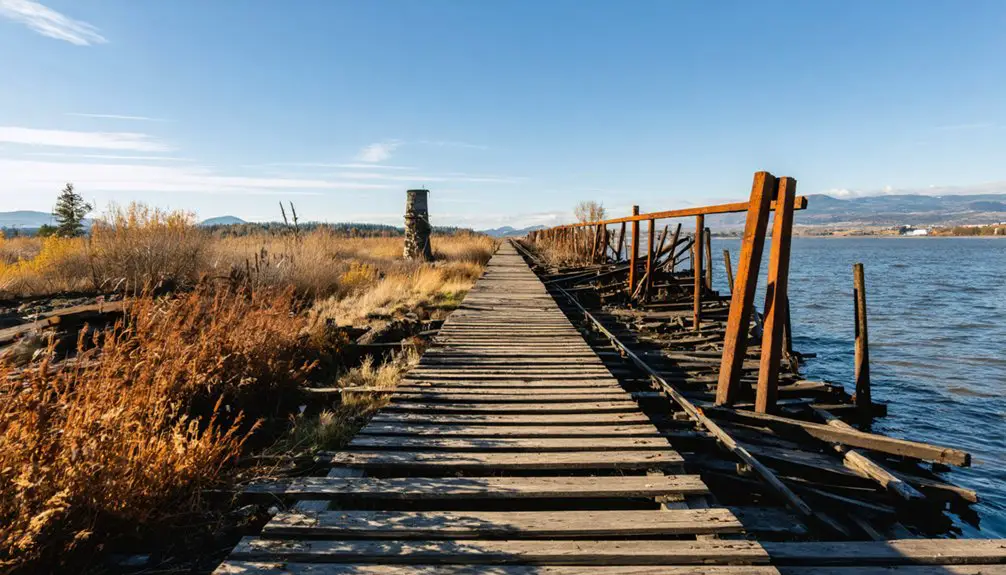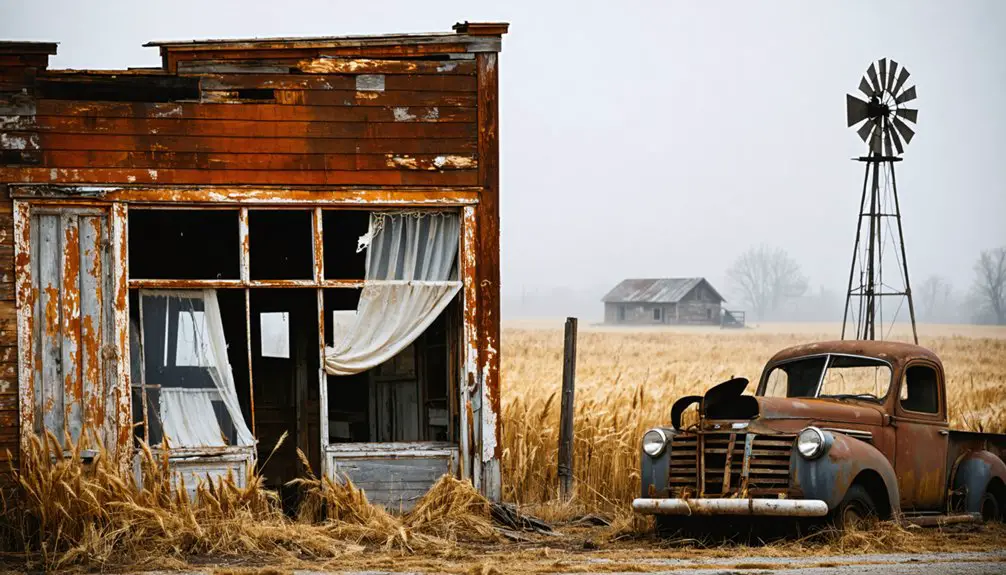
You’ll find Washington’s most famous ghost towns scattered across former mining districts, including Ruby Townsite—once called the “Babylon of the West” with 700 residents by 1888—and Monte Cristo, where John D. Rockefeller’s syndicate controlled gold and silver operations until devastating floods in 1896-1897. Nighthawk preserves its 1915 schoolhouse and hotel, while Old Molson showcases authentic frontier architecture and mining equipment from the early 1900s boom that shaped Washington’s pioneering heritage.
Key Takeaways
- Ruby Townsite served as a county seat in 1888 with 700 residents before silver price collapse led to abandonment.
- Monte Cristo reached over 1,000 residents by 1894 but devastating floods in 1896-1897 destroyed infrastructure and operations.
- Nighthawk operated six concentration mills during the 1903 boom and preserved structures include the hotel and 1915 schoolhouse.
- Old Molson features authentic frontier architecture with preserved buildings showcasing mining equipment and farming machinery from early 1900s.
- Liberty stands as Washington’s oldest mining town from the 1870s and received National Register of Historic Places recognition.
Ruby Townsite: The “Babylon of the West”
When silver glittered on Ruby Hill in spring 1886, it sparked the creation of one of Washington’s most notorious mining camps. You’ll find Ruby’s origins traced to discoverers John Clonan, Thomas Donan, William Milligan, and Thomas Fuller, who located the Ruby Mine’s eighteen-foot-wide ledge yielding $14 per ton in gold and silver.
By 1888, you’d witness 700 residents populating 70 buildings along Main Street. This “Babylon of the West” earned its reputation as a wide-open camp with little regard for law and order.
Ruby briefly claimed county seat status for eleven months in 1888. The town was promoted as the “Comstock of Washington” despite its modest mining success. Declining silver prices and poor ore quality contributed to the town’s eventual downfall.
However, the 1893 silver crash devastated fortunes. Ruby’s mining legacy ended by the early 1900s, leaving only stone foundations visible today in the Okanogan County foothills.
Loomistown: From Trading Post to Mining Hub
The 1890s gold rushes sparked Loomis’s evolution into a booming mining hub.
By 1916, you’d find three stores, a hotel, movie theater, and brewery serving the bustling population.
The Tungsten Mine operated nearby, where legendary trapper Frank Arnold maintained sixty miles of trap lines. Workers earned varying wages, with laborers receiving $2.00 daily while carpenters and miners made $2.75 for eight hours of work.
Frank Arnold’s legendary sixty-mile trap line network operated from the Tungsten Mine, establishing him as the region’s most renowned wilderness trapper.
Like other mining communities of the era, declining metal values eventually forced operations to close due to rising costs.
- Three stores and multiple businesses operated during 1916’s peak prosperity
- Tungsten Mine featured extensive trapping operations with six cabins
- Catholic priest Father Sherman served the community
- Town declined post-mining boom, returning to cattle-raising focus
Nighthawk: A Registered Historic Ghost Town
Forty years before its official platting, Nighthawk bustled with 3,000 miners who’d established a sprawling tent town by 1865 in one of Washington Territory’s oldest mining districts.
You’ll discover Nighthawk history rooted in this mineral belt settlement that developed around a strategic ferry crossing east of Miner’s Bend.
The Nighthawk Realty Co. officially platted the town November 18, 1903, transforming chaos into order.
During the 1903 boom, you’d have witnessed six concentration mills operating while the Vancouver, Victoria, & Eastern Railroad connected Nighthawk to Oroville around 1900. J.M. Hagerty constructed the Nighthawk Hotel in 1903, providing accommodations for the growing mining community.
Today, you can explore this registered historic ghost town‘s preserved structures, including the rebuilt Nighthawk Hotel, 1915 schoolhouse, and mining office. The town shares its name with nighthawk birds, which belong to the family Caprimulgidae and are known for their distinctive dawn and dusk feeding patterns.
This mining legacy stands as a tribute to Okanogan County’s frontier spirit and entrepreneurial determination.
Old Molson: Preserved Buildings and Mining Equipment
You’ll discover Old Molson’s remarkably preserved buildings that showcase authentic frontier architecture, including the original bank built on skids and pioneer cabins staged with period artifacts.
The ghost town displays well-maintained mining equipment and traditional farming machinery that tell the story of Okanogan County’s mining heyday from the early 1900s boom. The Poland China Mine operated intermittently for four decades, shipping ore across the border to Trail, British Columbia.
You can explore the Molson School Museum and other historic structures where black-and-white photographs and mining tools provide glimpses into the daily lives of the 300 residents who once called this border town home. The town was established with an initial investment of $170,000 by Canadian business magnate John Molson in 1900.
Historic Buildings Still Standing
Key structures you can explore include:
- Old Molson Bank Building – Original banking structure with period staging and historical photographs
- Pioneer Homestead Cabins – Walker and Odell buildings from 1900-1906 with authentic furnishings
- Assay Office – Highly photographed mining-era structure displaying operational artifacts from the Poland China mine donated in memory of Dwight W. Dart
- Law Office and Saloon – Complete Old West town elements with donated historical items displaying fascinating farming machinery alongside traditional western artifacts
Authentic Mining Equipment Display
Beyond the preserved structures, Old Molson’s outdoor exhibits showcase an impressive collection of authentic mining equipment that tells the story of the region’s industrial past.
You’ll discover remnants from the Buckeye Mine’s twenty-stamp mill, built in 1904 and operated for short summer runs. The Poland China Mine’s eight-stamp mill artifacts represent four decades of on-and-off operations, with ore shipped to Trail, British Columbia’s smelter.
Mining artifacts fill the machine shed alongside antique farm equipment, though most lack descriptive tags. The assay office displays ore processing equipment from early 1900s operations.
Harry Sherling established this outdoor pioneer collection in 1960, emphasizing historical preservation through full-scale buildings and mining gear. You can explore year-round during daylight hours, experiencing authentic remnants of Washington’s mining heritage firsthand.
Molson School Museum Features
The centerpiece of Old Molson’s preserved structures stands as a three-story brick schoolhouse that educated local children from the early 1900s until its final closure at the end of the 1968-1969 school year.
You’ll discover classroom exhibits that transport you back to frontier learning, where the first and second-grade room remains frozen in time from its final day of operation. The original school library displays books and materials used during the operational period, giving you authentic insights into pioneer education practices.
- Restored classroom preserved as time capsule – Setup exactly as it appeared on the last day of classes
- Original school library collection – Books and educational materials from the operational school years
- Hand tools display – Pioneer daily life implements sorted by dedicated volunteers
- Free admission year-round – Open Memorial Day through Labor Day, donations welcomed
Monte Cristo: Rockefeller-Backed Mining Empire
When Joseph Pearl and Frank Peabody discovered gold and silver in the remote Cascade Mountains in 1889, they couldn’t have imagined their find would attract one of America’s wealthiest industrialists.
By 1891, John D. Rockefeller‘s syndicate Colby and Hoyt had seized control of Monte Cristo’s prime properties, including the Pride and Mystery mines. This Rockefeller influence transformed a wilderness camp into Washington’s first major mining operation on the Cascade Range’s west slopes.
Eastern capital fueled explosive growth. The town reached over 1,000 residents by 1894, complete with railway connections to Everett.
However, devastating floods in 1896-1897 crippled infrastructure, while erratic ore bodies and avalanches plagued operations. Monte Cristo’s mining legacy ended in 1920, leaving behind a ghost town accessible only by hiking eight miles from Barlow Pass.
Govan: Railway Town With a Dark Past
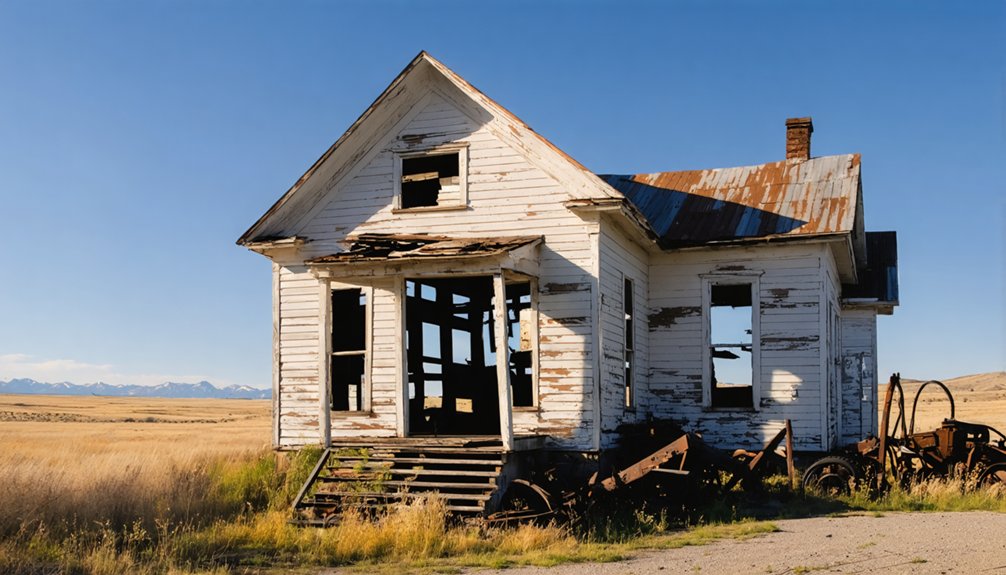
Unlike Monte Cristo’s mineral riches, Govan emerged from humbler beginnings as a railway station on the Central Washington Railway in 1889.
Named after a local landowner, this sheep and cattle ranching community grew from 33 residents in 1890 to a thriving farming town with schools, churches, and businesses by the early 1900s.
However, Govan’s Murders would forever stain its reputation. December 1902 brought Washington’s most grisly unsolved crime when Judge J.A. Lewis and his wife were hacked to death with an ax.
Additional killings followed, creating Ghostly Legends that persist today.
- Three brutal, unsolved murders between 1902-1941
- 1927 fire destroyed the entire business district
- Highway 2’s construction in 1933 bypassed the town
- Current population: just 3 residents in 2019
Exploring Washington’s Mining Heritage
You’ll discover Washington’s mining heritage through towns that rose during the 1860s-1900s gold and copper rushes, when prospectors flooded the Cascade Mountains and Okanogan County seeking fortune.
These boom towns operated massive precious metal extraction operations, with places like Nighthawk running six concentration mills by 1903 and Liberty becoming the center of the 1870s state Gold Rush.
Economic decline hit when ore deposits depleted and operating costs soared, forcing complete abandonment of once-thriving communities that had invested millions in mining infrastructure.
Mining Boom Towns Rise
As Washington Territory emerged in the 1860s, prospectors discovered rich mineral deposits throughout the Cascade Mountains and Okanogan County that would transform remote wilderness areas into bustling mining communities.
The Historic Gold Rush began with Liberty’s establishment as Meaghersville in the 1870s, featuring crystalline wire gold nuggets formed 15 million years ago. By 1900, entrepreneurs like George Meacham founded Molson with John Molson’s $170,000 investment, reaching 300 residents at its peak.
Mining Claim Consolidation created substantial operations—Copper City Rise consolidated 42 claims into the Copper Mining Company by 1910, while Palmer Mountain’s mile-long tunnel and concentrating mill demonstrated industrial mining’s scale.
- Liberty became Washington’s oldest mining town, now on the National Register of Historic Places
- Nighthawk operated six concentration mills during its 1903 boom period
- Chesaw expanded to 40 buildings and substantial boomtown status by 1910
- Loomis roared with Black Bear Mill, eight saloons, and three dance halls
Precious Metal Operations
Washington’s precious metal operations began with Captain George McClelland’s party discovering gold in the Yakima River valley in 1853, launching decades of systematic mineral extraction across the territory.
You’ll find that placer mining dominated early efforts, with prospectors working streams throughout Okanogan, Whatcom, Chelan, and Kittitas counties during the 1850s-1880s. Most gold came from these placers before 1900, but they contributed only 2% of total production afterward.
As surface deposits exhausted, miners shifted to lode extraction in the early 1870s. Major districts emerged including Republic in Ferry County, Wenatchee, Blewett, and Monte Cristo.
The Holden Mine exemplified this shift, producing 514,000 ounces as copper byproduct until 1957. Washington ultimately yielded $9 million during its peak period from 1860-1866.
Economic Decline Abandonment
Mining operations that once generated millions in wealth couldn’t withstand the mounting economic pressures that emerged across Washington’s territories by the early 1900s.
You’ll discover that economic factors systematically dismantled these once-thriving communities through a devastating combination of circumstances.
Washington’s mining history reveals how quickly prosperity can vanish when multiple pressures converge:
- Rising operational costs made mining unprofitable in towns like Nighthawk and Monte Cristo by 1907.
- Plummeting metal prices after the 1903 boom eliminated economic viability for precious metal operations.
- Infrastructure improvements like Highway 2 diverted commerce away from remote mining settlements.
- Single-industry dependency left communities vulnerable when their sole economic driver collapsed.
Natural disasters accelerated abandonment.
Melmont’s devastating 1920s fire destroyed buildings already weakened by economic decline, while railroad shifts from steam to diesel eliminated coal demand entirely.
What Remains: Structures and Artifacts
The remnants of Washington’s ghost towns tell stories through weathered structures and scattered artifacts that have endured decades of abandonment.
Among these abandoned mining towns in Washington, one can often find rusted mining equipment and crumbling buildings that hint at a once-thriving industry. Visitors may feel a sense of nostalgia as they wander through these deserted streets, imagining the lives once lived in these now-silent communities. Each site serves as a poignant reminder of the economic booms and busts that shaped the region’s history.
You’ll discover Claquato artifacts including the Methodist church’s original bell and crown of thorns steeple, restored in the 1950s, alongside a cemetery’s famous fir tree that sheltered pioneers.
Melmont foundations reveal schoolhouse basements and building remnants along abandoned rail grades, where you’ll find decaying vehicles scattered throughout the 6-mile trail system.
In Bodie, high-quality ore milling remnants from 1888-1930s operations mark mining town foundations, while Liberty preserves Thomas Meagher’s original cabin and mining equipment.
Govan’s deteriorating post office and 1940s schoolhouse attract photographers seeking authentic decay, representing the agricultural decline that followed Highway 2’s construction era.
Accessing Remote Ghost Town Locations
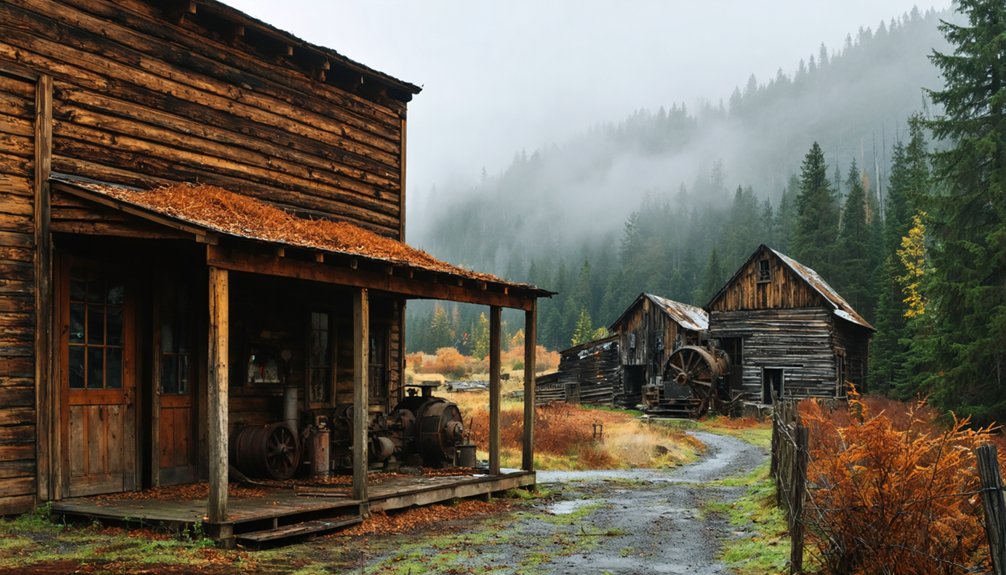
While these historic remnants capture your imagination, reaching Washington’s ghost towns requires careful planning since many occupy remote locations far from major highways.
Access routes vary dramatically depending on your destination and physical capabilities.
Access routes vary dramatically depending on your destination and physical capabilities.
Hiking Challenges by Difficulty Level:
- Easiest Access: Copper City requires only a 0.5-mile walk with 27 feet elevation gain to reach collapsed mining buildings
- Moderate Effort: Franklin Ghost Town involves a 2.5-mile gentle railroad grade walk with 200 feet elevation gain
- Pastoral Strolls: Northern State features 5-mile trails with minimal 50 feet elevation gain through designated recreation areas
- Most Demanding: Monte Cristo requires an 8-mile roundtrip hike including one log crossing, though elevation gain remains minimal
You’ll find border towns like Molson and Nighthawk more accessible by vehicle, while mountain locations demand proper hiking preparation and weather considerations.
Preservation Efforts and Historical Significance
Across Washington’s scattered ghost towns, dedicated preservationists have transformed crumbling remnants into protected historical sites that tell the story of the state’s pioneering past.
You’ll discover preservation strategies that began in Molson during the 1960s, where volunteers converted abandoned buildings into museums showcasing frontier artifacts and mining equipment. Liberty earned National Register recognition in 1974, preserving its 1870s Gold Rush legacy as Washington’s oldest mining town.
These historical narratives come alive through interpretive displays and guided experiences. At Claquato, you can visit Washington’s oldest standing church, complete with its original bell and crown of thorns steeple.
Documentation efforts by individuals like Tim Nyhus guarantee these stories survive for future generations, while organizations like Washington Trust provide grants supporting ongoing preservation work.
Frequently Asked Questions
Are There Guided Tours Available for Washington’s Ghost Towns?
Like Scrooge’s spectral visitors, you’ll find guided tour options throughout Washington’s ghost town history. Tim Nyhus leads explorations, Boom Towns & Relic Hunters offers daylong adventures, and Hanford provides historical experiences exploring abandoned settlements.
What Safety Precautions Should Visitors Take When Exploring These Abandoned Sites?
You’ll need proper footwear for muddy terrain, avoid entering unstable structures, carry navigation tools and water, watch for mine shafts, and respect ghost town safety protocols during urban exploration adventures.
Can Visitors Camp Overnight Near Any of These Ghost Towns?
You can’t camp directly at these ghost towns due to camping regulations, but you’ll find dispersed camping on surrounding national forest lands and nearby accommodations in towns like Oroville and Sedro-Woolley.
Which Ghost Towns Are Most Suitable for Families With Young Children?
You’ll find Liberty, Franklin, and Northern State offer prime family friendly attractions with Instagram-worthy educational activities. These sites feature interpretive trails, accessible paths, and hands-on history exploration that’ll captivate kids while teaching Washington’s mining heritage.
What Is the Best Time of Year to Visit These Locations?
You’ll find spring and fall offer the best seasons for exploring Washington’s ghost towns. Weather considerations include fewer crowds, clearer artifact visibility, and comfortable temperatures that support extended historical exploration without summer’s dense vegetation.
In addition to optimal exploring conditions, annual festivals in Washington ghost towns bring unique opportunities to experience local culture and history. These events often feature reenactments, craft fairs, and guided tours that add an immersive element to your visit. Don’t miss the chance to engage with other history enthusiasts and discover the captivating stories behind these abandoned settlements.
References
- https://okanogancountry.com/ghost-towns
- https://stateofwatourism.com/ghost-towns-of-washington-state/
- https://en.wikipedia.org/wiki/List_of_ghost_towns_in_Washington
- https://www.youtube.com/watch?v=FVveO9uJBvc
- https://www.cascadeloop.com/ghost-towns-and-haunted-places-in-the-washington-cascades
- https://www.youtube.com/watch?v=rsV_cHE7u1U
- http://www.ghosttownsusa.com/ruby2.htm
- https://ns3.ghosttowns.com/states/wa/ruby.html
- https://www.jstor.org/stable/40486432
- http://www.ghosttownsusa.com/bttales55.htm