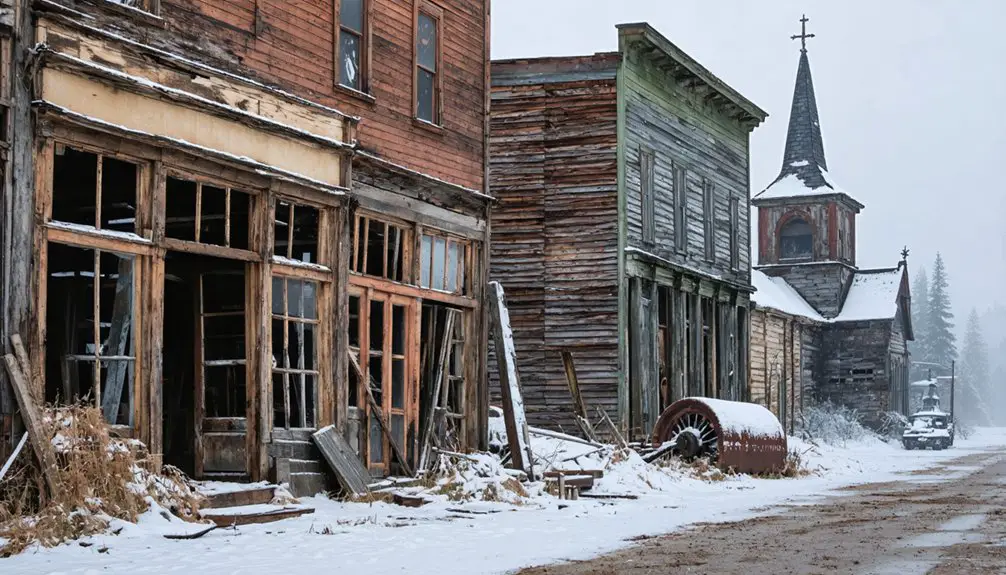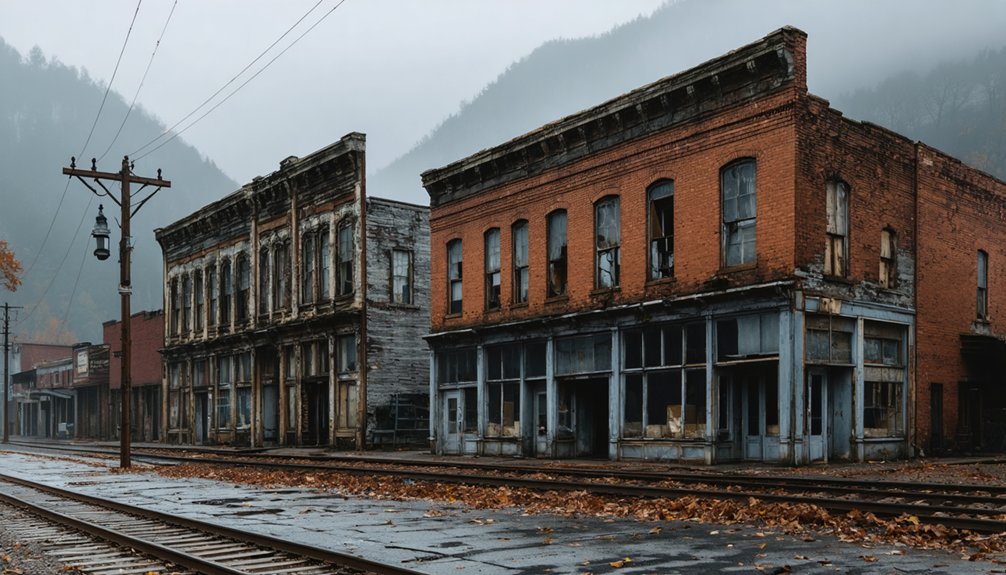
You’ll find West Virginia’s most famous ghost towns scattered throughout its coal mining regions, including Thurmond with just four remaining residents, Nuttallburg where Henry Ford once operated the world’s largest incline tipple, and Kaymoor with its legendary 821-step Miners Trail. These abandoned communities from the late 1800s and early 1900s showcase company housing, coke ovens, and mining infrastructure that once supported thousands of workers and their families during the state’s coal boom era.
Key Takeaways
- Thurmond, established in 1873 as a railroad junction, peaked at 500 residents but now has only four inhabitants.
- Nuttallburg was a coal town acquired by Henry Ford in 1919-1920 and is now a National Historic Site.
- Sewell operated from the 1870s until 1956, featuring nearly 200 coke ovens for smokeless coal production.
- Kaymoor housed 800-1,500 workers from 1899-1962 and features the famous 821-step Miners Trail to preserved ruins.
- Stotesbury operated West Virginia’s first mechanized longwall mining operation until closing in 2002 due to unsafe conditions.
Thurmond: The Railroad Town That Time Forgot
Nestled along the New River’s north bank, Thurmond stands as one of West Virginia’s most fascinating ghost towns, where the echoes of steam locomotives and coal commerce still whisper through abandoned streets.
You’ll discover Thurmond history began in 1873 when Captain William Thurmond surveyed this strategic railroad junction. By the 1920s, you’d have witnessed more coal passing through here than Cincinnati, with eighteen train lines serving the only refueling stop across seventy-three miles.
You can explore preserved Thurmond architecture today, including the restored depot that serves as a seasonal visitor center. The town reached its peak population of nearly 500 residents in 1930, with 40% employed by the railroad.
The town’s dramatic rise and fall—from prohibition-era prosperity to notorious lawlessness, devastating fires, and ultimate abandonment—creates a compelling narrative of American industrial heritage frozen in time. Today, Thurmond has approximately four remaining residents, making it the least-populous municipality in West Virginia.
Nuttallburg: Henry Ford’s Coal Mining Legacy
Beyond Thurmond’s railroad junction, the New River Gorge harbored another industrial marvel that would capture the attention of America’s most famous automaker.
You’ll discover Nuttallburg’s transformation from John Nuttall’s 1870 coal venture into Henry Ford’s ambitious enterprise. When Ford acquired the operation in 1919-1920, he revolutionized Nuttallburg history through massive modernization efforts.
Fordson operations replaced traditional pick mining with four full-time machines, constructing the world’s largest incline tipple and a 1,385-foot conveyor system. Ford’s investment transformed 49 workers into producers of 45,000 tons yearly, eventually reaching over 171,000 tons under subsequent ownership.
Though operations ceased in 1958, you can still explore America’s most intact coal-mining complex, now preserved as a National Historic Site. The town attracted immigrants and freed African American slaves who sought employment opportunities in this thriving industrial community. The miners extracted coal from the Sewell coal seam, which measured 3½ feet thick and produced the highly coveted smokeless coal prized for its high carbon content.
Sewell: Where Coal Became Coke in the 1870s
While Henry Ford modernized Nuttallburg with cutting-edge machinery, another New River Gorge community had already pioneered the region’s most essential industrial innovation decades earlier.
You’ll discover that Sewell history began in the 1870s when the Longdale Iron Company recognized the area’s potential for transforming coal into coke. They built the Gorge’s first coke ovens in 1874—fifty beehive-design structures that expanded to nearly 200 by the operation’s peak.
Sewell’s coal production centered on mining the low-volatile “smokeless” coal seam that bears the town’s name. The Chesapeake and Ohio Railway mainline provided crucial transportation infrastructure for moving coal and coke from the mining operations.
Underground operations reached 400-500 feet deep, extracting coal with 15,000 BTU energy content. This coal burned in those ovens until 1956, making Sewell the industrial heart that powered regional development and freed miners from dependence on distant fuel sources. The town’s strategic location at the CSX depot was chosen for its flat area between the river and steep mountainside, making it ideal for coal transportation operations.
Kaymoor: The 821-Step Journey to Mining History
When the Low Moor Iron Company established Kaymoor in 1899, they created what would become one of the New River Gorge‘s most enduring mining operations—a community that defied the typical 25-year coal town lifespan by operating for 62 years until 1962.
Named after company official James Kay, this unique settlement split between Kaymoor Bottom along the New River and Kaymoor Top on the gorge rim, housing 800 to 1,500 workers at its peak.
Kaymoor history reveals a community built around coal extraction, featuring 130 houses, company stores, and 101 coke ovens. The ovens, completed in 1901, featured traditional beehive design lined with fire brick from Pennsylvania to process coal into coke by burning away impurities.
Despite employing advanced steam technology, miners safety remained challenging—21 workers died from cave-ins, electrocutions, and accidents over six decades. Workers traveled between the camps using a single track incline that transported them over the 1,000-foot slope.
Today, you’ll find the famous 821-step Miners Trail descending to preserved ruins, including sealed mine entrances and rusted equipment.
Stotesbury: Nine Decades of Deep Coal Mining
You’ll find Stotesbury nestled in the Winding Gulf Coalfield, where Edward T. Stotesbury’s Beaver Coal Company transformed a remote hollow into a thriving mining community that operated for nine decades.
The town’s evolution from E.E. White Coal Company’s original camp to Koppers Coal’s sophisticated longwall operations represents one of West Virginia’s most enduring mining enterprises. Mining operations began with the Beckley seam before transitioning to deeper coal deposits in later decades.
When you visit today, only scattered house foundations remain of the community that once employed hundreds of miners and served as the childhood home of future U.S. Senator Robert C. Byrd. The mining legacy finally ended in 2002 when dangerous roof conditions forced the permanent closure of White Mountain LLC’s operations.
Edward Stotesbury’s Mining Empire
Ten miles south of Beckley in West Virginia’s Appalachian coalfields, the town of Stotesbury emerged in the late 19th century as Edward T. Stotesbury built his mining empire.
You’ll discover that Stotesbury, a prominent American banker and philanthropist, served as president of Beaver Coal Company and became instrumental in developing the region’s bituminous coal industry. His Stotesbury legacy transformed remote Appalachian terrain into a thriving industrial center focused on the lucrative Beckley seam.
The mining impact extended beyond mere extraction—Stotesbury’s enterprise created complete company towns featuring worker housing, company stores, schools, and churches.
This corporate control provided essential services while maintaining monopolistic influence over workers’ daily lives, establishing a self-contained community that would flourish for decades under his industrial vision.
Longwall Innovation and Operations
As Stotesbury’s mining operations evolved through nine decades of deep coal extraction, the introduction of computerized longwall mining in the 1970s revolutionized West Virginia’s coal industry.
You’ll find that Stotesbury Mine hosted the first mechanized longwall operation in the state’s history, fundamentally changing how coal was extracted from the earth.
This longwall technology sheared coal from sections hundreds of feet long onto conveyor belts, producing ten times more coal with half the workers compared to traditional room-and-pillar methods.
The mechanized mining system eliminated the need for driving rooms and pillaring, allowing continuous cuts across entire coal panel faces while the roof collapsed safely behind operations.
Ghost Town Remnants
When Stotesbury’s final mining operation shut down in 2002 due to dangerous roof conditions, it marked the end of nine decades of deep coal extraction that had sustained this once-thriving community in the Winding Gulf Coalfield.
You’ll find only scattered houses remaining from what was once a bustling town complete with company housing, stores, recreation halls, schools, and churches.
The ghost town architecture tells mining community stories of families who built lives around coal extraction, including Senator Robert C. Byrd, who was adopted into a local family in 1917.
Today, you can glimpse these remnants from the Burning Rock trail system, where a nearby trailhead sits atop restored 1920s coal refuse fill.
Dun Glen: The Sky-High Settlement Above New River
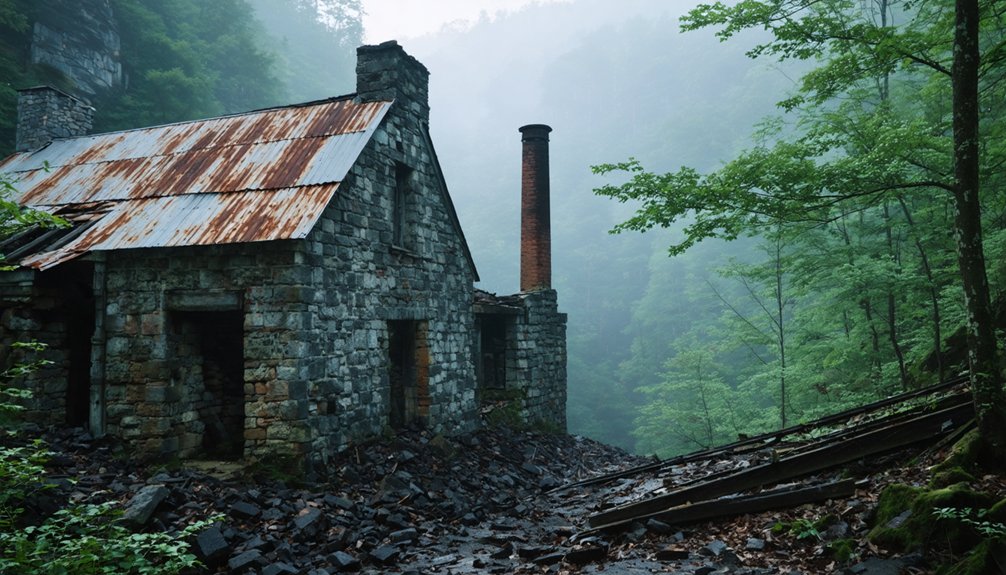
High above the New River Gorge near Thurmond, West Virginia, the remnants of Dun Glen cling to a mountainside where coal once ruled daily life.
You’ll find this abandoned mining community perched beyond Thurmond’s town limits, accessible only through a challenging hike into the gorge’s depths.
Named after the notorious Dun Glen Hotel that operated across the river, this settlement housed roughly twenty families who extracted coal from the Sewell and Fire Creek seams.
The community featured worker houses, a company store, and essential mining infrastructure.
Today, you’ll discover scattered metal wash bins, cut stone piles, and a lone powder house with its distinctive thick walls and concrete roof—silent witnesses to Dun Glen’s industrious past in Fayette County’s coal-mining legacy.
Exploring West Virginia’s Abandoned Mining Communities
You’ll find West Virginia’s abandoned mining communities scattered throughout the state’s mountainous terrain, with over 60 former coal towns sprouting after the Chesapeake & Ohio Railroad’s 1873 arrival.
These ghost towns require careful planning to access, as many sit in remote locations along former railroad corridors where companies once built entire settlements around their mining operations.
The National Park Service has undertaken significant preservation efforts at sites like Nuttallburg and Kaymoor, installing public access points and stabilizing structures to protect these important pieces of industrial heritage.
Coal Mining Legacy Sites
Deep within West Virginia’s rugged terrain, abandoned coal mining communities stand as silent monuments to an industrial era that shaped the state’s identity for over a century.
You’ll discover that coal town culture dominated southern West Virginia, where over 90% of miners lived in company-owned settlements before the 1930s Great Depression. These 465 company towns, concentrated in Raleigh, Fayette, McDowell, Logan, and Mingo counties, reveal complex mining community dynamics built on out-of-state capital and foreign labor from southern Europe.
You can explore preserved sites like Kaymoor, which produced nearly 17 million tons from 1900-1962, or Nuttallburg, leased by Henry Ford for steel production.
Each location tells stories of workers who endured harsh conditions while powering America’s industrial growth through their labor and sacrifice.
Accessing Remote Ghost Towns
Adventure awaits those seeking to explore West Virginia’s abandoned mining communities, though reaching these remote ghost towns requires careful planning and physical preparation.
Ghost town access varies dramatically across sites. You’ll find Nuttallburg accessible by car since National Park Service maintains it as a historic site, while Kaymoor demands descending 821 stairs to view ruins.
Dun Glen presents the greatest challenge for remote exploration—perched 700 feet above New River, you’ll need hiking endurance to traverse the 2018-built trail connecting Thurmond valley to Summit Bechtel Reserve.
Stotesbury offers easier access to abandoned company houses and segregated churches. Sewell’s coke oven ruins require walking through Babcock State Park, while Quinnimont’s railroad remnants await discovery through lost community paths.
Historic Preservation Efforts
While West Virginia’s ghost towns face constant threats from weathering and vegetation overgrowth, extensive preservation efforts now protect these mining heritage sites through federal funding and restoration programs.
As visitors explore these restored sites, they can discover hidden gems in West Virginia, revealing the rich history and culture of the region. Each location tells a story of resilience and community, inviting exploration and appreciation for the state’s unique heritage. These treasures offer a glimpse into the past, showcasing the beauty and character that define West Virginia.
You’ll find the most successful example at Nuttallburg, where the National Park Service stabilized structures and cleared vegetation after its 2005 National Register listing. This coal mining complex represents the nation’s most complete industrial site from that era.
Through the Abandoned Mine Land Economic Revitalization (AMLER) Program, you’re witnessing unprecedented investment in these communities. West Virginia received nearly $30 million in 2024 for economic revitalization projects spanning ten coalfield initiatives.
Historic preservation efforts now blend cultural protection with modern development, ensuring these ghost towns survive as educational resources while supporting local economies through tourism and heritage centers.
Frequently Asked Questions
Are There Entrance Fees Required to Visit These West Virginia Ghost Towns?
Want free exploration? Most West Virginia ghost towns don’t require entrance fees, offering unrestricted ghost town accessibility. However, you’ll pay entrance fees for guided tours, national parks, or special attractions at certain locations.
What Safety Equipment Should Visitors Bring When Exploring Abandoned Mining Sites?
You’ll need hard hats, safety-toed boots, protective gloves, and flashlights as essential safety gear when exploring abandoned mining sites. These precautions protect against falling debris, sharp objects, and other exploration hazards common in deteriorating structures.
Which Ghost Towns Allow Overnight Camping or Have Nearby Accommodation Options?
Like scattered campfires beckoning modern explorers, you’ll find camping regulations allow overnight stays at Erskine Coal Town Site, Thurmond’s riverbanks, and Baker’s Run, while Babcock State Park offers nearby attractions plus comfortable lodging options.
What Are the Best Months to Visit These Sites for Optimal Weather?
You’ll find spring visits from mid to late season offer ideal temperatures in the upper 60s-70s, while autumn exploration during late September through October provides peak foliage and comfortable hiking conditions.
Can Visitors Take Artifacts or Souvenirs From These Abandoned Mining Communities?
Absolutely not—you can’t livestream your artifact hunting from these sites. Legal regulations strictly prohibit removing any items, with fines up to $500. Artifact preservation protects these historic mining communities under federal and state law.
References
- https://kids.kiddle.co/List_of_ghost_towns_in_West_Virginia
- https://wvexplorer.com/2025/10/19/ghost-towns-in-southern-west-virginia/
- https://wvtourism.com/5-wv-ghost-towns/
- https://www.youtube.com/watch?v=-EeLwLa2t90
- https://minskysabandoned.com/2015/07/30/west-virginia-ghost-towns-part-1-nuttallburg/
- https://www.wvnews.com/news/wvnews/echoes-of-the-past-exploring-west-virginias-ghost-towns/article_2ec39746-1214-11ef-9af7-bbe4e62e6509.html
- https://www.legendsofamerica.com/thurmond-west-virginia/
- https://www.youtube.com/watch?v=yBKOIRxeNX0
- https://newrivergorgecvb.com/thurmond-west-virginia-a-ghost-town/
- https://www.youtube.com/watch?v=2x_SbnBKfq4