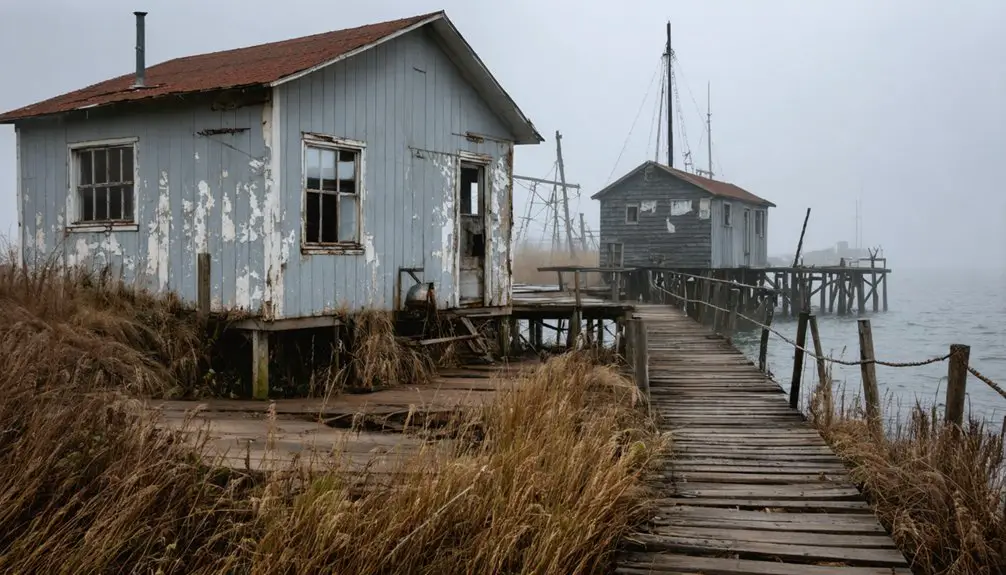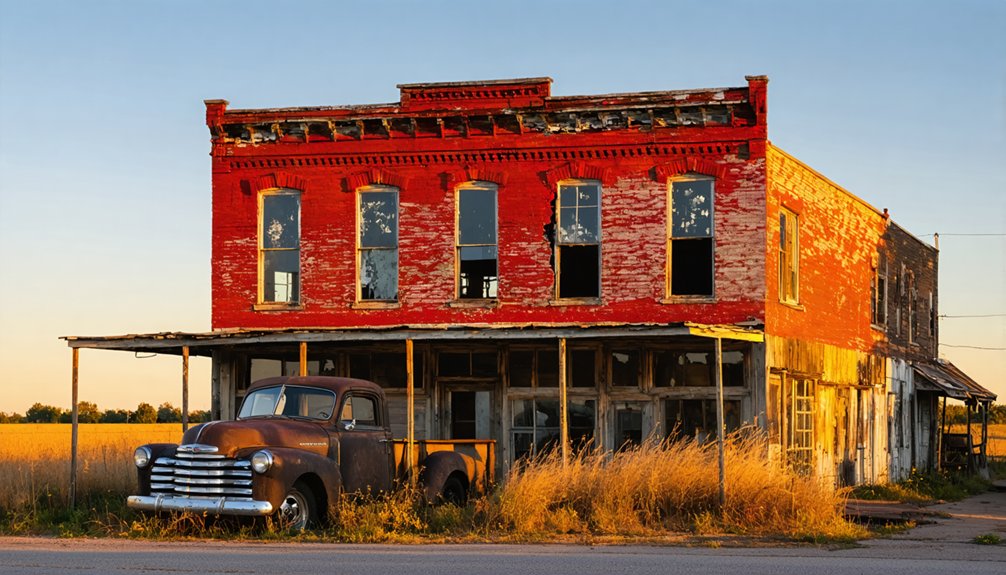
You’ll discover Wisconsin’s most famous ghost towns include Belmont, the territory’s first capital for just 46 days in 1836, and Fort Crawford, where military ruins from 1816 still stand along the Mississippi River. Cooksville became abandoned after railroads bypassed it in 1857, while Dover’s eerie cemetery remains from British settlers’ failed community. Ceresco and Voree represent failed utopian and Mormon experiments from the 1840s that collapsed within decades, leaving behind fascinating historical remnants throughout the state’s countryside.
Key Takeaways
- Belmont served as Wisconsin Territory’s first capital for only 46 days in 1836 before losing status to Madison.
- Cooksville became a ghost town when railroads bypassed it in 1857, preserving its 19th-century prestatehood architecture.
- Dover declined rapidly after railroad developers chose nearby Mazomanie, leaving behind eerie cemetery remnants and scattered graves.
- Ceresco was a failed utopian Fourierist community founded in 1844 that disbanded by 1851 due to internal pressures.
- Voree was a Mormon settlement established in 1844 that declined after leader James Strang relocated followers elsewhere.
Fort Crawford: Military Outpost Turned Historic Ruins
Fortifications at Prairie du Chien tell the story of America’s westward expansion through two distinct military installations that shaped Wisconsin’s frontier history.
You’ll discover Fort Crawford‘s legacy began in 1816 when soldiers constructed the first fort on Fort Shelby’s ruins, creating a 340-foot square enclosure with strategic blockhouses. After 1829 floods forced relocation, the second fort became a major garrison until 1856. Archaeological excavations in 1999 uncovered the fort’s foundations and revealed artifacts including ceramics and musket balls that help reconstruct daily military life.
This military history witnessed pivotal moments: the 1825 Treaty of Prairie du Chien, Black Hawk’s surrender to Colonel Zachary Taylor, and Jefferson Davis’s early service. Dr. William Beaumont conducted groundbreaking digestion experiments here during his tenure as army surgeon.
During the Civil War, you’ll find the site transformed into Union training grounds and a general hospital treating over 1,400 soldiers.
Today’s historic preservation efforts honor this National Historic Landmark‘s role in America’s march toward freedom.
Belmont: Wisconsin’s Forgotten First Capital
You’ll discover that Belmont served as Wisconsin Territory’s first capital for just 46 days in 1836, when legislators met in John Atchison’s hastily constructed council house to establish the foundation of state government.
Within months, the capital moved to Madison, triggering an immediate exodus that transformed this once-promising settlement into a gradually abandoning community over the next three decades. During their brief session, legislators accomplished significant work by enacting 42 laws that established Wisconsin’s territorial framework.
Today, you can visit the restored buildings at this historic site, where Wisconsin’s brief territorial government began before the original town faded into obscurity. The site operates on weekend hours from 10am to 4pm, offering visitors a glimpse into this pivotal moment in Wisconsin’s territorial history.
Brief Territorial Capital Era
When President Andrew Jackson signed the bill creating Wisconsin Territory on April 20, 1836, he set in motion events that would establish one of America’s most unlikely and short-lived territorial capitals.
You’d witness Governor Henry Dodge announcing Belmont as the territorial capital on September 9, 1836, choosing John Atchison’s hastily constructed buildings for territorial governance.
The first legislative session began October 25, 1836, in Atchison’s two-story council house.
For 46 days, lawmakers endured cold fall conditions while crafting Wisconsin’s governmental foundation. They passed 42 laws establishing judicial systems and calling for infrastructure development—early legislation that would form the backbone of Wisconsin’s 1848 statehood. This Wisconsin Territory included present-day Wisconsin, Iowa, Minnesota, and parts of other states.
Madison’s rise as the preferred capital led to Belmont’s swift decline as settlers moved to the more promising location.
Legislative Sessions and Decline
Although Wisconsin’s first territorial legislature accomplished significant work during their 46-day session, their departure from Belmont marked the beginning of the community’s rapid decline.
Meeting from October 25 to December 9, 1836, in John Atchison’s rented council house, you’ll find they passed 42 laws establishing Wisconsin’s governmental foundation. The legislative impact included creating the judicial system, organizing counties, and calling for infrastructure development.
However, James Doty’s successful lobbying for Madison as the permanent capital sealed Belmont’s fate. The capital relocation decision triggered an immediate exodus of people and businesses.
You’ll discover that Belmont’s population plummeted after losing its capital status, maintaining only a post office and scattered businesses before eventually dwindling into obscurity over thirty years. The Mineral Point Railroad’s route in 1867 bypassed the struggling community, prompting the remaining residents to relocate entirely. Today, visitors can explore the historic buildings where Wisconsin’s government was born, though the site reopens in May 2026 following seasonal closure.
Current Abandoned State
Today, Belmont’s original territorial capital site stands as a carefully preserved historical landmark rather than a true ghost town. You won’t find typical abandoned structures here—the Wisconsin Historical Society has meticulously restored the Council House and Supreme Court building to their 1836 appearance.
The site transforms ghost town legends into living history through modern interior exhibits that immerse you in Wisconsin’s territorial government origins.
The original buildings faced near-demolition after serving as livestock barns for decades. However, restoration efforts beginning in 1910 rescued these structures from abandonment. Before becoming Wisconsin’s first capital, Belmont was strategically chosen by Governor Henry Dodge despite controversy over his connections to land speculators who developed the site.
You can now explore where Wisconsin’s first 42 laws were established, contacting 608-987-2122 for current hours. This preserved site represents freedom’s foundation in Wisconsin, making it more historically significant than traditionally abandoned.
Cooksville: Railroad Bypass Victim
You’ll find Cooksville’s story centers on a single devastating event in 1857 when planned railroad lines bypassed the thriving settlement, routing instead to Edgerton and Stoughton.
This transportation shift immediately transformed the bustling trading hub into what residents called a “ghost town,” halting growth and modernization that would’ve erased its original character. The village had reached its peak with around 200 residents before the economic decline set in.
You can now explore one of Wisconsin’s most remarkable preservation success stories, where the very disaster that killed the town’s economy inadvertently saved its 1840s-1850s architecture for future generations.
Trading Hub Decline
When railroad companies began planning routes through southern Wisconsin in the 1850s, Cooksville appeared destined for continued prosperity as an essential trading hub between Janesville and Madison.
You’d have witnessed a thriving community supporting stagecoach stops and serving travelers along established trading routes. The village maintained about 35 dwellings, a store, church, and school while settlers raced on foot to Milwaukee for land claims, often outpacing horse-and-buggy competitors.
However, when railroads bypassed Cooksville in 1857, routing through Edgerton, Stoughton, and Evansville instead, you’d have seen immediate economic shifts transform this crucial commercial center.
Growth stagnated as freight and passenger service diverted to rail-served towns, turning the once-bustling trading post into a ghost town with unrealized potential.
Historic Preservation Efforts
Although the 1857 railroad bypass devastated Cooksville’s economy, this same misfortune inadvertently preserved the village’s 19th-century character and earned it recognition as Wisconsin’s best-preserved prestatehood rural community.
You’ll find that Cooksville’s vermilion brick houses anchored the settlement when neighboring communities relocated entirely to railroad sites. The village’s architectural significance led to its National Register designation, encompassing 35 dwellings, an active church, and the original public square.
Historic preservation efforts by community residents halted 20th-century modernization attempts. The Historic Cooksville Trust now promotes the village’s architecture and rural character.
You can visit about 40 historic buildings, including a reconstructed blacksmith shop using salvaged brick. Unlike typical bypassed towns that vanished, Cooksville remains a vibrant community that’s avoided becoming an open-air museum.
Dover: Creepy Remnants of Economic Decline

Dover’s story begins in the mid-1800s when British settlers established what would become a thriving community in either Racine County or, according to alternative records, Iowa County through the British Temperance Emigration Society in 1843.
Dover’s history represents classic 19th-century prosperity, positioned between Arena and Mazomanie with typical community amenities.
Dover flourished as a prosperous 19th-century settlement strategically located between Arena and Mazomanie with all the essential community amenities.
The railroad’s impact proved devastating when developers chose Mazomanie for their depot, bypassing Dover entirely. You’ll find this decision triggered rapid abandonment as residents literally moved their houses to the new rail town.
By 1870, Dover’s population reached zero.
Today, you can explore eerie remnants including an old cemetery with scattered graves. Nature’s reclaimed most structures, leaving behind chilling accounts and urban legends that cement Dover’s reputation among Wisconsin’s most haunting ghost towns.
Ceresco: Failed Utopian Community Experiment
While Dover fell victim to economic forces beyond its control, Wisconsin witnessed another type of community failure through idealistic ambition rather than external circumstances.
You’ll find Ceresco history began in 1844 when Warren Chase led nineteen men and one boy to establish Wisconsin’s first Fourierist community on Ripon’s western edge. Named after Ceres, the Roman goddess of agriculture, this utopian experiment embraced communal living based on Charles Fourier’s social theories.
The settlement welcomed divorced women as members and emphasized education, building a schoolhouse by 1845.
However, internal pressures and outside temptations gradually undermined their collective vision. By spring 1849, leadership acknowledged failure, and the community disbanded by 1851.
Today, you can visit the historical marker in Ceresco Park, where this ambitious social experiment once pursued human freedom through cooperative ideals.
Voree: Mormon Settlement’s Rise and Fall
After Joseph Smith’s 1844 death created a succession crisis within the Mormon church, James Jesse Strang emerged as one of several claimants to leadership, asserting he’d received divine appointment through both an angelic visitation and a letter from Smith himself.
Strang established Voree, meaning “garden of peace,” in Wisconsin’s White River area. Under Strang’s leadership, the settlement grew to 300-400 inhabitants who followed strict religious codes banning coffee, tea, and alcohol.
You’ll find that Strang’s discovery of the Voree Plates in 1845 legitimized his authority, leading to ambitious temple construction plans. However, financial constraints halted progress.
When Strang relocated followers to Beaver Island in 1849, Voree declined rapidly. Voree’s legacy endures through historical markers and a small surviving Strangite denomination maintaining headquarters in modern Burlington.
Exploring Wisconsin’s Abandoned Heritage Sites
Beyond Voree’s religious significance, Wisconsin harbors numerous abandoned settlements that reveal the state’s complex pioneer history.
You’ll discover Fort Crawford’s military ruins along the Mississippi, where 1816 barracks crumble from repeated flood damage. The archaeological site preserves remnants from the War of 1812 and Black Hawk conflicts.
Cooksville’s abandoned architecture tells stagecoach-era stories. Founded in 1842, this Rock County settlement peaked at 150 residents before railroads bypassed the community. You can still explore the surviving Norris General Store and stone houses.
Belmont offers Wisconsin’s most politically significant ghost town legends. Henry Dodge’s temporary capitol building served briefly in 1836 before Madison claimed the honor.
Dover’s barren cemetery and Ulao’s farmland remnants complete your journey through these freedom-seeking pioneer communities that shaped Wisconsin’s territorial development.
Frequently Asked Questions
Are There Any Legal Restrictions on Visiting These Wisconsin Ghost Towns?
You’ll face legal access restrictions since most ghost towns sit on private property requiring owner permission. Site regulations also protect burial sites and historic structures, making unauthorized entry potential trespassing with criminal penalties.
What Safety Precautions Should Visitors Take When Exploring Abandoned Structures?
These crumbling giants demand respect—always assess structural integrity before entering, wear sturdy boots, bring flashlights, avoid unstable floors, watch for debris, and prioritize personal safety over exploration curiosity.
Can Artifacts or Souvenirs Be Collected From These Historic Ghost Town Sites?
No, you can’t collect artifacts from Wisconsin’s ghost towns. Federal and state laws protect these cultural resources, requiring artifact preservation. Souvenir ethics demand respecting heritage sites—violations result in fines and legal consequences.
Which Wisconsin Ghost Towns Are Considered Most Haunted by Paranormal Investigators?
Paranormal investigators rank Whitewater as “Second Salem” and St. Nazianz as Wisconsin’s most haunted town for spooky sightings. You’ll find haunted legends stem from spiritualist experiments and excommunicated priests’ mystical works creating persistent supernatural activity.
Are There Guided Tours Available for Wisconsin’s Abandoned Heritage Sites?
You’ll discover absolutely incredible guided exploration opportunities throughout Wisconsin’s abandoned heritage sites. These tours emphasize historical significance, offering you freedom to experience authentic paranormal investigations and verified historical events at haunted locations statewide.
References
- https://www.onlyinyourstate.com/experiences/wisconsin/ghost-towns-wi
- http://freepages.rootsweb.com/~gtusa/history/usa/wi.htm
- https://pbswisconsin.org/news-item/southern-wisconsins-ghost-towns-leave-behind-vital-stories/
- https://www.ghosttowns.com/states/wi/wi.html
- https://grantcountyhistory.org/wp-content/uploads/2016/01/GhostTownsGrantCountyTLundeen.pdf
- https://www.youtube.com/watch?v=hyvSTpgwddA
- https://kids.kiddle.co/List_of_ghost_towns_in_Wisconsin
- https://www.uwlax.edu/mvac/past-cultures/specific-sites/second-ft.-crawford/
- https://en.wikipedia.org/wiki/Fort_Crawford
- https://www.fortcrawfordmuseum.com/history-fort-crawford-in-the-civil-war.html