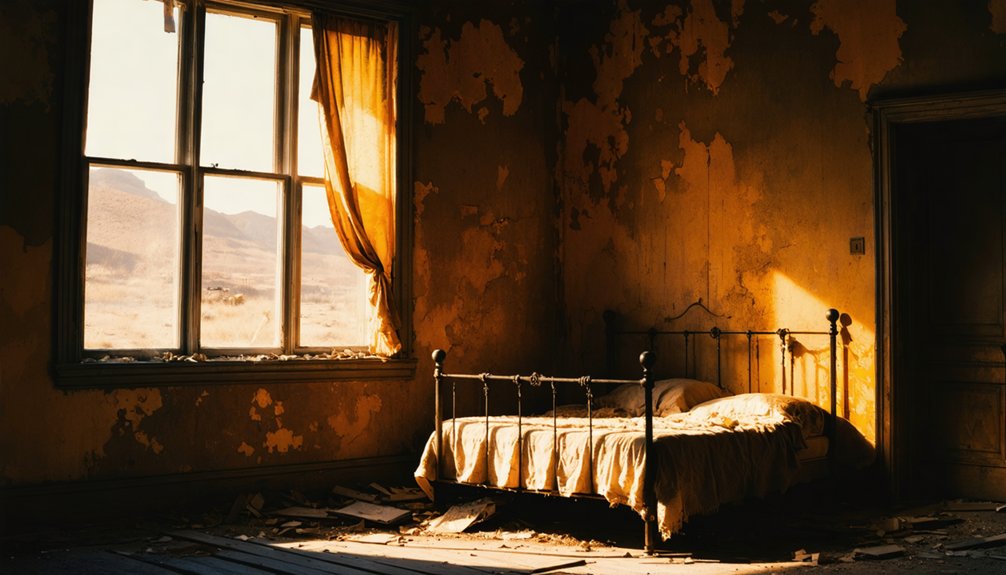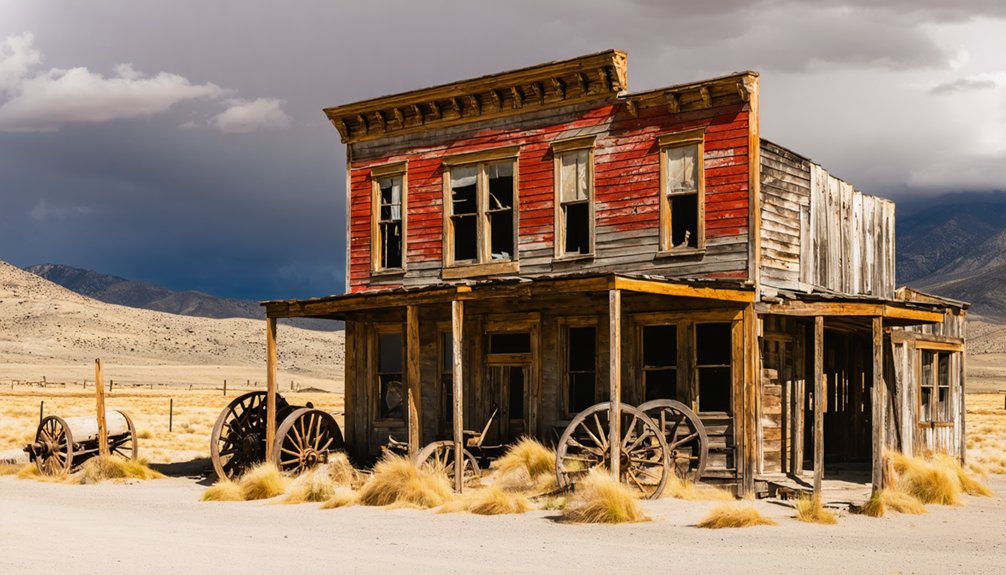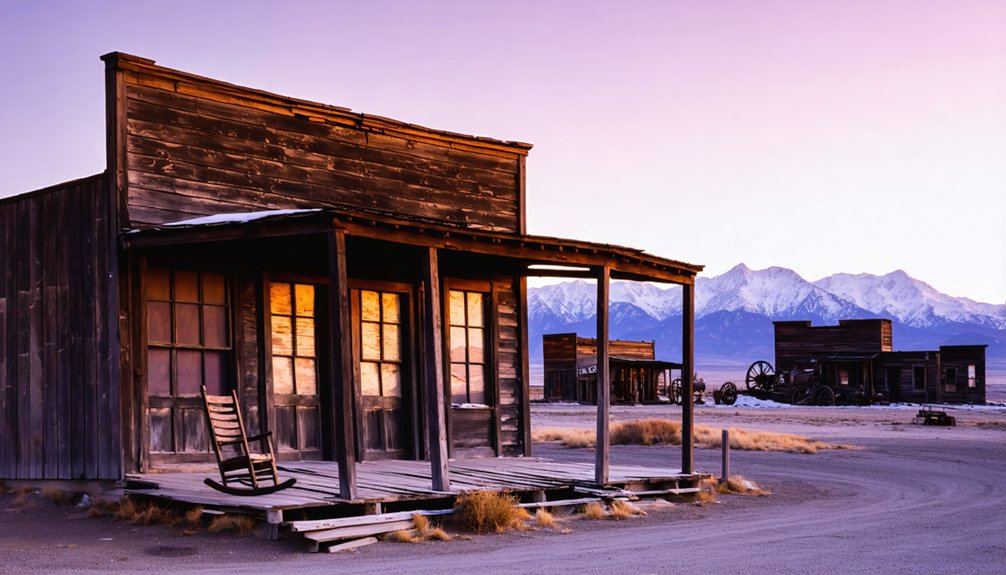
You’ll discover America’s most famous ghost towns like Bodie, California, where 10,000 gold rush residents once lived among 65 saloons before abandonment left 110 perfectly preserved buildings. Bannack, Montana peaked at 10,000 people in 1863 after gold discoveries, while Cahaba, Alabama served as the state’s first capital before floods and disease drove residents away. Texas leads with 511 ghost towns, followed by California’s 346 sites. These haunting destinations offer authentic glimpses into America’s pioneering past through restored structures and guided tours.
Key Takeaways
- Bodie, California is America’s most perfectly preserved gold rush ghost town with 110-200 original buildings maintained through “arrested decay.”
- Bannack, Montana was founded in 1862 after gold discovery and briefly served as Montana’s territorial capital before abandonment.
- Texas leads with 511-550 ghost towns, followed by California with 346 sites, mostly from oil and railroad booms.
- Many former mining boom towns now serve as popular tourist destinations offering authentic experiences and mine tours.
- Ghost towns like Cahaba, Alabama offer haunted legends and historical significance as former state capitals or Civil War sites.
The Most Common Ghost Town Names Across America
Across America’s landscape of over 4,530 documented ghost towns, certain names appear with striking frequency, revealing patterns in how settlers chose to identify their communities.
Center Point dominates this ghost town demographics analysis with seven instances, all located in Texas across different counties. This name represents the peak frequency among shared designations nationwide.
You’ll find Clifton, Hopewell, and Wilson each appearing five times across various states.
The four-instance tier includes names like Alma, Aurora, Boston, Liberty, and Pioneer—reflecting settlers’ aspirations and geographical references.
These naming patterns hold significant historical significance, showing how Americans repeatedly chose familiar, optimistic designations for their settlements. Some communities have embraced their unusual names as sources of local pride and tourist attraction. Among the various statuses these abandoned communities hold, classifications range from completely barren to semi-abandoned with residual populations.
The broader distribution reveals 61 names shared by three towns, 291 names appearing twice, while 3,668 remain unique across the continental United States.
Bodie, California: Gold Rush Glory Frozen in Time
Among these thousands of abandoned settlements, Bodie stands as America’s most perfectly preserved gold rush ghost town, where time stopped in 1942 when the last mine closed.
This remarkable Bodie history began in 1859 when William Bodey discovered gold near Mono Lake, creating one of the West’s wildest boomtowns. The town’s name underwent several variations and spellings as it developed into a major mining settlement.
At its 1879 peak, you’ll discover Bodie housed 10,000 residents across 2,000 structures. Ghost town legends tell of 65 saloons serving miners who’d extracted $38-70 million in precious metals. The phrase “bad man from Bodie” emerged from its violent reputation.
At its wild 1879 peak, Bodie’s 10,000 residents and 65 saloons created the West’s most notorious boomtown.
Today’s preservation efforts showcase:
- 110-200 original buildings maintained through “arrested decay”
- Authentic interiors stocked with period goods
- National Historic Landmark status since 1961
- 200,000 annual visitors exploring California’s official gold rush ghost town
The community included a significant Chinese population of about 350 people who provided essential services like wood hauling and laundry operations. The name Bodie has appeared in multiple contexts throughout history, from places to people sharing this common designation.
Bannack, Montana: The Wild West’s Toughest Town
When John White discovered gold in Grasshopper Creek on July 28, 1862, he unknowingly founded what would become the American West’s most dangerous boomtown.
You’ll find Bannack’s story mirrors the classic frontier struggle between lawlessness and order. Named after the Bannock tribe, this Montana settlement exploded to 10,000 residents by 1863, yielding over $500,000 in gold its first year.
Sheriff Henry Plummer allegedly led the “Innocents” gang, terrorizing miners through robberies and murders. Fed up citizens formed the Vigilance Committee in December 1863, executing 22 people without trials.
Vigilante Justice prevailed when Plummer himself swung January 10, 1864. The town briefly served as Montana’s territorial capital before losing this status in February 1865. The exceptional purity of gold at Grasshopper Creek measured 99-99.5%, far surpassing the typical 95% found elsewhere.
Today, you can explore this preserved state park, where Historic Hauntings include Hotel Meade’s Dorothy Dunn and 60 documented spirits still reliving their 1800s existence.
Cahaba, Alabama: From State Capital to Haunted Ruins
Long before Alabama became a state, Cahaba’s strategic location at the confluence of the Alabama and Cahaba Rivers made it a thriving Native American trade center.
You’ll discover this Mississippian village (100–1550 CE) possibly served as Maubila, where Hernando de Soto’s expedition met devastating defeat in 1540.
Governor William Bibb selected this site as Alabama’s first capital in 1818, incorporating ancient earthworks into his town plan.
Governor Bibb thoughtfully preserved Cahaba’s ancient Native American earthworks when designing Alabama’s first capital city in 1818.
You can explore how Cahaba history unfolded through triumph and tragedy:
- Economic boom followed by the Panic of 1819
- Yellow fever outbreaks decimating the population
- Devastating floods forcing capital relocation to Tuscaloosa
- Civil War prison holding 9,000 Union soldiers
The town experienced a remarkable post-relocation recovery, becoming a major cotton distribution center and reaching over 3,000 residents by the Civil War.
Today, you’ll find haunted legends surrounding the preserved ruins, including mysterious orbs in Pegues garden maze and ghostly encounters near Castle Morgan’s crumbling walls. The site now serves as an important disambiguation page helping visitors navigate between the historic town and other locations sharing the Cahaba name.
Mining Boom Towns That Became Tourist Destinations
You’ll find America’s most successful ghost town transformations among former mining boom communities that struck gold and silver during the 19th century.
These preserved Gold Rush sites now offer you authentic experiences through restored Main Streets, underground mine tours, and original wooden sidewalks that once echoed with prospectors’ boots.
Silver mining tourist towns have particularly thrived by maintaining their historic architecture while adding modern amenities that attract millions of visitors seeking both adventure and authentic Old West atmosphere. Many destinations now serve as mountain expedition bases where visitors can explore surrounding peaks through world-class hiking and climbing adventures.
Some ghost towns attracted European immigrants who came to work in the coal mines and lumber mills that powered America’s industrial expansion.
Gold Rush Preservation Sites
Although countless mining boomtowns across the American West have crumbled into dust, several exceptional sites have transformed their historical significance into thriving tourist destinations that preserve the authentic spirit of the Gold Rush era.
You’ll discover remarkably preserved ghost town architecture that tells stories of prospectors who chased fortune through treacherous terrain. Mining heritage tourism now connects you directly with America’s pioneering past.
These preserved sites offer authentic exploration opportunities:
- Bodie, California – 110 original buildings maintained in “arrested decay” with items still on shelves
- St. Elmo, Colorado – Well-preserved 1880s structures accessible for hands-on exploration
- Rhyolite, Nevada – Striking ruins featuring preserved train station and unique Bottle House
- Calico, California – Restored Mojave Desert town with over 500 former silver mines
Silver Mining Tourist Towns
Silver boom towns across the American West tell a different story than their gold-seeking predecessors—many transformed devastating mining busts into permanent tourism economies that continue thriving today.
You’ll find Silverton, Colorado survived the 1893 Sherman Silver Purchase Act repeal by embracing rail tourism after producing silver by the ton.
Durango flourished post-crash through railroad diversification and now anchors Southwest Colorado’s tourism industry.
Tombstone capitalized on Wild West drama, transforming from silver rush prosperity into preserved gunfight attractions.
Bodie became California’s premier ghost town showcase after its 1880s decline.
Meanwhile, Aspen evolved from hardrock silver mines into America’s luxury mountain destination.
These silver mining communities prove you can reinvent devastation into lasting economic success through strategic tourist attractions and historical preservation.
Geographic Distribution and Preservation of Ghost Towns
When examining the geographic spread of America’s ghost towns, you’ll discover that Texas dominates the landscape with an impressive 511-550 abandoned settlements, followed by California’s 346 sites and Kansas’s 308 documented locations.
This ghost town geography reflects distinct historical patterns across regions:
- Great Plains states showcase farming ruins from devastating Dust Bowl conditions.
- Western territories contain mining boom remnants from 1800s gold rushes.
- Texas experienced rapid expansion after 1901’s Spindletop oil discovery.
- California’s growth surged during 1880s railroad construction.
Preservation challenges vary greatly by location and ownership. Heritage tourism has revived select sites, while organizations like the Bureau of Land Management restore structures such as Harrisburg’s Orson B. Adams Home.
Fort Jefferson earned National Monument status in 1935, demonstrating successful long-term preservation efforts.
Frequently Asked Questions
What Safety Precautions Should Visitors Take When Exploring Ghost Towns?
Utah’s secured 7,000 of 17,000 abandoned mines by 2023. You’ll need proper safety gear including sturdy boots, gloves, and masks. Research local regulations beforehand, travel in groups, and always inform someone of your planned route.
How Much Does It Typically Cost to Visit Preserved Ghost Towns?
You’ll pay $1-$18 for entry fees at most preserved ghost towns, with children’s rates typically lower. Guided tours cost $150-$200 from major cities, while self-guided options run $3-$18 depending on location.
Are There Any Ghost Towns That Allow Overnight Camping or Lodging?
Like frontier pioneers seeking shelter, you’ll find ghost town camping at Calico’s campground ($30/night), Bannack’s tent sites, and lodging options including St. Elmo cabins plus Goldfield Airbnb rentals.
What’s the Best Time of Year to Visit Ghost Towns?
The best seasons depend on elevation and location. You’ll find spring through fall ideal for high-altitude sites, while winter’s perfect for desert ghost towns with essential weather considerations affecting road accessibility.
Can Visitors Take Artifacts or Souvenirs From Ghost Town Sites?
No, you can’t take artifacts or souvenirs from ghost town sites. Federal laws protect 100% of items at historic sites. Artifact preservation and souvenir guidelines strictly prohibit removing anything except trash like candy wrappers.
For individuals interested in exploring these abandoned places, it is crucial to understand the regulations surrounding metal detecting permits for ghost towns. Each state may have different requirements, and in many cases, permits are necessary to ensure compliance with preservation efforts. Engaging responsibly not only respects the history of these sites but also contributes to their protection for future generations.
References
- https://devblog.batchgeo.com/ghost-towns/
- https://www.visittheusa.com/experience/5-us-ghost-towns-you-must-see
- https://www.geotab.com/ghost-towns/
- https://en.wikipedia.org/wiki/Lists_of_ghost_towns_in_the_United_States
- https://whakestudios.com/us-ghost-towns/
- https://atkinsbookshelf.wordpress.com/2017/06/09/naughtiest-town-names-in-america/
- https://www.authentikusa.com/us-en/blog/english-top-5-villes-fantomes-aux-usa-maj
- https://albiongould.com/ghost-towns-to-visit-in-the-states/
- https://www.atlasobscura.com/lists/americas-best-preserved-ghost-towns
- https://en.wikipedia.org/wiki/Bodie