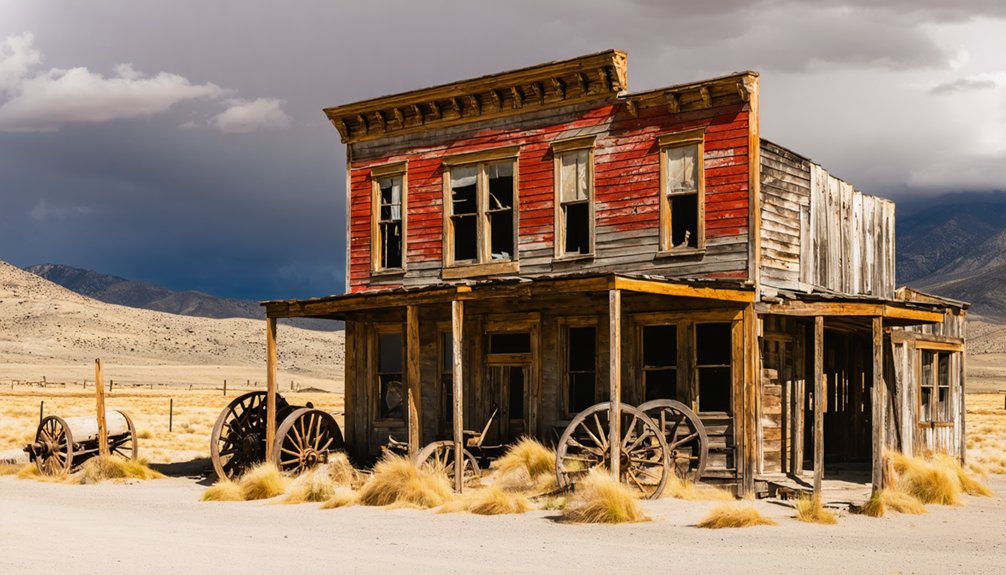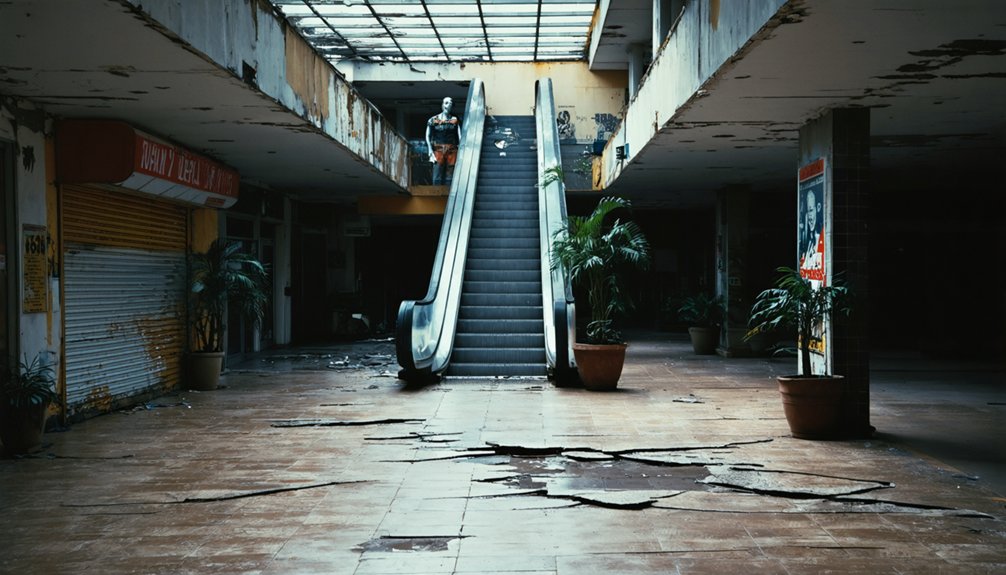
You’re seeing America’s mall empire crumble as iconic shopping centers transform into abandoned ghost towns. Chambersburg Mall closed completely by 2025 after structural collapse, while Circle Centre Mall’s sales plummeted from $406 to $184 per square foot. Hawthorne Plaza has remained vacant since 1999, and Jamestown Mall required $12 million in taxpayer funds for demolition. These systematic failures reflect broader economic forces reshaping retail landscapes nationwide, with extensive redevelopment strategies emerging to address this urban crisis.
Key Takeaways
- American shopping malls are declining at 3.08% annually, with projections showing 300 mall closures by 2028.
- Chambersburg Mall opened in 1982 but suffered 62% occupancy decline and total abandonment by 2025.
- Circle Centre Mall sales plummeted from $406 to $184 per square foot during the pandemic era.
- Hawthorne Plaza Mall has remained completely vacant since 1999 after losing half its stores.
- E-commerce captured 15% of retail sales while 6,000 physical stores closed in 2025 alone.
The Rise and Fall of American Shopping Centers
While American shopping malls once anchored retail ecosystems across suburban landscapes, they’re experiencing systematic decline that’s reshaping commercial real estate markets nationwide.
You’re witnessing a dramatic transformation where 1,200 malls will shrink to 900 by 2028, declining 3.08% annually from 2017 to 2022.
Consumer preferences have shifted toward open-air centers, which exceeded 2019 traffic levels by Q1 2024 with 10.1% year-over-year growth.
Open-air shopping centers are thriving with double-digit growth while traditional malls continue their steep decline across America.
Meanwhile, retail innovation bypasses traditional enclosed formats—Class C malls face 13.3% vacancy rates while generating under $300 per square foot annually. However, some indoor malls are showing signs of recovery, with foot traffic increasing 6.3% year-over-year in May 2025.
This systematic restructuring reflects your demand for choice and flexibility, driving 13,990 net store closures between 2016-2025 as market forces eliminate inefficient retail models. When these properties do sell, vacant malls typically trade at 43% below their original acquisition price, creating substantial losses for investors.
Chambersburg Mall: From Pennsylvania’s Pride to Complete Abandonment
Chambersburg Mall’s February 28, 1982 soft launch generated such overwhelming consumer demand that Interstate 81 experienced significant traffic disruptions, establishing the center as Pennsylvania’s strategic retail advantage over Maryland’s higher sales tax regime.
You witnessed retail evolution firsthand as 75 businesses thrived, anchored by J.C. Penney and Hess’s, drawing crowds from 50 miles away.
By 2009, you’d observe a 62% occupancy decline, yet management denied impending collapse.
Namdar Realty Group’s 2013 acquisition sealed the mall’s fate through systematic disinvestment. The company operates over 350 properties across the United States, following a pattern of purchasing distressed retail centers. Major roof leaks and collapsed ceilings have created dangerous conditions requiring condemnation of the property.
Burlington’s 2019 exit preceded total abandonment by mid-2025.
- Chambersburg nostalgia: Your childhood shopping memories now echo through empty corridors
- Economic freedom: Pennsylvania’s tax advantages couldn’t overcome corporate mismanagement
- Community impact: Decades of local commerce vanished under absentee ownership
Circle Centre Mall: Indianapolis’s Struggling Retail Giant
You’ll find Circle Centre Mall‘s transformation from Indianapolis’s premier retail destination to a struggling property exemplifies how anchor store departures trigger systematic decline.
The mall’s sales plummeted from $406 per square foot in 2007 to just $184 during the pandemic, forcing Hendricks Commercial Properties to acquire the 786,000-square-foot complex in 2024 with ambitious redevelopment plans.
You’re witnessing a $600 million strategy to convert the enclosed mall into an open-air campus by 2030, yet current vacancy rates and security issues continue challenging interim operations. Originally designed with extensive planning that pushed its opening from 1993 to 1995, the mall once drew up to 70,000 visitors daily in its prime.
The mall’s decline accelerated after Regal Cinemas closed on October 31, 2024, eliminating the last traditional anchor tenant from the four-level structure.
Developer Acquisition Plans
After months of negotiation, Hendricks Commercial Properties finalized its $85 million acquisition of Circle Centre Mall on April 24, 2024, marking a pivotal shift in Indianapolis’s downtown retail landscape.
You’re witnessing a bold developer vision that’ll transform 786,000 square feet of struggling retail into an open-air, mixed-use campus. The investment strategy involves $600 million over ten years, creating 300 residential units, office space, and outdoor public areas.
The city’s backing this transformation with $64 million in tax credits and financing, while you’ll see the south end close April 2025. This isn’t just renovation—it’s complete reimagining of urban space. Hendricks will replace the central interior hallway with an outdoor promenade to create a village-like atmosphere. The ambitious project will unfold in two phases, ensuring systematic progress toward the 2030 completion target.
- Your downtown freedom means escaping enclosed retail prison for open-air community spaces
- You’ll gain 400,000 square feet of dining and entertainment choices
- Your tax dollars finally work toward genuine urban revitalization
Vacancy Challenges Persist
Despite Hendricks Commercial’s ambitious $600 million transformation plan, Circle Centre Mall’s vacancy crisis reflects broader systemic challenges plaguing Indianapolis’s retail market.
You’re witnessing vacancy rates that climbed to 5.0% in Q3 2025, up 40 basis points year-over-year, while leasing activity plummeted 29.6% compared to previous periods.
The mall’s pivot to experiential tenants like immersive exhibits demonstrates desperate adaptation strategies, yet downtown’s core continues lagging pre-COVID recovery levels.
Retail trends show you’re dealing with structural shifts beyond temporary setbacks.
While suburban areas like Whitestown report zero vacancy, downtown struggles with stagnant commercial activity. The nationwide trend toward retail-to-industrial conversions has increased by 22%, offering alternative solutions for struggling properties.
The $650 million redevelopment represents necessary intervention, but persistent negative absorption and declining rents signal that market forces demand fundamental restructuring rather than cosmetic improvements. The transformation aligns with broader mixed-use developments emerging across the metro area as developers seek viable alternatives to traditional retail formats.
Revamping Empty Stores
While Circle Centre Mall’s vacancy crisis deepened throughout 2025, Hendricks Commercial Properties launched an unprecedented $600 million transformation that’ll convert the failing retail structure into “Traction Yards,” an open-air mixed-use district.
You’re witnessing adaptive reuse principles reshape downtown Indianapolis as developers replace enclosed glass structures with 400,000 square feet of retail space, 300 residential units, and 100,000 square feet of office facilities.
These revitalization strategies eliminate traditional mall constraints, creating pedestrian-focused environments with brick storefronts and outdoor plazas.
The phased construction targets 2029 completion, demonstrating market-driven solutions over government dependency:
- Developers terminated existing tenant leases, accelerating property control
- Mixed-use zoning reduces single-purpose retail vulnerability
- Private investment eliminates taxpayer bailout requirements
This transformation proves property owners can independently restructure failing commercial assets.
Hawthorne Plaza Mall: California’s Decades-Old Ghost Town

When Hawthorne Plaza Mall opened its doors in February 1977, it represented a $40 million investment that transformed 35 acres of blighted commercial strip into what city planners envisioned as an economic anchor for the community.
The mall’s grand opening drew 100,000 attendees and generated nearly $1 million annually in sales tax revenue.
However, aerospace industry layoffs, competing malls, and two 1979 shootings triggered rapid decline.
White flight and economic downturn compounded problems through the 1980s-1990s.
Store count plummeted from 130 to 70 between the late 1980s and 1998.
After court-appointed trustees took control in 1994, the final anchor closed in 1998.
Hawthorne Plaza’s community impact shifted from economic revitalization to decades-long blight, remaining vacant since 1999.
Jamestown Mall: Missouri’s Journey From Closure to Demolition
After serving Missouri’s north St. Louis County community since 1973, Jamestown Mall‘s decline exemplifies failed urban redevelopment strategies and insufficient community engagement initiatives.
You’ll find this story reflects broader systemic challenges facing American retail infrastructure.
The mall reached 30% vacancy by 2003, with all anchors departing by 2014. Despite multiple redevelopment attempts and a 2009 Urban Land Institute study, officials couldn’t reverse the deterioration.
Crime attraction and blight complaints from residents highlighted the disconnect between top-down planning and grassroots needs.
- Daily reminders of economic decay visible to thousands of community members
- $12 million taxpayer burden for demolition using federal ARPA funds
- Nine years of failed promises before decisive action in 2023
Completed demolition in 2024 demonstrates how decisive policy action can address community frustrations when market solutions fail.
Northridge Mall: Milwaukee’s Crime-Ridden Abandoned Structure
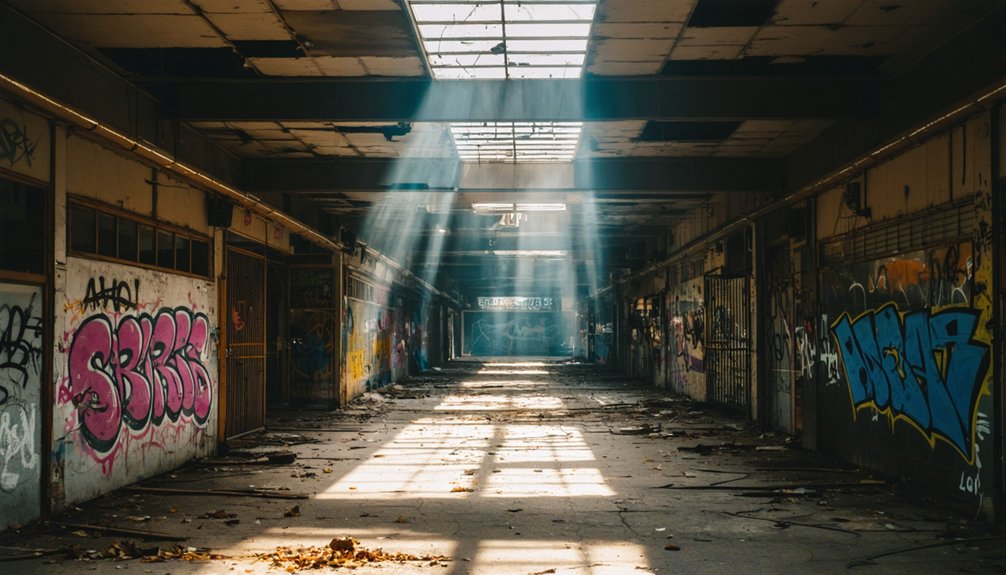
You’ll find Northridge Mall represents one of Milwaukee’s most problematic abandoned properties, sitting vacant for over two decades since its 2003 closure while generating significant public safety costs.
The structure’s deterioration has created conditions that led to fatal accidents, including a contractor’s electrocution in 2019, prompting municipal intervention through tax foreclosure procedures.
City officials have implemented systematic demolition planning to address the crime-ridden facility, though legal disputes continue delaying complete removal of this dangerous eyesore.
Two Decades Abandoned
Since Northridge Mall’s closure in 2003, the 1.3-million-square-foot structure has deteriorated into Milwaukee’s most prominent urban blight crisis, creating cascading public safety and economic development challenges across 58 acres of prime real estate.
You’ve watched this ghost mall become a magnet for vandalism, trespassing, and environmental hazards over twenty-one years of abandonment. The boarded-up complex attracted YouTubers and urban exploration enthusiasts who treated the decaying structure as their personal playground.
As you explore the remnants of the ghost mall, it’s hard not to draw parallels with ghost towns in popular TV shows that depict similar themes of decay and abandonment. These fictional settings often amplify the eerie atmosphere, highlighting the passage of time and the stories left untold. Each corner of the mall seems to whisper the secrets of its past, much like the desolate places showcased on screen.
Meanwhile, residents faced the consequences of unchecked deterioration in their neighborhood. The city’s tax foreclosure pursuit reflects the urgent need to address health and safety violations that accumulated during two decades of neglect.
- Families deserve safe neighborhoods free from crime-attracting abandoned structures
- Property owners shouldn’t bear the burden of diminished values from government inaction
- Communities need economic opportunities, not eyesores blocking development potential
Crime and Death
The deteriorating mall hasn’t just created an eyesore—it’s amplified an already challenging crime environment that puts residents at serious risk.
Northridge ranks #174 out of 191 Milwaukee neighborhoods with a C- crime rating, where violent crimes soar 283% above national averages. You’re facing property crime rates 20% worse than the city norm, though recent data shows promise with theft dropping 12% and burglaries down 14% citywide.
District 4’s targeted policing initiatives focus on high-crime areas near Northridge, implementing undercover operations against wanted shooters and robbers.
While crime prevention strategies show mixed results—homicides increased 9% despite overall crime decreases—community outreach efforts through block watch programs offer pathways toward reclaiming neighborhood safety and economic freedom.
City Demolition Plans
After years of legal battles with China-based owners, Milwaukee successfully acquired the 50-acre Northridge Mall site through tax foreclosure in January 2024, setting the stage for the largest urban redevelopment project in the city’s recent history.
The city’s demolition strategies proved remarkably effective. Veit & Co. completed the 900,000-square-foot teardown by fall 2025, finishing on time and within budget using $15 million in Wisconsin American Rescue Plan Act funding.
You’re witnessing systematic urban redevelopment that prioritizes community control over abandoned properties.
Milwaukee’s approach eliminates bureaucratic delays while maximizing local autonomy:
- Direct community ownership through tax foreclosure removes foreign speculation
- Strategic preservation of elevator towers demonstrates practical resource management
- Transparent public engagement empowers residents to shape their neighborhood’s future
Site marketing begins 2026, returning productive land to private hands.
Century III Mall: Pittsburgh’s Decayed Shopping Monument
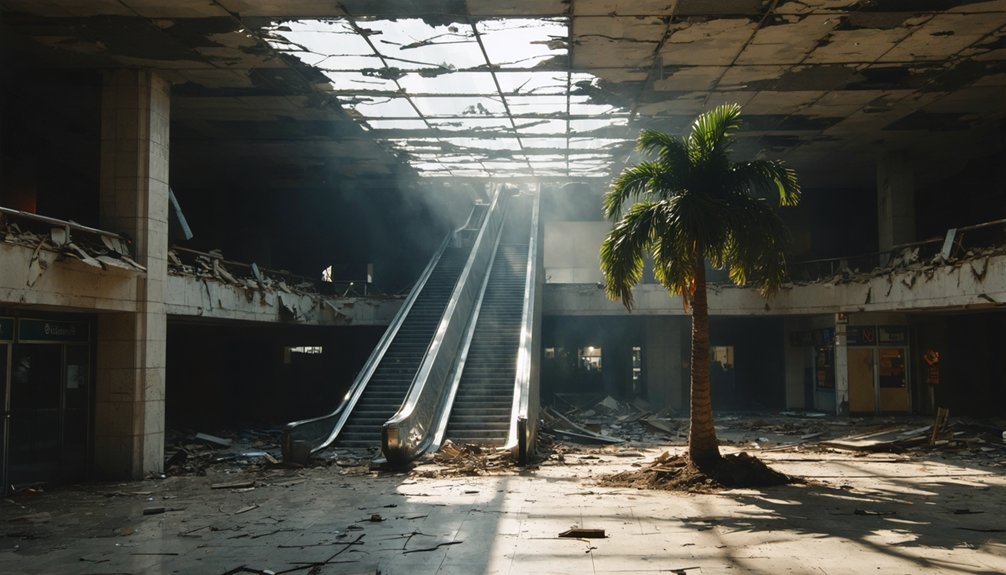
While urban planners today grapple with adaptive reuse of industrial sites, Century III Mall demonstrates how ambitious redevelopment projects can ultimately fail without sustainable economic foundations.
You’re witnessing the decay of what was once America’s third-largest mall, built on a former U.S. Steel slag dump in West Mifflin. The $100 million transformation of Brown’s Dump into 1.6 million square feet of retail space symbolized Pittsburgh’s postindustrial shift when it opened in 1979.
At its 1987 peak, you’d find 225 stores across six anchor departments.
Today’s mall nostalgia can’t mask the reality that urban redevelopment requires more than capital investment—it demands evolving economic ecosystems that adapt to changing consumer behaviors and regional demographics.
Economic Forces Behind Mall Abandonment
You’re witnessing the convergence of three seismic economic forces that systematically dismantled America’s mall ecosystem between 2010 and 2024.
Retail industry consolidation eliminated anchor tenants like Sears and JCPenney, while e-commerce captured 15% of total retail sales, fundamentally altering consumer acquisition channels from physical browsing to digital search algorithms.
Consumer spending patterns shifted toward experiential purchases and discount retailers, creating a structural demand gap that left traditional malls with 8.7% vacancy rates and negative absorption of 3.3 million square feet annually.
Retail Industry Shifts
Though America’s shopping malls once symbolized economic prosperity and consumer culture, a confluence of economic forces has transformed many into financial casualties of shifting retail dynamics.
You’re witnessing a fundamental retail evolution driven by changing consumer behavior and market forces beyond traditional brick-and-mortar control.
Store closures surged 67% in 2025, with nearly 6,000 shuttered by July alone. Between 2016 and 2025, you’ve seen a net loss of 13,990 mall stores as retailers adapt to digital-first strategies.
Rising operational costs, including rent increases and labor shortages, compound these pressures while foot traffic plummets amid anchor store departures.
- Nearly 6 million square feet more space was vacated than occupied in 2025’s first half
- Class C malls recorded 13.3% vacancy rates, 52.9% above overall mall averages
- 87% of large malls face potential closure within the next decade
Competition From Online Shopping
As e-commerce platforms captured 15.4% of total retail sales by 2024, they’ve fundamentally restructured consumer spending patterns away from traditional mall environments.
You’re witnessing the systematic displacement of physical retail as online retail delivers unprecedented convenience and competitive pricing without geographical constraints.
Consumer preferences have shifted toward digital-first shopping experiences that eliminate travel time, parking hassles, and crowded spaces. This transformation directly correlates with the 112% higher vacancy rates in malls compared to overall retail properties by Q4 2024.
The data reveals your shopping autonomy: you control when, where, and how you purchase goods.
Traditional mall operators can’t compete with 24/7 accessibility, infinite inventory selection, and personalized recommendation algorithms that online platforms provide, accelerating the structural obsolescence of enclosed shopping centers nationwide.
Changing Consumer Spending Patterns
Beyond e-commerce’s digital disruption, fundamental shifts in how Americans allocate their disposable income have accelerated mall abandonment across economic demographics.
You’re witnessing unprecedented value driven decisions as consumers slash spending—Gen Z cut apparel purchases 13% while planning 23% holiday reductions. Your shopping freedom now centers on treasure hunts through off-price retailers, thrift stores, and warehouse clubs rather than traditional anchor stores.
- Economic anxiety forces you to choose between paying rent or buying that jacket you wanted
- Your favorite stores sit empty while you’re forced to drive across town for affordable options
- Mall food courts echo with emptiness as families skip dining out to stretch grocery budgets
This experiential shopping evolution prioritizes tactical budget management over leisurely mall browsing, fundamentally restructuring retail geography.
Urban Decay and Safety Concerns in Dead Malls
When shopping centers transform into vacant shells, they create dangerous urban environments that threaten community safety and accelerate neighborhood decline.
Abandoned shopping centers become breeding grounds for criminal activity, transforming vibrant commercial spaces into threats that destabilize entire communities.
You’ll find these abandoned spaces become havens for crime, drugs, and vandalism as millions of square feet remain unmonitored. Dead malls evoke unsafe environments where ghosts of past shoppers outnumber real visitors, deterring law-abiding citizens from surrounding areas.
Rising crime rates in cities like San Francisco contribute directly to retail closures, creating a destructive cycle.
Without proper safety measures, these vacant corridors signal broader retail crisis while eliminating natural surveillance that active businesses provide.
You’re witnessing how lack of upkeep leaves escalators unrepaired and storefronts empty, transforming once-thriving commercial hubs into urban decay that spreads throughout neighborhoods, requiring immediate policy intervention.
Future Plans for America’s Abandoned Shopping Centers
Rather than accepting perpetual decay, cities across America are implementing extensive redevelopment strategies that transform abandoned malls into vibrant mixed-use communities.
These urban redevelopment initiatives prioritize housing, green spaces, and economic revitalization through strategic demolition and reconstruction.
You’ll witness dramatic transformations like Richmond’s Hilltop Mall becoming mixed-use districts, while Columbus converted 80% of demolished materials into greenspace that attracted $400 million in surrounding investments.
Community engagement drives these projects—over 1,000 citizens shaped Columbus’s Eastland plan, demonstrating local control over development decisions.
Key transformation strategies include:
- Housing-first approaches creating thousands of residential units where retail once failed
- Green space conversions turning asphalt wastelands into parks, trails, and recreational facilities
- Mixed-use districts combining residential, commercial, and entertainment spaces for sustainable communities
Frequently Asked Questions
How Much Does It Cost to Maintain Security at Abandoned Malls?
You’ll face security costs ranging from thousands per break-in incident to ongoing guard expenses. Remote monitoring systems cut maintenance expenses considerably compared to traditional on-site personnel while providing extensive 24/7 coverage.
What Happens to Mall Employees When These Shopping Centers Close Permanently?
When Hudson’s Bay shuttered all stores, you witnessed 8,347 workers face immediate job displacement. Employee changes typically involve severance packages, unemployment benefits, and retraining programs, though many must navigate competitive job markets independently.
Can Urban Explorers Legally Enter and Photograph These Ghost Malls?
You can’t legally enter ghost malls without permission since they’re still private property. Urban exploration of abandoned malls creates serious legal implications including trespassing charges, fines, and potential criminal records despite appearing vacant.
Do Property Taxes Still Apply to Completely Abandoned Shopping Centers?
Yes, you’ll face property taxes on abandoned property regardless of vacancy status. Tax implications persist because assessments reflect willing buyer-willing seller valuations, not actual use, creating ongoing financial obligations despite complete abandonment.
How Long Does the Complete Demolition Process Typically Take for Malls?
Mall demolition takes 6-18 months total. You’ll face demolition timeline extensions from permitting bureaucracy and construction delays during cleanup phases. Large structures like Richland’s 930,000 square feet require systematic deconstruction rather than swift teardowns.
References
- https://financebuzz.com/vacant-malls-in-america
- https://www.youtube.com/watch?v=h4jJOGpfV8E
- https://www.youtube.com/watch?v=h0eL52dikMg
- https://capitaloneshopping.com/research/mall-closure-statistics/
- https://www.emarketer.com/content/indoor-malls-outpace-other-mall-formats-2025-traffic-rebound
- https://www.placer.ai/anchor/articles/placer-ai-august-2025-mall-index-is-consumer-caution-weighing-on-mall-performance
- https://powercommerce.com/bs/blogs/ecommerce-hub/the-decline-of-american-shopping-malls-a-new-era-for-retail
- https://www.growthfactor.ai/blog-posts/mall-foot-traffic-data-guide
- https://www.signsnow.com/medford/ferrin?s-news-23499251-2025-12-26-major-shopping-centers-and-retail-stores-continue-to-thrive-amid-economic-growth-in-2025907413
- https://local21news.com/news/local/mall-closures-in-central-pennsylvania-have-a-common-denominator