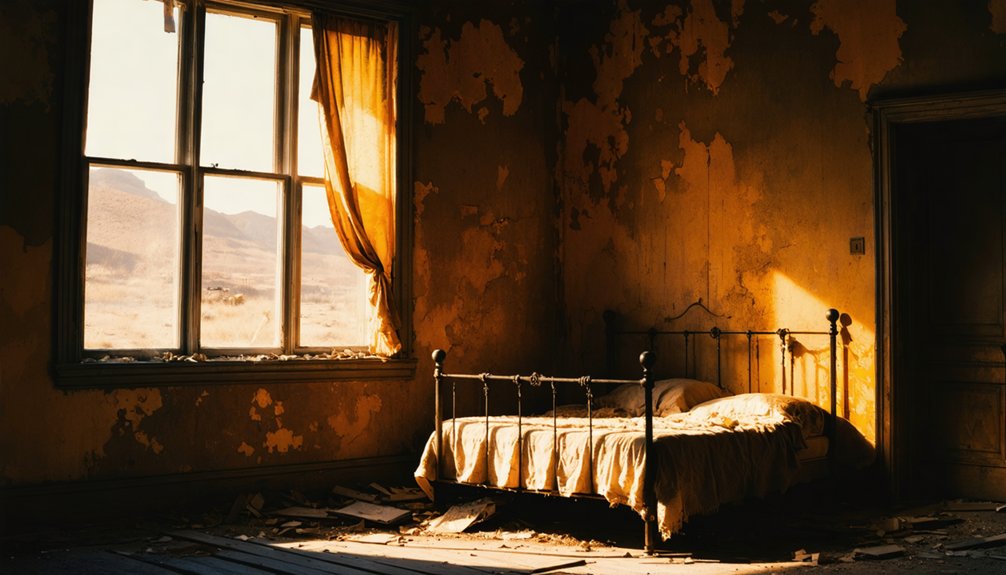
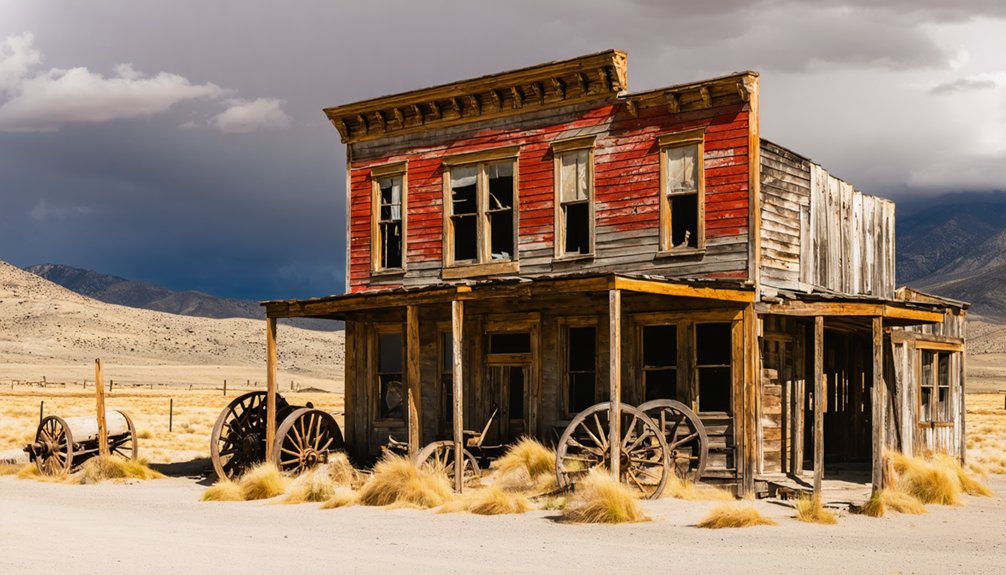
You’ll find America’s most famous ghost towns scattered across the continent, from California’s gold rush relic Bodie with its 65 saloons and $70 million legacy, to Pennsylvania’s Centralia where underground coal fires have burned since 1962. Alabama’s former capital Cahawba tells of political rise and fall, while Alaska’s Kennecott preserves copper mining history worth $300 million. Montana’s Bannack witnessed both gold fever and vigilante justice in the 1860s. These 4,530+ abandoned settlements reveal the complete story of America’s ambitious pioneers.
Key Takeaways
- The United States contains over 4,530 documented ghost towns reflecting American pioneers’ dreams and westward expansion struggles.
- Bodie, California peaked at 10,000 residents in 1880 during gold rush, generating $38-70 million in precious metals.
- Centralia, Pennsylvania has burned underground since 1962, forcing evacuation of 3,000 residents with fire continuing 250+ years.
- Bannack, Montana saw vigilante justice executions after gold discovery in 1862 brought lawlessness and Sheriff Plummer’s gang.
- Many ghost towns offer modern tourism including cemetery tours, historical site exploration, and dark tourism photography opportunities.
Bodie, California: The Golden State’s Frozen Frontier
When gold fever gripped California in the mid-1800s, few could’ve predicted that one of the state’s most infamous boomtowns would emerge from a tragic misspelling.
You’ll find Bodie’s origins in 1859 when W.S. Bodey discovered gold in the eastern Sierra foothills. After Bodey died in a blizzard seeking supplies, the town adopted his name through a clerical error.
Bodie history transformed dramatically in 1876 when a mine cave-in exposed rich veins, triggering an explosive boom. By 1880, you’d encounter 10,000 residents, 65 saloons, and notorious violence earning the phrase “bad man from Bodie.” The town included its own China Town where hundreds of Chinese residents contributed significantly to the local economy through laundry services, logging, and providing essential vegetables and firewood.
A catastrophic mine collapse in 1876 unexpectedly revealed Bodie’s golden fortune, launching the town into wild prosperity and infamy.
This Gold rush settlement produced $38-70 million in precious metals before declining in the late 1880s. The name Bodie has become associated with multiple subjects beyond just the famous ghost town, representing various places and people throughout history.
Today, you can explore California’s official ghost town where 110 buildings remain frozen in time.
Centralia, Pennsylvania: The Town That Burns Below
You’ll find Centralia’s underground inferno began on May 27, 1962, when Memorial Day trash burning in an abandoned strip mine pit accidentally ignited the coal seam beneath the town.
The fire spread through the labyrinth of mine tunnels and has burned continuously for over six decades, creating toxic smoke, sinkholes, and ground subsidence that forced nearly all 3,000 residents to abandon their homes. Ground temperatures exceeded 900 degrees Fahrenheit, making early extinguishing efforts with water and sand ineffective. Experts predict the fire could burn for another 250 years.
You can still visit this near-ghost town today, where St. Mary’s Church holds weekly services and new forests grow where homes once stood, though the famous Graffiti Highway was buried in 2020 to discourage tourism.
In addition to St. Mary’s Church, the area also bears remnants of the past, much like the abandoned malls in America that tell stories of a different era. These empty spaces serve as a haunting reminder of changing economic times and shifting consumer preferences. As nature reclaims these structures, they become fascinating sites for exploration and reflection.
Underground Fire Origins
On May 27, 1962, Centralia Borough personnel ignited what would become one of America’s most notorious underground fires when they intentionally burned municipal waste in a landfill located in a surface mine pit southeast of the borough boundary.
You’d find this wasn’t unusual—borough officials routinely conducted these landfill fires before Memorial Day to clean the dump and reduce odors for the holiday weekend.
However, this particular coal seam ignition occurred because hot ash penetrated an incomplete fire-resistant clay barrier, allowing burning material to reach the Buck Mountain coal bed below.
Though Pennsylvania had outlawed such landfill fires in 1958 due to mine fire risks, Centralia’s volunteer fire company continued the practice.
When the fire spread to underground coal workings, borough officials deceptively claimed “unknown origins” to secure help from the Lehigh Valley Coal Company. The fire generates lethal clouds of carbon monoxide and other toxic gases that pose ongoing health and safety risks to anyone in the area. The fire now spans six square miles and reaches depths of 300 feet beneath the surface.
Current Visitor Attractions
Despite decades of underground fires and mass evacuations, Centralia remains accessible to visitors who can explore the haunting remnants of what was once a thriving Pennsylvania mining town.
You’ll discover an eerie landscape where smoke rises through cemetery grounds and toxic gases seep from sinkholes.
Current visitor experiences include:
- Graffiti Highway exploration – Walk the abandoned mile-long stretch covered in colorful graffiti, though recent dirt coverings limit access.
- Cemetery tours – Visit three maintained cemeteries featuring steam vents and the surviving 1911 Ukrainian Greek-Catholic Church.
- Street wandering – Roam empty grids where only five residents remain, finding coal chunks and tilting homes.
- Dark tourism photography – Capture the scorched terrain that inspired Silent Hill’s haunting visuals.
While unofficial ghost tours aren’t available, you’ll experience authentic apocalyptic atmosphere without commercial tourism development. The underground fire has been burning continuously for over six decades since it first ignited in the town dump in 1962. Visitors should stay on high ground to avoid the accumulation of toxic gases in lower areas.
Cahawba, Alabama: Alabama’s Lost Capital
You’ll find Alabama’s most historically significant ghost town at the confluence of the Cahaba and Alabama Rivers, where the state’s first capital once thrived before falling into complete abandonment.
Cahawba’s dramatic rise from political powerhouse in 1820 to near-total desertion by 1870 represents one of America’s most striking examples of urban decline. An 1825 flood caused part of the statehouse to collapse, ultimately forcing the state Legislature to relocate the capital to Tuscaloosa.
The town’s transformation from bustling cotton port to Civil War prison site created a haunting legacy that still echoes through its archaeological remains today. Visitors can explore the Crocheron Columns, which stand as enduring reminders of the town’s former grandeur and prosperity.
From Capital to Ruin
When Alabama achieved statehood in 1819, territorial leaders selected an ambitious location at the confluence of the Cahaba and Alabama Rivers as their new capital.
You’ll find Cahawba history reveals a dramatic rise and fall within decades. Governor William Wyatt Bibb championed this river mouth location, and by 1820, a brick Capitol building anchored the growing town of 1,000 residents.
However, the swampy terrain proved problematic:
- Seasonal flooding from two rivers regularly inundated the settlement
- 1825 flood damage collapsed part of the statehouse structure
- Health concerns included malaria, yellow fever, and cholera outbreaks
- Legislative action in 1826 triggered capital relocation to Tuscaloosa
You’d witness a town nearly abandoned within weeks after losing its political status, transforming Alabama’s first capital into a cautionary tale of poor site selection.
Ghostly Civil War Legacy
While Cahawba struggled to survive after losing its capital status, the Civil War breathed temporary life back into the dying settlement. Confederate authorities converted an 1860 cotton warehouse into Castle Morgan prison in 1863, cramming over 3,000 Union prisoners into a facility designed for 500.
You’d find prisoners packed into less than one-third acre, creating horrific overcrowding that’d make your skin crawl.
Despite these brutal prison conditions, Captain H.A.M. Henderson’s humane leadership kept death rates surprisingly low compared to Andersonville’s 30 percent mortality rate.
After the March 1865 evacuation, nearly 1,000 freed prisoners tragically perished in the Sultana explosion.
Today, visitors report historical hauntings throughout Cahawba’s ruins, where echoes of suffering prisoners allegedly still whisper through the abandoned streets of Alabama’s lost capital.
Kennecott, Alaska: Copper Mining in the Wilderness
Deep in Alaska’s remote wilderness, the discovery that would create one of America’s most remarkable ghost towns began during the summer of 1900 when prospectors Clarence Warner and Jack Smith stumbled upon a copper outcrop on the Kennecott Glacier moraine.
You’ll find this Kennecott history represents one of the most ambitious mining ventures ever attempted in America’s last frontier.
The Guggenheim and Morgan interests invested $25 million to build:
- 196-mile Copper River and Northwestern Railway – Essential transportation infrastructure
- Self-contained town – Complete with hospital, school, and recreation facilities
- Revolutionary mining technology – Including the first successful ammonia leaching process
- Integrated operations – From extraction to smelting in Tacoma, Washington
Operating from 1911 to 1938, Kennecott produced 4.6 million tons of ore valued at $200-300 million.
Bannack, Montana: Gold Rush Lawlessness in the Wild West
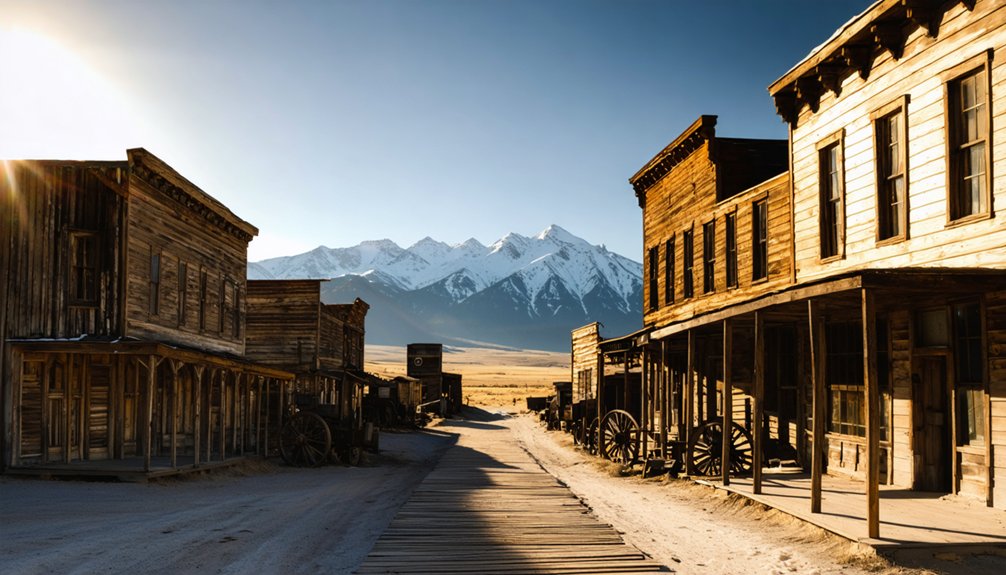
Although the summer of 1862 brought countless prospectors to Montana Territory’s rugged landscape, John White’s discovery of gold deposits along Grasshopper Creek would transform a remote wilderness into one of the West’s most notorious boomtowns.
You’d witness Bannack’s population explode to 5,000 miners by 1863, pulling over $500,000 worth of gold from the earth.
However, Sheriff Henry Plummer‘s “Innocents” gang terrorized the Gold Rush community, using his position to track shipments for robberies and murders.
When crime peaked, you’d see citizens form the Vigilance Committee of Alder Gulch in December 1863. This Vigilante Justice movement executed 22 individuals, including Plummer himself, without trials.
Crime rates plummeted, but Bannack’s boom had already ended.
Most Common Ghost Town Names Across America
Across America’s landscape of 4,530+ documented ghost towns, you’ll discover that certain names appear with striking frequency, revealing patterns of settlement and abandonment that mirror the nation’s westward expansion.
These ghost town names carry deep historical significance, reflecting the dreams and struggles of American pioneers.
Each ghost town name serves as a weathered monument to forgotten aspirations and the relentless pursuit of the American Dream.
Center Point dominates with seven abandoned settlements, all located across Texas counties, making it America’s most repeated ghost town name.
This frequency pattern tells compelling stories:
- Five-town names: Clifton, Hopewell, and Wilson each claim five ghost towns spanning multiple states.
- Four-town tier: Nineteen names including Alma, Aurora, Boston, and Liberty appear exactly four times.
- Triple occurrences: Sixty-one names like Dogtown, Empire, and Ruby mark three locations each.
- Unique names: 3,668 ghost towns bear completely original names, representing individual community identities.
Frequently Asked Questions
What Safety Precautions Should Visitors Take When Exploring Ghost Towns?
You’ll need sturdy boots, respirators, flashlights, and first aid kits for ghost town safety during urban exploration. Don’t trespass on marked property, avoid unstable structures, travel in groups, and research sites beforehand.
Are There Entrance Fees or Permits Required to Visit These Locations?
Entrance regulations vary dramatically—you’ll pay fees at Bodie State Historic Park and Kennecott’s national preserve, while St. Elmo and Cahawba offer free access. Check permit requirements for private property areas beforehand.
What Is the Best Time of Year to Visit Ghost Towns?
You’ll find spring and fall offer the best seasons for visiting ghost towns. March through May provides pleasant temperatures, while September through November delivers comfortable weather. Many locations host special ghost town events during these ideal periods.
Can Visitors Camp Overnight in or Near These Ghost Towns?
You can’t camp inside most ghost towns, but you’ll find freedom camping nearby on BLM land for 14 days. Camping regulations vary by location, while nearby accommodations include forest campgrounds and boondocking sites.
How Do Weather Conditions Affect Ghost Town Accessibility Throughout the Year?
Weather impacts create significant seasonal challenges for your ghost town visits. Winter snow blocks roads to Bodie, Animas Forks, and St. Elmo, while summer heat makes desert sites difficult to explore safely.
References
- https://devblog.batchgeo.com/ghost-towns/
- https://www.christywanders.com/2024/08/top-ghost-towns-for-history-buffs.html
- https://www.visittheusa.com/experience/5-us-ghost-towns-you-must-see
- https://www.authentikusa.com/us-en/blog/english-top-5-villes-fantomes-aux-usa-maj
- https://www.geotab.com/ghost-towns/
- https://en.wikipedia.org/wiki/Lists_of_ghost_towns_in_the_United_States
- https://www.atlasobscura.com/lists/americas-best-preserved-ghost-towns
- https://www.youtube.com/watch?v=Z69cNeuZGsA
- https://joybird.com/blog/top-ghost-towns-in-america/
- https://thelittlehouseofhorrors.com/bodie-the-cursed-ghost-town/