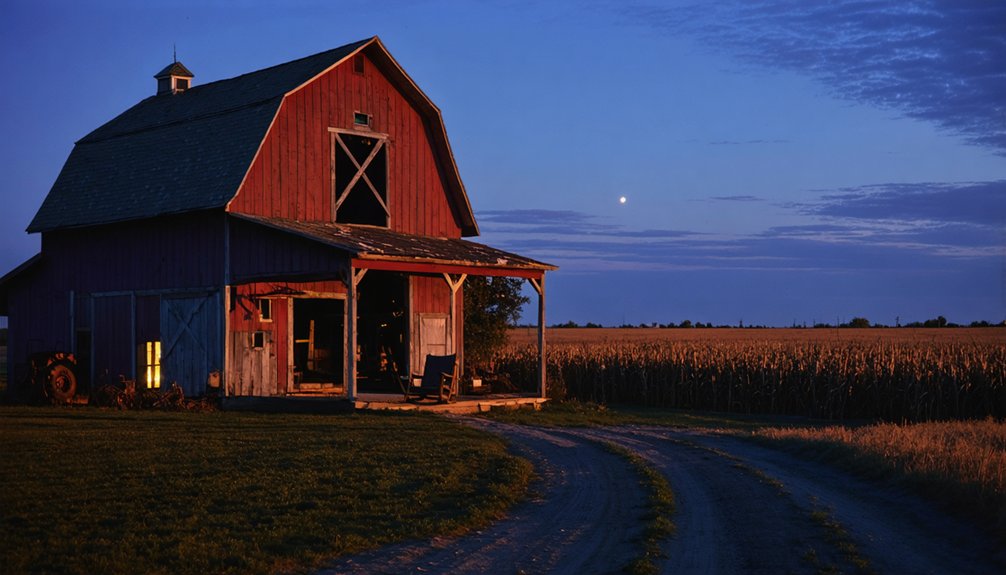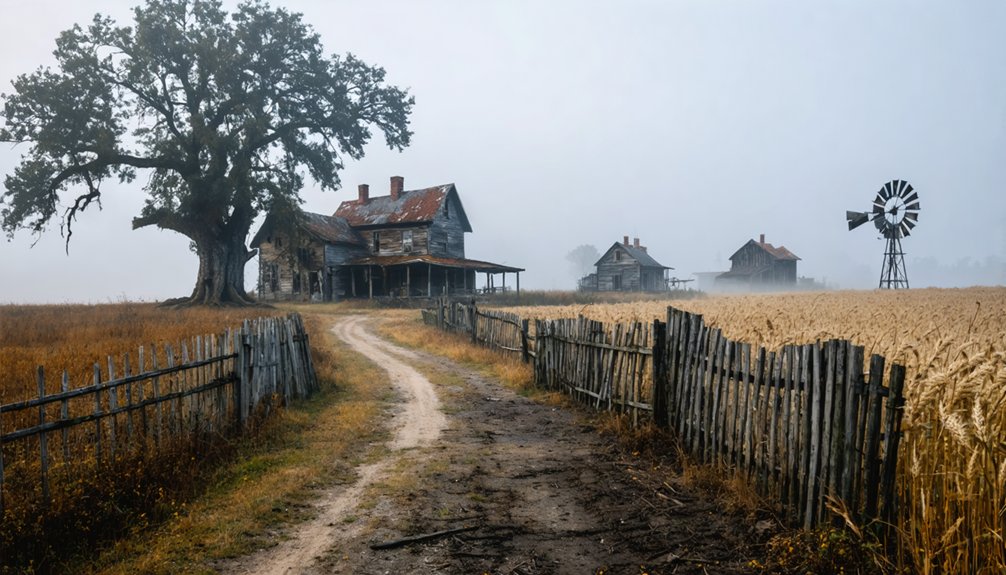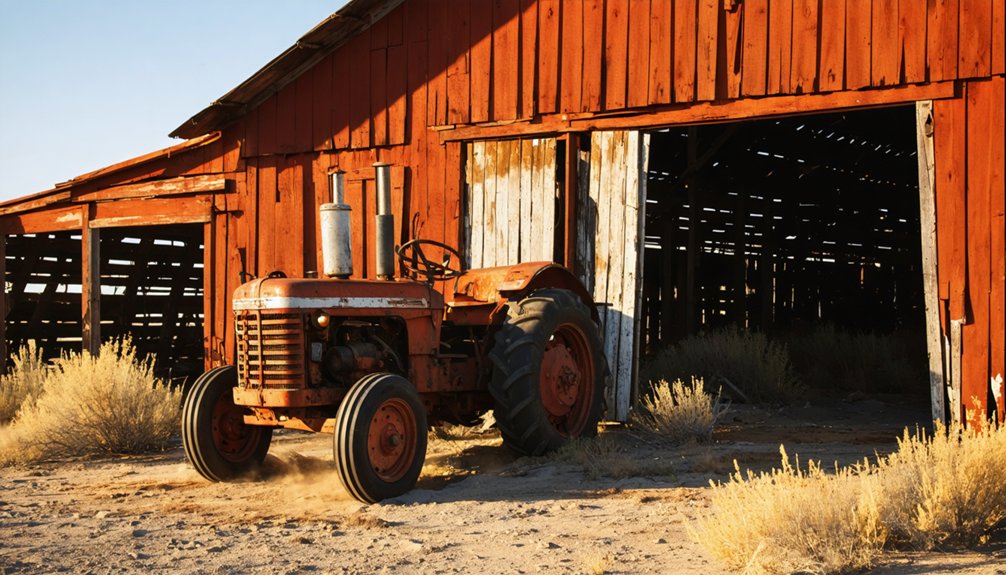
America’s agricultural ghost towns emerged primarily during the 1930s Dust Bowl when 2.5 million people fled unproductive farmland. You’ll find these forgotten communities marked by crumbling cotton gins, abandoned rail spurs, and vacant schoolhouses. Mechanization transformed farming as tractors replaced horses, eliminating 850,000 jobs by mid-century while agricultural productivity soared. Today, these sites serve as open-air museums chronicling rural resilience, with preservation efforts now safeguarding America’s agrarian heritage. Further exploration reveals the full human cost of this transformation.
Key Takeaways
- The Dust Bowl of the 1930s created America’s first widespread agricultural ghost towns, displacing 2.5 million people from affected states.
- Mechanization, particularly tractors replacing horses from 1910-1960, eliminated 850,000 farming jobs and contributed to rural community collapse.
- Abandoned structures like cotton gins, silos, and commercial buildings chronicle the rise and fall of agricultural prosperity across rural America.
- Agricultural ghost towns serve as open-air museums showcasing pre-mechanization farming lifestyles and documenting rural resilience.
- Despite high agricultural productivity gains (47% from 2000-2021), farming employment plummeted from 41% in 1900 to just 4% by 1970.
The Dust Bowl Exodus: America’s First Agricultural Ghost Towns

While many Americans associate ghost towns primarily with abandoned mining settlements, the Dust Bowl of the 1930s created America’s first widespread agricultural ghost towns across the Great Plains.
Ghost towns of the Great Plains reveal the Dust Bowl’s devastating impact on America’s agricultural communities
You’d have found entire communities suddenly emptied when four years of severe drought decimated regional agriculture.
The scale of this Economic Migration was unprecedented—2.5 million people fled the Dust Bowl states, with 500,000 “Okies” abandoning Oklahoma alone.
As 35 million acres became completely unfarmable and banks foreclosed on unproductive land, settlers who’d been lured by misleading “booster” campaigns and favorable homesteading acts abandoned their homes.
Families desperate for survival often packed their few remaining possessions into jalopies and headed west seeking opportunities.
Following catastrophic dust storms that destroyed over 350 houses in single events, farmers watched helplessly as topsoil—and their livelihoods—blew away, leaving ghostly remnants of America’s agricultural heartland.
These devastating conditions led to severe health issues, with many children developing dust pneumonia that sometimes proved fatal.
Mechanization’s Double-Edged Sword: How Innovation Emptied Rural America
You’ve likely never witnessed the stark transformation that occurred when tractors replaced horses in America’s breadbasket between 1910-1960, fundamentally altering not just farming methods but entire community structures.
As early adopters expanded their acreage by 37% through mechanization efficiency, neighboring family farms disappeared at alarming rates, with nearly one million farms vanishing from the rural landscape.
What appeared as progress to agricultural economists represented devastating loss to rural communities—each tractor purchased meant fewer farmhands needed, fewer shopkeepers supported, and eventually, fewer schoolhouses filled with children, creating the hollow shells of townships you might encounter today. This technological shift represents the early beginnings of traditional industries’ decline that continues to challenge rural economies today. Regions with strong agricultural presence demonstrate significantly lower poverty and unemployment rates than those reliant on extraction industries or cyclical markets.
Progress Breeds Decline
As American agriculture embraced unprecedented technological advances throughout the twentieth century, a paradox emerged that would fundamentally reshape rural America’s demographic landscape.
While agricultural productivity soared 47% between 2000-2021, you witnessed a 17% workforce decline—the culmination of a progressive displacement that had been unfolding since 1900, when farming employed 41% of Americans. By 1970, that figure plummeted to just 4%.
Labor-saving innovations that once promised liberation from backbreaking toil instead triggered massive agricultural transformation, with self-employed and family farmworkers plunging 73% between 1950-2000.
You’ve seen this technological efficiency concentrate wealth disproportionately—the income gap between top and bottom rural households now exceeds 26:1.
Nonmetro communities, where 51% of farm employment resided, bore the brunt of this mechanization without adequate economic alternatives.
Tractor vs. Community
When tractors first rumbled across American fields in the early 1900s, they ignited an agricultural revolution that would systematically hollow out rural communities within decades.
You’d witness dramatic tractor impact as equipment replaced human hands—eliminating 850,000 jobs by mid-century and halving the farm workforce between 1910-1960. While productivity soared, cutting 3.4 billion man-hours annually, community decline followed inevitably.
Without mechanization, nearly one million more farms would’ve existed in 1960. Instead, your rural landscape transformed as operators abandoned their homesteads, seeking urban employment when a single farmer with machinery could perform tasks previously requiring multiple families. This dramatic shift was partially driven by the Fordson model introduced in 1917, which made tractors more affordable and accessible to average farmers. The rapid increases in farm productivity created a deflationary effect, with commodity crop prices continuously falling for over 150 years.
The ghost towns dotting America’s countryside aren’t merely victims of progress—they’re monuments to efficiency’s cost. When you gained technological freedom through horsepower and hydraulics, you sacrificed the interdependence that once bound rural society together.
These ghost towns in rural landscapes serve as stark reminders of the economic shifts that left them behind. They challenge us to remember the vibrant communities that thrived before the allure of modernization reshaped our values. As nature reclaims these abandoned spaces, we must consider how to balance progress with preserving the connections that once defined us.
King County, Texas: A Case Study in Extreme Rural Depopulation
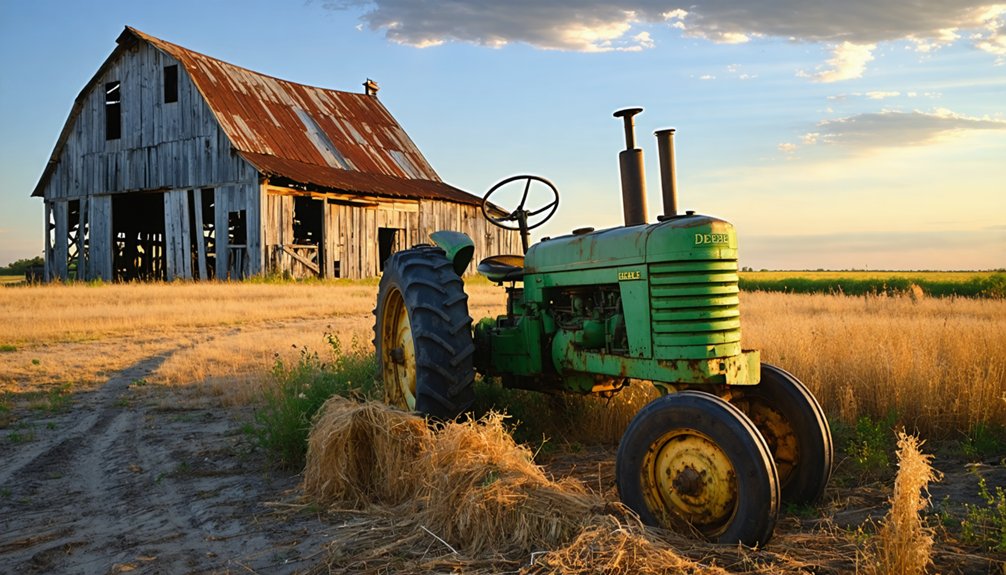
You’ll find few places in America that better illustrate dramatic rural exodus than King County, Texas, where the population plummeted from nearly 1,200 residents in 1930 to just 265 in 2020, leaving behind a skeletal infrastructure with more abandoned homesteads than occupied dwellings.
This sparsely populated ranching community maintains the state’s highest cattle-to-person ratio at 87:1, a statistical anomaly reflecting the shift from diversified agriculture to mechanized operations requiring minimal human labor. Research shows that insufficient water supply has been a significant factor contributing to the ongoing depopulation of Texas Great Plains counties since 1910.
Schools, churches, and commercial buildings now stand vacant throughout the county’s 944 square miles, silent indicators to how technological advancement and economic consolidation transformed a once-thriving agricultural settlement into America’s rural hinterland.
The heart of this dwindling community is Guthrie, which offers minimal amenities including a restaurant, church, and supply stores, with survival dependent on maintaining the Guthrie Common School that serves approximately 95 students.
From Boom to Bust
King County, Texas stands as a compelling case study of extreme rural depopulation that transformed a once-thriving agricultural community into a virtual ghost town.
You’ll find a stark boom-decline narrative etched across this landscape. When railroads arrived in the early 1900s, the county flourished with wheat fields, cotton production, and cattle operations.
By the 1920s, agricultural prosperity defined the region’s identity. Then came the devastating one-two punch: the Great Depression collapsed commodity prices while the Dust Bowl stripped away topsoil and hope alike.
Mechanization eliminated jobs, drought sapped the water table, and families abandoned homesteads for urban opportunities. Similar to how Belle Plain College closed in 1892 due to financial hardships from a drought, King County’s institutions couldn’t withstand the environmental and economic challenges. As rural exodus accelerated, community infrastructure collapsed—schools shuttered, church bells fell silent, general stores boarded up.
Much like Indianola, which was once a prosperous frontier seaport before hurricanes destroyed it, King County’s prosperity quickly vanished with environmental calamities.
What remains today stirs agricultural nostalgia while revealing how quickly prosperity can vanish from America’s heartland.
Statistical Population Collapse
The stark numerical reality of King County’s population collapse reveals one of America’s most dramatic examples of rural exodus.
You’re witnessing a community that plummeted from 1,193 residents in 1930 to just 189 in 2023—a staggering 84% decline across nine decades.
Population statistics tell the sobering tale: the steepest drops occurred post-1940, with 2010-2023 showing an accelerated 33% decrease.
Behind these numbers lies the mechanization of agriculture, reducing labor demand while the Great Depression and Dust Bowl forced farmers into bankruptcy.
Despite cattle historically outnumbering people (38,000 cattle to 490 residents in 1900), and oil production exceeding 114 million barrels by 1991, the rural exodus continued unabated.
Today, King County stands as Texas’ second-least populated county, where agricultural land use has diminished alongside its human presence.
Infrastructure Left Behind
Across the now-quiet landscape of King County, remnants of once-thriving agricultural infrastructure stand as weathered monuments to rural prosperity’s decline.
You’ll find crumbling foundations of cotton gins that once processed harvests from 3,000 acres of cotton fields, alongside abandoned mill structures where farmers brought their corn and sorghum.
The infrastructure decay tells a compelling story: abandoned railroad spurs that once shipped coal to San Francisco, collapsed bridges that connected commercial lifelines, and irrigation ditches now reclaimed by prairie grass.
Four churches, a Masonic lodge, and a college—all now silent—reveal the depth of community investment.
This rural nostalgia isn’t merely sentimental; it’s evidenced in physical artifacts.
Water systems, blacksmith shops, and post offices—the practical vertebrae of farming towns—now stand as skeletal reminders of freedom-seeking communities.
The Death of Main Street: When Local Economies Collapsed
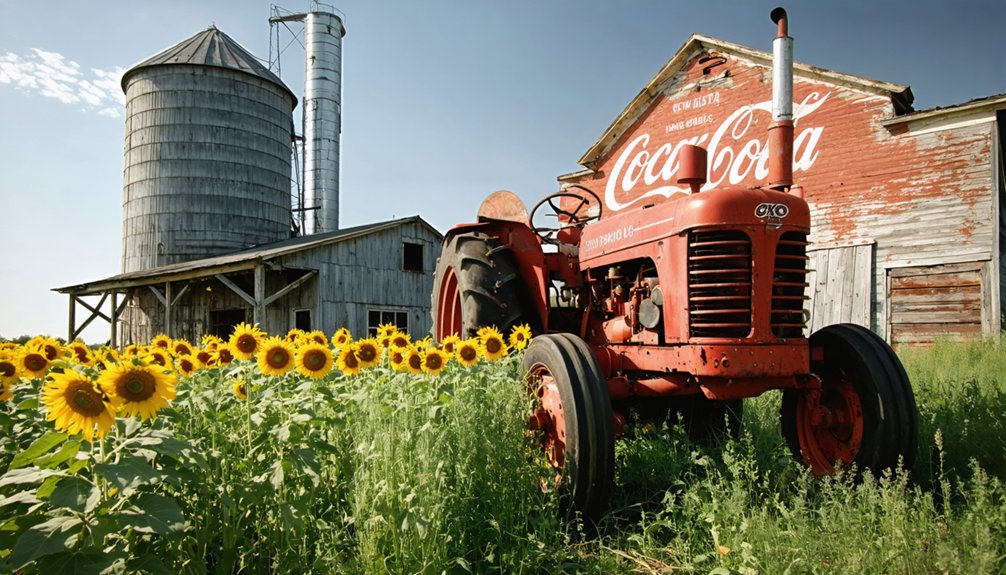
When agricultural communities began to disintegrate during the economic upheavals of the 20th century, Main Streets across America’s farming regions suffered catastrophic declines that transformed vibrant commercial centers into hollowed-out remnants.
You’d have witnessed economic resilience crumble as the 1929 Crash wiped out billions, triggering 9,000+ bank failures that severed farmers’ access to capital. By the 1930s, with unemployment reaching 25%, rural consumer spending collapsed.
Main Street merchants—once essential nodes in local commerce—shuttered as foreclosures multiplied.
The mechanization revolution compounded this crisis, as farm consolidation eliminated countless homesteads. Rural nostalgia often glosses over how the Great Recession delivered another devastating blow, with GDP shrinking 4.3% and 11 million foreclosures further emptying these communities, leaving behind commercial districts that now stand as monuments to lost agricultural prosperity.
Abandoned Schools and Churches: The Social Cost of Farm Consolidation
You’ll find once-bustling rural schoolhouses standing vacant across America’s heartland, where consolidation has closed over 150 of 230 public schools in Arizona alone since 2011.
The shuttering of these educational centers, alongside the silent church steeples where only one in five rural residents now attend services, represents the profound social cost of farm amalgamation that began in the mid-20th century.
These abandoned institutions—where generations gathered for learning and worship—now stand as weathered monuments to communities fractured by the economic pressures that transformed family farms into industrial agricultural operations.
Vacant Classrooms Echo Memories
As you walk through the silent corridors of abandoned schoolhouses dotting America’s rural landscape, the empty desks and faded chalkboards tell a stark story of agricultural transformation.
These vacant classrooms, once vibrant centers of learning and community gatherings, now echo with rural nostalgia of a pre-consolidation era.
Since the early 20th century, the mechanization of farming has reshaped America’s heartland. When family farms consolidated into industrial operations, populations dwindled, forcing schools to close or merge.
You’ll notice longer bus routes replaced neighborhood walks, severing vital community bonds. In Arizona alone, 150 rural schools have lost students since 2011.
These classroom memories represent more than abandoned buildings—they’re artifacts of vanishing rural culture, where schools once formed fundamental pillars alongside churches and families in America’s agricultural communities.
Church Bells Fall Silent
The church bells that once reverberated across America’s rural landscape have fallen silent in unprecedented numbers, paralleling the closure of country schools and reflecting the profound social consequences of agricultural consolidation.
You’re witnessing the dissolution of rural spirituality at a staggering pace—12-15 churches close daily, with projections indicating 15,000 closures in 2025 alone.
The church community crisis stems from:
- Demographic hemorrhage: 57% of congregants exceed age 51
- Economic unsustainability: 15,000 churches shifted from full-time to part-time pastoral care
- Leadership drought: Median age of church leaders stands at 62 and rising
- Systematic neglect: Denominations prioritized urban ministry despite rural America encompassing 80% of the nation’s land
While mechanization boosted per-acre yields throughout the 20th century, the spiritual harvest fields of rural America increasingly lie fallow, untended by denominations pursuing urban missions.
From Family Farms to Corporate Agriculture: The Changing Landscape
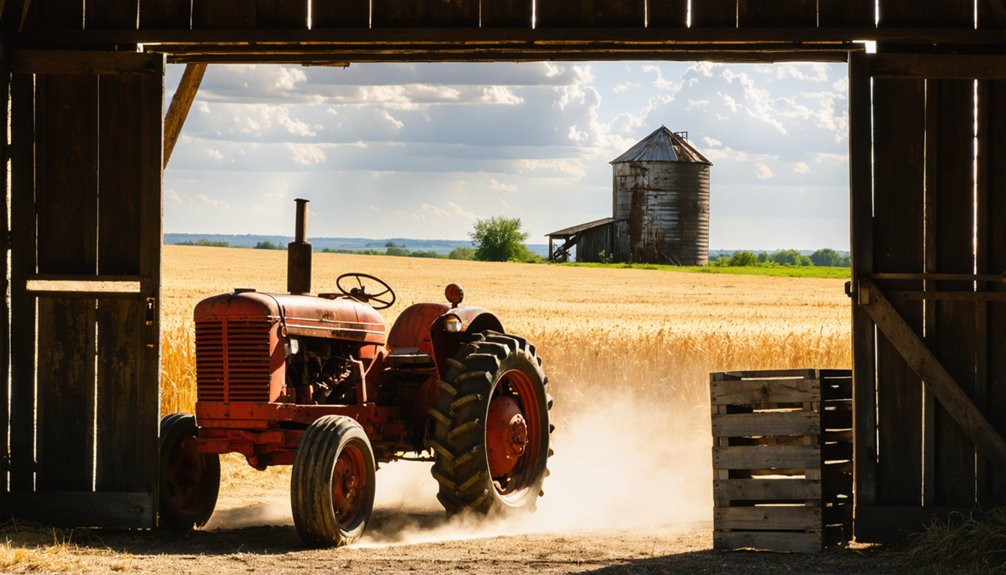
When American agriculture stood at its apex in 1910 with 6.4 million operational farms, few could have anticipated the dramatic transformation that would unfold over the next century.
As you wander through these forgotten towns, you’re witnessing the skeletal remains of sustainable agriculture that once thrived before post-WWII consolidation.
Farm numbers plummeted to 2.2 million while average acreage doubled—a revolution driven by mechanization and chemical innovations requiring massive capital investment.
What appears as corporate takeover is more nuanced; many operations remain family-owned but structured as “Family, Inc.” for legal protection.
Though true corporate land ownership hovers around 10%, the squeeze comes from market control—four companies dominating livestock slaughter and seed production, leaving farmers with merely 15 cents of your food dollar.
Rural revitalization now hinges on recognizing this complex history.
The Great Plains Diaspora: Mapping Rural Population Decline
Sprawling across America’s heartland, the Great Plains has witnessed an unprecedented demographic exodus that fundamentally transformed its rural landscape since the 1930s.
Population mapping reveals the severity of this rural migration, with 71% of counties experiencing depopulation between 1980-2010.
The diaspora’s magnitude includes:
- 40% cumulative population loss in rural counties (1930-2010)
- 112 counties suffering 10%+ population decline in a single decade (2000-2010)
- 56% of counties now experiencing natural decline (more deaths than births)
- Young adult population (20-34) plummeting by 15% in many farming communities
You’re witnessing a demographic transformation where out-migration consistently outpaces natural increase—462,000 more people departed than arrived since 2010, leaving behind agricultural heritage spanning generations.
Silent Silos: The Architecture of Abandoned Farming Communities

Dotting America’s forgotten farming landscape, abandoned silos stand as silent monuments to agricultural prosperity that once defined rural communities.
You’re witnessing the evolution of silo architecture when you encounter these cylindrical sentinels—from Francis Morris’s pioneering designs in 1880s Maryland to the reinforced concrete structures that dominated the mid-20th century.
As you travel through Wisconsin, Illinois, and Iowa, you’ll find the densest concentration of these agricultural relics, their airtight, moisture-proof construction representing ingenious solutions to winter feeding challenges.
Today, these structures offer unique opportunities for agricultural preservation and adaptive reuse. Visionaries have transformed these cylindrical spaces into residences and commercial venues, breathing new life into their distinctive forms while honoring America’s farming heritage.
The precision of their design continues to inspire artists drawn to their raw industrial beauty.
Agricultural Ghost Towns as Living Museums of American Resilience
Though long abandoned by their original inhabitants, America’s agricultural ghost towns now function as powerful open-air museums chronicling rural resilience throughout the nation’s farming history.
Walking these silent streets, you’ll witness the embodiment of economic resilience as communities adapted to devastating challenges like the Dust Bowl and technological displacement.
These settlements preserve our agricultural cultural heritage through:
- Original homesteads showcasing pre-mechanization farming lifestyles
- Main street storefronts reflecting boom-cycle prosperity before eventual bust
- Infrastructure remnants (grain elevators, irrigation systems) demonstrating technological evolution
- Archaeological artifacts telling stories of daily life during settlement expansion
What you’re experiencing isn’t merely abandonment—it’s a reflection of the pioneering spirit that defined America’s agrarian ambitions and the adaptability of those who faced environmental and economic upheaval before seeking opportunity elsewhere.
Reclaiming History: Preservation Efforts in Farming Ghost Towns
While abandoned farming settlements once faced inevitable decay, a remarkable nationwide preservation movement has emerged since the 1970s to reclaim these agricultural heritage sites.
You’ll find nonprofit organizations like the Chesterfield Foundation spearheading restoration efforts, offering interpretive tours that connect visitors to pioneer cultivation techniques and settlement patterns.
Community engagement proves essential as historical societies collaborate with residents to protect structures from threshing barns to grain silos.
However, restoration challenges persist—primarily financial ones. The multi-million dollar cost of stabilizing weathered clapboard storefronts and deteriorating homesteads far exceeds available government funding through the National Park Service.
The financial burden of rural preservation outweighs available funding, leaving our agricultural heritage vulnerable despite best efforts.
Despite these limitations, adaptive reuse has breathed new life into many towns.
Former granaries become museums, and abandoned mercantiles transform into craft centers celebrating agricultural heritage—each preservation effort safeguarding the narrative of America’s agrarian past.
Frequently Asked Questions
What Technologies Replaced Specific Farm Workers During Agricultural Mechanization?
Sunset fell on manual labor as tractor innovation displaced your predecessors—plowmen replaced by disk plows, scythers by combines, cotton pickers by mechanical harvesters, and threshers by integrated equipment you’ll never operate.
How Did Gender Roles Evolve in Declining Agricultural Communities?
You’ll notice gender dynamics shifted as rural feminism emerged—women evolved from farmstead keepers to co-managers when men migrated for wage labor, ultimately claiming greater decision-making authority in shrinking agricultural settlements.
Did Ghost Town Residents Attempt Collective Ownership to Prevent Abandonment?
You’ll find limited evidence of cooperative farming in ghost towns; while Roosevelt’s 1930s Resettlement Administration attempted collective models, residents generally lacked the community resilience and ownership rights needed to prevent abandonment through cooperation.
How Did Agricultural Abandonment Affect Native American Communities Differently?
You’ll find Native American agricultural abandonment stemmed from environmental collapse versus market forces, leading to cultural displacement through forced migration while traditional land preservation practices couldn’t overcome unprecedented drought cycles during the 13th-15th centuries.
What Environmental Benefits Emerged From Agricultural Land Abandonment?
When you allow farm abandonment, you’ll witness robust soil regeneration and biodiversity restoration, enhanced carbon sequestration, improved watershed protection, and new opportunities for renewable energy production on previously cultivated lands.
References
- https://www.legendsofamerica.com/gt-emergingghosttowns/
- https://www.youtube.com/watch?v=E4PnbL4oCHY
- https://www.tpr.org/economy-and-labor/2024-11-14/texas-uneven-population-boom-is-creating-ghost-towns-in-many-rural-counties
- https://www.geotab.com/ghost-towns/
- https://jasontdunn.com/files/ghost_towns_big_cities.pdf
- https://jrap.scholasticahq.com/api/v1/articles/9543-the-economics-of-ghost-towns.pdf
- https://www.richmondfed.org/-/media/richmondfedorg/publications/research/econ_focus/2011/q3/pdf/feature2.pdf
- https://www.loveexploring.com/gallerylist/188219/the-us-state-with-the-most-ghost-towns-revealed
- https://www.businessinsider.com/vintage-photos-us-small-towns
- https://blogs.loc.gov/maps/2023/12/climate-migrants-of-the-1930s-dust-bowl/