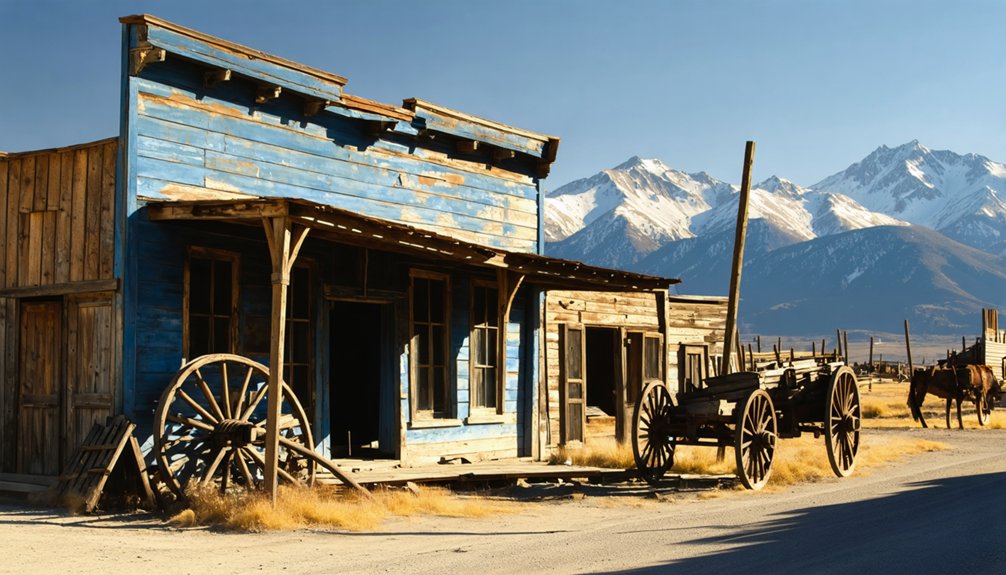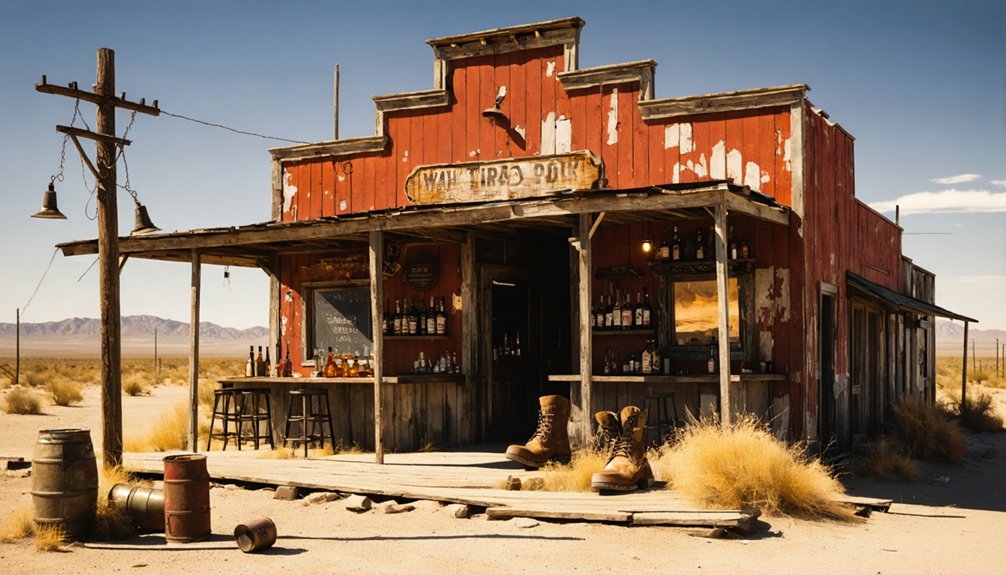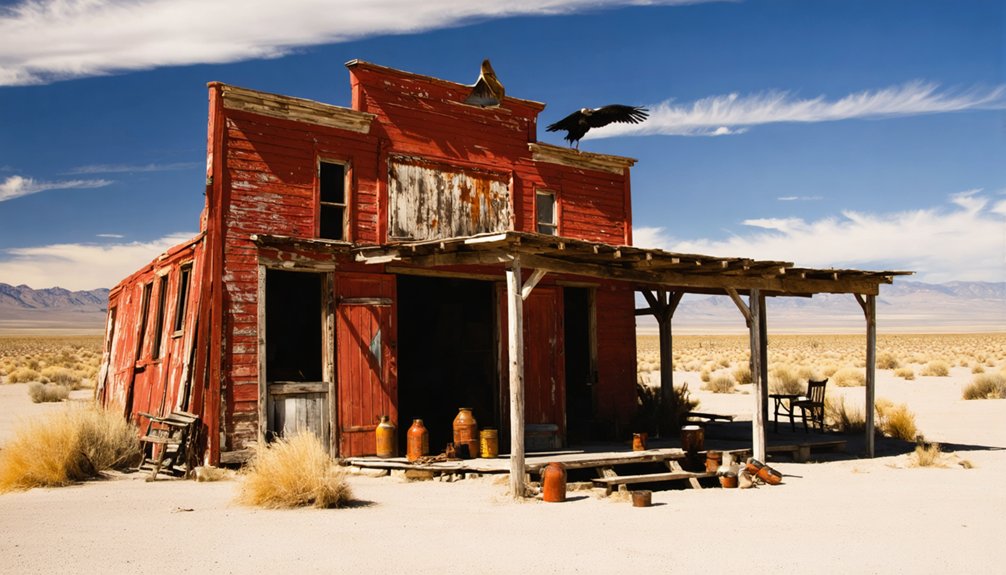
Ghost towns across the American West stand as haunting reminders of boom-and-bust cycles that shaped the frontier. You’ll find preserved wooden structures in Bodie, California, while Nevada’s abandoned silver towns hide tales of lost treasures. These settlements collapsed when railroads redirected or natural disasters struck, leaving behind architectural artifacts of frontier life. Preservation groups now race against weather and time to stabilize these fragile windows into a vanished era of American ambition.
Key Takeaways
- Abandoned settlements like Bodie preserve nearly 200 wooden structures that showcase the rise and fall of mining communities.
- Railroad decisions to reroute tracks or abandon lines led to swift economic collapse of once-thriving western towns.
- Natural disasters including floods forced evacuations in towns like Thistle, Utah, and Grafton.
- Ghost towns hold legends of lost treasures, including Nevada’s Shoshone Lost Ledge and Goldfield’s buried fortunes.
- Preservation efforts by organizations like the Ghost Town Club of Colorado combat weather damage and funding challenges.
The Boom and Bust Cycle of Western Mining Communities
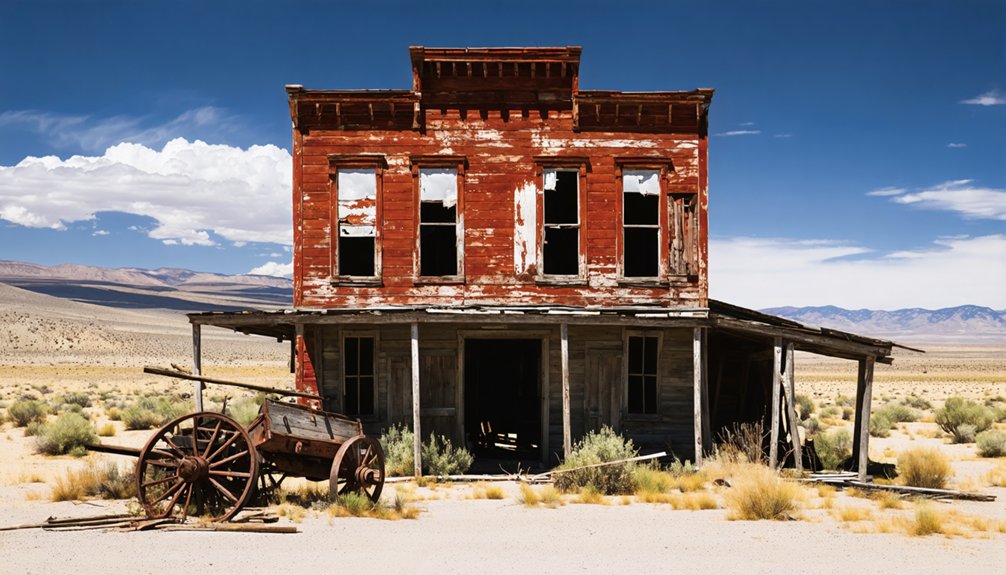
When prospectors discovered gold at Sutter’s Mill in 1848, they unwittingly established a pattern that would define the American West for decades to come. This cyclical rhythm of boom and bust transformed remote mountainsides into bustling cities almost overnight, only to abandon them within a decade as minerals depleted.
You can trace this pattern from Virginia City’s silver-fueled explosion to 25,000 residents, to Goldfield’s dramatic rise and fiery collapse. The “Black Sunday” oil shale bust in 1982 mirrored these earlier cycles when Exxon’s sudden withdrawal from the Colony Project left thousands unemployed overnight.
The mining economics shifted dramatically mid-century—individual prospectors with pans gave way to eastern corporations with heavy machinery and deep pockets. This transformation concentrated wealth away from communities while intensifying environmental impact.
Mercury poisoned waterways, sulfurous gases filled the air, and rock dust silted riverbeds, flooding towns downstream. Many towns like Rhyolite, Nevada became famous ghost towns after their mining booms ended. By the 1920s, the landscape was littered with abandoned settlements—silent testimonies to the frontier’s transitory nature and extraction’s true cost.
Bodie: California’s Frozen-in-Time Gold Rush Town
Among California’s many ghost towns, Bodie stands as the quintessential frozen tableau of Gold Rush ambition.
You’ll find nearly 200 wooden structures preserved in “arrested decay,” offering an authentic glimpse into boom-era life following William Bodey’s 1859 gold discovery.
Bodie architecture reveals the stark reality of mining culture—from humble cabins to the imposing Standard Mill.
The weathered facades and utilitarian designs speak volumes about the harsh realities miners faced in pursuit of fortune.
When you walk these deserted streets, you’re traversing the same paths where 7,000-10,000 souls once lived during the town’s 1879 peak.
Bodie legends abound with tales of violence and vice.
The infamous question “Have we a man for breakfast?” reflected the deadly reputation of a town boasting 65 saloons.
After producing over $38 million in precious metals, Bodie’s flame extinguished by the 1940s, leaving behind America’s most hauntingly preserved ghost town.
The nickname “Badman from Bodie” emerged by 1880, cementing the town’s notorious place among the wildest settlements in the American West.
The name requires careful navigation as “Bodie” refers to multiple places and people, making it important to specify the California ghost town when researching its history.
Lost Treasures of Nevada’s Silver Circuit
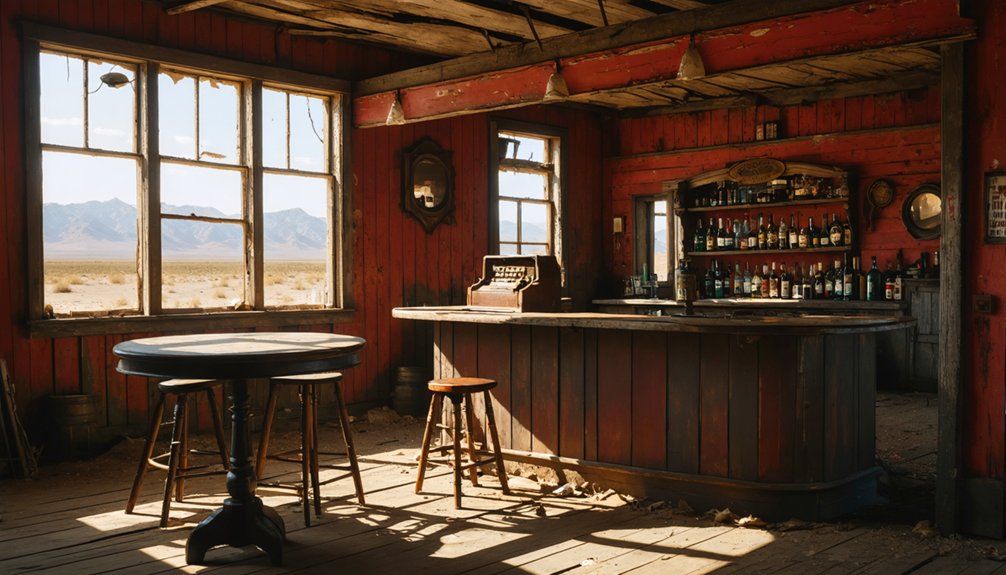
While Bodie’s ghostly streets tell tales of California’s golden past, Nevada’s abandoned mining settlements harbor secrets of a different kind—buried fortunes that never made it to bank vaults or government ledgers.
These abandoned treasures remain scattered across Nevada’s harsh landscape, waiting for those bold enough to seek them. The mysterious Shoshone Lost Ledge with its rich silver ore remains hidden somewhere in the Stillwater Range, adding to Nevada’s legend of undiscovered wealth.
The Silver Circuit’s lost wealth represents more than mere riches:
- Goldfield’s flash flood-swept safes and Bishop’s golden leg caches reflect how quickly fortune could vanish in boom towns.
- Prison Hill’s $62,000 Wells Fargo haul connects imprisonment to freedom through Gabriel Gonzales’s tantalizing window view.
- Lincoln County’s Mormon caravan gold and Mineral County’s missing mine payroll demonstrate how easily wealth disappeared in vast desert expanses.
Virginia City rose to prominence as a significant boomtown following the discovery of the Comstock Lode in 1859, creating wealth that sometimes vanished mysteriously.
Treasure hunting continues despite decades of fruitless searches—perhaps because finding these lost hoards represents reclaiming a piece of untamed Western liberty.
The Railroad’s Role in Ghost Town Formation and Abandonment
You’ll find that railroads served as the economic lifelines of western boom towns, bringing supplies, people, and connecting remote resource extraction to global markets.
When rail companies abandoned tracks or rerouted lines away from once-thriving communities, you can trace the swift collapse of isolated settlements that couldn’t sustain themselves without this vital infrastructure. Corporate decisions often prioritized new town creation over supporting existing settlements for financial gain. Grafton, West Virginia’s transformation into a bustling railroad hub in the 1850s demonstrates the profound impact railways had on community development.
These “tracks to nowhere” remain as physical artifacts of abandoned economic systems, with ghost towns like St. Elmo and Chloride standing as archaeological evidence of the railroad’s power to both create and destroy frontier communities.
Lifelines Of Boom Towns
The iron rails that carved paths across the American frontier did more than connect distant points on a map—they breathed life into settlements that would otherwise never have existed.
Railroad significance extended beyond mere transportation—these steel arteries determined which towns flourished and which withered. When Captain William Thurmond established his namesake town in 1873 along the Chesapeake & Ohio line, he tapped into the economic lifelines that railways provided.
- Resource-rich settlements transformed into vibrant communities when rail access enabled mineral wealth to flow outward.
- Branch lines to coal mines created explosive growth, turning quiet stops into raucous boomtowns teeming with miners, merchants, and entertainers.
- Railroad infrastructure—stations, yards, repair facilities—generated employment that sustained these frontier economies.
This pattern was evident when Canyon Diablo emerged after railroad construction halted for 18 months while workers built a bridge across the canyon.
By 1910, Thurmond had become an economic powerhouse, generating $4.8 million in freight revenue which represented 20% of the C&O Railroad’s total earnings.
You’re witnessing the skeleton of an intricate relationship between technology and settlement, where a town’s fate hung on steel rails.
Railroad Abandonment Impacts
As rail companies stretched their lines across the continent, they wielded extraordinary power—not just connecting towns but determining which would survive and which would perish.
When railroads abandoned routes, they effectively sentenced communities to economic death. You can trace this railroad legacy in places like Saint Elmo, where service ended in 1922, triggering a slow exodus that culminated with mail service termination in 1952.
The economic implications were devastating. Merchants shuttered businesses when passenger traffic vanished. Mining operations collapsed without affordable ore transport.
In Rhyolite, a bustling population of 5,000 completely disappeared by 1920 following rail abandonment and mine closure. Across Colorado, Utah, and Texas, hundreds of ghost towns stand as evidence to what happens when lifelines are severed, their preserved structures silently documenting the consequences of railroad withdrawal.
Tracks To Nowhere
While railroad tracks once symbolized economic lifelines for frontier communities, these same steel corridors became harbingers of abandonment across the American West.
You can still find these forgotten settlements scattered along obsolete railroad routes—ghosts of America’s industrial expansion.
When railroads changed course, towns vanished. The switch from steam to diesel locomotives eliminated water and coal supply stops, while infrastructure projects and environmental disasters permanently altered landscapes where communities once thrived.
- Corinne, Utah flourished as a “Gentile capital” until route changes made it obsolete
- Thurmond, West Virginia—once generating more wealth than Cincinnati—emptied when coal declined
- Promontory vanished when transcontinental lines rerouted across Great Salt Lake
These abandoned tracks reveal how technological change can transform prosperity into desolation almost overnight.
Daily Life in America’s Abandoned Frontier Settlements
Living in America’s frontier settlements demanded extraordinary resilience from pioneers who faced isolation as their constant companion. You’d find your nearest neighbor half a mile away—sometimes much further—forcing almost complete self-sufficiency.
Women often managed households alone while men traveled for supplies, their sod houses offering minimal protection against harsh elements.
Frontier survival hinged on producing everything yourself: food from subsistence farming, clothing from available materials, and tools crafted by hand. When illness struck, medical care might be days away—a death sentence for many.
Despite these hardships, community resilience emerged through rare but crucial social gatherings at one-room schoolhouses and churches.
These buildings, now abandoned shells in ghost towns, once hosted barn raisings, religious services, and local governance—brief respites from the crushing isolation that defined frontier existence.
Natural Disasters and Town Exodus: When Nature Reclaimed the West
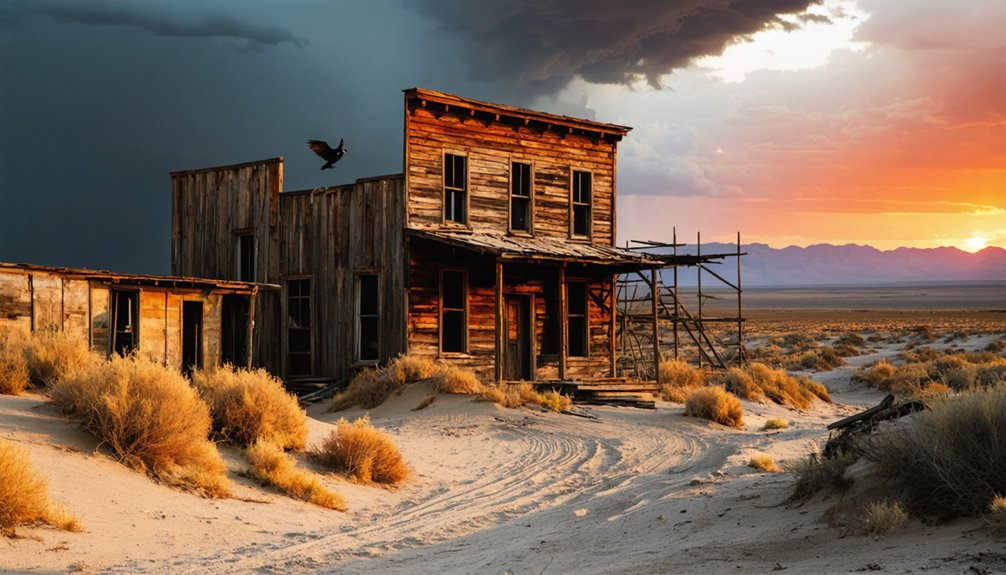
The harsh realities of frontier life were often compounded by nature’s unforgiving power, which could erase entire communities overnight.
You can still witness the remnants of this environmental struggle in places like Thistle, Utah—buried by a catastrophic 1983 flood—or Grafton, abandoned after repeated flooding destroyed settlers’ resolve.
The vulnerability of isolated Western settlements became their undoing when confronted with nature’s might.
Nature inevitably reclaims what pioneers built, crushing isolation with elemental force that no frontier determination could withstand.
- Fort Jefferson crumbled beneath hurricane winds in 1906, leaving only stone foundations to mark humanity’s brief claim.
- Environmental degradation from mining operations poisoned Treece and Picher, forcing government-mandated evacuations.
- Resource exhaustion through drought and soil erosion transformed once-thriving agricultural communities into barren landscapes.
These ghost towns stand as silent monuments to nature’s ultimate authority over human ambition.
Preservation Efforts and the Fight Against Time
When you visit ghost towns today, you’ll find a delicate balance between preservation efforts and nature’s reclamation process, often maintained by community organizations like the Ghost Town Club of Colorado and Historic St. Elmo.
You’re witnessing the results of fundraising campaigns, volunteer workdays, and grant-funded projects that stabilize deteriorating structures while maintaining their historical integrity.
These preservation initiatives frequently struggle against weather damage, vandalism, and funding inconsistencies, creating an ongoing tension between authentic decay and structural safety that defines modern ghost town management.
Community-Led Restoration Initiatives
Across desolate landscapes where once-vibrant communities flourished, grassroots restoration initiatives now represent the last line of defense against complete erasure of these historic settlements.
You’ll find passionate locals organizing volunteer workdays, documenting crumbling structures, and preserving oral histories before they’re lost to time. Community pride drives these grassroots efforts, transforming forgotten ruins into living monuments.
When you explore these restoration projects, you’ll discover:
- Local residents reclaiming their heritage through hands-on preservation
- Collaborative partnerships between community groups and historical societies
- Self-organized fundraising campaigns that bypass traditional institutional gatekeepers
These citizen-led initiatives represent more than mere historic preservation—they’re acts of resistance against the homogenization of American landscapes.
Balancing Decay and Safety
While community-led initiatives breathe life into forgotten towns, these preservation efforts face a constant, unforgiving adversary: time itself.
You’ll find preservationists walking a tightrope between “arrested decay” and complete deterioration. Their decay management strategies often involve stabilizing roofs and foundations without erasing the authentic weathered character that makes these sites historically significant.
When you visit these towns, wooden boardwalks and designated pathways aren’t just conveniences—they’re calculated safety measures protecting both visitors and fragile structures.
What appears as minimal intervention actually represents a sophisticated preservation philosophy. Rather than reconstructing an idealized past, today’s approach embraces controlled decay, documenting through photographs and maps what can’t physically be saved.
This balance honors the natural lifecycle of these settlements while ensuring their stories remain accessible for those seeking connection to America’s untamed history.
Ghost Towns as Living Museums: Photography and Documentation
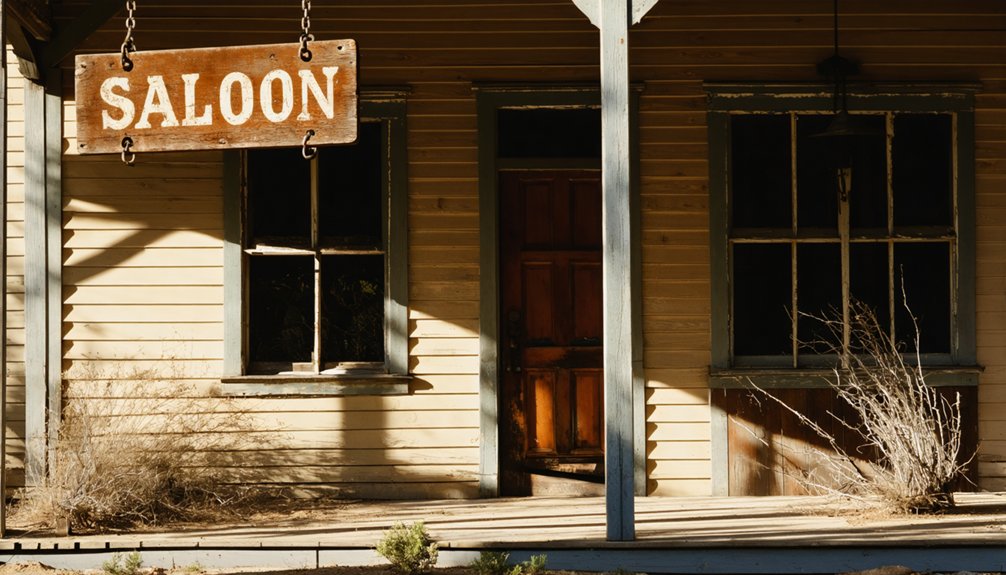
As time slowly erases the physical remnants of frontier settlements, ghost towns transform into invaluable living museums that photographers and historians race to document. Through photographic techniques like wide-angle contextual shots and intimate architectural details, you’re capturing more than decay—you’re preserving historical storytelling that might otherwise vanish.
Ghost towns stand as fragile time capsules where photographers capture not just abandonment, but the echoes of American frontier dreams.
When documenting these weathered settlements, consider:
- Major structures tell different stories—jails speak to law and order while brothels reveal social dynamics.
- Artifacts become tangible connections to past lives—rusted tools, faded signage, abandoned vehicles.
- Both day and night photography reveal distinct narratives—sunlit textures versus star-streaked skies.
Your camera becomes a preservation tool, recording these records to boom-and-bust cycles before nature reclaims them completely, ensuring future generations understand the freedom and hardship of frontier life.
Legends and Lore: The Supernatural Side of Abandoned Towns
Beyond the weathered wood and rusting metal of abandoned frontier settlements lies a spectral dimension that continues to captivate visitors and historians alike.
You’ll encounter supernatural sightings in places like Bodie, California, where miners’ spirits reportedly move objects and whisper in empty buildings. Tombstone’s haunted history features Marshal Fred White’s ghost and victims of the Bisbee Massacre wandering the streets.
Each ghost town carries its distinct paranormal signature: Garnet, Montana’s cold spots and shadowy figures; St. Elmo’s phantom miner with his bobbing lantern; and South Pass City’s watchful presences in restored buildings.
These phenomena aren’t merely entertainment—they’re cultural artifacts preserving the violent, tragic aspects of frontier life. The executions, shootouts, and mining accidents that once defined these communities continue echoing through their abandoned structures, connecting you to their unresolved past.
Planning Your Ghost Town Road Trip: Access and Seasonal Considerations
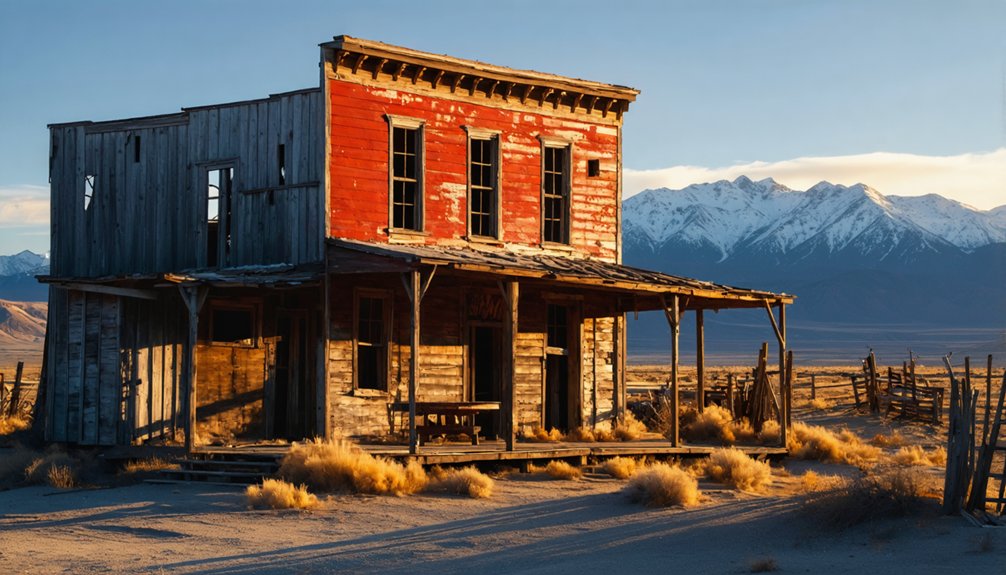
The spectral allure of these forgotten places creates a compelling reason to visit, but practical considerations will shape your ghost town exploration experience.
Planning your route can lead you to some of the most intriguing ghost towns in the United States, each with its unique history and stories to tell. From the eerie silence of Bodie, California, to the intriguing ruins of Centralia, Pennsylvania, these locations offer a glimpse into a bygone era. Whether you’re an avid historian or just looking for an adventure, exploring these sites can provide a fascinating look into America’s past.
Ghost town accessibility varies dramatically—many require high-clearance vehicles to navigate unpaved roads, while others like Kennecott demand long journeys on gravel paths. Seasonal travel tips are vital: spring and fall offer ideal conditions, while summer brings desert heat and winter creates hazardous passages.
- Your vehicle choice determines which towns you’ll reach—four-wheel drive reveals the most remote locations.
- Pack essentials for self-sufficiency; facilities rarely exist beyond tourist-centric locations.
- Consider guided tours for restricted areas, providing both access and contextual understanding of these weathered artifacts.
Frequently Asked Questions
How Do Ghost Towns Impact Local Indigenous Communities Today?
You’ll find indigenous communities grappling with ghost towns as complex sites of contested cultural heritage while also exploring potential economic opportunities through tourism and reclamation of ancestral landscapes.
What Wildlife Has Reclaimed These Abandoned Settlements?
You’ll find coyotes, raccoons, and birds dominating these ruins. Wildlife sightings reveal nature’s reclamation—reptiles inhabit crumbling foundations while plants crack through sidewalks, restoring ecological balance that existed before human settlement.
Are There Legal Issues With Taking Artifacts From Ghost Towns?
Pocketing relics is like silencing history’s whispers. You’re breaking federal and state laws governing artifact ownership, with serious legal implications including fines and imprisonment, regardless of the ghost town’s location or perceived abandonment.
Which Ghost Towns Are Accessible for Visitors With Disabilities?
You’ll find accessible attractions at Bodie with terrain-adapted wheelchairs, Virginia City’s wheelchair-navigable buildings, and Ashcroft’s boardwalk path. Each site offers varying disability resources while preserving authentic artifact contexts within their historical landscapes.
How Have Ghost Towns Influenced Modern American Architecture and Design?
You’ll find ghost towns provide architectural inspiration through their authentic materials and “arrested decay” aesthetic, influencing sustainable design, experimental communities, and urban planning that embraces both history and freedom from conventional constraints.
References
- https://explorethearchive.com/western-ghost-towns
- https://www.geotab.com/ghost-towns/
- https://whakestudios.com/us-ghost-towns/
- https://www.youtube.com/watch?v=yeTVfoQxqJc
- https://en.wikipedia.org/wiki/Lists_of_ghost_towns_in_the_United_States
- https://www.ghosttowns.com
- https://www.atlasobscura.com/lists/americas-best-preserved-ghost-towns
- https://wildwestcity.com/old-west-ghost-towns/
- https://www.colorado.edu/center/west/projects-publications/energy-mining/oil-shale/engineering-boom-second-boom
- https://westernmininghistory.com/map/