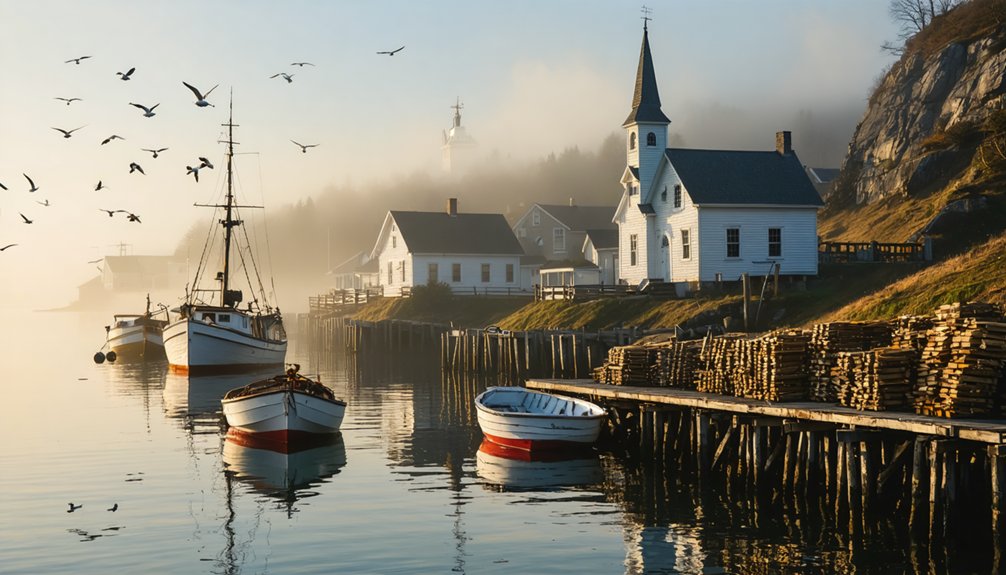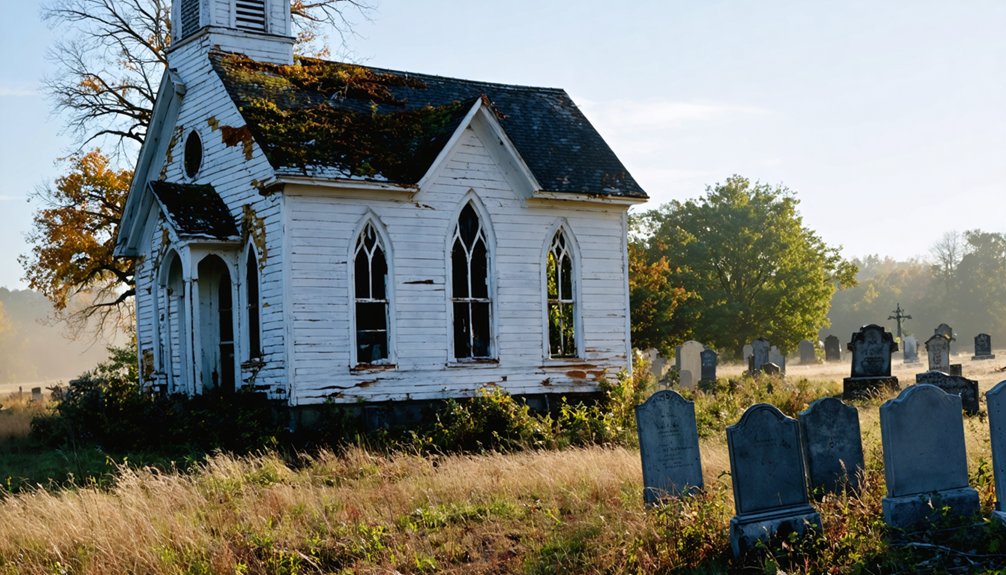
You’ll discover numerous forgotten ghost towns across the East, from Centralia, Pennsylvania (abandoned due to an underground mine fire) to Cahaba, Alabama (a former state capital). Unlike Western counterparts, Eastern abandoned settlements deteriorate rapidly due to humidity, vegetation, and timber construction. Preservation efforts focus on sites like Eckley Miners’ Village, which documents coal mining heritage. The region’s ghost towns often hide in plain sight, their stories waiting beneath layers of history and foliage.
Key Takeaways
- Eastern ghost towns are found throughout Appalachia, New England, and Mid-Atlantic states, with concentrations in Pennsylvania, Tennessee, North Carolina, and Virginia.
- Abandoned eastern settlements were primarily linked to economic collapse in industries like coal, timber, and agriculture.
- Eastern ghost towns deteriorate faster than western counterparts due to higher humidity, rainfall, and primarily timber construction.
- Many eastern ghost towns were absorbed by nearby metropolitan areas or experienced neighborhood-level “ghosting” within larger cities.
- Eckley Miners’ Village in Pennsylvania preserves industrial heritage with intact miners’ homes and company stores from 19th-century mining life.
The Hidden History of Eastern Ghost Towns
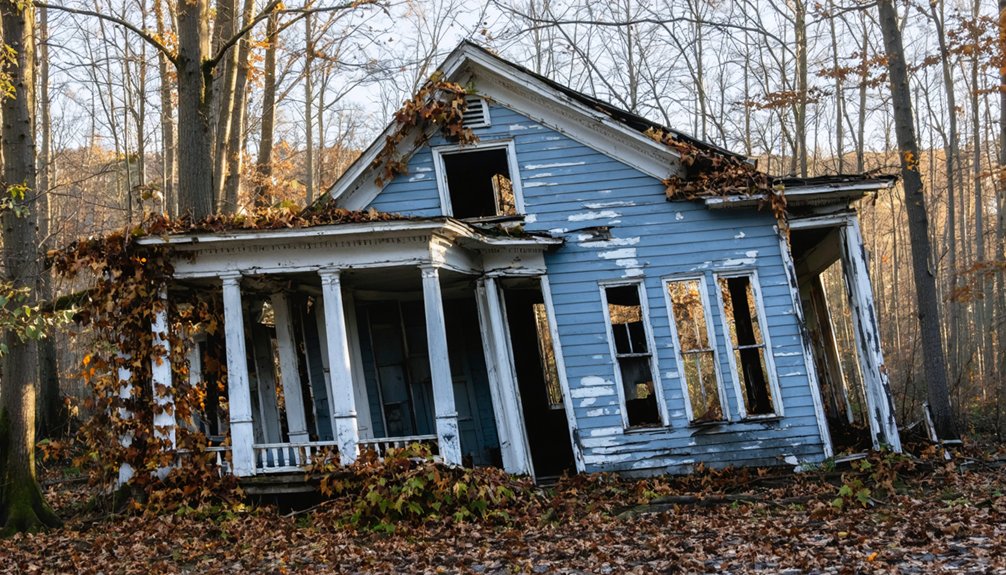
While most Americans associate ghost towns with the Old West’s abandoned mining settlements, the eastern United States harbors its own rich collection of forsaken communities that tell a compelling but often overlooked chapter of American history.
These forgotten communities lie scattered throughout Appalachia, New England, and the Mid-Atlantic states, with significant concentrations in Pennsylvania, Tennessee, North Carolina, and Virginia.
You’ll discover hidden stories of 19th-century settlements that once thrived around industries like coal, timber, and agriculture.
Unlike their western counterparts, eastern ghost towns often remain concealed within national parks and state forests.
Hidden beneath eastern America’s verdant canopies, forgotten communities wait to be rediscovered by intrepid explorers.
Their abandonment stemmed from economic collapse, natural disasters, transportation shifts, urban migration, and government land acquisitions—leaving only foundations, cemeteries, and occasional interpretive signs as silent witnesses to their existence.
Places like Elkmont Historic District in Tennessee offer visitors a chance to explore over 60 historic buildings that became vacant after lease expirations.
While many heritage tourism initiatives have focused westward, eastern ghost towns represent important educational opportunities for showcasing regional American history and cultural heritage.
Why Eastern Ghost Towns Vanish While Western Ones Endure
You’ll notice that Eastern ghost towns deteriorate far more rapidly than their Western counterparts due to higher humidity levels and aggressive vegetation growth that overwhelm abandoned structures.
The prevalence of timber construction in Eastern settlements contrasts sharply with the stone and adobe buildings typical of Western ghost towns, making Eastern ruins more susceptible to rot, fire, and complete structural collapse. In Japan, once-thriving communities like Hashima Island stand as stark examples of rapid deterioration after their abandonment in 1974.
Higher population densities throughout Eastern regions have also led to more efficient land reclamation, with abandoned properties quickly repurposed or dismantled rather than preserved as historical artifacts like the iconic Western ghost towns that draw tourism. Unlike Eastern sites, Bodie State Park exemplifies the Western practice of maintaining ghost towns in a state of arrested decay, preserving their historical condition for visitors to experience.
Climate Accelerates Decay
The stark contrast between preserved Western ghost towns and the largely vanished Eastern counterparts stems primarily from fundamental climatic differences that dramatically affect structural deterioration rates.
When examining climate factors impacting these historical sites, you’ll discover that Eastern environments accelerate decay through multiple mechanisms, while Western regions naturally preserve structures.
- Higher humidity and rainfall in Eastern states cause rapid wood rot, metal corrosion, and foundation instability.
- Freeze-thaw cycles in Eastern winters repeatedly expand and contract building materials, creating structural failure.
- Aggressive vegetation growth in moist Eastern climates overtakes abandoned structures quickly.
- Western aridity naturally preserves wood, leather, paper and other organic building materials.
- Lower precipitation in Western regions minimizes erosion, foundation damage, and material degradation that preservation techniques must combat in Eastern locations.
Ghost towns across different regions often tell stories of sudden abandonment due to catastrophic events like natural disasters or human calamities.
While Eastern ghost towns quickly disappeared, Western settlements like Buckskin Joe and Garnet have survived with their rich historical narratives intact for visitors to experience today.
Timber Versus Stone
Beyond climate factors, the fundamental building materials employed in abandoned settlements explain much of the stark disparity in ghost town preservation between America’s regions.
While exploring eastern ghost towns, you’ll encounter foundations where timber structures once stood—victims of their own impermanence. Eastern settlers prioritized speed and affordability, utilizing abundant local wood resources without considering timber durability. These shallow-foundation structures quickly surrendered to moisture, insects, and rot after abandonment. The tragic story of Dawson, New Mexico demonstrates how even substantial company towns with immigrant populations can disappear when structures aren’t built to withstand time.
Conversely, western mining communities built with permanence in mind. Limited timber availability forced them to embrace European masonry techniques, creating structures with stone resilience that withstands centuries of exposure.
These deep-foundation buildings remain intact with minimal maintenance, justifying preservation investments that timber ruins can’t economically support. The stone and brick construction has proven intrinsically more worthy of conservation efforts, creating the enduring western ghost towns you can still visit today.
Population Density Differences
While abandoned settlements have persisted throughout America’s westward expansion, population density patterns fundamentally determine whether ghost towns vanish or endure. The East’s higher baseline population density creates distinctive abandonment patterns compared to Western regions.
Eastern population trends reveal:
- Urban municipalities attract migration while rural areas experience accelerated depopulation.
- Eastern ghost towns face absorption by nearby metropolitan areas rather than isolated preservation.
- Neighborhood-level “ghosting” occurs within larger cities like Detroit and Youngstown.
- Transportation networks facilitate gradual fragmentation rather than abrupt abandonment.
- Economic diversification in Eastern regions limits complete town abandonment.
Eastern high vacancy areas often show significant population decline, with many ZIP codes experiencing double-digit percentage drops over just five years.
Unlike Western ghost towns that stand as preserved monuments to boom-bust cycles, Eastern abandoned areas typically reintegrate into the urban fabric.
You’ll find urban migration consolidates Eastern populations in fewer, denser areas, leaving high-vacancy neighborhoods rather than isolated, enduring ghost towns.
Recent studies using the Ghost Cities Index have identified the vitality gap between new and old urban areas, showing how Eastern regions experience abandonment differently than Western counterparts.
Cahaba: Alabama’s Submerged First Capital
Nestled at the confluence of the Cahaba and Alabama rivers, Cahaba emerged as Alabama’s first permanent capital in 1818, established through careful urban planning that mimicked Philadelphia’s grid layout.
At the meeting point of two great rivers, Alabama’s original capital arose with Philadelphia-inspired precision and ambition.
Its historical significance was immediately apparent as the town raised an impressive $123,856 from lot auctions, funding Alabama’s first statehouse and essential infrastructure.
Cahaba’s legacy isn’t merely as a failed capital that succumbed to political rivalries when the seat moved to Tuscaloosa in 1826.
You’d be surprised to learn it rebounded as a thriving cotton distribution hub, reaching 3,000 residents by the Civil War.
However, postwar political changes, devastating floods, and the loss of railroad access transformed this once-promising metropolis into a ghost town by 1900, its buildings dismantled or reclaimed by nature.
The town became known as the Mecca of Republicans after the Civil War, with many freed slaves attending political meetings in the old courthouse building.
The Industrial Resurrection of Batsto Village
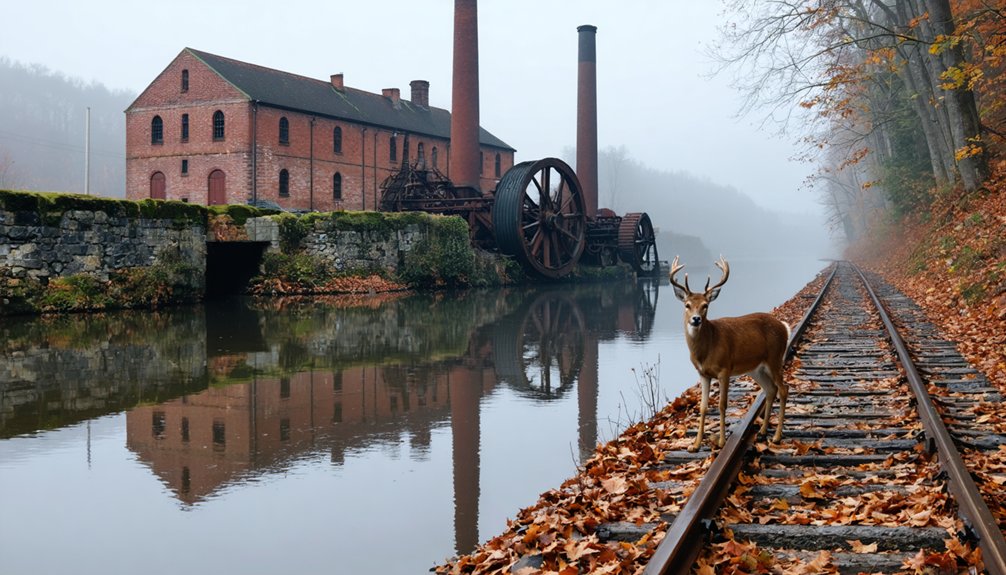
Deep in New Jersey’s Pine Barrens, Batsto Village emerged in 1766 as a tribute to early American industrial innovation when Charles Read established ironworks along the Batsto River.
This self-sufficient community exemplifies industrial heritage and community resilience through multiple economic transformations.
When you visit this preserved ghost town, you’ll witness:
- Revolutionary War-era production site that supplied the Continental Army
- Richards family’s century-long management that transformed it from ironworks to a complete village
- Strategic diversification into glassmaking as iron production declined
- Model industrial community with workers’ residences and essential services
- Shift from bustling industrial center to historic preservation site within Wharton State Forest
After industrial decline in the late 1800s, Batsto evolved from abandonment to resurrection as a cultural treasure, now maintained by New Jersey as an educational portal into America’s industrial past.
Coal and Community: Exploring Eckley Miners Village
While strolling through the preserved streets of Eckley Miners Village, you’ll witness the rich tapestry of immigrant labor that built America’s industrial backbone, as Eastern European, Irish, and other ethnic workers transformed this Pennsylvania patch town into a thriving coal community.
The museum’s meticulous preservation of original miners’ homes, the company store, and other structures offers an unfiltered glimpse into the harsh realities and cultural resilience that defined 19th-century anthracite mining life.
Pennsylvania’s coal culture permeates every aspect of the village, from the stark contrast between ornate owners’ mansions and austere workers’ dwellings to the ethnic churches and social halls that provided rare refuge from the demanding underground work that powered America’s industrial revolution.
Immigrant Labor Legacy
Although initially established as the rural settlement of Shingletown, Eckley’s transformation into a coal mining town in 1853 catalyzed a significant immigrant labor movement that would shape northeastern Pennsylvania’s industrial landscape for generations.
When you visit Eckley today, you’ll witness the enduring impact of these immigrant workers’ contributions and labor struggles. Their legacy persists through:
- European immigrants who arrived seeking temporary work but found themselves trapped in company-controlled poverty
- Crowded double homes where up to 30 people lived, symbolizing economic exploitation
- Ethnic societies and mutual aid organizations that fostered solidarity despite oppression
- Cultural traditions, bands, and social events that created pockets of independence
- Economic contributions that fueled America’s industrial revolution while workers remained disadvantaged
These immigrant laborers, despite facing harsh working conditions and limited mobility, established resilient communities that formed Eckley’s economic and cultural foundation.
Mining Life Preservation
Despite being preserved as one of America’s most authentic anthracite coal mining communities, Eckley Miners’ Village stands as more than a static museum—it’s a living representation of Pennsylvania’s industrial heritage.
When you visit this 100-acre site with its 200 structures, you’re witnessing mining heritage preservation in its most authentic form.
Transferred to the Pennsylvania Historical and Museum Commission in 1970 after serving as the filming location for “The Molly Maguires,” Eckley exemplifies community resilience through its continuing habitation by miners’ descendants who rent the historic houses.
This living museum captures the industrial discipline of the patch town system while honoring immigrant families’ experiences.
Current preservation efforts include plans to rebuild the original coal breaker—a powerful symbol of anthracite mining’s legacy that guarantees this vital chapter of American labor history remains tangible.
Explorations of abandoned mining towns in California reveal a rich tapestry of stories and artifacts, offering insight into the lives of those who once called these remote locations home. These towns, often forgotten, hold remnants of a bygone era, inviting historians and adventurers alike to uncover their hidden narratives. As interest in preserving such sites grows, there is potential for educational programs that showcase the region’s unique mining heritage.
Pennsylvania Coal Culture
When you step into Eckley Miners’ Village today, you’re walking through the physical manifestation of Pennsylvania’s distinctive coal culture—a complex social ecosystem that emerged from the anthracite boom of the mid-19th century.
This remarkably preserved patch town offers insights into the anthracite heritage that transformed America’s industrial landscape.
- Red wooden frame houses reveal stark class stratification—from miners’ humble dwellings to ornate owners’ mansions
- Company control extended beyond work into housing, shopping, and even leisure activities
- Immigrant families from diverse backgrounds forged resilient communities despite difficult conditions
- The band practice house (1890) represents workers’ determination to maintain cultural expression
- Labor struggles emerged naturally in this environment where economic power was heavily concentrated
Eckley’s preservation guarantees these stories of industrial control and worker resilience remain accessible, documenting a pivotal chapter in American energy shift and social history.
Spotting the Signs: How to Identify an Eastern Ghost Town
As travelers venture into the forgotten corners of America’s eastern states, they’ll discover that identifying a ghost town requires more than simply finding abandoned buildings.
Look for ghost sign identification markers—those faded, hand-painted advertisements on brick facades revealing businesses long shuttered. These weathered remnants, often visible only in certain light, showcase products and services from the late 19th to early 20th centuries.
Ghost signs whisper forgotten commerce, painted specters fading on brick walls—visible only when light reveals their weathered stories.
Architectural clues provide further evidence: buildings with distinctive 1880-1913 brickwork, boarded windows, and abandoned storefronts.
Eastern ghost towns frequently cluster around defunct industries—coal mining hubs, textile manufacturing centers, or shipping districts. You’ll notice concentrated areas where commerce ceased decades ago, leaving behind visual footnotes of economic history: civet cats for perfumers, mortar and pestle for apothecaries—silent storytellers of once-thriving communities.
Resources for Eastern Ghost Town Hunters
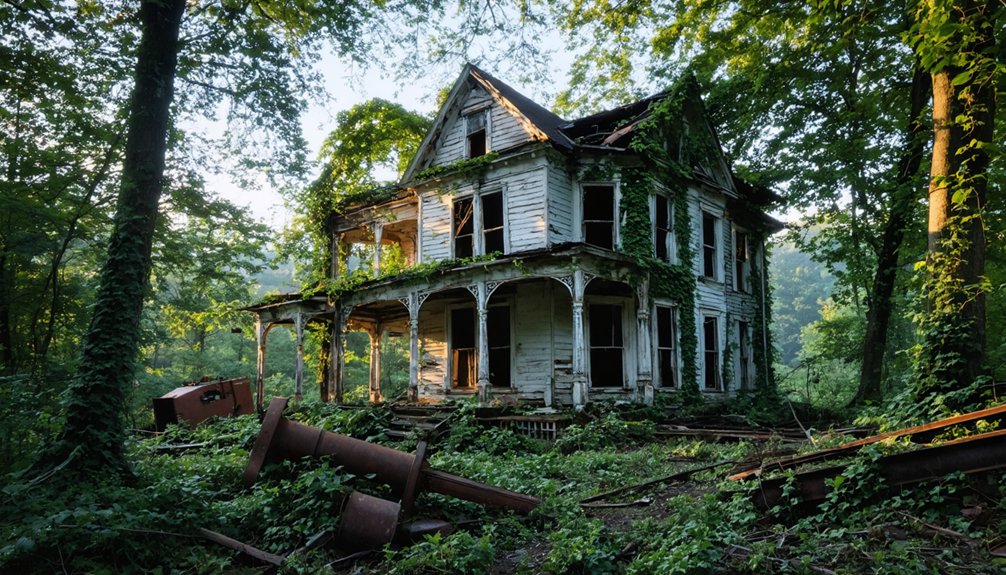
For serious ghost town explorers who seek to document rather than merely visit abandoned eastern settlements, a wealth of specialized resources exists beyond casual internet searches.
Historical preservation efforts have generated extensive documentation systems that you’ll find invaluable for your research:
- Local historical societies maintain settlement archives with region-specific ghost town mapping indexes
- County courthouse records provide property deeds and tax information revealing ownership patterns
- Library microfilm collections of regional newspapers document town rise and decline timelines
- State historical commission websites offer official documentation of recognized abandoned settlements
- Bureau of Land Management databases contain information on preserved structures and protected sites
These resources enable you to reconstruct forgotten communities with scholarly precision.
Frequently Asked Questions
Are Eastern Ghost Towns Safe to Explore Without Official Permission?
No, you shouldn’t explore eastern ghost towns without permission. Unauthorized exploration violates exploration ethics and exposes you to legal consequences and significant safety risks requiring proper precautions.
Can Metal Detecting Be Done Legally at Eastern Ghost Town Sites?
You can legally metal detect at eastern ghost towns only with proper permits and landowner permission. Metal detecting regulations emphasize historical artifact preservation, requiring you to follow state-specific laws governing public and protected lands.
What Wildlife Dangers Might Visitors Encounter at Abandoned Eastern Settlements?
You’ll face diverse wildlife encounters at abandoned settlements, including venomous snakes, bears, coyotes, ticks carrying Lyme disease, and black widow spiders. Implement safety precautions through vigilant exploration of overgrown ruins.
How Do Seasonal Changes Affect Accessibility of Eastern Ghost Towns?
You’ll encounter significant accessibility challenges as seasonal weather transforms Eastern ghost towns. Winter brings impassable snow; spring creates muddy trails; summer vegetation obscures structures; while autumn’s shorter days limit exploration time despite improved visibility.
Are There Paranormal Tours Available at Any Eastern Ghost Towns?
Yes, you’ll find guided paranormal tours at Moonville, Elkmont, Boston Mills, and Hope Furnace, where paranormal experiences are facilitated through equipment provision and historical narratives during seasonal availability.
References
- https://albiongould.com/ghost-towns-to-visit-in-the-states/
- https://www.geotab.com/ghost-towns/
- https://www.visittheusa.ca/experience/5-us-ghost-towns-you-must-see
- https://stateofwatourism.com/ghost-towns-of-washington-state/
- https://www.legendsofamerica.com/gt-ghosttownseast/
- https://en.wikipedia.org/wiki/Lists_of_ghost_towns_in_the_United_States
- https://www.atlasobscura.com/lists/americas-best-preserved-ghost-towns
- https://traveloregon.com/things-to-do/culture-history/ghost-towns/
- https://www.newmexico.org/places-to-visit/ghost-towns/
- https://www.youtube.com/watch?v=6gHFUM4MNck