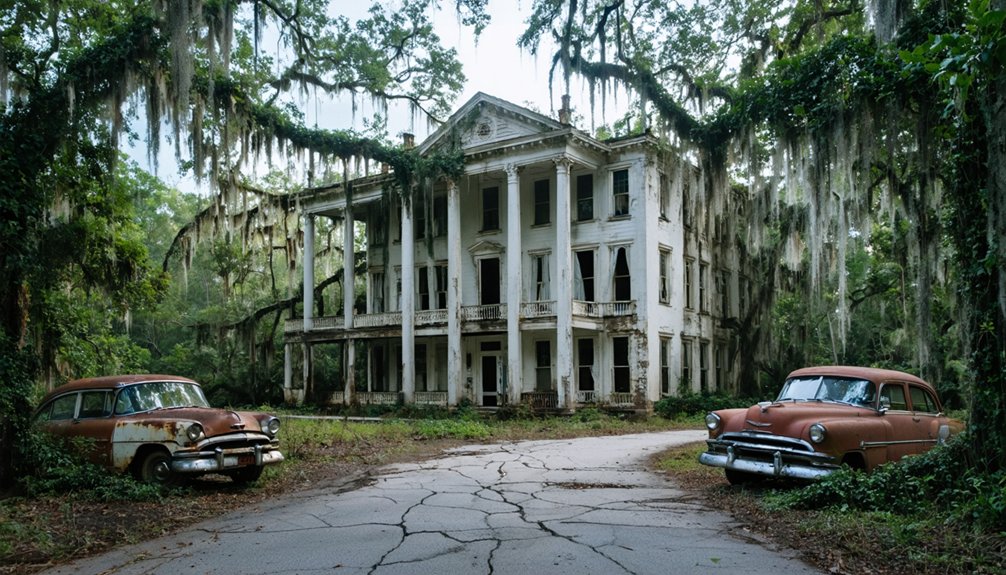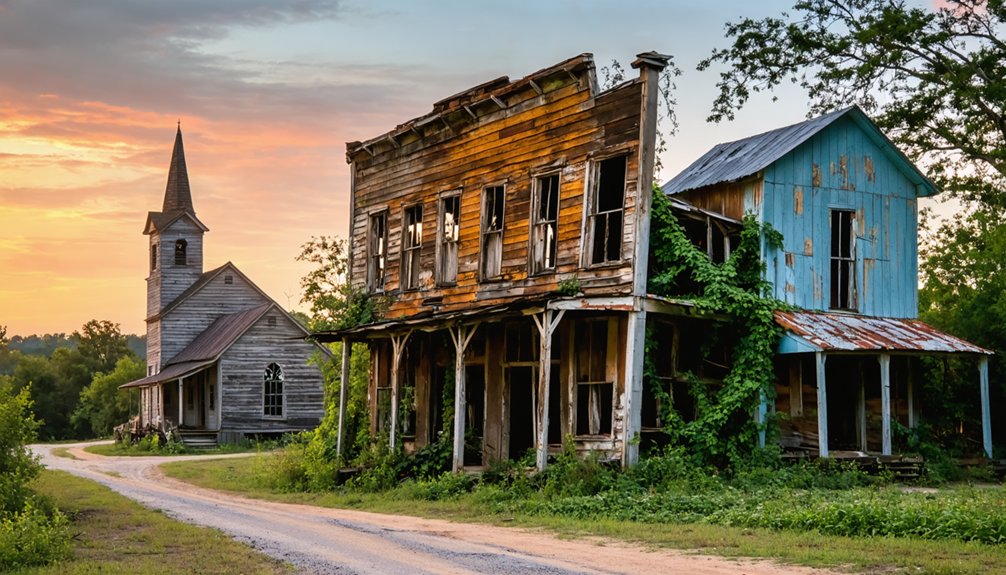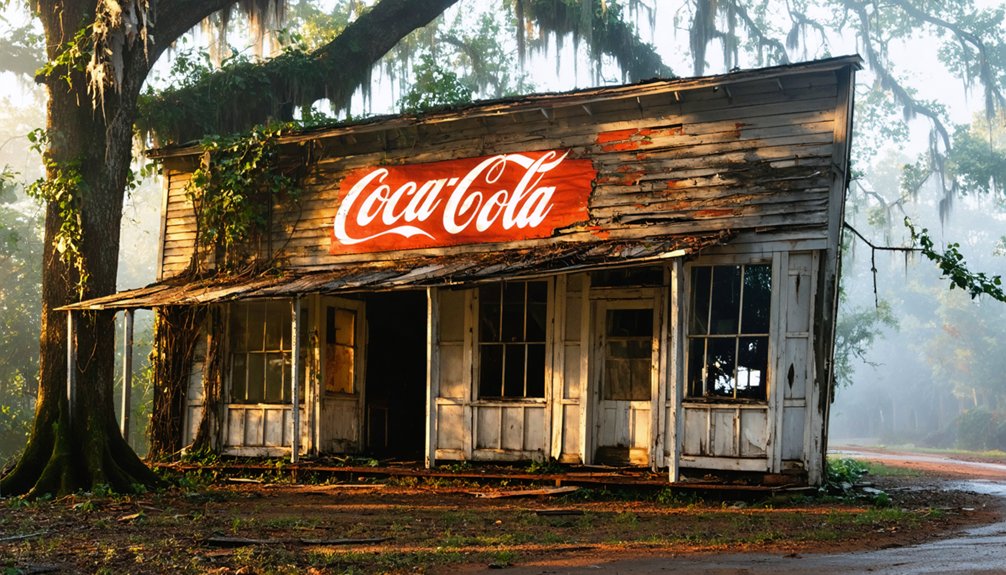
The South’s forgotten ghost towns include Alabama’s Old Cahawba, once a capital with 3,000 residents, and Mississippi River settlements like Rodney, which declined after the river changed course in 1870. You’ll find abandoned textile mill villages with distinctive architecture and mining boomtowns decimated by resource depletion. Disease outbreaks, particularly yellow fever, and Civil War destruction hastened many towns’ demise. These silent witnesses to prosperity’s fragility await your exploration into America’s impermanent past.
Key Takeaways
- Old Cahawba, Alabama’s first capital, reached 3,000 residents before complete abandonment by 1870.
- Rodney, Mississippi once had 4,000 residents before the river changed course and yellow fever epidemics struck.
- Claiborne, Alabama peaked at 5,000 residents before epidemics decimated the population, leaving only historical markers.
- Prentiss, a critical Mississippi River trade hub, was burned during the Civil War and later submerged underwater.
- Abandoned Southern textile mill towns like Newry showcase distinctive architecture and the region’s industrial heritage.
Alabama’s Vanishing Historic Settlements
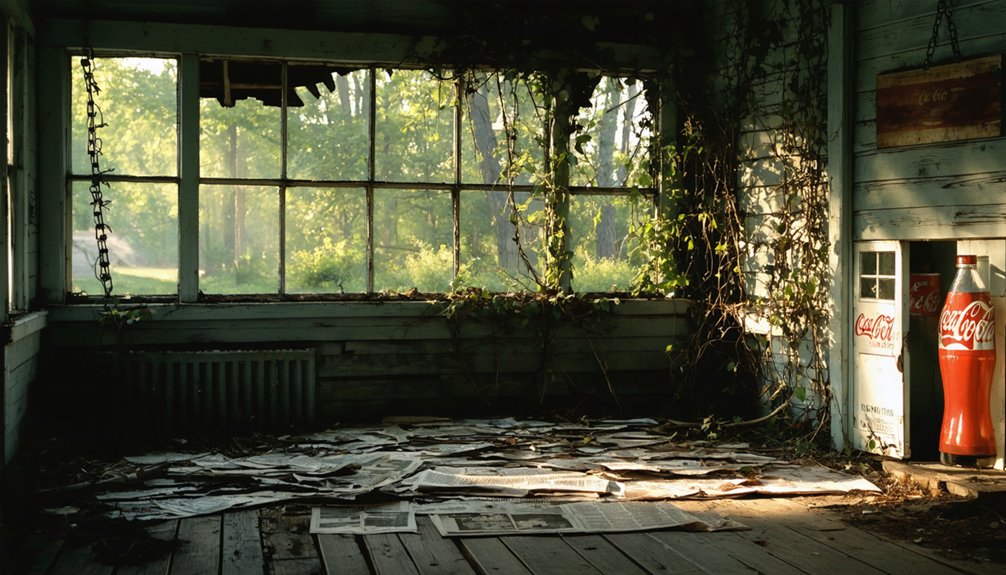
While modern Alabama bustles with thriving cities and suburbs, its landscape is dotted with the skeletal remains of once-prosperous communities that time has largely forgotten.
You’ll find Alabama’s first capital at Old Cahawba ruins, where a town of 3,000 residents and 450 buildings once thrived before abandonment by 1870. Today, only fragments remain as part of an archaeological park, including the Fambro-Arthur Home and Barker Slave Quarters.
Claiborne history tells an even starker tale—a settlement that peaked at 5,000 residents before epidemics decimated the population. Unlike Cahawba, virtually nothing physical remains of Claiborne except historical markers and road names.
Once home to 5,000 souls, Claiborne now exists only in markers and memories—a ghostly reminder of Alabama’s vanished past.
Other settlements like Blakeley and Prairie Bluff have similarly faded into obscurity, their stories preserved only through dedicated historical research. The town of Bellefonte exemplifies how transportation changes can devastate a community, as its decline began when the railroad depot was relocated away from the town in the 1920s. Exploring these six ghost towns creates a fascinating road trip of approximately 280 miles between Mobile and Montgomery.
Mississippi River Ghost Towns and Their Haunting Past
You’ll discover that Mississippi River ghost towns like Prentiss and Rodney showcase the precarious relationship between commerce and nature, with once-thriving river ports ultimately succumbing to the river’s shifting course and economic obsolescence.
These settlements bear the physical scars of Civil War destruction, with Prentiss being burned by Union troops and later submerged beneath the Mississippi River itself. Originally known as Wellington, Prentiss was only accessible by boat until the first road was constructed in 1838.
Yellow fever epidemics decimated river communities like Rodney, combining with floods and economic isolation to transform bustling ports of 4,000 residents into abandoned places with fewer than a dozen inhabitants by the late 20th century. A devastating sandbar formation in 1870 changed the course of the Mississippi River away from Rodney, effectively ending its prominence as a commercial center.
River Commerce Legacies
Along the banks of the mighty Mississippi River, once-thriving commercial ports have succumbed to the river’s unpredictable nature, leaving behind haunting reminders of the South’s economic past.
You’ll find towns like Prentiss, completely submerged by the 1870s after flourishing as a crucial river trade hub with 800 residents, a hotel, and the only ferry crossing between major cities.
Similarly, Rodney’s fate was sealed when the Mississippi shifted course in 1870, moving two miles away and severing the town’s commercial lifeline. Rodney nearly became Mississippi’s state capital, losing by only three votes before its eventual decline.
This pattern of economic decline repeats throughout Southern ghost towns, where river commerce once supported thriving cotton and timber industries. Historians estimate there may be up to 50,000 ghost towns across the United States, many reflecting these economic shifts and natural disasters.
During rare droughts, you might glimpse artifacts of this bygone era—champagne bottles, courthouse bricks, and whiskey barrels—silent witnesses to prosperity washed away by time and water.
Civil War Battleground Remnants
As the Mississippi River shaped commerce in these forgotten towns, it also carved battlefields that witnessed significant Civil War confrontations, forever altering their trajectories toward abandonment.
You’ll find haunting Civil War battlefield remnants throughout these river towns. In Rodney, Mississippi, the Presbyterian Church still bears witness to the 1863 skirmish where Confederate cavalry captured Union sailors—the only instance where cavalry seized an ironclad gunboat.
The USS Rattler’s retaliatory cannon fire left scars still visible today, with a cannonball replica marking this unique confrontation. Many of these battles were part of the often overlooked Trans-Mississippi Theater, where Confederate forces frequently employed offensive tactics that resulted in high casualty rates.
Strategic positions like Cairo, Illinois served as vital Union command posts, while Confederate forces fortified river bluffs with artillery. Reverend Robert Price served the Rodney Presbyterian Church during the early Civil War years, witnessing the town’s transition from prosperity to conflict.
Post-war, these towns faced not only war destruction but natural calamities when the Mississippi shifted course around 1870, stranding once-vital ports miles from water and accelerating their decline into today’s ghost towns.
Disease-Decimated River Communities
While Civil War battles scarred many Southern ghost towns, deadly epidemic diseases ultimately delivered the fatal blow to numerous Mississippi River communities.
Rodney, Mississippi exemplifies this tragic pattern. Yellow fever devastated the town in 1843, nearly depopulating it as fatalities mounted and every local physician fell ill. Though residents briefly returned, a second outbreak struck in 1847, further weakening the community.
These disease impacts coincided with natural calamities. By 1870, the Mississippi River changed course, causing river isolation that crippled Rodney’s commerce. The once-prosperous port, built on cotton trade, found itself stranded three miles from the water.
During its peak, Rodney was the busiest port on the Mississippi River with a thriving population that reached 4,000 residents by 1860. The town originally established as Petit Gouffre by French settlers in 1763 was later renamed after Judge Thomas Rodney.
Fires in 1869 and recurring floods throughout the early 20th century destroyed remaining infrastructure. By 1930, Rodney lost its town status, becoming a ghost town where only ruins testify to its former significance.
Mormon Ghost Towns of Utah and the Southwest
When Brigham Young directed the establishment of Mormon settlements across the western United States between 1847 and 1900, he set in motion a strategic colonization effort that would create nearly 500 villages throughout Utah and the Southwest.
These Mormon settlements were carefully positioned near water sources and fertile land to guarantee self-sufficiency for the growing religious community.
Mormon pioneers strategically selected settlement locations ensuring water access and arable lands for community sustainability.
Grafton history exemplifies the challenges these pioneers faced. Founded in 1859 along the Virgin River to develop cotton cultivation, Grafton (originally called Wheeler) endured devastating floods, Navajo raids, and the Black Hawk War of 1866.
Despite these hardships, the community persisted until 1921 when the LDS Church discontinued services.
Today, you can visit Grafton’s remarkably preserved schoolhouse, cemetery, and Russell house—tangible remnants of Mormon frontier determination.
Southern Textile Mill Communities Lost to Time

The Southern textile industry, once a titan of regional economic development, left behind ghostly remnants of company towns that now stand as haunting testimonials to America’s industrial past. Dating back to Graniteville (1845), these communities established a template that defined Southern industrialization for a century.
When you visit these abandoned villages today, you’ll find distinctive mill town architecture—workers’ cottages, community buildings, and imposing brick factories—slowly succumbing to nature.
Places like Newry, with its 118 historic structures, reveal the segregated social structures that defined mill life.
Despite global competition forcing closures by the 1970s, textile heritage preservation efforts continue through repurposed mills like Monaghan and Taylors, transformed into apartments and studios, keeping alive the memory of communities that once thrived around the rhythmic clatter of looms.
Mining Boomtowns: From Prosperity to Abandonment
You’ll find stark contrasts between the opulent prosperity and devastating collapse throughout Southern mining boomtowns like Rhyolite and Goldfield, where populations swelled to thousands before dwindling to near-nothing within a decade.
These abandoned communities now face complex challenges balancing historical preservation against the urgent need to reclaim lands contaminated by toxic mining waste from copper, gold, and silver extraction.
While some ghost towns have transformed into tourism destinations that showcase preserved Victorian architecture and mining equipment, others remain caught in environmental remediation efforts that must address century-old chemical hazards before any meaningful restoration can proceed.
Boomtown Riches and Ruins
Southern mining boomtowns represent some of America’s most dramatic examples of economic volatility, springing to life virtually overnight before succumbing to equally rapid decline.
These communities followed predictable prosperity cycles tied directly to mineral availability and market demands. You can trace this pattern in Arizona’s mining legacies: Harshaw’s quick rise and fall, Courtland’s copper-driven boom reaching 2,000 residents, and Ruby’s emergence as southwestern Arizona’s largest mining camp.
When mines closed—whether from resource depletion or economic downturns like the Great Depression—populations vanished almost as quickly as they arrived.
What remains today tells their story: Victorian architecture, abandoned machinery, and adobe ruins. Environmental scars persist through toxic waste, while some sites find new purpose as tourist destinations, offering glimpses into America’s extractive past.
Toxic Land Reclamation
Behind the romantic ruins of abandoned mining towns lies a darker legacy that continues to plague Southern landscapes today. Places like Picher, Oklahoma, once thriving with lead and zinc extraction, now stand abandoned due to toxic contamination that rendered them uninhabitable.
You’ll find mountains of toxic waste called “chat piles” throughout these former boomtowns, where sinkholes from underground collapses threaten remaining structures. Approximately 30% of some towns sit precariously over voids, causing dangerous land subsidence and foundation failures.
The toxic legacies include cyanide-laced water supplies and soil poisoned with lead, arsenic, and cadmium. While environmental restoration efforts have begun in some locations, cleanup costs often reach tens of millions and continue for decades.
Ironically, some of these devastated landscapes now attract tourists, even as their poisoned earth remains a hidden danger.
Preservation Versus Progress
While thousands of Southern mining towns experienced meteoric rises during resource booms of the late 19th and early 20th centuries, their equally dramatic collapses have created a modern dilemma between historical preservation and economic redevelopment.
You’ll find these communities facing complex preservation challenges as they navigate competing priorities.
Four key tensions in Southern ghost town conservation:
- Historic Victorian-era structures require substantial funding to maintain, while modern development promises immediate economic returns.
- Tourism based on mining heritage competes with potential new resource extraction opportunities.
- Authentic preservation of mining artifacts conflicts with safety requirements for public access.
- Local communities desire economic revitalization while maintaining the distinctive cultural identity formed during boom years.
These economic tensions often result in compromise solutions that attempt to balance honoring the past with creating sustainable futures.
Nature’s Reclamation: Towns Overtaken by Wilderness
Abandonment casts a peculiar spell on Southern ghost towns, where nature’s steady, persistent forces gradually reclaim what humans once built.
You’ll find Blakeley’s fort now resembling natural hills, while Old St. Stephens lies hidden beneath 200 years of vegetation growth. Claiborne, once home to 5,000 citizens, has surrendered to the landscape, marked only by a historical plaque.
Throughout the region, nature’s reclamation transforms abandoned settlements into wild spaces.
In Rodney, Mississippi, dilapidated buildings slowly disappear beneath encroaching flora. The Cole Family Cabin in North Carolina rots silently in forest shadows, while Utah’s Silver Reef reveals only foundations as desert sands consume its mining-era remains.
Urban decay accelerates this process, as epidemics, economic collapse, and environmental disasters have left these places to wilderness’s inexorable advance.
Preserving the Past: Visiting Accessible Ghost Towns Today
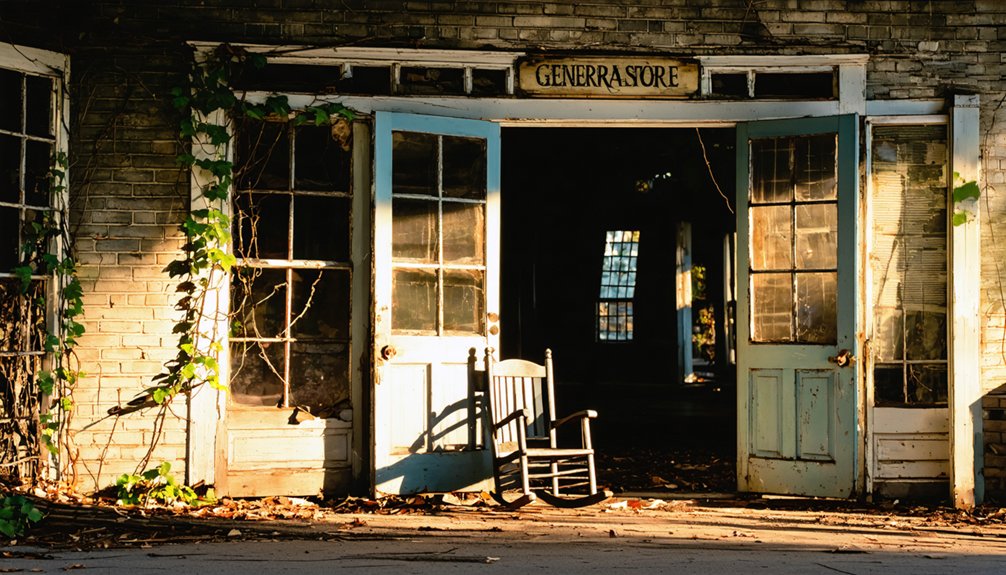
Despite nature’s relentless reclamation, many Southern ghost towns remain accessible today, offering visitors tangible connections to forgotten chapters of American history.
Among these hidden ghost towns in southern America, remnants of old storefronts and crumbling homes create a haunting yet beautiful landscape. Exploration of these abandoned places allows for a unique glimpse into the lives of those who once thrived there. Each town tells a story, inviting curious travelers to discover the whispers of the past that linger in the air.
Ghost town preservation efforts vary dramatically across the South, with some sites providing robust historical interpretation while others retain their rugged authenticity.
If you’re seeking these historical treasures, consider these accessible destinations:
- Blue Heron, Kentucky – Reachable by train from Stearns, featuring metal shell representations and audio recordings of former residents.
- St. Elmo, Colorado – Well-preserved wooden storefronts accessible by regular car.
- Lost Cove, North Carolina – Requires hiking the Lost Cove Trail near Burnsville.
- Buffalo City, North Carolina – Former “Moonshine Capitol” with visible remnants of its prohibition-era past.
Most sites require proper footwear and respect for private property boundaries, balancing accessibility with preservation needs.
Frequently Asked Questions
Are There Any Underwater Ghost Towns in the South?
Yes, you’ll discover underwater ruins in Ferguson (Lake Marion), Gad (Summersville Lake), Proctor (Fontana Lake), and Loyston (Norris Lake)—each preserving submerged history beneath Southern waters.
Can You Legally Collect Artifacts From Southern Ghost Towns?
You generally can’t legally collect artifacts from Southern ghost towns. Federal and state legal regulations prohibit artifact removal without permits, with preservation laws strictly enforced on public lands and requiring written permission on private property.
Which Southern Ghost Towns Are Considered Haunted or Paranormal Hotspots?
In an ocean of supernatural sites, you’ll find haunted legends at Cahawba and Myrtles Plantation, while paranormal encounters frequently occur at Claiborne and Old St. Stephens, all backed by documented evidence.
How Have Natural Disasters Created Modern Ghost Towns?
You’ll find disaster impact evident in towns like Valmeyer (flooding), Bayou Corne (sinkholes), and Holland Island (erosion), where natural forces triggered evacuation, abandonment, and subsequent urban decay across southern communities.
Which Southern Ghost Towns Offer Guided Historical Tours?
Where there’s history, there’s a tour. You’ll find guided tours of historical significance in Franklin, Tennessee and Fort Worth, Texas, both offering walks through haunted Southern landmarks with compelling Civil War narratives.
References
- https://deepsouthurbex.com/2020/01/02/6-south-alabama-ghost-towns/
- https://www.americansouthwest.net/ghost-towns.html
- https://quirkytravelguy.com/ghost-towns-of-the-deep-south/
- https://www.geotab.com/ghost-towns/
- https://www.visitutah.com/things-to-do/history-culture/ghost-towns
- https://theforgottensouth.com/ghost-towns/
- https://www.newmexico.org/places-to-visit/ghost-towns/
- https://en.wikipedia.org/wiki/Lists_of_ghost_towns_in_the_United_States
- https://www.youtube.com/watch?v=tErPiMbfhsw
- https://thebamabuzz.com/5-alabama-ghost-towns-to-put-on-your-bucket-list/