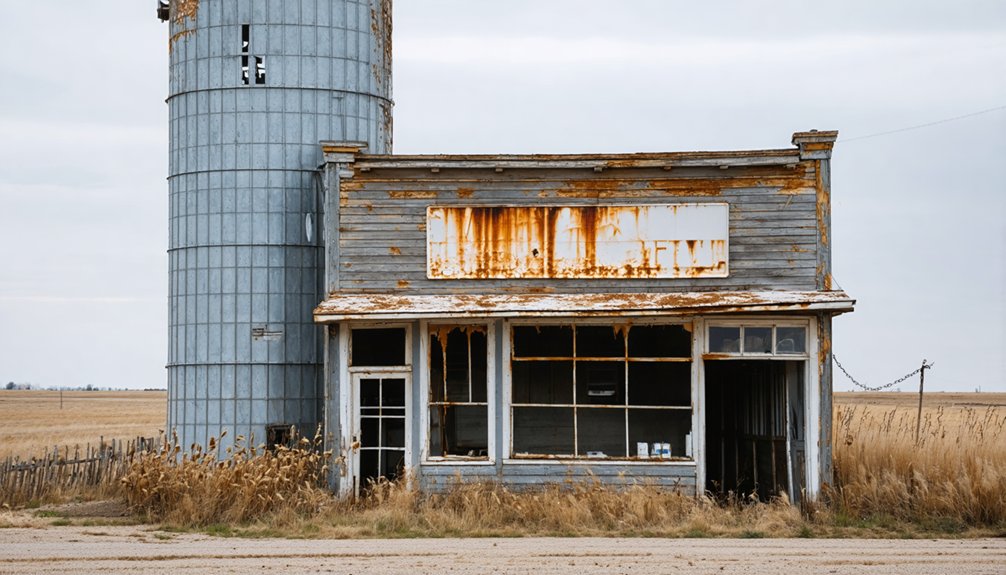
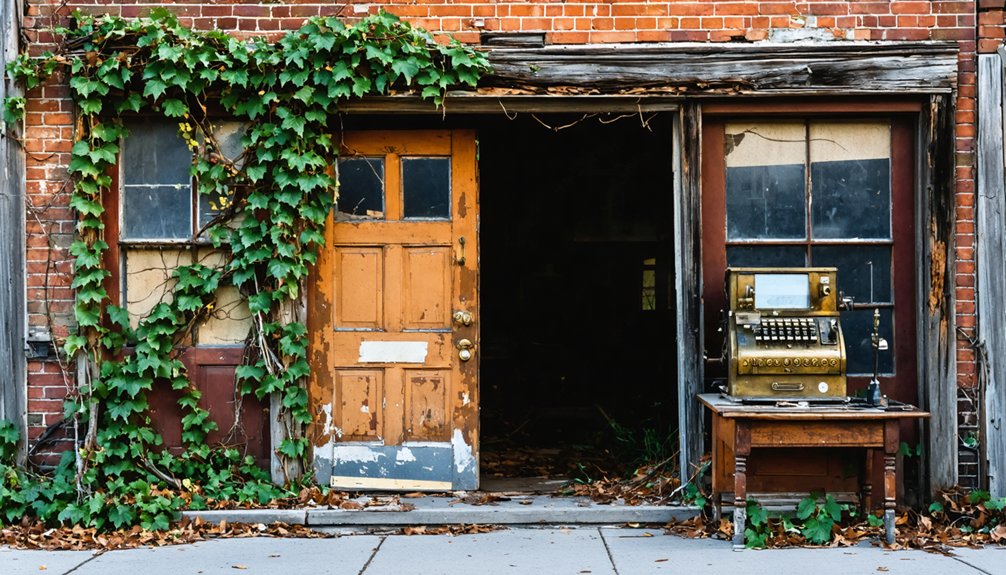
Ghost towns of the Great Plains emerged from railroad, mining, and agricultural booms that drastically altered settlement patterns. You’ll find abandoned depots, crumbling homesteads, and empty Main Streets where once-thriving communities existed. The Dust Bowl and economic forces triggered mass exodus, with some counties losing over one-third of their population. Nature now reclaims these sites while tourism offers new purpose to these forgotten landscapes. Their stories reveal America’s complex relationship with frontier development.
Key Takeaways
- The Dust Bowl of the 1930s triggered abandonment of numerous Great Plains homesteads and towns as environmental devastation drove mass exodus.
- Agricultural ghost towns emerged after unsustainable farming practices, economic hardship, and post-WWII mechanization reduced rural population needs.
- Abandoned railway infrastructure created ghost towns when water stops became unnecessary and railroad employment opportunities diminished.
- Physical artifacts like crumbling banks, churches, and homesteads reveal boom-and-bust settlement patterns across the Great Plains landscape.
- Heritage tourism now offers economic revitalization for some ghost towns through preservation efforts and repurposing of historic structures.
The Railroad’s Role in Creating and Abandoning Frontier Communities
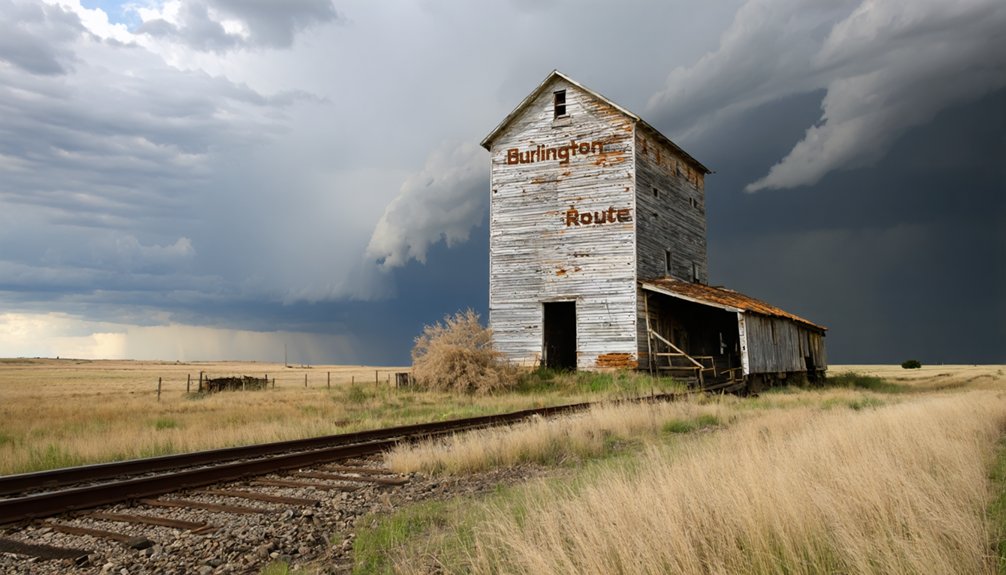
As the iron rails stretched across the American frontier during the nineteenth century, they carved new settlement patterns into the landscape that defied traditional geographic logic.
You’ll find these railroad-born communities didn’t emerge from natural harbors or fertile valleys, but at strategic stopping points determined by corporate planners.
Railroad impact transformed barren prairies into bustling towns overnight. When tracks arrived, so did infrastructure—schools, hotels, and grain elevators—creating instant economies where none existed before.
Section stations and construction camps evolved into permanent settlements, often populated by immigrant labor groups. Towns like Terrace supported the third largest Chinatown in Utah territory, reflecting the significant presence of Chinese railroad workers. Ottawa’s incredible growth to 6,250 residents by 1872 demonstrated how railroad job creation could rapidly expand frontier populations.
Yet this railroad-dependent community evolution contained the seeds of eventual decline. When companies rerouted lines or abandoned unprofitable sections, they effectively sentenced towns to death.
Without their economic lifeline, these once-thriving communities withered, becoming the ghost towns you might stumble upon today.
Mining Boom and Bust Cycles: How Resource Depletion Created Ghost Towns
When precious metals glinted beneath western soil in the nineteenth century, they triggered profound transformations across America’s frontier landscape. You’d witness boomtowns erupting overnight as prospectors flooded mining districts, with populations swelling from hundreds to tens of thousands within months. Montana’s population explosion from 38,159 in 1880 to 132,159 by 1890 exemplifies this gold rush phenomenon.
These settlements followed predictable spatial patterns, clustering around ore deposits with little consideration for long-term community resilience. As accessible minerals vanished, production costs soared and profitability plummeted. The failure of resource management became evident as mines abruptly closed, triggering mass exodus.
The physical landscape bears witness to this cycle—scarred hillsides, abandoned structures, and contaminated waterways remain as evidence of humanity’s brief but intense occupation.
These ghost towns now stand frozen in time, their decaying frames revealing how swiftly prosperity can vanish when built upon finite resources.
Agricultural Dreams and Dust Bowl Nightmares on the Plains
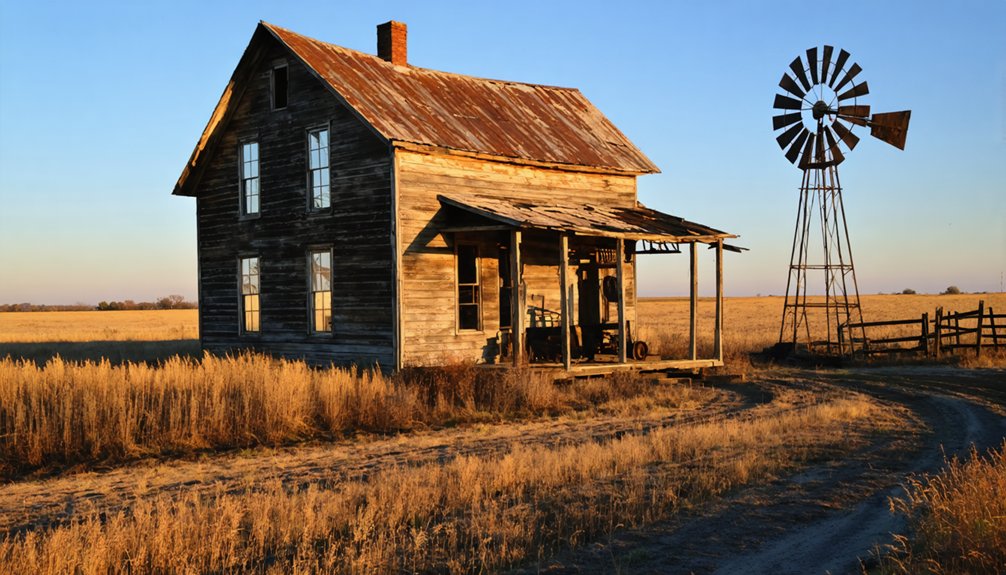
While mining towns appeared and vanished with the glint of precious metals, a different pattern of settlement and abandonment unfolded across America’s Great Plains.
You can trace these agricultural ghost towns to the Homestead Act of 1862, which lured settlers with 160-acre plots. Their dreams collapsed when unsustainable farming practices met the harsh realities of Plains ecology.
As these communities dwindled, many industries also faltered, leaving behind abandoned factories in the Midwest that once thrived on agriculture and manufacturing. The remnants of these structures serve as a haunting reminder of what was lost, echoing the stories of the families who once called these places home. Today, they stand as symbols of the economic shifts that reshaped the landscape, inviting contemplation on the future of rural America.
- Deep plowing destroyed native grasses that had anchored topsoil for millennia
- Monoculture wheat farming left vast landscapes vulnerable to drought
- “Black blizzards” buried homesteads and equipment under mountains of dust
- Mass exodus west created abandoned farmhouses still dotting the landscape
These forgotten communities reveal the consequences of ignoring agricultural sustainability. The term Dust Bowl was coined by an Associated Press reporter in 1935 to describe the devastating environmental conditions. By 1936, economic losses from the environmental catastrophe reached 25 million dollars per day as families abandoned their farms unable to pay mortgages.
The Dust Bowl‘s painful lessons eventually fostered community resilience through new conservation practices, but not before countless Plains towns became mere memories on the wind.
Notable Ghost Towns of Eastern New Mexico: A Case Study
In Eastern New Mexico’s vast landscape, you’ll find Puerta De Luna‘s adobe remnants testifying to its once-thriving ranching and trading economy along the Pecos River corridor.
Just miles away, Yeso’s deteriorating railway station marks the spatial shift from prosperity to abandonment after the Santa Fe Railroad reduced operations in the mid-20th century.
These settlements’ divergent fates—one shaped by changing water access patterns and the other by transportation network evolution—illustrate how economic shifts permanently altered human occupation across the region’s high plains terrain. Unlike many other ghost towns, Yeso was founded in 1906 specifically as a watering stop for steam locomotives traversing the state’s eastern plains. Similar to Madrid, which supported coal mining for 80 years, these towns show how changing energy and transportation needs dramatically altered settlement patterns.
Puerta De Luna’s Legacy
Among the scattered remnants of New Mexico’s past, Puerto de Luna stands as a compelling case study of frontier settlement evolution and decline.
You’ll find layers of cultural assimilation where European settlers integrated into existing Mexican communities, creating a unique frontier society. The town’s historical significance extends beyond its physical structures to include connections with iconic western figures like Billy the Kid. Spanish explorer Coronado’s passage in 1541 marks the area’s earliest documented European contact. Horacio Lopez notes that the town has experienced ongoing decline since the early 1900s, particularly after the railroad bypassed it.
- Adobe ruins east of the Pecos River create a haunting “Pseudo Ghost Town” landscape
- The well-preserved Church of Nuestra Senora del Refugio anchors the settlement’s visual identity
- Courthouse ruins with standing red brick walls mark the former county seat’s importance
- Settlement patterns reveal the critical impact of transportation networks on community survival
Yeso’s Railway Decline
Positioned strategically along the Belen Cutoff railway route, Yeso emerged in 1906 as a demonstration to how transportation networks shape settlement patterns across New Mexico’s arid landscape.
You’ll find the town’s entire lifecycle tethered to railroad technology. Initially thriving as a crucial water stop for steam locomotives, Yeso developed fundamental infrastructure—depot, post office, hotel, and WPA-built school—despite poor agricultural conditions and non-potable creek water. The area was primarily used for sheep grazing rather than farming due to unsuitable land conditions.
Yeso’s decline directly correlates with diesel locomotive adoption in the 1940s. These engines eliminated the need for frequent water stops, fundamentally erasing Yeso’s purpose on the landscape.
The population scattered as railway employment opportunities vanished, culminating in the school’s closure by mid-1960s and the depot’s abandonment in 1968.
What remains today reflects how technological evolution can rapidly transform settlement patterns, leaving ghost towns as historical markers of abandoned transportation networks.
The Timeline of Decline: How the Great Plains Lost One-Third of Its Population

Though once bustling with optimistic settlers who transformed the expansive grasslands into farmland, the Great Plains has witnessed a dramatic demographic reversal over the past century.
You’re witnessing the remnants of population migration patterns that began in the 1920s and accelerated dramatically during the Dust Bowl era when thousands abandoned their dreams.
- Rural counties peaked between 1920-1930, then lost over one-third of their inhabitants
- The Dust Bowl triggered 20-30% population losses in just one decade
- Post-WWII mechanization required fewer farmers to work larger landholdings
- Two-thirds of Great Plains counties experienced sustained population loss since 1950
Rural revitalization efforts face steep challenges as many areas now contain fewer than two people per square mile – landscapes returning to their pre-settlement emptiness.
What Remains: The Physical Artifacts of Abandoned Communities
You’ll find crumbling structures throughout Great Plains ghost towns, where abandoned banks, churches, and homesteads remain as physical testimony to once-thriving communities.
Railways that once delivered prosperity now cut through empty landscapes, their stations and water towers standing as silent monuments to transportation networks that shaped settlement patterns.
As each passing season brings further deterioration, the surrounding plains gradually reclaim these built environments, with prairie grasses pushing through foundations and windblown soil slowly burying the material remnants of human habitation.
Crumbling Structures Tell Stories
Across the forgotten landscapes of abandoned communities, crumbling structures serve as silent historians documenting the ebb and flow of human settlement patterns.
These architectural decay patterns reveal historical narratives more powerful than written records alone. As you explore these sites, you’ll notice regional variations where nature reclaims human-made environments at different rates.
- Duncan House’s distinctive bay window stands defiant against time, marking where prosperity once reigned.
- Red-brick Presbyterian churches punctuate the landscape like anchors holding memories in place.
- Abandoned storefronts with faded signage illustrate the economic forces that drove populations away.
- Mining equipment scattered across alpine meadows maps the desperate search for mineral wealth.
The spatial distribution of these remnants tells a complex story of boom-and-bust cycles that shaped our frontier identity.
Railways Shape Landscapes
Beyond the scattered buildings and neglected structures, railway infrastructure forms the most extensive and revealing network of artifacts in ghost towns nationwide.
You’ll discover these traces everywhere—faint railbeds cutting through hills, abandoned depots standing sentinel in empty towns, and roundhouses slowly returning to earth. These aren’t just relics but evidence of deliberate landscape transformation.
As you explore, notice how railway infrastructure dictated town placement and growth patterns, with communities rising where tracks met and fading when lines were abandoned.
Since 1929, America’s rail network has shrunk by 55%, leaving physical scars across the Great Plains. Those raised embankments and overgrown cuts you’ll spot while driving rural roads aren’t random—they’re the skeletal remains of competing rail companies that once fought fiercely to dominate these territories.
Desert Reclaims Communities
As the unforgiving desert sun bears down on abandoned settlements, nature methodically reclaims what humans have left behind.
You’ll find concrete foundations slowly cracking under the pressure of resilient desert plants, while toxic chat piles from mining operations stand as monuments to forgotten industry. These community remnants tell stories of sudden departure and gradual desert reclamation.
- Overgrown street grids reveal the skeleton of once-thriving communities
- Mining equipment rusts beneath layers of sand and soil
- Structural remains crumble as vegetation wedges between weakened joints
- Weathered artifacts emerge after storms, only to disappear again
The desert’s conquest is relentless but incomplete.
Where people once built lives, you’ll now discover a landscape in flux—neither fully wild nor tamed, where human ambition and nature’s persistence engage in a silent, ongoing negotiation for dominance.
Water Access and Economic Sustainability in the Plains
While geographic features shaped the initial settlement patterns of the Great Plains, access to water ultimately determined which communities would thrive and which would disappear beneath the waves of progress.
You’ll find the remains of once-thriving towns like Preston Bend and Cedar Mills now submerged beneath reservoirs that serve distant urban centers. These settlements fell victim to competing demands for hydroelectric power, irrigation, and flood control.
Water scarcity transformed countless communities across the plains. When railroads closed water stops or drought depleted critical resources, economic decline followed swiftly.
Community resilience depended on adapting to these harsh realities. Towns reliant on water-powered mills or agriculture withered when their lifelines dried up, while others were sacrificed entirely to create the infrastructure sustaining modern cities today.
The Great Depression’s Impact on Rural Settlement Patterns
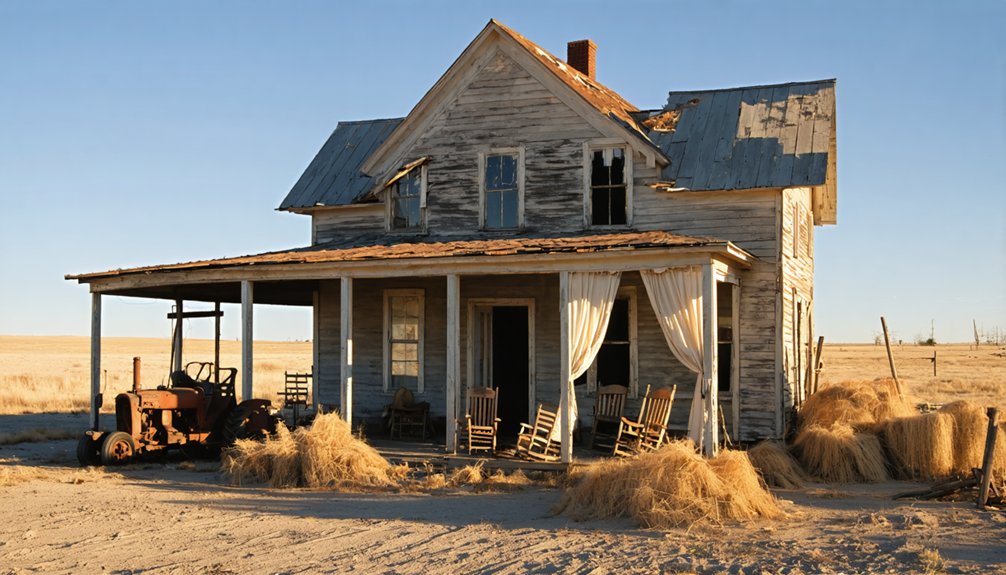
The Great Depression struck the American landscape with devastating force, transforming vibrant rural communities into abandoned shells across the Great Plains. You’d witness a dramatic reshaping of settlement patterns as economic hardships forced roughly 2.5 million people to abandon their homes, creating a landscape dotted with emptiness.
- Foreclosed farms created a patchwork of abandoned homesteads as commodity prices plummeted beyond survival.
- Ghost towns emerged where once-thriving market centers stood, their Main Streets emptied by bank failures.
- Rural displacement accelerated as families migrated westward, leaving behind collapsing social structures.
- Settlement boundaries contracted around remaining viable lands, while marginal territories returned to grassland.
This massive population outflow permanently altered the human geography of the Plains, concentrating survivors in fewer, more sustainable locations.
Why Young People Left: Economic Forces Driving Rural Exodus
During the mid-twentieth century, economic forces carved new migration pathways across rural America, fundamentally reshaping settlement patterns in ghost towns and struggling communities.
The economic exodus hollowed America’s heartland, leaving behind skeletons of communities where dreams once took root.
You’d witness a landscape transformed by technological revolution—agricultural mechanization and manufacturing automation eliminated traditional livelihoods that once anchored rural populations. As farm efficiency increased, fewer hands were needed to work the same land.
The 1980s farm crisis accelerated this rural decline, pushing young residents toward urban opportunities.
Economic migration followed predictable geographic patterns. Between 1950-1960 alone, rural areas lost 753,000 people, including 229,000 young adults.
Two-thirds of Great Plains counties experienced net outmigration as metropolitan areas flourished. This demographic reshuffling created settlement voids—places where schools closed, main streets emptied, and population aged rapidly—transforming vibrant communities into landscapes of absence where opportunity once flourished.
Tourism and Preservation Efforts in Great Plains Ghost Towns

Across abandoned main streets and weathered frontier structures, a quiet transformation has taken root as heritage tourism breathes new economic life into Great Plains ghost towns.
You’ll find communities balancing preservation with economic revitalization, where historic buildings now house boutique shops and cafes. The spatial distribution of these preservation efforts reveals patterns of successful community-led initiatives alongside areas resisting tourist development.
- In Wyoming’s Gold Rush-era towns like South Pass City, authentic historical landscapes draw visitors seeking connections to frontier narratives.
- Annual events like Montana’s Garnet Day create temporal pulses in otherwise dormant settlement patterns.
- Adaptive reuse of historic structures in Paxico, Kansas demonstrates evolution from abandoned space to heritage tourism center.
- Grassroots preservation movements transform the economic landscape while maneuvering tensions between authenticity and commercialization.
Frequently Asked Questions
Were Ghost Towns Ever Successfully Revitalized in the Great Plains?
Like phoenixes from prairie ashes, you’ll find several ghost towns revitalized through community resilience. Their settlement patterns evolved as revitalization efforts transformed abandoned landscapes into vibrant spaces where freedom breathes through historic structures once more.
What Technologies or Innovations Might Have Saved These Communities?
You’d have seen sustainable agriculture and renewable energy transform dying settlements into vibrant hubs where people cultivate resilient landscapes. These innovations could’ve anchored populations across vast plains, enabling freedom from environmental constraints.
Did Any Indigenous Communities Occupy These Sites Before European Settlement?
Yes, you’ll find indigenous heritage evident at many ghost towns. Their settlement patterns followed waterways, with earth lodges and villages preceding European structures, leaving a lasting cultural impact on these landscapes.
How Did Women’s Experiences Differ in Boom-And-Bust Ghost Town Cycles?
You’ll find women’s roles shifted dramatically through boom-bust cycles. During prosperity, you’d see diverse economic opportunities alongside brothels. When towns collapsed, you’d witness heightened vulnerability as social networks disintegrated across the landscape.
What Supernatural Legends or Folklore Emerged From These Abandoned Towns?
You’ll find haunted histories in stone churches where witches gathered, and spectral sightings across barren landscapes—from weeping brides in abandoned hotels to ghostly horsemen galloping freely through the vast, spiritually charged plains.
References
- https://www.vice.com/en/article/inside-the-abandoned-ghost-towns-of-new-mexico/
- https://plainshumanities.unl.edu/encyclopedia/doc/egp.ct.024.html?stream=top
- https://www.grandcountyutah.net/388/Ghost-Towns-Communities
- https://www.geotab.com/ghost-towns/
- https://www.legendsofamerica.com/gt-emergingghosttowns/
- https://www.britannica.com/topic/ghost-town
- https://en.wikipedia.org/wiki/Ghost_town
- https://www.kbia.org/agriculture/2017-03-22/great-plains-ghost-town-sheds-light-on-forgotten-piece-of-african-american-history
- https://dianastaresinicdeane.wordpress.com/2012/06/12/ghost-trains-on-the-low-plains-a-kansas-railroad-story/
- https://www.youtube.com/watch?v=WJUYn160BlM