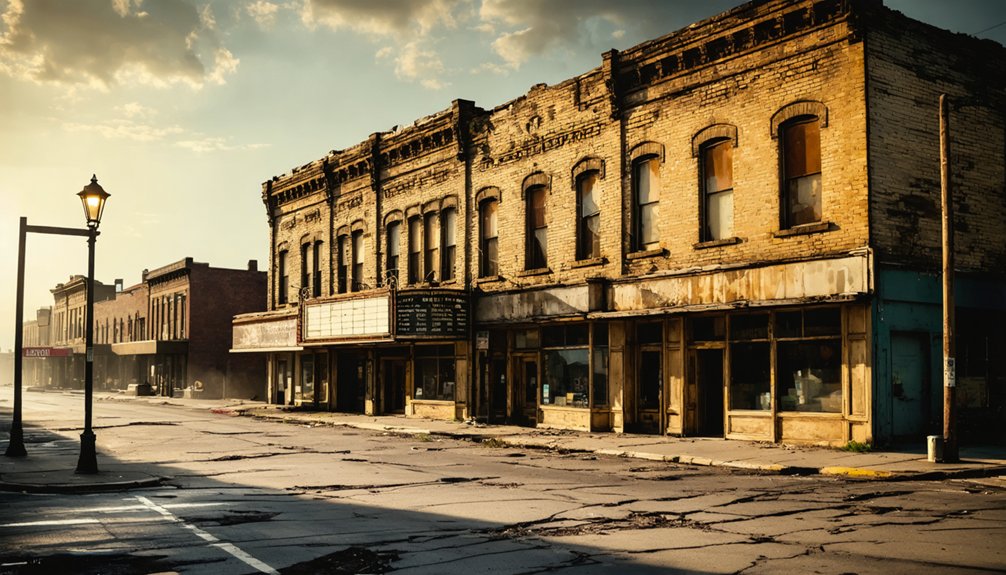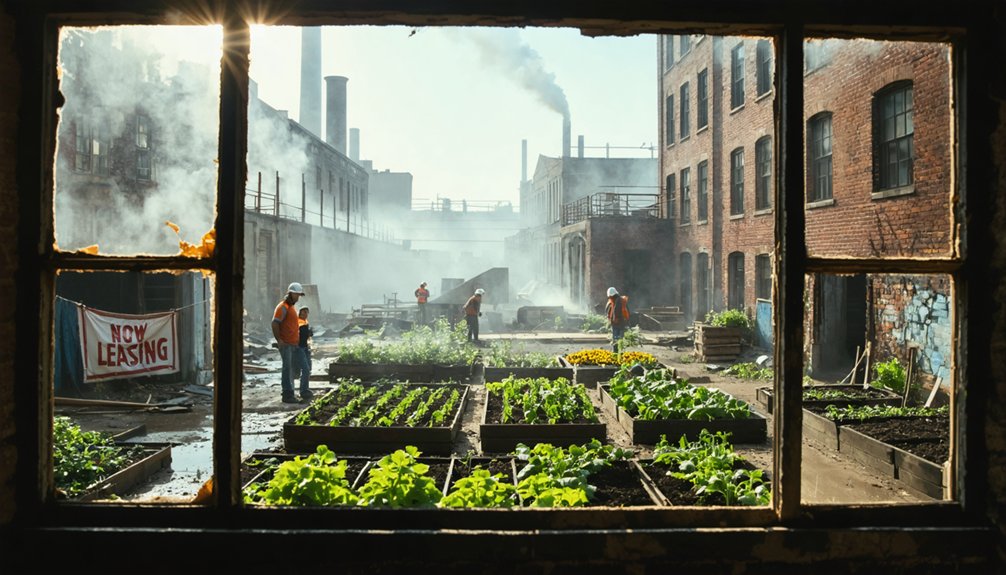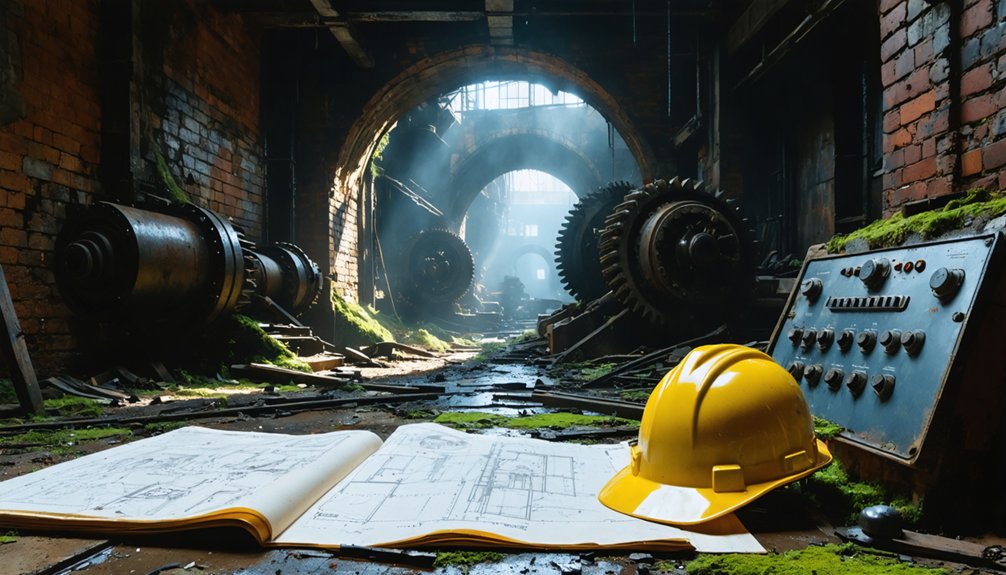
Across America’s Rust Belt, you’ll find haunting remnants of once-thriving industrial communities. Towns like Moonville, Ohio and Gary, Indiana exemplify how resource depletion, technological change, and economic migration transformed bustling hubs into modern ghost towns. While some places like Pittsburgh successfully reinvented themselves through education and technology sectors, others remain frozen in time with vacancy rates exceeding 20%. Their abandoned tunnels, shuttered factories, and empty streets reveal deeper truths about America’s industrial rise and fall.
Key Takeaways
- Moonville, established in 1856 for coal mining, declined when railroads closed and now exists only as a haunted tunnel landmark.
- Thousands of Rust Belt ghost towns like Jaite, Oreton Station, and Sprucevale collapsed due to resource depletion and transportation obsolescence.
- Former industrial powerhouses lost over 60% of their populations, with cities like Youngstown seeing 65% decline since 1930.
- Many ghost towns now feature vacancy rates exceeding 20%, with places like Robbins, Illinois reporting 21.4% empty homes.
- Some former ghost towns have found new life through heritage tourism, preserving industrial identity while generating economic opportunities.
The Rise and Fall of Coal Towns: Moonville and Beyond
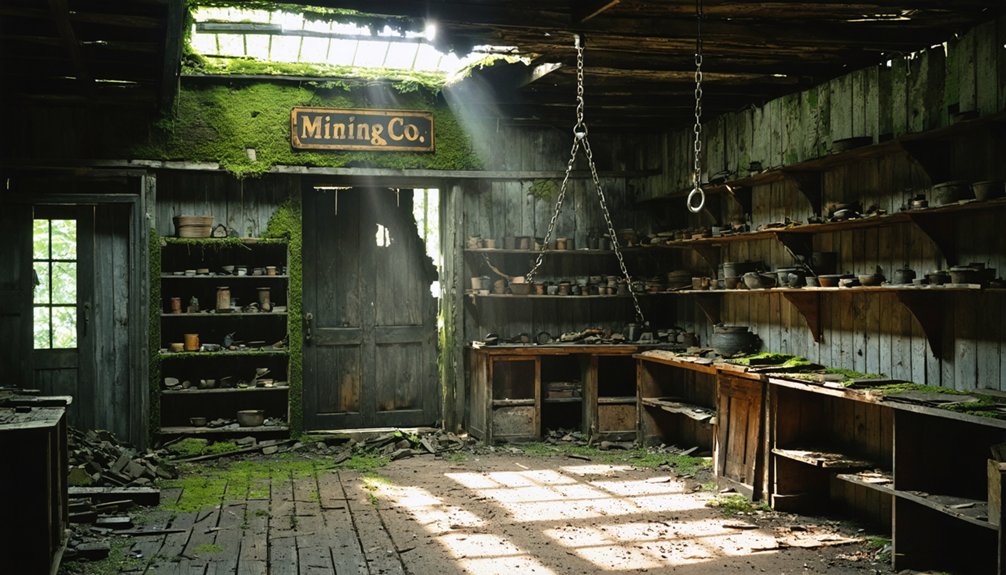
When the Marietta and Cincinnati Railroad carved its way through the rugged terrain of southeastern Ohio in the mid-1800s, it simultaneously birthed and sealed the fate of Moonville, a quintessential coal town that would eventually become emblematic of America’s Rust Belt decline.
You’ll find Moonville’s industrial heritage reflected in its origin as an isolated outpost established around 1856, entirely dependent on rail access to transport coal, clay, and iron ore. The arrangement came about when Samuel Coe permitted the financially troubled railroad to pass through his property in exchange for coal transport services.
The tunnel constructed that year became the lifeline of the town and now stands as a haunted landmark with numerous ghost stories surrounding it.
The community’s resilience manifested through their contributions to Civil War efforts via the Hope Furnace’s iron production.
Abandoned Railroad Communities of the Ohio Valley
The railroad networks that once served as lifelines for countless Ohio Valley communities now stand as skeletal remains of the region’s industrial past, with approximately 4,000 miles of Ohio’s rail infrastructure having vanished since the 1920s.
The ghosts of American progress—steel rails rusting silently where industrial dreams once thundered across the Ohio landscape.
These forgotten railroads shaped the destiny of places like Jaite, Oreton Station, and Sprucevale—company towns that thrived alongside the rails before succumbing to economic shifts and transportation evolution.
- Jaite’s paper mill company town, with its flag stop depot and worker housing, exemplifies the tightly integrated rail-industrial complexes that became unsustainable.
- Oreton Station’s economic collapse followed the pattern of resource depletion and transportation obsolescence that plagued many rail communities.
- Despite widespread abandonment, community resilience emerged in places like Boston Mills, which adapted to railroad dominance after canal operations ceased.
The hauntingly beautiful Moonville tunnel remains one of the most iconic structures from Ohio’s railroad ghost towns, attracting visitors interested in both history and paranormal experiences.
The Jaite Mill relied heavily on the Baltimore and Ohio Railroad for transporting its paper products, becoming the 11th largest multi-wall paper producer in the United States during its peak years in the 1920s and 1930s.
Modern Ghost Towns: Vacant Housing and Population Exodus
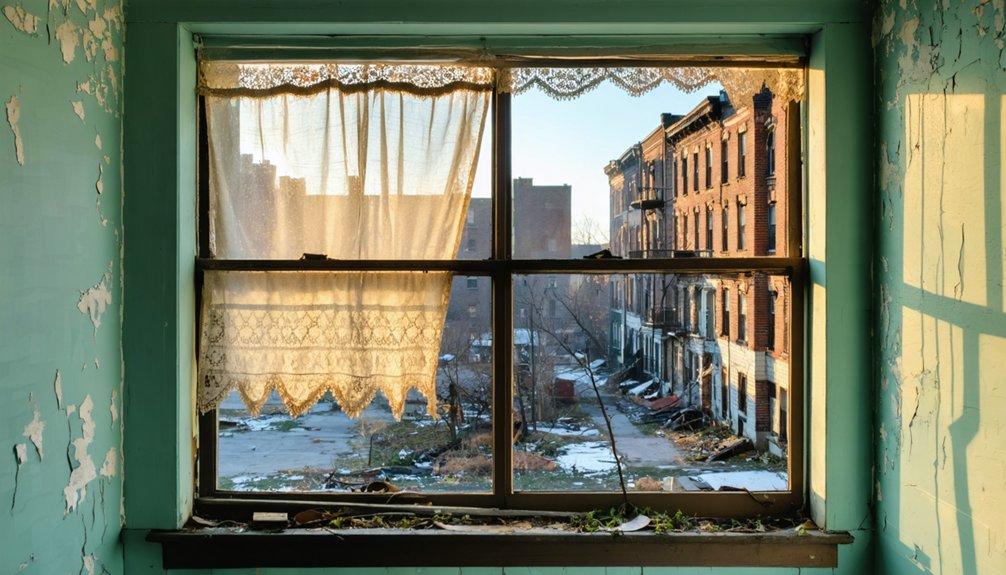
You’ll find once-thriving industrial communities transformed into modern ghost towns, with places like Robbins, Illinois reporting 21.4% of housing units sitting vacant while Gary, Indiana has lost a staggering 62% of its population since 1960.
The exodus patterns reveal alarming population collapses, exemplified by Buffalo’s 52% decline since 1950 and San Francisco’s recent distinction as America’s fastest-shrinking major city with a 7.4% drop between 2020 and 2023.
These vacant housing crises correlate directly with manufacturing job losses throughout the Rust Belt, where entire neighborhoods stand abandoned and property values have plummeted to as little as 14% of statewide medians in the hardest-hit areas. In cities like Dayton, Ohio, an astonishing 46.2% of homes have remained vacant for more than two years, further accelerating urban decay. According to recent analysis, approximately 1.3 million vacant homes exist across the United States, with highest concentrations found in economically declining regions.
Housing Vacancy Crisis
Despite featuring vast numbers of vacant homes, many Rust Belt cities simultaneously suffer from a paradoxical housing crisis that defies simple solutions.
You’ll find national vacancy rates around 3.3%, but in former industrial strongholds like Cincinnati, these numbers skyrocket, creating landscapes of urban blight amid persistent housing affordability challenges.
While 1.5 million affordable units are needed nationally, the Rust Belt faces a particularly acute shortage despite its visible emptiness.
- Rental vacancy rates (7.1% nationally) concentrate in economically distressed neighborhoods, creating ghost town conditions.
- Functionally obsolete housing remains vacant while affordable, modern housing remains scarce.
- Lower-income households face severe cost burdens exceeding 30% of income, despite living amid abandoned properties.
This contradiction reflects a fundamental mismatch—abundant housing stock that no longer meets community needs or modern standards. Homebuyers in these areas typically have greater purchasing power with households earning 120% AMI having significantly more opportunities to buy homes than in coastal markets. The crisis disproportionately impacts minority communities, with 57% of Black renters and 53% of Hispanic renter households experiencing cost burden in these areas.
Population Flight Patterns
As manufacturing jobs vanished from America’s industrial heartland, a devastating population exodus transformed once-thriving urban centers into modern ghost towns, leaving behind haunting landscapes of emptiness and decay.
You’ll notice distinct patterns in this urban decline—neighborhoods with the lowest housing prices suffered the steepest population losses, while middle-income areas experienced sharper economic deterioration. Cities like Youngstown lost over 65% of their residents since 1930, with population migration accelerating between 2000-2020. Detroit’s dramatic fall from 1.85 million residents in 1950 to fewer than 650,000 today exemplifies this industrial collapse.
This exodus wasn’t random—high taxes, rising crime, deteriorating schools, and the allure of cheaper, sunnier states drove residents away. Many who left the Rust Belt experienced higher income growth than those who remained.
The consequences form a vicious cycle: as populations shrink, tax bases collapse, infrastructure crumbles, and abandoned buildings multiply.
Communities with higher percentages of college-educated residents proved more resilient, highlighting education’s critical role in economic adaptation.
Cities Without People
While major cities across the United States have historically experienced population fluctuations, recent data reveals an alarming acceleration in urban exodus that’s transforming once-vibrant metropolitan areas into modern ghost towns.
You’re witnessing unprecedented population stagnation, with San Francisco losing 7.4% of its residents in just three years, followed closely by St. Louis (-6.6%), Jackson (-6.5%), and New York City (-6.2%).
This mass departure has created startling vacancy rates, exemplified by Montgomery, Alabama’s ZIP code 36104, where nearly one-fifth of homes stand empty.
- Urban decay manifests in Muncie’s 47305 ZIP code, where 18% of properties sit vacant
- Commercial vacancies are driving tax revenue declines, crippling essential municipal services
- Construction activity has collapsed, with Akron experiencing a 69% drop in building permits
Mining Boom to Bust: Resource Depletion in Former Boomtowns
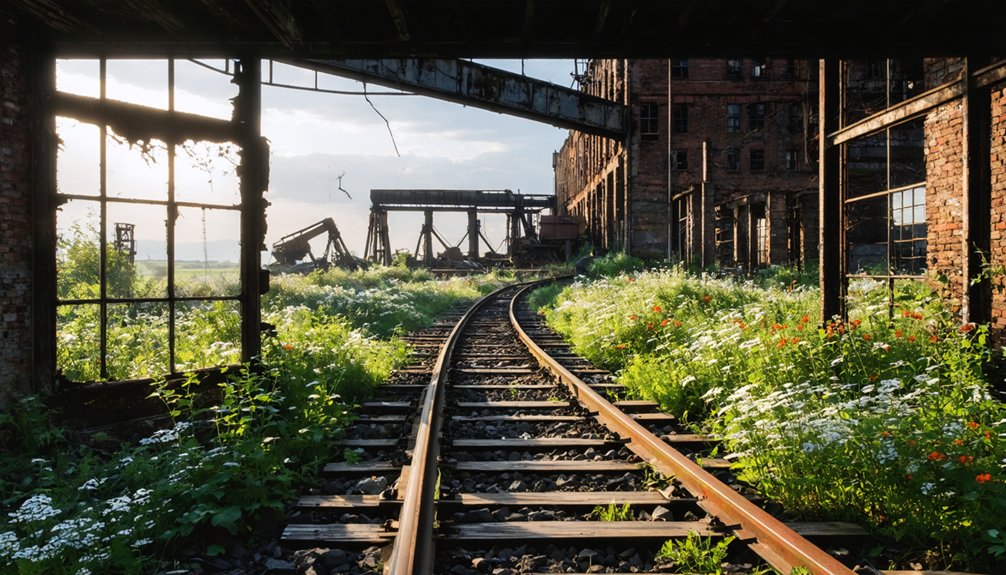
Once the lifeblood of America’s industrial heartland, the rich natural resources that built the Rust Belt‘s economic power ultimately became the catalyst for its decline.
You’ll find the pattern repeated across the region: intensive extraction depleted Appalachian coalfields and Great Lakes iron deposits by mid-century, triggering catastrophic economic collapse.
Poor resource management transformed vibrant communities into shells of their former selves. Gary, Indiana’s population plummeted from 180,000 to under 60,000 as mines closed and steel mills shuttered.
The shift to Wyoming’s Powder River Basin and the rise of fracking delivered the final blow to traditional mining communities. Without economic diversification, these single-industry towns couldn’t survive when resources dwindled.
When extractive industries moved west, monolithic economies collapsed—a cautionary tale of dependence without adaptation.
The consequences—abandoned buildings, crumbling infrastructure, and social deterioration—remain visible decades later, stark monuments to the boom-and-bust cycle that defined the region.
Economic Revival Stories: Towns That Escaped the Ghost Town Fate
Not all Rust Belt communities succumbed to the economic devastation that transformed so many industrial powerhouses into ghost towns. Cities like Pittsburgh and Columbus implemented successful revitalization strategies, diversifying from manufacturing into healthcare, technology, and education sectors.
These forgotten rust belt towns in history remind us of the resilience that still exists within these communities. Rising from the ashes of their industrial past, many have found new identities that embrace innovation and creativity. As they adapt, local leaders are focusing on attracting new businesses and fostering entrepreneurship to ensure a sustainable future.
Kalamazoo’s Promise program demonstrates how innovative educational initiatives can reverse population decline through community engagement.
- Pittsburgh attracted corporate investment from tech giants like Google and Uber, while unemployment fell below the national average.
- Columbus experienced remarkable population growth, surpassing 900,000 residents by 2020 through infrastructure investments and downtown development.
- Cleveland’s healthcare expansion through Cleveland Clinic and tech incubators like JumpStart transformed its economic landscape.
These success stories share common elements: economic diversification, investment in education, and deliberate urban core revitalization—providing blueprints for other struggling communities seeking renewal.
Preserving the Past: Heritage Tourism in Abandoned Communities

While touring abandoned industrial sites offers economic stimulus beyond mere appreciation of ruins, you’ll find these heritage experiences generate revenue through accommodations, dining, and retail that collectively revitalizes struggling communities.
Your visit supports preservation of authentic industrial identity through careful curation of machinery, buildings, and worker narratives that distinguish genuine historical sites from commercialized attractions.
Digital heritage trails now connect these physical locations through smartphone applications, allowing you to experience guided tours, historical photographs, and oral histories that extend the accessibility and educational value of these rust belt treasures.
Economic Benefits Beyond Ruins
As former industrial powerhouses have crumbled into disrepair across America’s Rust Belt, heritage tourism has emerged as a surprisingly effective economic catalyst for communities once defined solely by their abandonment.
You’ll find these towns leveraging their industrial past through tourism initiatives that transform abandoned factories and mines into interactive museums and cultural attractions.
The economic benefits extend well beyond preserving ruins:
- Authentic experiences led by former industry workers create unique selling points that generic tourist destinations can’t replicate
- Community engagement increases when locals see their collective history valued and monetized
- Diversification opportunities arise as service industries develop around heritage sites
Despite challenges maintaining visitor numbers and meeting safety regulations, cities like Pittsburgh and Detroit demonstrate how industrial heritage can anchor broader economic revivals.
When executed thoughtfully, these programs don’t just preserve history—they rebuild economies while honoring the identity that shaped these communities.
Preserving Authentic Industrial Identity
The preservation of authentic industrial identity within Rust Belt communities represents a critical counterbalance to the homogenizing forces of modern development, where each weathered brick and rusted beam embodies generations of collective memory.
When you explore these spaces, you’re witnessing the material legacy of American industrialization—daylight factories with exposed structural elements that tell stories of labor, innovation, and community resilience.
Effective industrial preservation requires meaningful community engagement, ensuring local voices shape heritage decisions rather than external developers.
You’ll find the most successful preservation efforts integrate contemporary functions while respecting historic character, avoiding the superficial aesthetics that plague many redevelopment projects.
This approach resists demolition threats and celebrates the authentic architectural typologies that define these regions.
The challenge lies in balancing preservation with adaptation, retaining what makes these places uniquely themselves while enabling their continued evolution.
Digital Heritage Trails
Digital heritage trails have emerged as transformative tools for documenting and experiencing Rust Belt ghost towns, merging technological innovation with historical preservation in ways previously unimaginable.
Through digital storytelling, these immersive experiences utilize 3D scanning, GIS mapping, and augmented reality to create accessible archives of industrial history that you can explore from anywhere in the world.
- AR/VR technologies allow you to walk through reconstructed factory floors and neighborhoods that physically no longer exist.
- Community engagement workshops empower local residents to contribute their stories and artifacts to these digital repositories.
- Open-source platforms democratize historical documentation, freeing these narratives from institutional constraints.
These trails not only preserve disappearing industrial landscapes but also revitalize tourism economies in struggling regions, creating new pathways for economic freedom while ensuring authentic historical narratives endure beyond physical deterioration.
Frequently Asked Questions
What Legal Issues Arise When Exploring Abandoned Rust Belt Properties?
You’ll face significant liability concerns and violate trespassing laws when entering abandoned properties without permission, risking misdemeanor charges, fines, or felony penalties if damage occurs.
How Do Seasonal Weather Patterns Affect Ghost Town Preservation Efforts?
Like vultures circling weathered remnants, seasonal extremes create significant climate impact on preservation challenges—you’ll face freeze-thaw damage in winter, flooding in spring, vegetation encroachment in summer, and erosion from autumn rains.
Are There Hidden Health Hazards in Former Industrial Ghost Towns?
You’ll encounter abundant hidden health hazards, as toxic materials persist in soil, water, and decaying structures. Environmental assessments frequently reveal carcinogens, heavy metals, and “forever chemicals” threatening your long-term wellbeing.
What Role Do Paranormal Investigations Play in Ghost Town Tourism?
You’ll discover paranormal investigations serve as economic catalysts, transforming abandoned sites into tourism magnets. Ghost hunting activities generate substantial revenue streams while preserving historical structures and creating immersive experiences that satisfy your desire for supernatural exploration.
How Have Artists Repurposed Abandoned Industrial Spaces in Rust Belt Communities?
You’ll find artists transforming decaying factories into vibrant hubs through large-scale murals and creative installations that memorialize local heritage, catalyze urban revitalization, and generate economic opportunities through increased tourism and community engagement.
References
- https://www.lovemoney.com/gallerylist/86648/americas-empty-ghost-towns-and-why-theyre-abandoned-today
- https://ohioghosttowns.org/top-10-ghost-towns/
- https://www.geotab.com/ghost-towns/
- https://www.loveexploring.com/gallerylist/127789/then-and-now-us-rust-belt-cities-that-bounced-back
- https://www.youtube.com/watch?v=pUZtHpf-rEo
- https://247wallst.com/housing/2024/04/11/americas-modern-ghost-towns-2/
- https://en.wikipedia.org/wiki/Rust_Belt
- https://www.industryweek.com/talent/article/22028380/the-abandonment-of-small-cities-in-the-rust-belt
- https://digging-history.com/2013/11/13/ghost-town-wednesday-moonville-ohio/
- https://www.ravenwoodcastle.com/2015/07/14/legends-lore-moonville-tunnel/