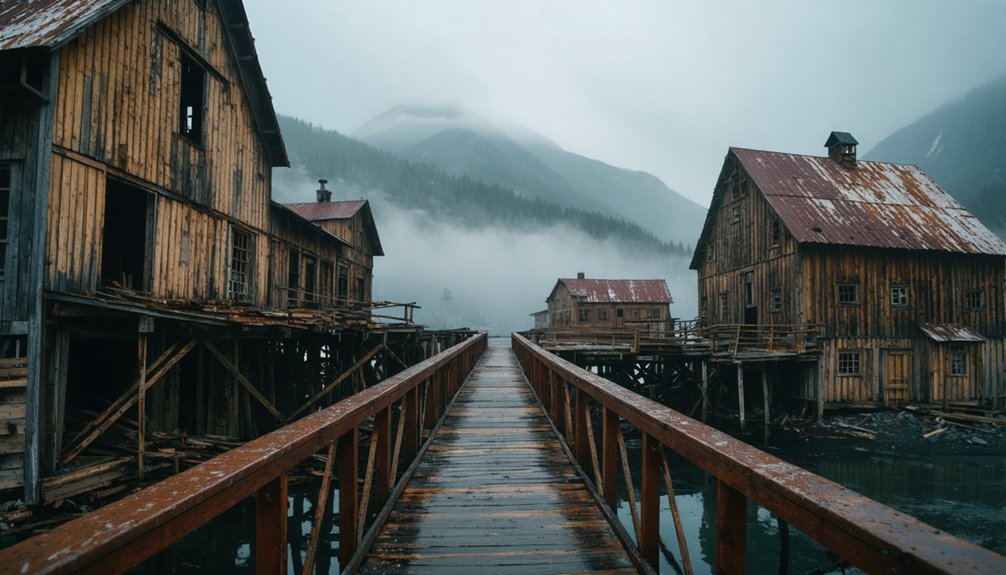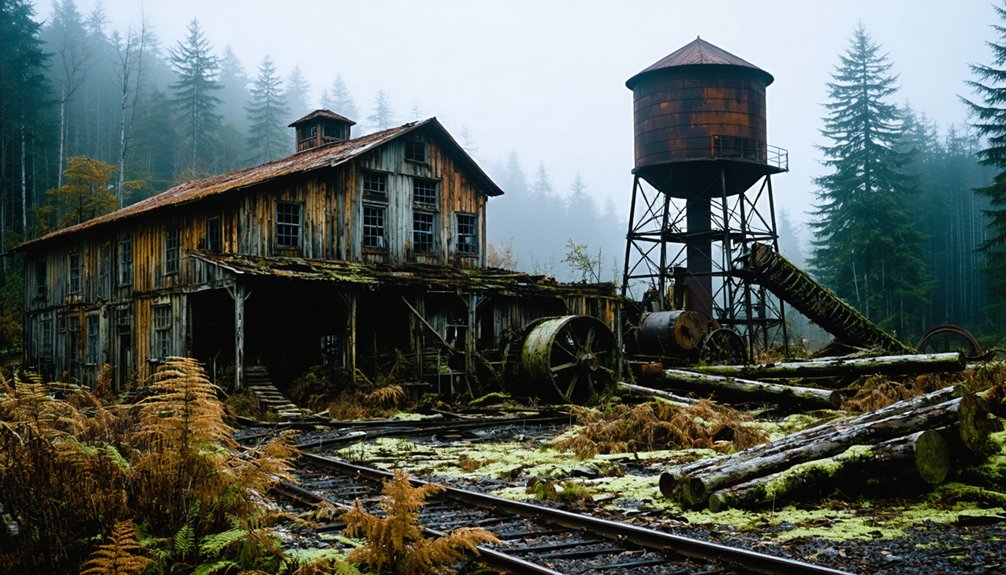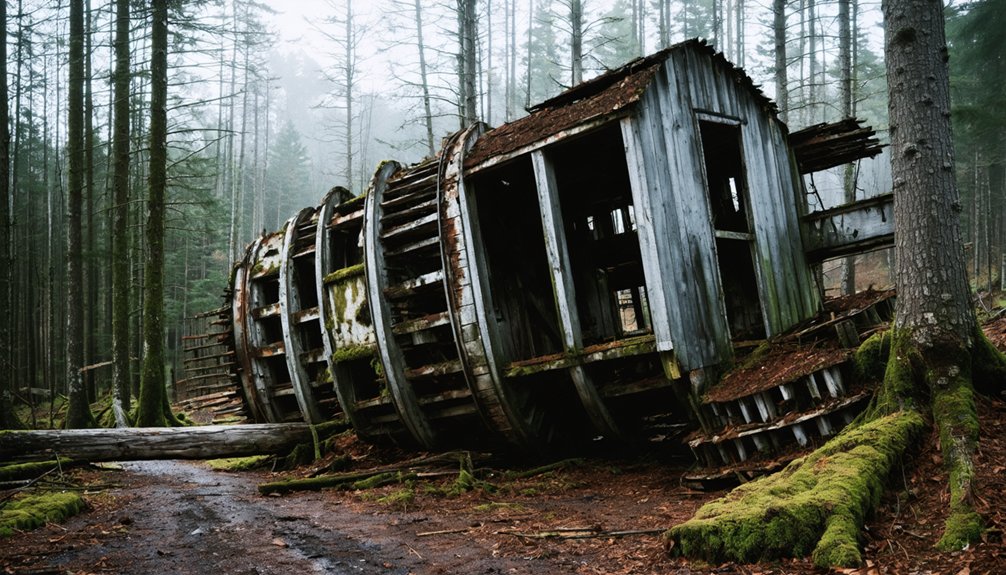
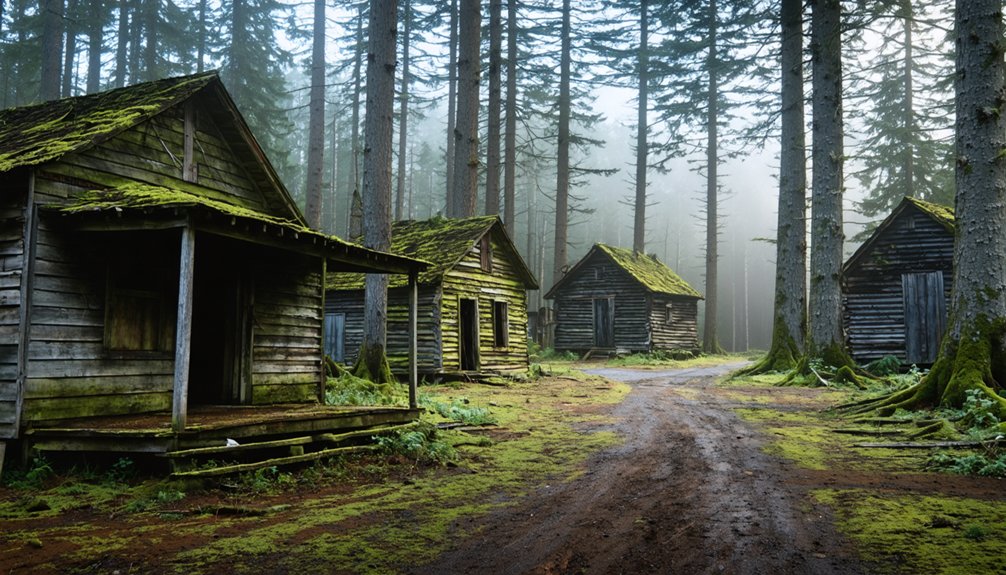
You’ll find America’s forgotten logging towns hidden beneath reclaiming forests, remnants of the 1870-1920 timber boom. These company settlements once bustled with sawmills and railroad operations in regions like the White Mountains, Pacific Northwest, and Southern forests. When timber resources vanished, communities like Livermore and Zealand emptied overnight, leaving ghostly foundations and rusted machinery. Their weathered structures now tell stories of harsh conditions and tight-knit communities that defined America’s logging frontier.
Key Takeaways
- Abandoned logging towns like Livermore tell stories of America’s industrial timber boom and subsequent ecological collapse.
- Weathered structures and stone foundations serve as historical archives of logging communities’ boom-and-bust cycles.
- Company-owned logging settlements created self-contained communities with both social cohesion and economic dependency.
- Resource exhaustion and environmental degradation were primary factors leading to logging towns’ abandonment.
- Preservation efforts maintain logging ghost towns in “arrested decay” while guided tours share their historical significance.
The Rise of America’s Logging Empires (1870-1920)

While the forests of North America had been harvested since colonial times, the period between 1870 and 1920 marked an unprecedented industrial transformation of America’s timber industry.
You’d witness production skyrocket as Kentucky’s output reached 214 million board feet in 1870, while Idaho’s surged from 65 million to 745 million board feet between 1899 and 1910.
As Great Lakes timber dwindled in the 1880s, operations shifted south and west. Logging innovations like rail transport replaced water-based methods, while timber legislation through the Forest Service coordinated sales and infrastructure development.
Western North Carolina saw its logging industry expand dramatically after 1895 when the Henderson-Brevard Railroad arrived, connecting previously isolated timber resources to larger markets.
By 1919, the South had become a dominant force in American lumber production, contributing 37 percent of the nation’s total output.
Livermore: New Hampshire’s Vanished Logging Community
Nestled in the White Mountains of New Hampshire, Livermore emerged in 1876 as a purposeful logging settlement established by the entrepreneurial Saunders family, who invested approximately $150,000 in creating this industrial outpost.
Logging ambition transformed wilderness into industry as the Saunders family carved Livermore from New Hampshire’s untamed mountains.
If you’re intrigued by Livermore history, you’ll discover a community built around the Grafton County Lumber Company that once bustled with 150-200 residents. The mill operated with a 150 horsepower engine that drove the town’s economic activity. The logging impacts were transformative but temporary:
- The town featured two sawmills connected by the Sawyer River Railroad, cutting valuable spruce and fir for New England markets.
- A devastating 1927 flood destroyed critical infrastructure, hastening economic collapse.
- By 1940, only two caretakers remained, with official disincorporation following in 1951.
Today, you’ll find only ruins where this logging community once thrived—foundations silently testifying to America’s transient industrial past. Visitors exploring the area should exercise caution as the overgrown terrain creates numerous tripping hazards throughout the abandoned town site.
Walking Through Sawdust: What Remains of These Ghost Towns Today

When you walk the weathered boardwalks of these forgotten towns today, you’ll encounter weathered wooden structures and stone foundations that silently narrate the lives of those who once populated these bustling communities.
Guided tours at sites like Bodie and Kennecott now offer meticulously researched narratives of daily life, illuminating the economic and social conditions that shaped these now-deserted settlements.
Archaeological teams continue careful excavation work at several sites, gradually uncovering artifacts that provide scholars with invaluable insights into the material culture of America’s transient mining and logging communities.
The preserved buildings at St. Elmo, Colorado stand as remarkable examples of mountain charm that characterized many mining communities before their eventual abandonment.
Visitors to Bannack, Montana can stroll along wooden sidewalks while exploring numerous well-preserved historical buildings from the frontier era.
Preserved Buildings Tell Stories
Abandoned structures standing in America’s ghost towns serve as physical archives of the nation’s boom-and-bust economic cycles, preserving stories that might otherwise be lost to time.
In these vacant settlements, architectural significance speaks through the weathered facades of once-vibrant communities. Similar to the preserved ghost town of Bodie State Park, these locations offer glimpses into America’s fascinating past.
As you explore these remnants of cultural heritage, you’ll discover:
- Original furnishings in Bodie, California’s 110 standing structures, frozen in “arrested decay” that captures authentic late 19th-century mining life.
- Elkmont Historic District’s 60+ buildings within Great Smoky Mountains National Park, revealing the intimate connection between logging operations and community development.
- Dearfield, Colorado’s preserved gas station and diner, silent witnesses to a once-thriving Black mining community valued at nearly one million dollars before the Depression crushed its prosperity.
Mortimer, North Carolina stands as a testament to the devastating impact of floods and fires that ultimately led to the complete abandonment of this once-bustling lumber town.
Guided Tours Showcase History
Guided tours through America’s ghost towns transform static historical remnants into dynamic narratives, allowing visitors to fully engage with these forgotten communities beyond mere observation.
You’ll discover two distinct approaches to guided exploration: self-guided walking tours like Falk’s two-mile circuit highlighting cultural resources and logging practices, and expert-led experiences such as Kennecott’s copper mining town tours granting access to otherwise restricted buildings.
These immersive historical narratives connect you directly to past economies—revealing how loggers earned $3 daily, survived seasonal shutdowns through self-sufficient orchards, and utilized two-person handsaws that left distinctive notches still visible in giant redwood stumps.
Whether following interpretative trails or joining ranger-led walks, these tours provide tangible links to the socioeconomic fabric that once animated these now-silent communities. Visitors can explore what remains of Falk’s once-thriving community where Elk River Lumber Company employed most of the town’s 400 residents during its peak.
Archaeological Excavation Efforts
Beneath the weathered planks and rusted remnants of America’s ghost towns lies a treasure trove of historical data that archaeologists meticulously unearth through sophisticated excavation techniques.
You’ll find teams employing 3D modeling to document structural remains while cataloging artifacts that reveal untold stories of diverse communities.
When visiting these excavation sites, you’ll discover how artifact analysis illuminates the lives of forgotten residents:
- Medicine bottles and kitchenware reveal daily domestic routines
- Tools and industrial equipment demonstrate occupational practices
- Segregated housing remains expose social hierarchies previously undocumented
Through collaborative efforts between federal agencies, universities, and volunteers, these excavation techniques uncover evidence of diverse racial and ethnic groups—Black loggers, Chinese laborers, Japanese immigrants—whose contributions were often omitted from written histories, freeing these stories from historical oblivion.
Environmental Factors Behind Logging Town Abandonment
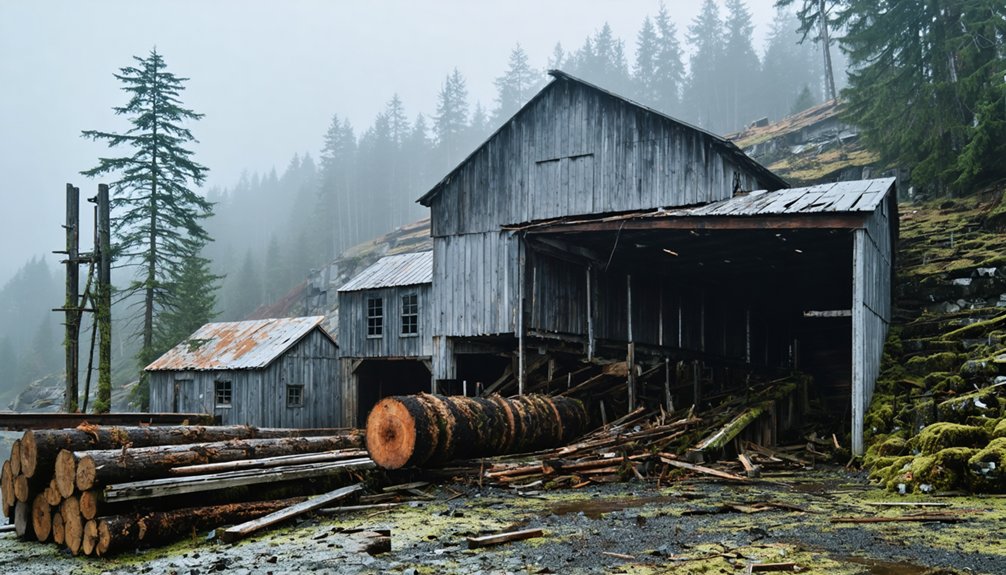
Though still visible on forgotten maps and marked by crumbling foundations, America’s abandoned logging towns stand as evidence to the dramatic environmental changes that once forced their residents to flee.
You’ll find these settlements were primarily abandoned due to resource exhaustion—once-mighty forests stripped bare of their timber wealth, leaving communities without economic purpose.
This ecological degradation created cascading environmental hazards. Soil erosion, contaminated water sources, and increased wildfire vulnerability made these areas increasingly uninhabitable.
Community displacement often followed toxic pollution from logging operations, as chemical runoff poisoned groundwater systems. Without sustainable forest management practices, logged areas frequently fell into ecological traps, dominated by invasive species and unable to regenerate naturally.
Environmental destruction follows reckless profit—poisoned water, ecological collapse, and communities forced to abandon their homes forever.
The legacy of these ghost towns reveals how environmental mismanagement can transform thriving communities into abandoned landscapes, where nature slowly reclaims what humans once built.
Life in a Company-Owned Logging Settlement
While America’s bustling cities were developing with independent economies and democratically elected leadership, life in company-owned logging settlements followed a fundamentally different pattern of existence. Your entire world existed within the company’s sphere of influence – from the house you rented to the store where you purchased necessities.
Company culture permeated every aspect of daily life through:
- Controlled infrastructure – companies built and owned housing, stores, schools, and churches, creating self-contained communities.
- Limited economic freedom – your wages often circulated back to the company through rents and store purchases.
- Social engineering – company-sponsored activities fostered worker loyalty and community cohesion.
Despite harsh working conditions and isolation, many residents developed strong communal bonds.
You’d find yourself caught in a paradoxical relationship – dependent on the company yet part of a tight-knit community forged through shared hardship and mutual support.
From Timber Boomtowns to Historical Preservation Sites

As the timber industry retreated from its apex in the early twentieth century, logging boomtowns across America faced a stark choice: adapt or disappear.
You’ll find these divergent paths clearly illustrated in places like Scotia and Falk, California. Scotia demonstrates remarkable community resilience, maintaining its timber economy through the Humboldt Redwood Company mill while preserving its heritage through museums and public displays of logging equipment.
Contrast this with Falk, where the mill’s 1937 closure during the Depression transformed a 400-person settlement into a ghost town by the 1950s.
Today, preservation efforts mirror those in former mining towns like Bodie and Rush, where park services stabilize remaining structures in “arrested decay.”
These preservation approaches—ranging from Scotia’s living history to the skeletal remains of abandoned settlements—offer you glimpses into America’s industrial past while protecting these fragile historical sites.
Mapping the Lost Logging Communities of the White Mountains
Deep within the verdant folds of New Hampshire’s White Mountains lie the fading footprints of once-thriving logging communities, their stories slowly disappearing beneath forest regrowth.
You’ll discover towns like Johnson, Zealand, and others that vanished when timber resources were depleted around 1916. The G.L. Johnson Lumber Company’s operations—including the Gordon Pond Railroad established in 1907—created temporary economic engines that collapsed when virgin red spruce forests were exhausted.
When exploring these forgotten landscapes, look for:
- Abandoned logging railroads that once connected Kinsman Notch and Mount Moosilaukee
- Remnants of sawmills and “squirt dams” used for hydraulic log transport
- Artifacts like ax heads, peaveys, and rails that tell stories of industrial freedom and subsequent environmental constraints
These ghost towns represent America’s complex relationship with resource extraction and conservation.
Comparing Lumber Ghost Towns With Mining Settlements
America’s abandoned settlements reflect distinct patterns of resource exploitation that shaped our nation’s economic development.
While mining towns boomed rapidly around mineral discoveries, lumber towns emerged more gradually where timber transportation networks could reach dense forests.
You’ll notice mining settlements typically invested in substantial infrastructure—electricity, elaborate buildings, and cultural venues—whereas lumber communities focused primarily on practical structures supporting logging techniques like sawmills and worker housing.
Mining towns often peaked with thousands of residents; lumber settlements remained smaller but equally vulnerable to resource depletion.
As these towns were abandoned, they became ghost towns in the western us, serving as haunting reminders of both prosperity and decline. Today, many of these sites attract tourists fascinated by their histories and the stories frozen in time. Their crumbling structures and remnants of past lives offer a glimpse into the challenges faced by communities that once thrived on the edge of survival.
The economic fragility of both town types stemmed from isolation and single-industry dependence, though mining settlements sometimes diversified their economies.
Lumber ghost towns, dependent on specific timber transportation methods like rivers or railways, typically vanished more completely once the surrounding forests were harvested.
Frequently Asked Questions
Did Any Logging Towns Successfully Transition to Permanent Communities?
Like a phoenix texting from the ashes, you’ll find numerous logging town survival stories. Butte Falls, Bonner County, and Bend exemplify successful community transformation through tourism, resource management, and economic diversification.
What Happened to the Machinery and Equipment After Abandonment?
You’ll find abandoned machinery decaying where it stood, rusting in remote forests. Equipment repurposing occurred when locals salvaged parts or collectors restored pieces, while many remain as historical artifacts of industrial decline.
How Did Families Maintain Education for Children in Remote Logging Towns?
Like miners panning for knowledge, you’d find families using one-room schoolhouses, homeschooling methods, or traveling teachers. Companies often built modest schools, but when camps moved, education continued through parental instruction or shared teaching arrangements.
Did Indigenous Communities Participate in or Resist Logging Town Development?
You’ll find Indigenous communities both participated in logging economies when forced by necessity and resisted through economic resistance and cultural impact retention, often working under wage discrimination while struggling to preserve traditional forest relationships.
What Archaeological Techniques Help Researchers Study These Forgotten Settlements?
Like a detective uncovering hidden truths, you’ll find archaeologists employ non-invasive remote sensing, stratigraphic site excavation, artifact analysis, and traditional documentation methods to reveal logging towns’ forgotten stories beneath the forest floor.
References
- https://www.whitemountainhistory.org/abandoned-towns
- https://www.geotab.com/ghost-towns/
- https://albiongould.com/ghost-towns-to-visit-in-the-states/
- https://www.mentalfloss.com/geography/wanderlust/creepiest-ghost-towns-united-states
- https://whakestudios.com/us-ghost-towns/
- https://www.christywanders.com/2024/08/top-ghost-towns-for-history-buffs.html
- https://www.youtube.com/watch?v=yeTVfoQxqJc
- https://en.wikipedia.org/wiki/Lists_of_ghost_towns_in_the_United_States
- https://www.atlasobscura.com/lists/americas-best-preserved-ghost-towns
- https://www.smithsonianmag.com/travel/americas-coolest-ghost-towns-180952954/