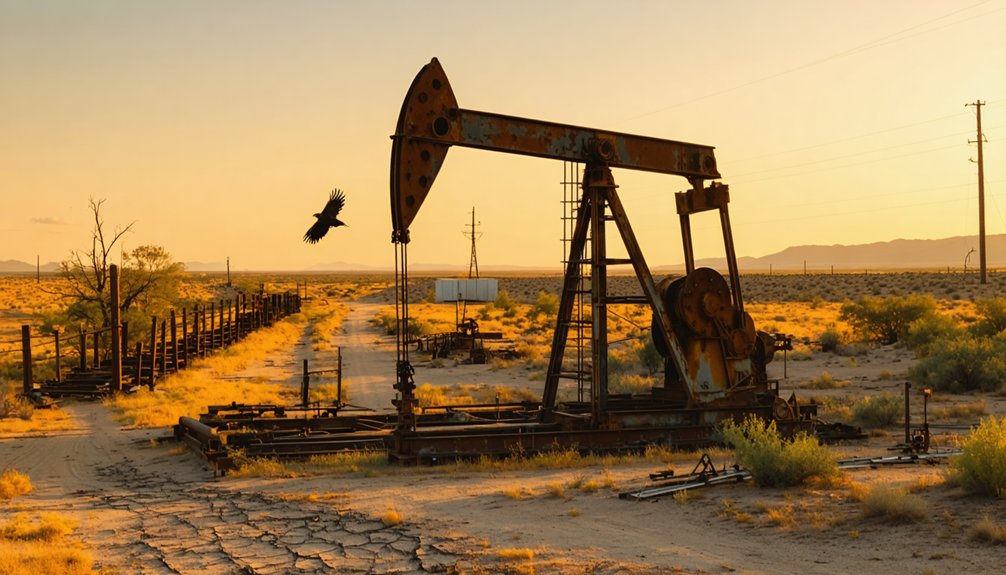
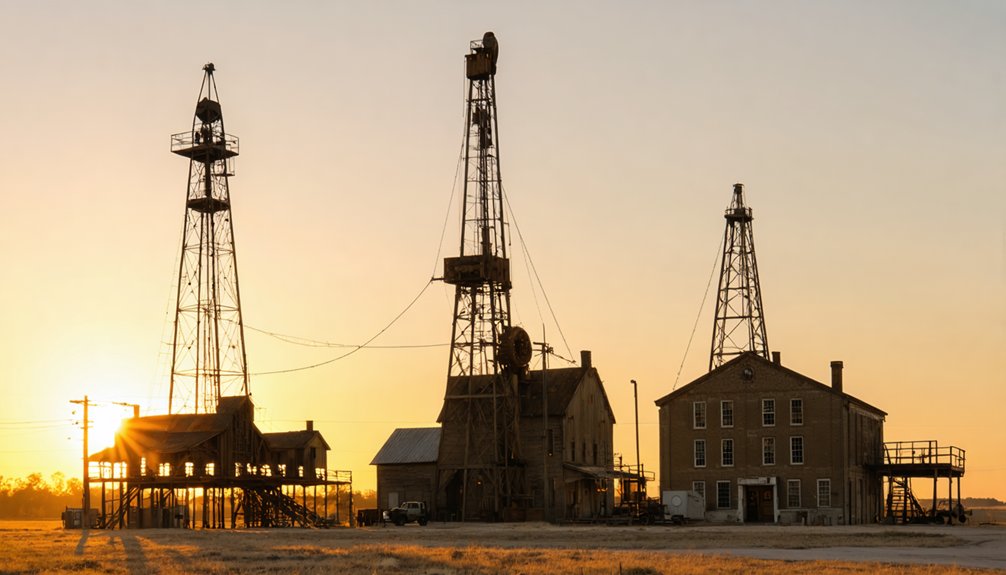
America’s landscape is dotted with forgotten oil boomtowns that once thrived during petroleum rushes before collapsing dramatically. You’ll find haunting remnants like Volcano, West Virginia, which burned in a single night in 1879, and abandoned filling stations along Route 66. These ghost towns reveal the volatile boom-bust cycle of resource-dependent economies, where populations of 25,000 could vanish within years. Their weathered structures and empty streets tell stories of American ambition, environmental disaster, and economic fragility.
Key Takeaways
- America’s oil boomtowns experienced dramatic boom-bust cycles, with many towns returning to wilderness after brief periods of prosperity.
- Volcano, West Virginia was destroyed by a catastrophic fire in 1879, eventually ceasing to exist despite once housing nearly 4,000 residents.
- Abandoned filling stations like Alanreed’s Super 66 and Depew’s Gimmel station stand as skeletal remains of once-thriving oil communities.
- Environmental disasters in towns like Picher, Oklahoma and Centralia, Pennsylvania forced complete evacuations, creating modern ghost towns.
- Historic buildings like Mentryville’s Pico Cottage mansion offer tangible connections to America’s oil boom heritage despite economic collapse.
The Rise and Fall of America’s Black Gold Boomtowns
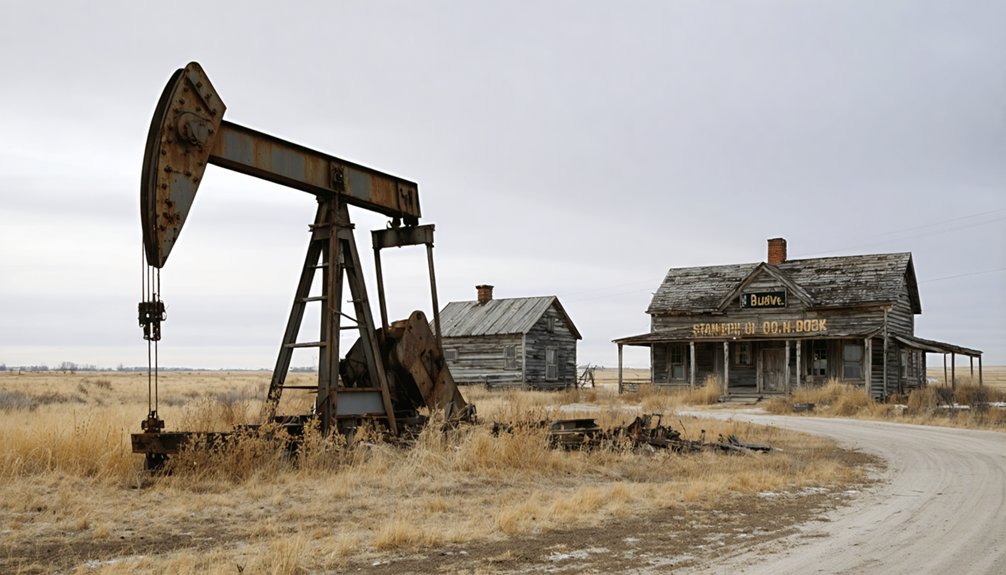
When America’s industrial revolution intersected with the discovery of “black gold” in the mid-19th century, it birthed a phenomenon that would permanently alter the nation’s landscape and economy.
You can trace this transformation to 1859 when Drake’s well in Pennsylvania ignited a rush that quickly spread across Appalachia during the Civil War era.
These boomtowns followed a predictable lifecycle: explosive growth over 5-12 years followed by devastating contraction.
Places like Oil City in Louisiana’s Caddo Parish swelled from swampland to hosting 25,000 residents before collapsing when wells dried up.
The boom-bust cycle claimed countless victims, as once-thriving communities returned to wilderness after their brief, frenzied moment of prosperity.
The oil legacy of these towns reshaped America’s economic impact, with production regions shifting from Appalachia to California, then to Texas, which has produced 80 billion barrels since becoming the production leader in 1927.
The 1901 discovery of the Spindletop field near Beaumont transformed the Texas oil industry and accelerated the state’s rise to prominence in energy production.
Modern boomtowns like Williston, North Dakota face similar challenges with harsh winter conditions making life difficult for the transient oil workforce.
Volcano, West Virginia: The Town That Burned in a Night
As you visit the haunting remnants of Volcano, you’ll witness the catastrophic path of the 1879 fire that devoured the entire town in a single night, transforming a thriving oil boomtown into smoldering ruins within hours.
The inferno started suspiciously at 4 a.m. in a downtown building before rapidly engulfing wooden oil tanks, creating rivers of fire that destroyed homes, businesses, and critical oil infrastructure valued at thousands of dollars.
Today, Mountwood Park preserves the stone foundations of W.C. Stiles’ estate and other archaeological remains, offering you a tangible connection to this once-prosperous community that exemplifies the volatile nature of America’s early petroleum industry. Prior to its destruction, the town was serviced by the Laurel Fork Railroad, which had been instrumental in transporting oil to Parkersburg since 1869. The town’s population had reached nearly 4,000 residents before the devastating fire permanently altered its future.
Midnight Inferno’s Destruction Path
In the quiet pre-dawn hours of August 1879, a mysterious fire erupted in downtown Volcano, transforming the prosperous West Virginia oil town into an apocalyptic inferno. Within minutes, flames engulfed Graham & Smith’s Store before racing toward wooden oil storage tanks, creating a catastrophic chain reaction.
You’d have witnessed the Farrow Residence, Walking Beam Printing office, Nicholi Hotel, and U.S. Post Office consumed by unstoppable flames. The fire’s aftermath left 630 barrels of heavy oil worth $3,600 destroyed, along with three derricks, nine tanks, and a boiler works. The flames also devoured the offices of the Volcano Lubricator newspaper, which had been reporting on oil production and local events since 1871.
Despite town resilience with some commercial activity resuming post-disaster, Volcano never truly recovered. Prior to the fire, W. C. Stiles had pioneered endless cable method that revolutionized oil extraction in the region. Oil production had already begun declining, hampering rebuilding efforts.
The once-thriving 4,000-person boomtown gradually faded, officially ceasing to exist by the early 1950s.
Mountwood Park Preserves Ruins
Today, Mountwood Park stands as the silent guardian of Volcano’s ghostly remnants, preserving what little survived the catastrophic 1879 inferno. When you visit, you’ll discover the ruins of the Stiles estate—accessible via a rugged 20-minute hiking trail that demands sturdy footwear.
The park’s Volcano Museum, operating seasonally from May to October on weekends, offers a window into America’s early oil industry history. Here, you can examine artifacts chronicling the innovative endless cable pumping system developed by town founder W.C. Stiles Jr., which revolutionized oil extraction nationwide.
Beyond oil industry history, Mountwood also houses a World War II submarine memorial. Located approximately 12 miles east of Interstate 77, the park is easily accessible via West Virginia State Route 50. Despite its name, the town of Volcano wasn’t formed by tectonic plate activity but rather by the booming oil industry of the 1860s. You can explore these historical treasures without admission fees, though the museum maintains weekend-only hours, letting you connect with this forgotten chapter of American industrial freedom.
Haunting Remains Along Route 66: Oil Towns Left Behind
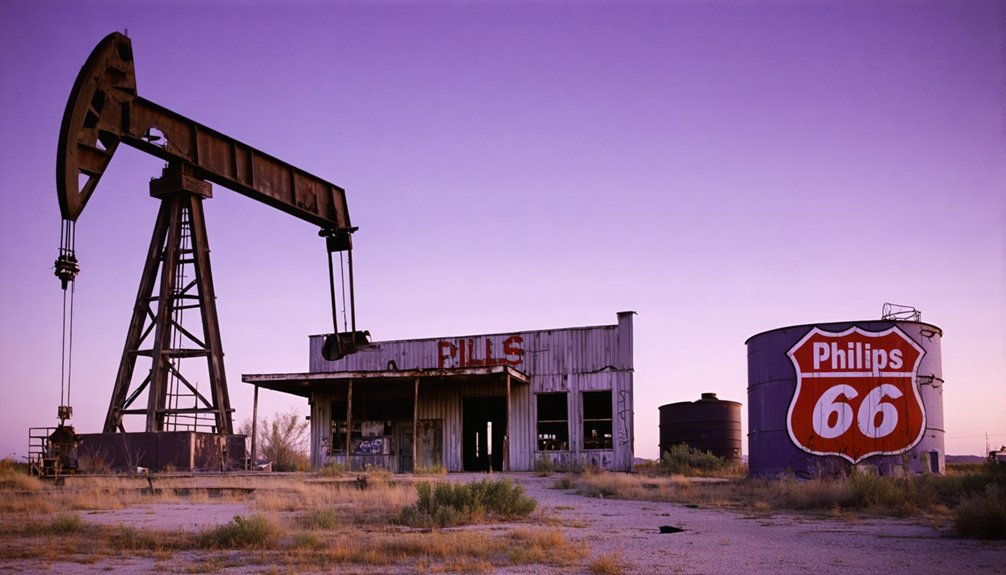
As you travel the forgotten sections of Route 66, you’ll encounter the skeletal remains of once-thriving oil towns that flourished during the early 20th century boom before being decimated by resource depletion and interstate bypassing.
Abandoned filling stations like Alanreed’s restored Super 66 and Depew’s Gimmel station stand as weathered sentinels of prosperity that vanished when crude reserves dwindled and travelers sought faster routes. The town of Alanreed once boasted a population of 500 residents during the oil boom days when Route 66 was in its prime. Depew itself experienced a significant population surge in 1911 when oil discovery transformed the small settlement practically overnight.
These deteriorating roadside attractions—from Shamrock’s historic structures to the infamous mud traps of Jericho Gap—tell a compelling story of American boom-and-bust cycles that left behind ghostly communities with dwindling populations and crumbling infrastructure.
Abandoned Filling Stations
Hundreds of abandoned filling stations dot the landscape along Historic Route 66, standing as ghostly sentinels of America’s golden age of automobile travel.
You’ll find these nostalgic relics transformed through decay and rebirth, with less than 100 of the original 500 Phillips 66 cottage-style stations surviving today. The abandoned architecture tells America’s petroleum-fueled expansion story, with many now repurposed as museums, shops, and offices.
- Only one Phillips 66 station in O’Donnell, Texas still operates as originally intended
- Kan-O-Tex station in Galena was reclaimed by “Four Women on the Route” as a community hub
- Odell’s Standard Oil station earned National Register of Historic Places status in 1997
These fading monuments now fuel heritage tourism, offering tangible connections to Mother Road’s storied past.
Bypassed Boomtown Remnants
Along America’s historic Route 66 corridor, dozens of once-thriving oil boomtowns now stand frozen in time, their prosperity abruptly halted by a perfect storm of economic forces.
Places like Alanreed and Depew—where populations once soared to 500 and 876 respectively—collapsed when oil reserves depleted and Interstate-40 diverted traffic in the 1970s.
You’ll find poignant oil field remnants throughout these bypassed boomtown landscapes: restored Super 66 stations, abandoned Whiting Brothers outposts, and century-old cemeteries.
The nostalgia is palpable in towns that plummeted from commercial hubs to virtual ghost towns in single decades.
What remains—Coppedge Drug Store, original Route 66 concrete, and scattered mercantile buildings—tells a stark story of American boom-and-bust cycles.
Some communities cling to existence through heritage tourism, transforming their abandonment into cultural preservation.
Deteriorating Roadside Attractions
Scattered across the former lifeblood of American westward migration, Route 66’s abandoned oil towns tell haunting stories through their deteriorating roadside attractions.
You’ll find ghostly remnants in places like McLean, where the Shamrock Oil Company’s 1926 strike transformed a quiet cattle station into a bustling boomtown, now marked only by dilapidated attractions and cemetery stones.
- Super 66 station in Alanreed stands restored amid decay—a rare survivor in a town that plummeted from 500 residents to barely 50.
- Skeletal Whiting Brothers stations with sun-bleached signs mark where timber-built empire once fueled America’s westward journey.
- Jericho’s infamous 18-mile “Gap” claimed countless vehicles in muddy traps, now commemorated only by decaying ruins and weathered markers.
Environmental Disasters and Toxic Ghost Towns

Throughout America’s industrial history, environmental disasters have created a particularly haunting type of ghost town—places abandoned not due to economic decline, but rendered uninhabitable by toxic contamination.
One such chilling example lies in the haunted history of Salem Massachusetts, where the echoes of the past still linger in the air. The infamous witch trials left a mark on the town, intertwining its legacy with tales of despair and the supernatural. Today, visitors wander through its streets, captivated by both its tragic history and the spectral stories that haunt its old buildings.
You’ll find the most stark examples in Picher, Oklahoma, where lead mining left a toxic legacy of contaminated soil and collapsing ground, forcing complete evacuation by 2009. Similarly, Times Beach, Missouri disappeared after dioxin-contaminated oil poisoned the entire community.
These ghost towns represent failures of environmental justice, with corporations often leaving devastation behind for residents to suffer.
While not oil-related, Centralia, Pennsylvania offers a chilling parallel—an underground coal fire has been burning since 1962, releasing deadly gases and creating dangerous sinkholes that emptied the town.
These abandoned communities serve as warnings about industrial practices that prioritize profit over public health.
Architectural Survivors: Historic Buildings Standing Against Time
While toxic contamination rendered some communities uninhabitable, other oil ghost towns offer a different kind of historical evidence through their surviving structures.
At Mentryville, you’ll find the impressive 13-room Pico Cottage mansion built in 1896, while Pithole City’s dramatic rise and fall is memorialized through its visitor center featuring a detailed diorama of its former glory.
These architectural survivors demonstrate remarkable resilience despite natural disasters, economic collapse, and abandonment.
- The red barn and first Santa Clarita schoolhouse in Mentryville showcase authentic 19th-century design elements
- Pithole’s walkable street grid offers a physical connection to streets once bustling with 15,000 residents
- Mentryville’s structures withstood earthquakes, fires, and floods, demonstrating extraordinary historical significance
These remnants provide tangible connections to America’s oil boom heritage, offering you glimpses of prosperity, innovation, and eventual abandonment that defined these once-thriving communities.
Oklahoma’s 2,000 Forgotten Communities

Oklahoma’s landscape is dotted with an astounding 2,000 ghost towns, revealing a dramatic demographic transformation that has reshaped the state’s population distribution.
You’ll notice the stark east-west divide in this rural decline pattern—counties west of Interstate 35 hemorrhaged residents throughout the 1990s, while eastern regions generally gained population.
Since 1990, these forgotten communities have watched their youth migrate toward urban centers, with the 22.5% youth population dropping to 19.9% by 2005.
The Hispanic demographic has become the primary growth engine, accounting for 52% of Oklahoma’s total population increase between 2000-2008.
Many abandoned settlements began as thriving agricultural centers, boomtowns, or mining communities before economic shifts forced residents to leave, leaving only decaying post offices, churches, and cemeteries as silent witnesses to once-vibrant communities.
Economic Collapse and Mass Exodus: Why Oil Towns Disappeared
Despite long-held promises of economic stability, America’s oil towns have suffered catastrophic collapse as the petroleum industry’s extreme volatility triggered widespread abandonment across once-thriving communities.
You’re witnessing the harsh reality of economic decline as production increases while employment plummets—oil and gas jobs fell 40% while output rose 60% over the last decade.
- Major gas-producing counties in Ohio, Pennsylvania, and West Virginia lost 11% of their population share between 2008-2019
- Over 130 North American oil companies declared bankruptcy since 2015, devastating local economies
- Former $100,000 drilling jobs disappeared, forcing workers into low-wage employment
This population shift isn’t temporary—it’s structural.
Even during production booms, job growth in gas counties fell below national and state averages, trapping remaining residents in housing markets with artificially inflated costs and diminishing opportunity.
Preserved Tourist Attractions vs. True Abandoned Ruins
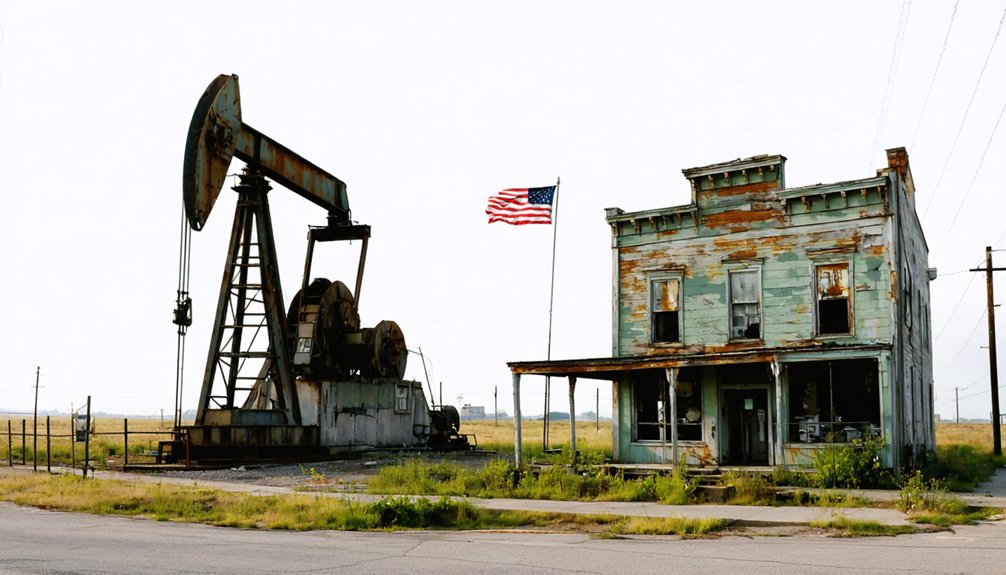
Across America’s forgotten oil landscapes, a stark contrast exists between commercially developed ghost towns and their truly abandoned counterparts.
Places like Bodie, California and St. Elmo, Colorado offer curated experiences with maintained structures, museums, and guided tours, while true ruins like Volcano, West Virginia remain largely untouched, preserving authentic decay.
The curated past versus the forgotten present—America’s ghost towns offer both sanitized history and raw, untamed decay.
You’ll find significant preservation challenges in both scenarios.
Commercialized sites like Fort Jefferson receive federal funding and attract tourists who both support and impact site integrity.
Meanwhile, genuinely abandoned locations like Kennecott, Alaska face deterioration from weather and neglect, with minimal infrastructure.
When exploring these remnants of America’s oil boom, you’re witnessing two competing visions: the carefully preserved past that generates tourism revenue versus the naturally decaying sites that offer a raw, unfiltered glimpse into history’s abandonment.
Railroad Ghost Towns: When the Tracks and Wells Went Dry
When America’s railroads shifted from steam to diesel power in the mid-20th century, they inadvertently sentenced hundreds of small towns to oblivion.
Places like Thurmond, West Virginia and Amboy, California—once crucial service stations for water and repairs—became economically obsolete overnight.
The economic impact was devastating across the American West, where failed railroad expansions left countless communities stranded without market access.
The situation worsened when the Interstate Highway System bypassed these rail-dependent towns, cementing their isolation.
- Texas, California, and Kansas contain over 1,100 ghost towns combined
- Resource depletion in mining and oil towns accelerated abandonment when railroad connections vanished
- Towns that bet their futures on promised railroad expansions withered when competing locations received the connections instead
Frequently Asked Questions
Are There Any Successful Oil Towns That Survived the Boom-Bust Cycle?
Yes, you’ll find numerous oil towns achieved resilience through economic diversification. Oil City, Bartlesville, Beaumont, and Santa Clarita all survived by developing transportation infrastructure, refining operations, and corporate headquarters beyond extraction.
What Happened to the Wealth Generated During Oil Boom Periods?
You’ll find boomtown wealth scattered unevenly through the economy—flowing to corporations, enriching regional infrastructure temporarily, creating national economic growth, but ultimately widening economic disparities as benefits failed to sustain local communities long-term.
How Dangerous Is It to Explore These Abandoned Towns Today?
You’re walking the fine line between adventure and obituary! Without proper safety precautions, you’ll face potential hazards like toxic gases, structural collapses, legal troubles, and possibly angry ghosts demanding back rent.
Can People Legally Collect Artifacts From Oil Ghost Towns?
You can’t legally collect artifacts without proper permissions. Legal regulations require landowner consent on private property and permits on public lands to guarantee artifact preservation. Violating these rules risks serious penalties.
Were Any Ghost Towns Completely Relocated Rather Than Abandoned?
Yes, Harrisville, Utah was completely relocated after an 1862 flood, with residents establishing Harrisburg upriver. This ghost town relocation’s historical significance lies in preserving community continuity despite natural disaster.
References
- https://www.atlasobscura.com/places/ghost-town-volcano-west-virginia
- https://www.youtube.com/watch?v=qTjCUt_-hUQ
- https://www.routemagazine.us/stories/loneliest-places-along-route-66
- https://www.geotab.com/ghost-towns/
- https://www.youtube.com/watch?v=oW66pgyhMYM
- https://en.wikipedia.org/wiki/List_of_ghost_towns_in_Oklahoma
- https://www.epa.gov/mo/town-flood-and-superfund-looking-back-times-beach-disaster-nearly-40-years-later
- https://www.loveexploring.com/gallerylist/67994/americas-eeriest-gold-rush-ghost-towns
- https://visualizingenergy.org/the-history-of-oil-production-in-the-united-states-2/
- https://notevenpast.org/historical-perspectives-on-the-fracking-boom/