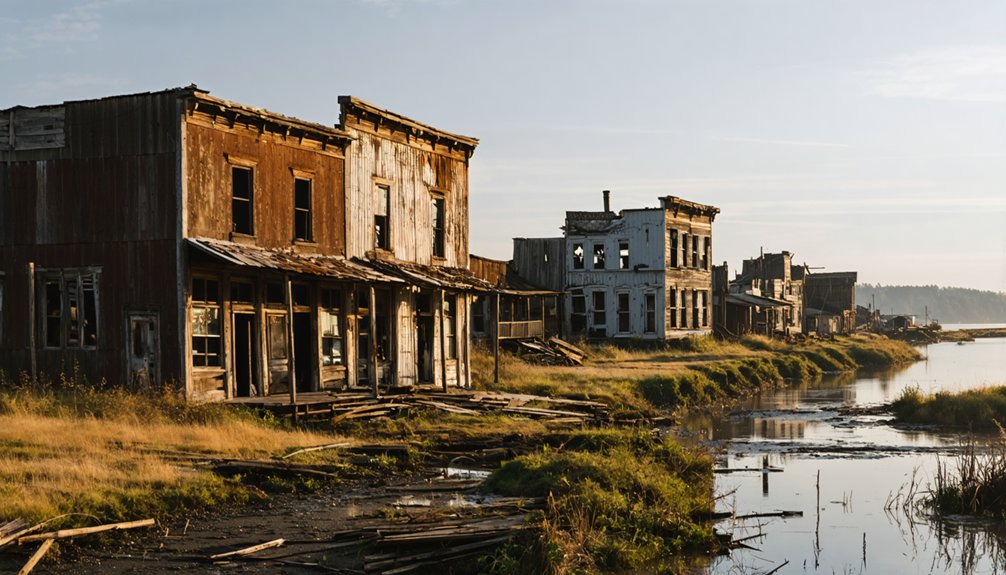
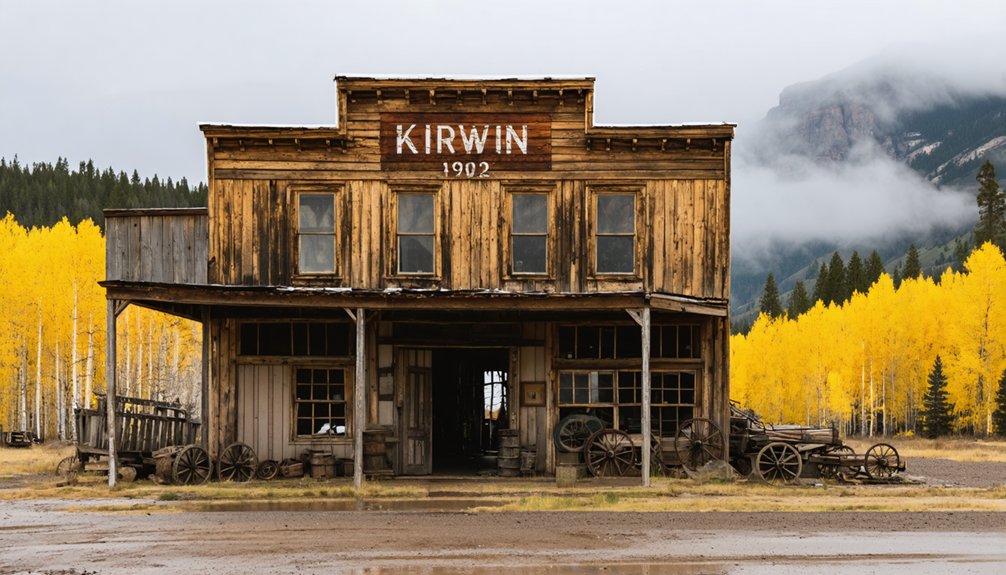
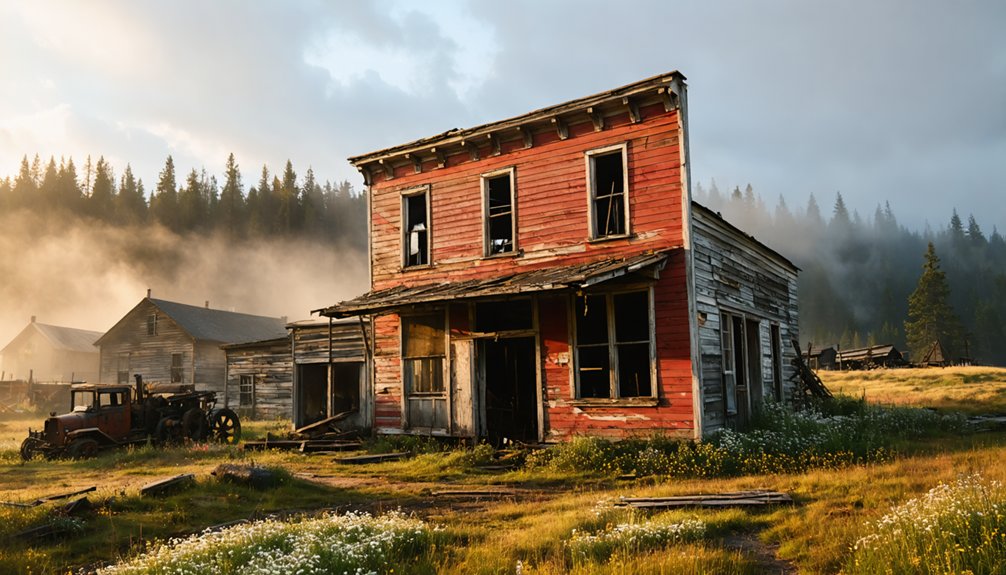
Oregon’s forgotten towns tell stories of boom-and-bust cycles, from gold rush settlements like Sterlingville to communities lost to floods like Vanport and Heppner. You’ll find remarkably preserved structures in Golden, Buncom, and Shaniko, offering glimpses into pioneer life. These ghost towns now serve as living museums and tourism destinations, generating substantial economic benefits for surrounding communities. Explore these haunting relics and you’ll discover the complex narrative of Oregon’s frontier development.
Key Takeaways
- Oregon’s ghost towns like Golden, Buncom, and Shaniko preserve authentic structures from the 1850s gold rush era.
- Mining boomtowns generated $30-60 million in gold before declining due to resource depletion and government policies.
- Natural disasters, including Heppner’s 1903 flood and Vanport’s 1948 destruction, dramatically altered Oregon’s settlement landscape.
- Visitors can explore preserved hotels, jails, and mining equipment while experiencing heritage celebrations like Shaniko Days.
- Ghost town tourism generates substantial economic benefits, contributing to a $196.3 million industry that supports 1,325 jobs statewide.
Mining Boomtowns: The Gold Rush Legacy of Oregon

When gold was discovered in Southern Oregon in the early 1850s, it triggered a transformative wave of migration that would permanently alter the state’s landscape and demographics.
The golden rush of the 1850s forever changed Oregon’s identity, drawing thousands to its untamed wilderness.
As you explore these abandoned settlements, ghostly whispers of the past still echo through decaying structures and rusted mining equipment.
Towns like Sterlingville exploded from wilderness to communities of over 1,000 residents virtually overnight. Auburn and Canyon City followed similar trajectories, with populations swelling into the thousands after gold discoveries in the 1860s.
These settlements began with simple placer mining but evolved as technologies advanced. Sterlingville saw significant revival when hydraulic mining technology advanced in the 1870s, bringing renewed interest to the area. Golden, unlike typical mining towns, was founded by the Ruble family as a community without saloons or brothels.
The mining tales of these boomtowns reveal a complex social fabric—predominantly young males from diverse backgrounds including Chinese miners who often succeeded on claims abandoned by whites.
Despite their brief existence, these towns generated between $30-60 million in gold, permanently shaping Oregon’s development.
Preserved in Time: Ghost Towns With Remaining Structures
Unlike their vanished counterparts throughout Oregon, a handful of historic ghost towns have defied the erosion of time, preserving physical structures that offer tangible connections to the state’s frontier past.
You’ll discover Golden’s four preserved buildings, including a church and combined store/post office that exemplify ghostly architecture from the 1840s gold rush era.
In Buncom, three original structures—bunkhouse, post office, and cookhouse—stand as monuments to historical preservation efforts led by the Buncom Historical Society.
Hardman’s couple dozen structures include a lodge recognized on the National Register of Historic Places.
Meanwhile, Shaniko’s Wild West buildings and rusted pickup trucks attract hundreds of visitors annually.
Sumpter offers the most thorough experience with its gold dredge centerpiece and access to four nearby ghost towns.
These historical sites serve as time capsules revealing how Oregonians lived during boom-and-bust economic periods throughout the state’s development.
Oregon boasts 200 ghost towns, the highest number of any state in America, making it a premier destination for history enthusiasts and adventurous explorers alike.
Washed Away: Towns Lost to Floods and Natural Disasters

While physical remnants of Oregon’s past still stand in places like Golden and Buncom, other historic towns have disappeared entirely beneath raging waters.
Heppner’s catastrophic 1903 flood claimed 247 lives—nearly a quarter of its population—when a 40-foot wall of water surged through with only 15 minutes’ warning. The flood impacts extended beyond physical destruction, as typhoid fever killed 18 more in contaminated downstream communities. Remarkably, citizens of Ione were saved by evacuation warnings that allowed them to escape a similar fate. The area later saw the construction of Willow Creek Dam in 1983 as a preventive measure against future flooding disasters.
The water came without mercy, claiming a quarter of Heppner’s souls in minutes, then lingering as disease in its terrible aftermath.
You’ll find ghostly remnants of Robinette now submerged 100 feet underwater since 1957’s Brownlee Dam construction. The ancient Celilo Village met a similar fate that year, erasing centuries of Indigenous heritage.
In 1948, Vanport—once Oregon’s second-largest city—disappeared in two hours when Columbia River waters breached its protective embankments, displacing 18,000 residents and forever altering Portland’s social landscape.
Timber and Tracks: Abandoned Logging and Railroad Communities
Oregon’s forgotten timber towns tell a compelling story of industrial ambition and eventual abandonment across the state’s densely forested landscape.
You’ll find communities like Maxville, where racial segregation shaped town design, with Black families relegated to areas “across the tracks” despite their essential role in the logging heritage.
Some settlements, including Shevlin and Maxville, were designed to be dismantled and relocated as timber resources depleted—entire buildings transported via railroad connections to fresh cutting grounds.
When Waldport West’s accessible timber vanished by the 1930s, new environmental regulations hastened its decline.
Archaeological discoveries at Maxville reveal how Black families adapted to Oregon life, with century-old kitchen middens containing charred animal bones from local hunting.
These ghost towns highlight the symbiotic relationship between logging operations and railroads.
When companies departed—often during economic downturns like the Great Depression—they left behind abandoned communities that tell a complex tale of industrial efficiency and social stratification.
The abandoned one-room schoolhouse in Waldport West stands as a poignant reminder of the town’s commitment to education even as economic forces drove residents away.
The Rise and Fall: Why Oregon Ghost Towns Were Abandoned
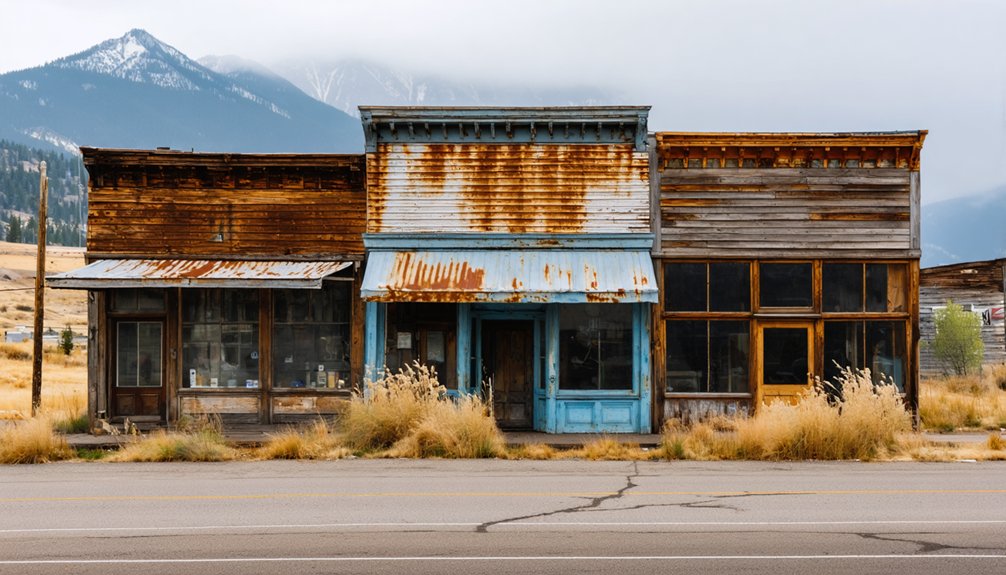
Although once-thriving communities dotted Oregon’s rural landscape, these settlements succumbed to a complex interplay of forces that rendered them uninhabitable or economically unviable.
Resource depletion devastated single-industry towns like Waldport West when timber vanished, while Greenhorn collapsed after government policies outlawed gold mining during WWII.
Transportation changes proved equally devastating—Peak withered when bypassed by new highways, cutting off essential trade.
Environmental impacts, including catastrophic floods that obliterated Champoeg in 1861, permanently altered settlement patterns. The protection of these historic sites now includes verification processes similar to those used in cybersecurity to prevent automated access that could damage remaining structures.
Economic decline accelerated during depressions, compounded by urban migration as residents sought better opportunities elsewhere.
Buena Vista demonstrates how shifts in transportation infrastructure could doom towns, as its prosperity ended when railroads bypassed it in favor of nearby Independence.
Social shifts left aging populations without replacement generations, while transformed labor needs in post-industrial eras made once-bustling communities unsustainable as workers relocated, severing community bonds that had sustained these now-forgotten places.
Hidden Gems: Lesser-Known Ghost Towns Worth Exploring
While Oregon’s well-known ghost towns draw crowds, you’ll discover richer histories in places like Golden, established circa 1840 and now preserved as a State Heritage Site, or the enigmatic Idiotville, born from the Tillamook Burn cleanup efforts.
These forgotten settlements—from McCoy’s old stagecoach stop to Persist’s mining remnants—reveal Oregon’s complex past through their remaining structures, foundations, and the stories preserved by local historical societies.
Exploring the forgotten towns of the Pacific Northwest offers a glimpse into the region’s rich history and diverse cultures. Each location, with its unique tales of pioneers and settlers, contributes to a broader understanding of how the landscape has shaped human experiences. Visitors can uncover hidden gems that tell the story of resilience and innovation in the face of change.
Your exploration of these hidden gems requires varying levels of preparation, as some sites like Golden offer interpretive signage and paved access, while others such as Luper demand high-clearance vehicles and a willingness to venture down remote forest service roads.
Forgotten Stories, Enduring Legacy
Beyond the famous ghost towns that attract thousands of tourists each year, a rich tapestry of lesser-known abandoned settlements dots Oregon’s diverse landscape, each with stories waiting to be unearthed by curious explorers.
These forgotten legacies reveal complex economic and social patterns that shaped Oregon’s development. At Jennyopolis, you’ll encounter the site of Oregon’s first murder, which influenced the state’s legal framework.
Buncom preserves authentic 1850s structures where diverse communities, including Chinese miners, once thrived. In Golden, now a State Heritage Site, ghostly narratives materialize through preserved buildings—alongside synthetic elements like wooden grave markers used in media productions.
As you wander these abandoned towns, you’re walking through living museums where transportation shifts, resource depletion, and government policies converged to write the final chapters of once-vibrant communities.
Trails Less Traveled
Far from the well-trodden tourist paths of Jacksonville and Shaniko, Oregon’s landscape harbors a constellation of lesser-known ghost towns that reward intrepid explorers with authentic glimpses into the state’s frontier past.
You’ll discover Hardman in Morrow County, where abandoned hotels stand as sentinels of a bygone agricultural hub.
Follow ghostly trails to Galena, nestled along the Middle Fork John Day River, where gold mining remnants whisper tales of 1860s prosperity.
Greenhorn, completely abandoned by 2010, offers seven standing structures along hidden paths in eastern Oregon’s mountainous terrain.
In Deschutes County, Millican sits hauntingly empty since a 1988 murder ended its single-resident status.
For those seeking remote exploration, Ashwood in Jefferson County presents building ruins that photographers and history enthusiasts still document, connecting you to one of Oregon’s 80 registered ghost towns.
Whispers From Yesterday
Deep within Oregon’s forgotten landscapes, lesser-known ghost towns harbor untold stories that rival their more famous counterparts.
As you explore Buncom, you’ll discover one of Oregon’s best-preserved sites where Chinese miners established a multicultural community in 1851, leaving behind spectral echoes of silver and cinnabar mining operations.
In northern Oregon, Hardman’s multiple name changes reflect its evolution from bustling travel hub to quiet ghost town.
Meanwhile, Golden’s stone structures—surviving a 1957 brushfire—tell forgotten tales of a mining center that uniquely prohibited saloons amid its churches and orchards.
While Canyon City rebuilt after its 1898 fire, maintaining its role as Grant County’s seat, Sumpter’s opera house and brewery ruins stand as evidence to the boom-and-bust cycle that defined Oregon’s resource-dependent settlements.
Walking Through History: What Visitors Can Experience Today
When you wander through Oregon’s ghost towns today, you’ll discover partially intact hotels, jails, and cabins that offer glimpses into pioneer life through their weathered facades and aging foundations.
You can enhance your historical immersion by timing visits with heritage celebrations like Shaniko Days, where reenactments and artisan demonstrations transform quiet ruins into living portrayals of the Old West.
The mining artifacts trails in towns like Sumpter present preserved equipment and interpretive displays that chronicle the boom-and-bust cycles which shaped these once-thriving communities before their eventual abandonment.
Preserved Building Exploration
Oregon’s forgotten historic towns offer remarkable building exploration opportunities where you’ll encounter authentic 19th century structures preserved in time.
In Buncom, you can examine three original buildings—a bunkhouse, post office, and cookhouse—that showcase Chinese mining heritage from the Gold Rush era.
Golden presents four deteriorating yet historically significant structures, including an 1890s church and general store, all listed on the National Register of Historic Places.
The preserved architecture in Sumpter centers around a historic gold dredge, while nearby ghost towns like Granite and Bourne provide additional exploration sites.
Hardman’s two dozen historic structures include an old lodge of considerable historical significance, while Sherman County offers dispersed ruins across former settlements like Rosebush and Kent, presenting a more fragmented yet fascinating architectural record.
Heritage Festival Experiences
For deeper historical engagement, join guided ghost walks through Albany’s Monteith District or Independence’s “Apparition Avenue,” where community storytelling blends architectural history with local lore.
These seasonal tours, often led by costumed guides, connect you with both the physical and spiritual remnants of Oregon’s past.
Throughout these festivals, artisan markets showcase traditional craftsmanship while musical performances resurrect the authentic sounds that once enlivened these now-quiet streets.
Mining Artifacts Trail
Stepping onto the Mining Artifacts Trail transports you through Oregon’s rich 19th-century mineral rush legacy, where five distinct historical pathways connect once-bustling boomtowns to their silent industrial remains.
You’ll walk reconstructed routes like the Sterling Mine Ditch Trail, showcasing the engineering marvel of a 26-mile water system built in 1887. The artifacts significance becomes tangible as you examine remnants of early mining technology—stamp mills, hydraulic mining ditches, and collapsed fireplaces at tent platforms.
- Weathered pickaxes and shovels scattered near tunnel entrances, rust slowly consuming their once-essential forms
- Wooden boardwalks creaking underfoot as you navigate between reconstructed miner cabins and charcoal pits
- Water-carved channels winding through hillsides, silent monuments to the ingenuity of hydraulic mining operations
From Ghosts to Tourism: The Economic Impact of Historical Preservation
The transformation of Oregon’s ghost towns into vibrant heritage destinations has yielded substantial economic dividends throughout the state. When you visit these once-abandoned settlements, you’re participating in a $196.3 million economic engine that supported 1,325 jobs and generated $55 million in labor income in 2019 alone.
Beyond ghostly encounters at historical sites, your spending ripples through local economies, revitalizing communities that once faced extinction.
In Central Oregon, tourism now represents the region’s largest industry, generating $1.3 billion annually and employing over 10,000 residents. The benefits extend beyond economics—transient room taxes, which reached $14.7 million in Bend during 2023, fund essential services that improve quality of life for locals while preserving the authentic character that drew you there.
Frequently Asked Questions
Can Children Safely Explore Oregon Ghost Towns?
Yes, you can safely explore Oregon’s ghost towns with children if you’re vigilant about child safety. Keep them supervised, wear appropriate footwear, and assess structural hazards before permitting ghost town exploration.
Are There Paranormal Reports or Hauntings in These Abandoned Towns?
You’ll find Oregon’s ghost towns riddled with paranormal reports—ironically, where life departed, stories multiplied. Historical hauntings in Shaniko, Buncom, and Golden attract paranormal investigations despite skepticism about their scientific validity.
What Survival Gear Is Recommended for Visiting Remote Ghost Towns?
You’ll need survival essentials including navigation tools, first aid kit, water purification methods, emergency shelter, and communication devices. Don’t forget weather-appropriate clothing, emergency supplies, and three days’ worth of food rations.
Which Ghost Towns Allow Metal Detecting or Artifact Collection?
You’ll find Granite accessible for metal detecting with proper equipment, but you’re bound by strict artifact preservation ethics and metal detecting regulations. Always secure permission at Buncom through its Historical Society.
Are Any Ghost Towns Accessible for People With Mobility Challenges?
Yes, journey-seekers with varied mobility experiences can explore several ghost towns via accessible routes. You’ll find Mobi-Mats in coastal locations and wheelchair-friendly paths at Painted Hills and Oregon Trail Interpretive Center where mobility aids work effectively.
References
- https://www.travelmedford.org/southern-oregon-ghost-towns-
- https://www.visitoregon.com/oregon-ghost-towns/
- http://www.photographoregon.com/ghost-towns.html
- https://en.wikipedia.org/wiki/List_of_ghost_towns_in_Oregon
- https://www.pdxmonthly.com/travel-and-outdoors/2025/10/oregon-ghost-towns-history
- https://www.youtube.com/watch?v=8HrSsE_MNZ0
- https://traveloregon.com/things-to-do/culture-history/ghost-towns/
- https://www.nationaldaycalendar.com/lists/12-oregon-ghost-towns
- https://www.historynet.com/golden-oregon-ghost-town/
- https://www.oregonencyclopedia.org/articles/sterlingville/