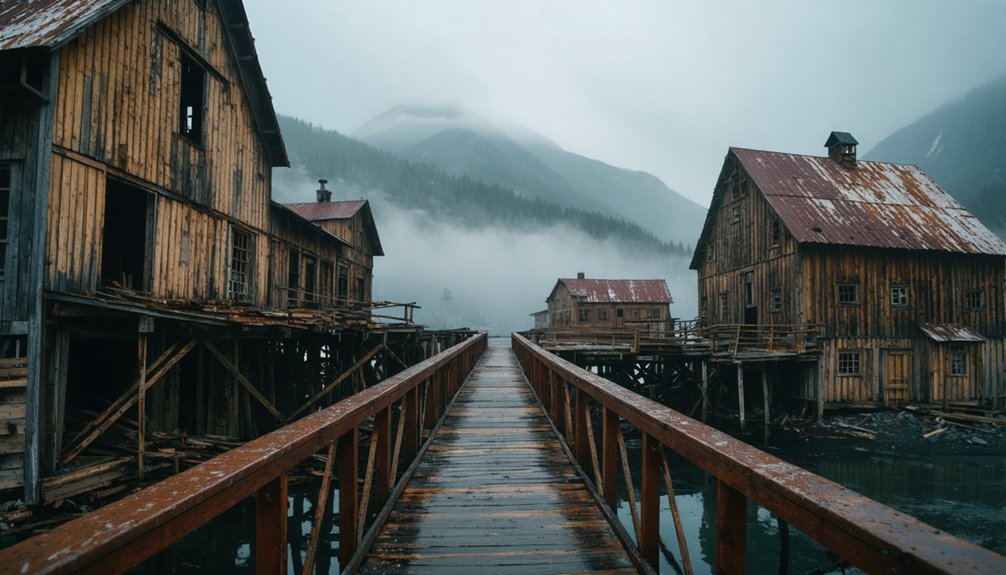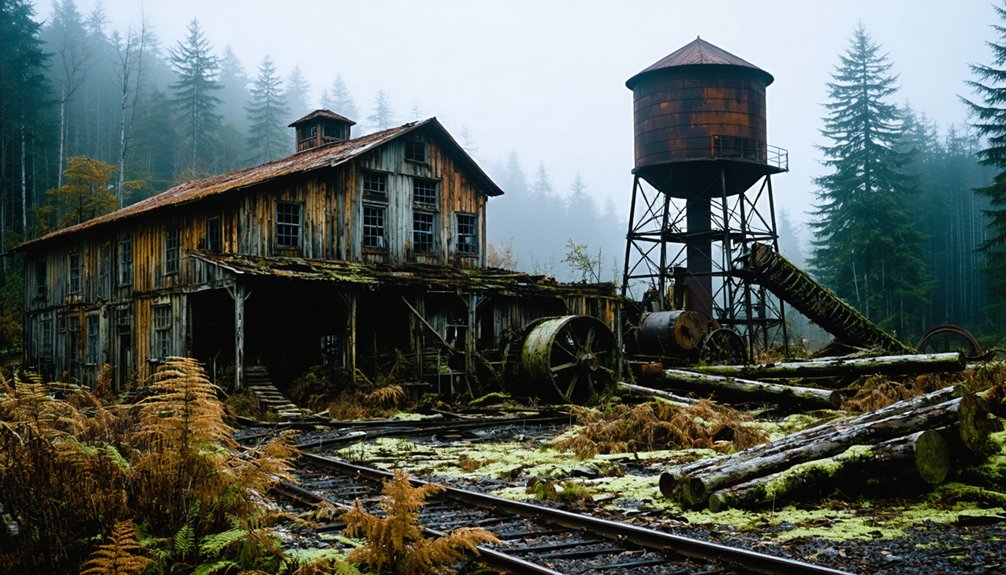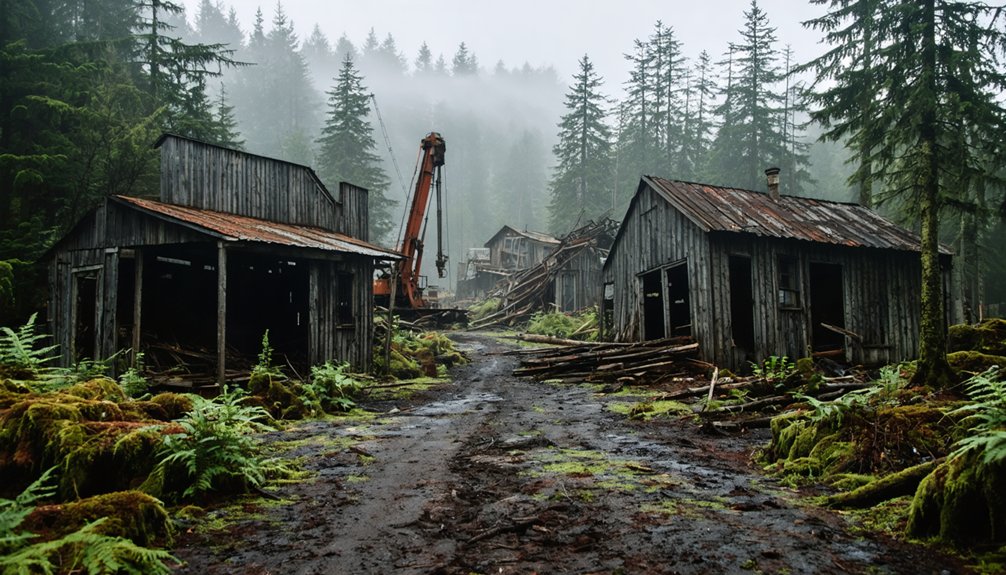
You’ll find hundreds of abandoned logging towns scattered across America’s landscapes, from Deward (Michigan) to Valsetz (Oregon) and Cedar Mills (Washington). These “sawdust ghosts” thrived during the timber boom between the 1880s-1940s before resource depletion forced their abandonment. Louisiana’s company towns, Pennsylvania’s logging camps, and California’s redwood communities now exist only as weathered foundations and overgrown rail beds. Their silent remains tell a fascinating story of boom-and-bust that shaped America’s wilderness.
Key Takeaways
- Deward, Michigan reached 800 residents before being abandoned by 1932 after depleting the region’s virgin white pine.
- Valsetz, Oregon housed over 1,000 residents until 1984 when Boise Cascade demolished the town after timber resources were exhausted.
- Louisiana’s “sawdust ghosts” include Alco, which housed 1,000 residents until its mill closure in 1945.
- Pennsylvania logging camps were abandoned by 1900, leaving a landscape described as “stumps and ashes.”
- California’s forgotten redwood logging towns like Crannell, Falk, and Korbel flourished between the 1880s-1930s before disappearing.
The Lumber Giants of Northern Michigan: Deward and Shelldrake
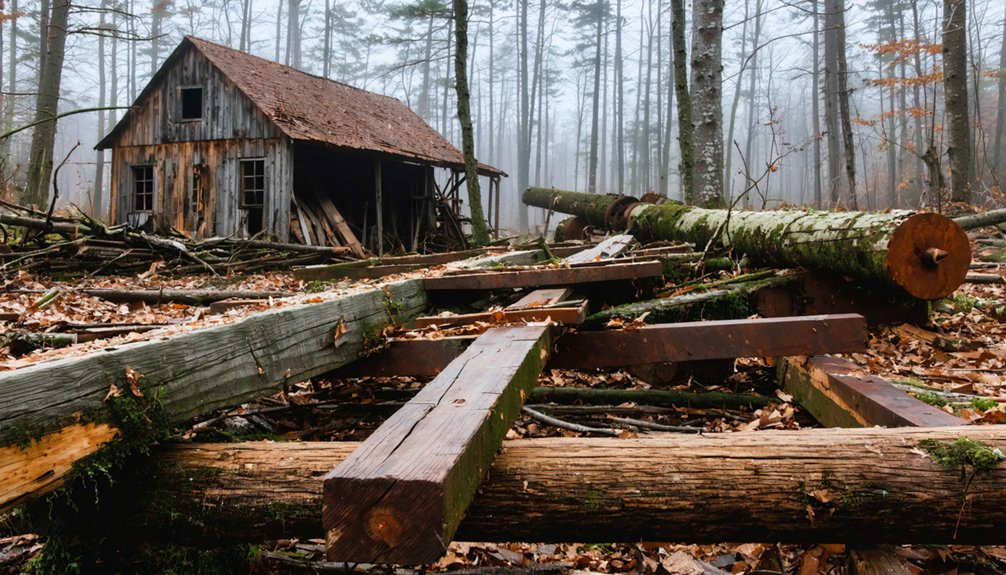
While Michigan’s forested north is often romanticized for its natural beauty, few visitors realize they’re walking through the ghosts of once-thriving industrial communities.
Deward history reveals a quintessential boom-and-bust tale of American industry. Founded in 1900 after Michigan’s “Pine King” David Ward died, this powerhouse operated for just twelve years, harvesting the Lower Peninsula’s final virgin white pine stands.
At its peak, 800 residents supported a massive state-of-the-art mill that ran continuously, shipping nearly half a million board feet of lumber daily via the Detroit & Charlevoix Railroad. The mill utilized high-tech machinery imported from Germany, enabling its impressive production capacity.
The logging impact was profound—transforming 90,000 acres of old-growth forest into stump barrens. By 1912, when the timber was exhausted, Deward rapidly emptied, completely abandoned by 1932.
Ninety thousand acres of ancient forest reduced to stumps. A town thrived, then vanished—erased by its own hunger for timber.
Today’s forests have regrown but haven’t reclaimed their former ecological glory. The town once operated on the banks of the Manistee River, strategically positioned to facilitate timber transportation and processing.
Oregon’s Vanished Timber Empires: Valsetz and Wendling
Unlike Michigan’s ghost towns, Oregon’s vanished timber communities represent a later chapter in America’s logging history.
Valsetz history began in 1919 when the William W. Mitchell Company established it following a 1910 forest fire that created accessible timber stands. They built a 39-mile railroad from Independence to transform transient logging into stable family settlements.
At its peak, Valsetz housed over 1,000 residents with Tudor Revival-style buildings, a man-made lake, and extensive amenities. The town received an astonishing 120 inches of rainfall annually, making it one of the wettest locations on the West Coast. The town’s name derived from combining “Valley & Siletz” railroad names which connected this remote community to the outside world.
When Boise Cascade took ownership in 1959, dwindling old-growth timber forced a shift to plywood production. By 1984, the company bulldozed and burned everything after closure, leaving only concrete foundations where vibrant life once existed.
While the Wendling legacy parallels Valsetz as a company town built around railway access and sawmill operations, both symbolize America’s timber industry boom-and-bust cycle.
The Rise and Fall of Washington’s Cedar Mills
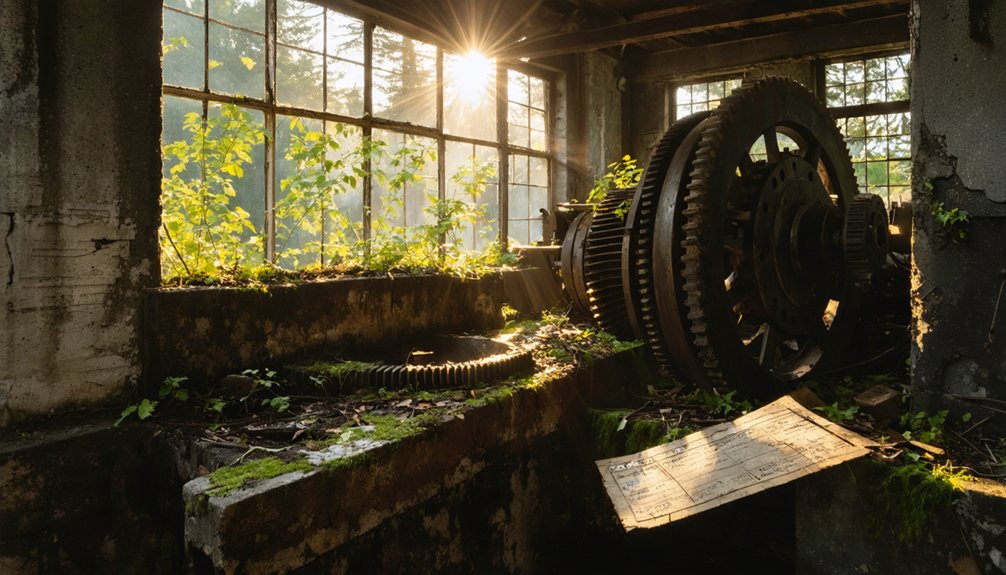
You can still trace the legacy of Cedar Mill’s lumber industry, which sparked the town’s growth around 1855 and flourished until timber depletion forced its closure in 1892.
The abandoned mill’s holding pond transformed into a community recreation site for swimming and fishing, serving as a reminder of the town’s industrial past for nearly five decades.
These patterns of rapid resource exploitation followed by economic contraction mirror the boom-and-bust cycle common to Pacific Northwest logging communities, where initial prosperity gave way to adaptation once accessible timber was exhausted. The mill was originally established where Cornell Road meets 119th, becoming the first organized business in the area. Similar challenges faced the McEwan mill, which became the largest cedar shingle producer in the world before economic difficulties and resource scarcity led to its closure in 1973.
Cedar Town Boom Era
The cedar-rich forests of northeast Washington gave rise to one of America’s most dynamic logging booms in the early 1900s, transforming Cedar Mills from wilderness into a thriving industrial center.
When timber barons like Weyerhaeuser arrived, they revolutionized the local economy using industrial logging techniques that rapidly harvested the region’s prized white pine.
You’ll find Cedar Mills exemplified the timber industry’s boom-and-bust cycle:
- Steam-powered donkey engines and narrow-gauge railways enabled previously impossible harvesting operations.
- Clear-cutting practices depleted virgin forests within a single generation.
- Hundreds of logging camps housed workers who shipped millions of board feet annually.
- Economic vulnerability to market fluctuations and devastating forest fires eventually undermined the town’s stability.
This unrestrained exploitation created temporary prosperity but ultimately sealed Cedar Mills’ fate when resources dwindled. The Wobblies’ labor strikes of 1917 further challenged the logging industry as workers demanded better conditions in the dangerous camps across northeastern Washington. The feudal-like structure of these mill towns gave owners nearly complete authority over workers, creating isolated communities with limited social opportunities for residents.
Abandoned Mill Remnants
Today’s decaying remnants of Washington’s cedar mills tell a sobering story of industrial rise and fall that shaped the Pacific Northwest landscape.
You’ll find these mill relics scattered along waterfronts where they once thrived, victims of frequent fires, economic depressions, and resource depletion.
As you explore these forgotten industrial sites, you’ll notice how machinery was often salvaged and relocated when operations failed.
Tacoma’s waterfront, once known as the lumber capital of the world, housed over 40 operational mills from the 1880s through the early 20th century.
By the 1930s, Seattle’s lumber dominance had waned considerably, with abandoned mill lands repurposed for other development.
Dedicated volunteer groups lead historical preservation efforts at notable sites, maintaining water-powered mechanisms like Pelton wheels and infrastructure such as covered bridges and flumes.
These preserved fragments offer a window into the economic forces that once employed vast portions of Washington’s population before mechanization and market shifts transformed the industry forever.
The original Yesler Mill, established in 1853, marked the beginning of Seattle’s identity as a lumber hub that would transform the region’s economy and landscape.
Sawdust Ghosts: The Abandoned Timber Towns of Louisiana
Deep in the piney woods of Louisiana, forgotten communities known as “sawdust ghosts” stand as silent witnesses to America’s voracious lumber industry between 1880 and 1925.
These company towns—where lumber corporations owned everything from homes to stores—thrived briefly before saw mill closures left them abandoned.
- Alco in Vernon Parish once housed 1,000 residents until its mill closed in 1945, leaving little behind except memories.
- Neame (formerly Keith) remains identifiable only by weathered graveyards and a decayed mill pond.
- Fisher represents rare ghost town preservation, celebrating its logging heritage through annual “Fisher Sawmill Days.”
- Longleaf survived until 1969, allowing more of its structures to remain intact.
When mills closed, residents scattered to find work elsewhere, leaving cemeteries as the most enduring markers of these once-thriving communities.
Pennsylvania’s Silent Logging Camps: Cross Fork to Tionesta
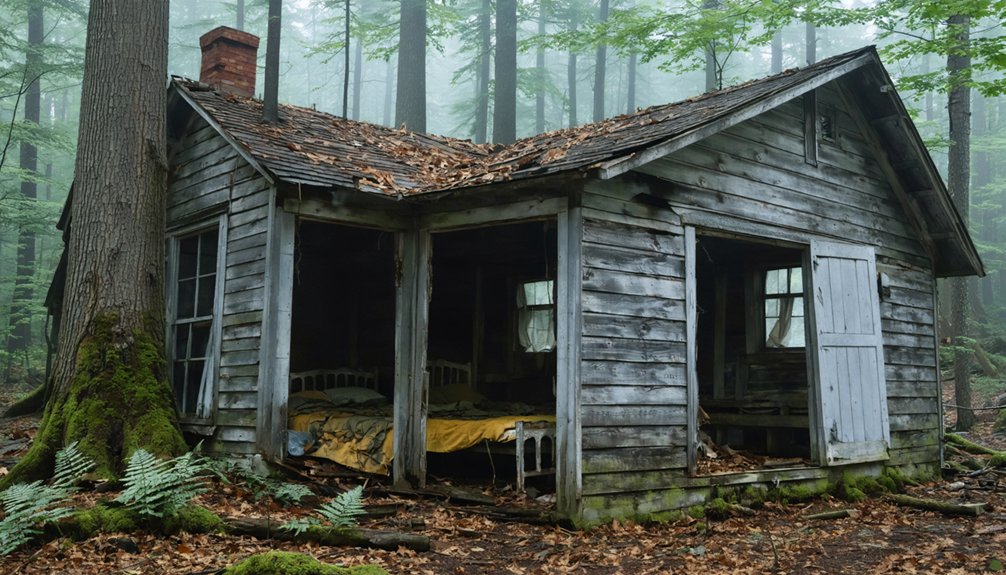
While Louisiana’s timber history largely faded by mid-century, Pennsylvania’s logging boom had already peaked decades earlier, leaving a different kind of ghost town legacy across the state’s northern tier.
From Cross Fork to Tionesta, these ephemeral settlements once buzzed with diverse logging town demographics—immigrants and migrant workers who endured grueling 14-hour workdays fueled by 9,000-calorie diets.
By 1900, the landscape transformed from virgin forest to “stumps and ashes” as narrow-gauge railroads carried away the region’s timber wealth.
When companies abandoned these camps, they left ecological devastation in their wake. You can still find subtle traces—old rail beds, bridge foundations—marking where bustling communities once stood.
What seemed like destruction ultimately spurred ecological restoration as the state purchased depleted lands, initiating modern forestry practices that allowed these silent camps to return to forest.
The Last Stand: California’s Lost Redwood Communities
Among the towering giants of California’s ancient forests, a different kind of ghost now haunts the landscape—forgotten logging towns that once thrived in the heart of redwood country.
Many of these forgotten towns in California have succumbed to nature, their remnants slowly being claimed by the encroaching forest. As visitors traverse the winding trails, they might stumble upon the crumbling structures and rusted relics that tell the stories of lives once lived amidst the towering trees. Each step through these silent spaces offers a glimpse into a past where community and industry once flourished, now reduced to whispers of history.
Amid ancient giants, spectral settlements linger where loggers once carved their living from California’s mighty redwoods.
These lumber communities boomed between the 1880s-1930s, housing immigrant workers from Scandinavia, Ireland, and Nova Scotia who faced extraordinary challenges harvesting these massive trees.
California’s logging legacies include:
- Crannell – Founded 1906, razed in the 1960s after serving as a railroad headquarters
- Falk – Built 1884, abandoned during the Depression in 1937
- Korbel – Established 1895, declined after transportation improved in the 1930s
- Scotia – A rare survivor that adapted when its mill closed
These ghost towns emerged from economic necessity but vanished when accessible timber was depleted.
Their remains stand as silent monuments to the “redwood curtain” that once defined Northern California’s identity.
Frequently Asked Questions
What Tools and Machinery Were Used in These Logging Towns?
You’d find logging towns equipped with crosscut saws, peaveys, steam donkeys, and skidders for harvesting. Sawmill machinery included band saws, edgers, and planers for processing the timber into usable lumber.
How Did Extreme Weather Affect Logging Town Operations?
Blizzards that buried entire towns alive disrupted your logging operations completely. You’d face operational challenges when weather patterns caused flooding, damaged railroads, and isolated communities—limiting timber transport and creating financial strain.
What Indigenous Communities Were Displaced by Logging Operations?
You’ll find that numerous Indigenous communities, including those in the Amazon and North America, faced displacement narratives due to logging operations, while demonstrating cultural resilience despite losing traditional territories and subsistence resources.
How Did Prohibition Impact Social Life in Logging Towns?
During dry times, you’d find speakeasy culture thriving underground in logging towns. Your social gatherings shifted from public saloons to clandestine meetups, deepening community divisions while enforcement struggled against workers’ thirst for freedom.
What Unique Cultural Traditions Emerged in Isolated Logging Communities?
You’d find logging festivals celebrating seasonal work cycles, community celebrations blending religious practices with local folklore, distinctive dialects, specialized work songs, and oral storytelling traditions that preserved knowledge across generations in these isolated settlements.
References
- https://www.geotab.com/ghost-towns/
- https://www.businessinsider.com/life-in-these-american-towns-before-abandoned-2019-5
- https://www.cbsnews.com/pictures/ghost-towns-of-america/
- https://backroadplanet.com/9-ghost-towns-still-standing-in-the-west/
- https://www.christywanders.com/2024/08/top-ghost-towns-for-history-buffs.html
- https://www.youtube.com/watch?v=yeTVfoQxqJc
- https://www.legendsofamerica.com/gt-hiddentales/
- https://www.atlasobscura.com/lists/americas-best-preserved-ghost-towns
- https://en.wikipedia.org/wiki/Lists_of_ghost_towns_in_the_United_States
- https://wildwestcity.com/old-west-ghost-towns/