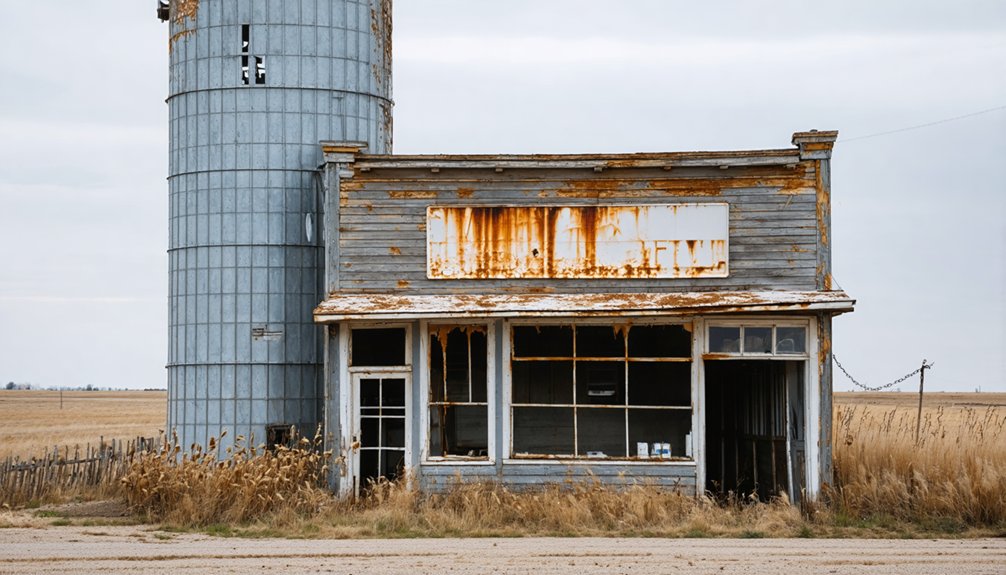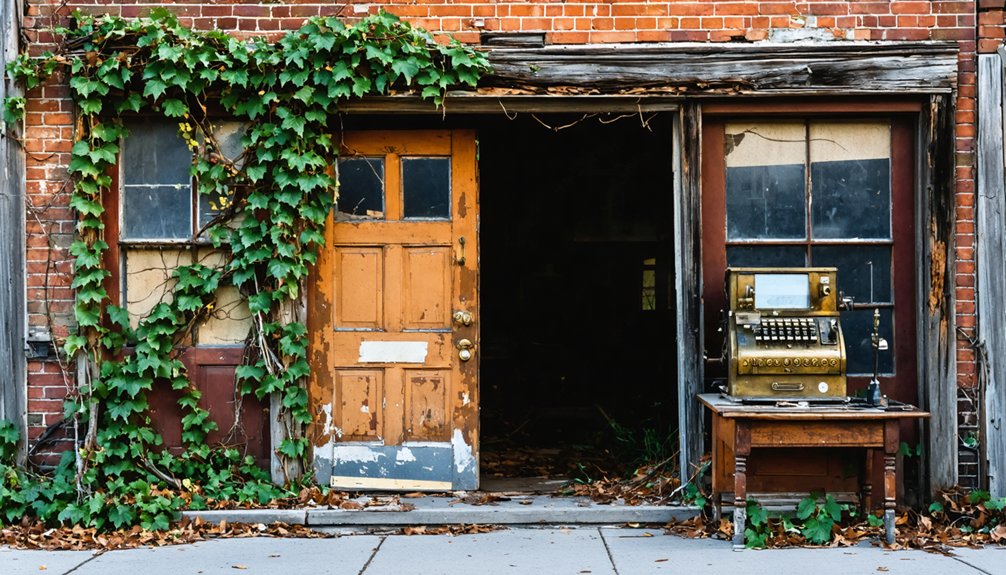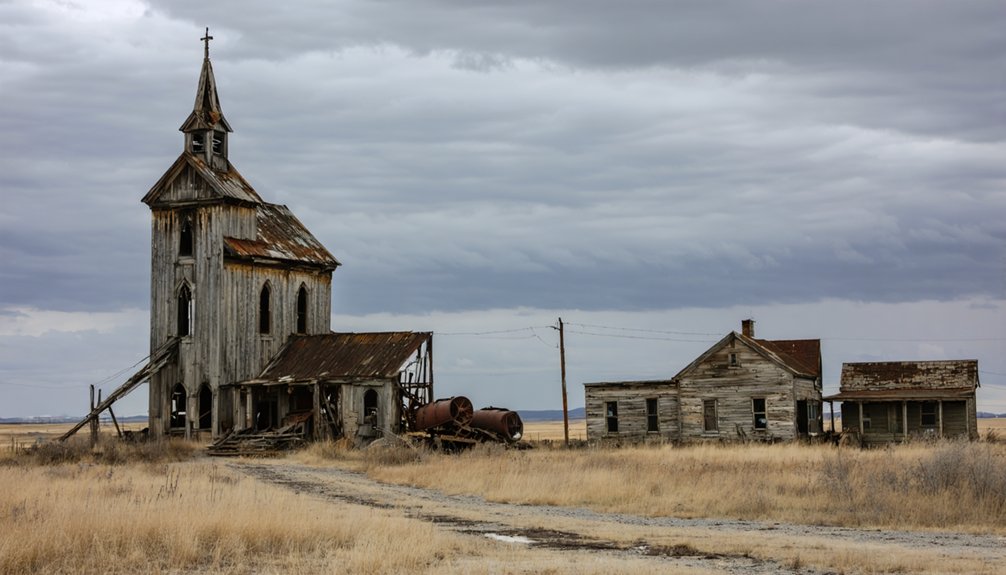
Across the Midwest, you’ll find remnants of once-prosperous mining towns like Ishpeming and Braidwood that boomed in the 19th century before collapsing when resources depleted. These forgotten communities showcase dramatic boom-bust cycles, European immigrant influences, and devastating environmental impacts still visible today. Transportation networks initially fueled their growth but later contributed to their demise. The crumbling structures and abandoned foundations tell complex stories of ambition, prosperity, and ultimate decline that await further exploration.
Key Takeaways
- Ishpeming, Michigan transformed from wilderness to a city of 11,000 residents by the early 1900s through iron mining operations.
- Braidwood, Illinois experienced rapid growth to 2,000 residents by 1873 following coal discoveries before eventual decline.
- New Sweden, Iowa, founded in 1846, became America’s first permanent Swedish settlement built around mining activities.
- The Calumet area in Michigan exemplifies mining communities where immigrant entrepreneurs established lasting commercial centers.
- Many Midwestern mining towns now exist as ghost towns with abandoned structures, mine shafts, and tailings marking their industrial past.
The Copper Kingdom: Keweenaw Peninsula’s Mining Legacy
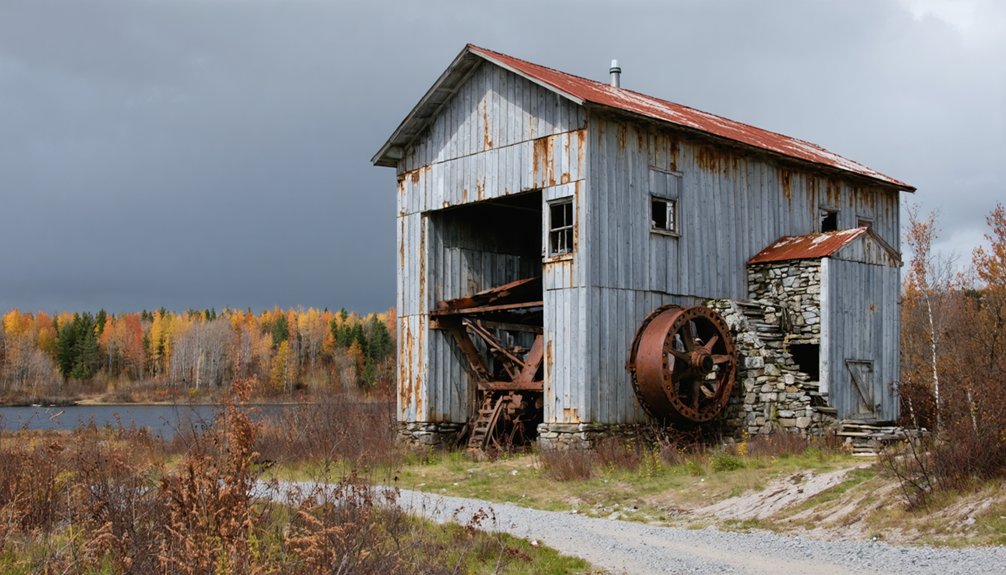
While most Americans associate the nation’s mining heritage with California’s gold rush or Nevada’s silver bonanzas, the Keweenaw Peninsula of Michigan’s Upper Peninsula represents one of America’s most significant yet overlooked mineral regions.
Native mining traditions date back to 5000 BCE, with indigenous peoples crafting copper artifacts millennia before European arrival.
When Douglass Houghton’s 1840 geological survey revealed the peninsula’s vast copper deposits, it triggered America’s first mineral rush.
The region’s subsequent development saw operations like the Cliff Mine and Quincy “Old Reliable” producing 11 billion pounds of native copper. Among these was the Central Mining Company, which was remarkably profitable from inception, unlike most neighboring operations in the Keweenaw.
The copper giants of Keweenaw transformed America’s industrial landscape, their vast output fueling a nation’s growth from underground wealth.
These mines transformed the landscape both physically and culturally, creating boomtowns that flourished until declining ore quality and falling prices led to their abandonment. Today, visitors can explore this rich history through underground tram tours of these historic mines, experiencing firsthand the challenging conditions miners once faced.
Boom and Bust: The Life Cycle of Midwestern Mining Communities
You’ll witness a predictable trajectory in Midwestern mining towns, where the discovery of mineral wealth created explosive growth and overnight millionaires, followed by swift economic collapse once resources depleted or market demand shifted.
These boom-and-bust cycles left behind abandoned company stores, deteriorating mine shafts, and vacant houses—physical remnants of communities that once bustled with thousands of workers.
Ishpeming exemplifies this pattern with its dramatic rise after the Cleveland Iron Mining Co. began operations in 1854, transforming from wilderness to a city of nearly 11,000 residents by the early 1900s.
The architectural skeletons you encounter today—half-collapsed stamp mills, ornate but crumbling opera houses, and weathered headframes—stand as silent indicators of the ephemeral nature of extraction-based prosperity.
Braidwood illustrates how the accidental discovery of coal could instantly change a location’s destiny, with its population swelling to 2,000 by 1873 as immigrants arrived seeking mining work.
Overnight Wealth, Swift Decline
When mineral deposits were discovered across the Midwestern frontier in the late 19th and early 20th centuries, they triggered an economic phenomenon that followed a predictable yet dramatic trajectory.
You’d witness towns like Butte, Montana explode from 45 residents to 41,000 within decades, driven by gold rushes and frantic extraction efforts.
These communities developed economic monocultures, thriving initially when surface deposits yielded overnight riches but faltering once easily accessible minerals depleted.
You could observe wealth creation and infrastructure development happen at breakneck speed, only to collapse with equal velocity when resources ran dry or prices crashed.
The pattern proved devastatingly consistent: hastily constructed towns that flourished briefly would empty almost as quickly, leaving behind abandoned buildings and equipment as silent monuments to capitalism’s boom-bust cycles. The discovery of the Comstock silver in 1859 exemplified this pattern, leading to large-scale underground mining and rapid growth before inevitable decline. This same cycle occurred in Salt Creek, Wyoming, where the population of Midwest soared to 10,000 during the boom only to plummet to fewer than 500 residents after the oil industry’s decline.
Abandoned Dreams, Remnant Structures
As the once-thriving mining communities scattered across the Midwest spiraled from prosperity to abandonment, they left behind physical remnants that tell a story of economic devastation and unfulfilled aspirations.
You’ll find dilapidated houses, exposed mine shafts, and crumbling foundation pilings where thousands once pursued their fortunes.
These abandoned dreams materialize in places like Michigan’s Upper Peninsula, where towns like Central Mine thrived for 44 years before closure in 1898.
The remnant structures—over 110 in Bodie, California—stand as silent witnesses to boom-and-bust cycles.
Some communities have preserved their history by converting old jails into museums, as in Gleeson, Arizona. Towns emptied rapidly when mineral deposits were exhausted, forcing residents to seek opportunities elsewhere. Garnet, Montana exemplifies these preservation efforts with its annual visitor events that connect tourists to the region’s mining heritage.
What began as company towns with schools, churches, and immigrant-filled neighborhoods now exists only as decaying architecture, awaiting rediscovery by those seeking freedom in America’s industrial past.
Immigrant Stories: The Cultural Mosaic of Mining Settlements

The cultural landscape of Midwestern mining settlements transformed dramatically between 1820 and 1930 as waves of European immigrants arrived, creating a rich tapestry of languages, customs, and traditions that forever shaped the region’s identity.
Immigrant waves reshaped Midwestern mining towns, weaving diverse languages and customs into the region’s cultural identity.
You’ll find evidence of immigrant contributions in places like Wisconsin’s lead region, where British and Irish miners established early settlements in the 1820s, and in Iowa’s New Sweden, founded in 1846 as America’s first permanent Swedish settlement.
These communities developed intricate support networks—Swedes pooled earnings to sponsor relatives while wives managed boarding houses that facilitated cultural exchanges. The rich lead mines in southwestern Wisconsin became a powerful magnet that drew settlers from diverse backgrounds, fundamentally altering the demographic makeup of the territory.
In Michigan’s Calumet area, entrepreneurs like Peter Ruppe and Joseph Wertin established general stores that became commercial anchors for the growing mining communities.
Mining operations in the Iron Range eventually attracted forty-three distinct nationality groups, with Eastern Europeans, Finns, and Scandinavians working alongside Jewish merchants and Chinese restaurant owners in a complex social ecosystem that balanced cooperation with preservation of distinct ethnic identities.
Environmental Aftermath: How Mining Shaped the Midwestern Landscape
Mining’s catastrophic environmental legacy across the Midwest remains visible in scarred landscapes that bear little resemblance to their pre-industrial states.
You’ll find once-pristine ecosystems transformed into barren stretches where toxic remnants continue to leach into water systems decades after operations ceased. Despite modern mining regulations, these forgotten towns reveal the inadequacy of early environmental protections.
- Waterways contaminated with copper, mercury, and PCBs extend hundreds of kilometers beyond mine sites
- Abandoned tailings and waste rock cover vast tracts, smothering wildlife habitats and preventing natural regrowth
- Communities near historic operations face ongoing exposure to airborne particulates and groundwater contamination
- Environmental restoration efforts often underestimate centuries-long remediation timelines needed to heal devastated ecosystems
This enduring devastation demonstrates the true cost of resource extraction without accountability.
Beyond Extraction: Transportation Networks That Built and Broke Towns
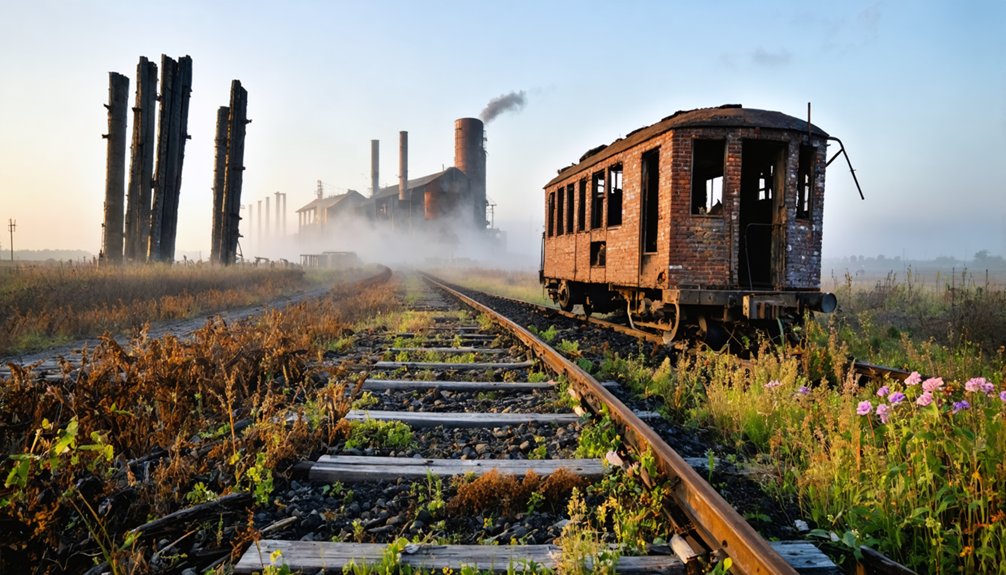
When you examine the forgotten mining towns of the Midwest, you’ll find their rise and fall inextricably linked to transportation networks that once connected these remote communities to broader markets.
As you explore the forgotten towns of the American West, you’ll uncover stories of resilience and innovation that shaped their identities. Many of these communities thrived during the gold rush, only to fade into obscurity when the veins ran dry. However, remnants of their rich history can still be found in the crumbling facades and lonely streets that tell tales of a bygone era.
Rail lines, constructed specifically to serve copper and iron operations, transformed isolated mining camps into thriving urban centers with populations far exceeding their current numbers.
As mining operations eventually declined, these essential transportation arteries—including rail corridors, streetcar systems, and ferry services—were systematically abandoned, accelerating the economic collapse of once-prosperous communities.
Rail-Dependent Mining Economies
Although often overshadowed by the extractive processes themselves, railroad networks functioned as the literal lifelines that determined the fate of Midwestern mining communities throughout the late 19th and early 20th centuries.
Railroad dependency wasn’t merely an economic convenience but the fundamental infrastructure that dictated whether a mining town flourished or failed. You’ll find these rail-dependent mining economies characterized by their symbiotic relationship with transportation systems that extended far beyond mere mining transportation.
- Towns like Thurmond, West Virginia existed almost exclusively as railroad coal shipment hubs for decades.
- Rail service fluctuations directly correlated with mining viability and town prosperity.
- Specialized rail networks with spurs and sidings evolved specifically to accommodate mineral extraction.
- Multiple competing railroad companies sometimes served a single mining district, highlighting transportation’s critical economic importance.
Waterways and Town Decline
While railroads revolutionized mineral transportation across the Midwest, waterways had already established the foundational transportation networks that shaped the region’s earliest extractive economies.
These essential waterways impact became evident as numerous mining towns initially thrived along rivers and canal systems that transported iron ore from open pits to steel centers.
You’ll find that when water transport declined—either through resource depletion or infrastructure shifts—towns experienced dramatic economic shifts.
Communities that once flourished when waterways provided efficient transport for ore and timber suddenly lost their significance.
Many settlements became ghost towns as water-based commerce deteriorated and populations migrated elsewhere.
The environmental toll from mining operations further degraded waterways, compounding the decline.
Towns dependent on water transport systems were particularly vulnerable when canals were abandoned or when rail transportation eventually supplanted the region’s river-based economies.
Ghosts in Plain Sight: Visible Remains of Michigan’s Upper Peninsula Towns
As you traverse the rugged terrain of Michigan’s Upper Peninsula today, you’ll encounter the haunting physical remnants of once-thriving mining communities that have largely faded from public consciousness.
These ghost towns reveal a rich mining heritage through structures that have withstood over a century of abandonment.
The silent sentinels of Michigan’s mining past tell their stories through weathered beams and crumbling stone.
- Deserted houses exceeding 100 years stand alongside broken foundations and scattered rubble
- The 1868 Methodist Episcopal Church remains intact, a symbol of architectural resilience
- Mine shafts, tailings piles, and rock formations mark industrial operations now silent
- Grassy clearings, apple trees, and old cemeteries indicate where vibrant communities once existed
The Cliff Mine Location represents one of the best-preserved 1840s mining sites, while Victoria Copper Mine features hand-hewn log cabins constructed for miners nearly a century ago.
From Minerals to Memories: Preserving the Heritage of Forgotten Mining Sites

The physical remnants of these once-thriving mining communities represent more than mere abandoned structures—they embody a rich cultural heritage that necessitates dedicated preservation efforts.
Mining archaeology efforts along the Iron Ore Heritage Trail now showcase the 160-year history of the Marquette Range, built on the same rail beds that once transported ore to Lake Superior.
You’ll find these preservation sites telling complex stories of immigrant experiences—Cornish, Finnish, Swedish, and Italian workers who shaped distinct cultural enclaves throughout the Upper Midwest.
When you explore these sites, you’re witnessing the tangible remains of boom-and-bust cycles that defined regional economics.
Heritage preservation efforts guarantee that the legacies of these forgotten towns aren’t lost as completely as the minerals that once made them prosperous.
Second Lives: Former Mining Towns That Found New Purpose
Many former mining towns throughout the Midwest have undergone remarkable transformations, emerging from economic collapse to find innovative second lives in diverse sectors.
From rust to renewal, Midwest mining towns have reimagined their futures through bold economic diversification.
You’ll discover how these communities have leveraged their industrial pasts while embracing future opportunities through renewable shifts and agricultural innovation.
- Centralia, Washington secured a $55 million coal shift fund, supporting energy efficiency upgrades and establishing a local energy generation technology fund.
- Hershshaw Farms in West Virginia repurposed abandoned coal caverns for mushroom cultivation, creating sustainable food production and new employment.
- Detroit converted its abandoned rail depot into Ford’s mobility innovation center, while Milwaukee transformed empty factories into affordable housing.
- Grand Rapids implemented long-term civic-business partnerships that successfully diversified their economy beyond traditional manufacturing.
Frequently Asked Questions
How Did Mining Towns Handle Healthcare During Disease Outbreaks?
You’d find disease management severely limited with rudimentary quarantine practices, understaffed infirmaries, and minimal healthcare access, relying on company doctors who prioritized traumatic injuries over infectious disease prevention and treatment.
What Recreational Activities Existed in These Isolated Mining Communities?
You’d find hiking trails following old rail beds, community festivals featuring logging competitions, underground mine tours, fishing in pit lakes, and seasonal activities like snowmobiling across reclaimed mining landscapes.
How Were Women’s Roles Defined in Midwestern Mining Towns?
Like silent pillars holding up a weathered house, you’d find women’s work centered on domestic duties, economic contributions as laundresses and shopkeepers, while providing essential community support through organizing social networks and activism.
Did Mining Towns Have Unique Architectural Styles or Construction Methods?
Yes, you’ll find mining towns developed distinctive “Boomtown Style” architecture with flat-roofed wooden structures featuring decorative façades. Their construction techniques utilized local materials like mine rock for foundations, maximizing both space and profitability.
What Happened to the Mining Equipment After Towns Were Abandoned?
Like iron giants frozen in time, abandoned machinery faced four fates: deterioration from exposure, scrap metal salvage, repurposing for other industries, or occasional historical preservation as educational artifacts of mining’s legacy.
References
- https://www.geotab.com/ghost-towns/
- https://www.nps.gov/slbe/learn/historyculture/ghosttowns.htm
- https://www.visitkeweenaw.com/blog/post/our-top-7-keweenaw-ghost-towns-to-explore/
- https://www.youtube.com/watch?v=7-vjuqiGWJU
- https://visitnebraska.com/trip-idea/explore-7-authentic-ghost-towns-nebraska
- https://battlegroundhistory.com/american-midwest/
- https://www.michigan.org/article/three-abandoned-mining-towns
- https://en.wikipedia.org/wiki/Lists_of_ghost_towns_in_the_United_States
- https://www.keweenawhistory.org/Central-Mining-Co
- https://www.nps.gov/kewe/learn/historyculture/copper-mining-timeline.htm