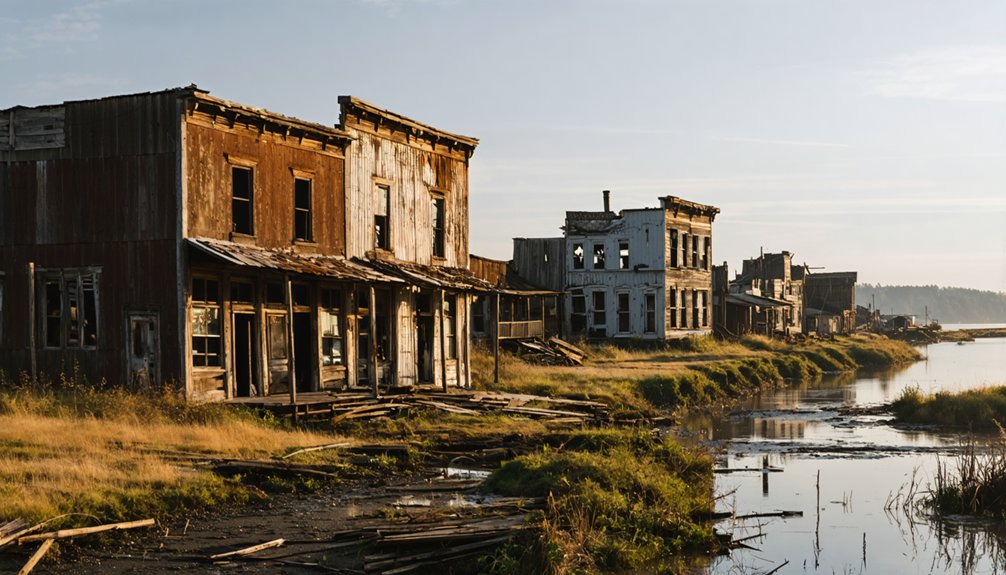
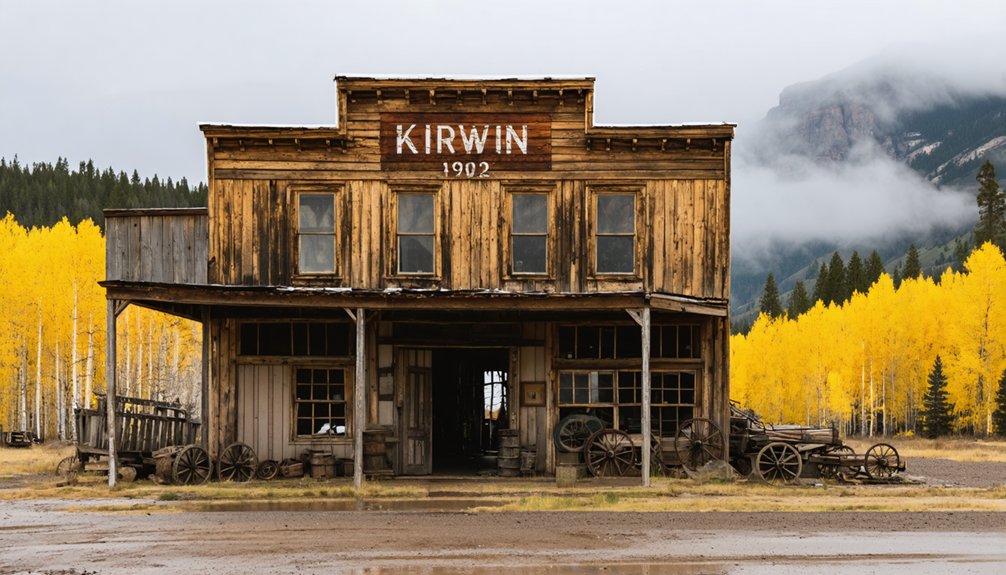
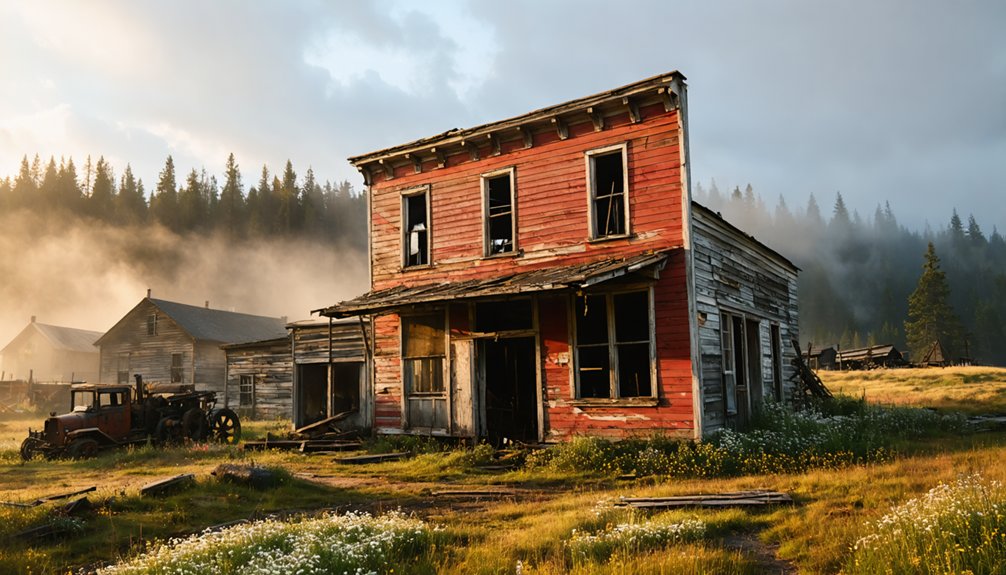
You’ll find dozens of abandoned mining settlements scattered across the Pacific Northwest, victims of resource depletion and economic shifts. Once-bustling towns like Molson, Liberty, and Melmont now exist as weathered ruins and stone foundations. These ghost towns experienced dramatic boom-bust cycles between 1880-1930, leaving behind architectural remnants, environmental scars, and multicultural heritage. Proper preparation is essential for visiting these remote historical sites where the region’s resource-driven past awaits your discovery.
Key Takeaways
- Gold Rush discoveries like the Poland China Mine in 1896 transformed sparsely populated regions into booming communities like Molson, Washington.
- Most Pacific Northwest mining towns followed a boom-bust cycle, eventually collapsing when resources depleted or markets shifted away from coal.
- Abandoned mining operations left environmental legacies including acid drainage and heavy metal contamination in waterways throughout the region.
- Liberty and Nighthawk feature preserved vernacular mining architecture, including historically recognized buildings available for public exploration.
- Many forgotten mining towns require careful planning to visit, with some requiring high-clearance vehicles or hiking through challenging terrain.
The Gold Rush Fever That Built Molson, Washington
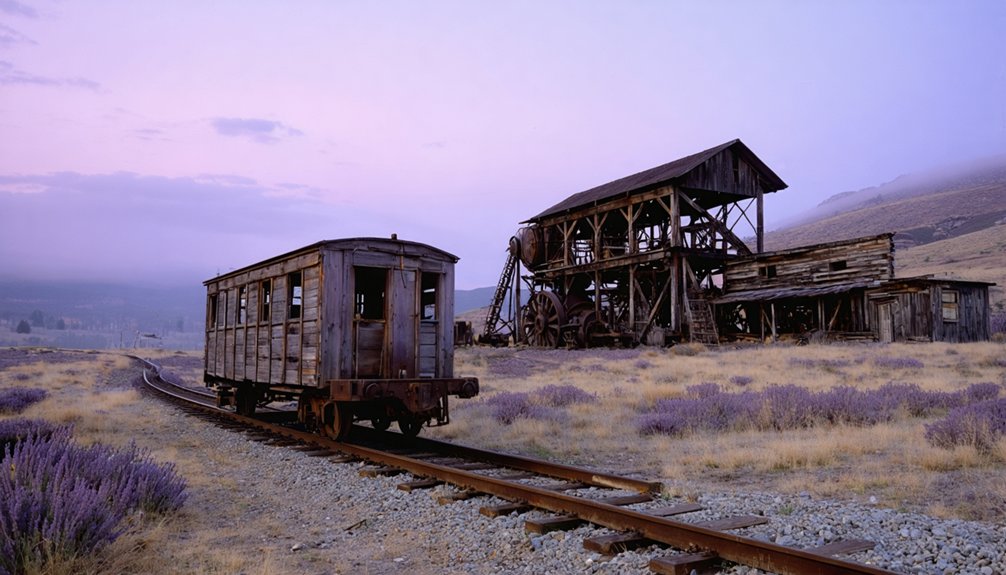
When gold-rich ore was discovered in Washington’s Okanogan Highlands in 1896, it transformed a sparsely populated border region into a bustling frontier town.
You’ll find the roots of Molson’s mining heritage in the Poland China Mine, staked by Neal Undem and J.M. Henkins on May 22, 1896.
This critical discovery sparked the area’s gold rush, drawing hundreds of fortune-seekers to a place previously inhabited by just a dozen souls.
The town was officially founded in 1900 by John Molson during Washington’s gold rush with an initial investment equivalent to millions in today’s currency.
Within a short time, the town emerged as a vital trading center for families living on both sides of the American-Canadian border.
Liberty and Nighthawk: Tales of Boom and Bust
You’ll find Liberty, Washington’s oldest mining townsite, distinguished by its exceptional crystalline gold deposits that once drew hundreds of miners while maintaining an unusually stable community structure compared to typical boomtowns.
Unlike many abandoned mining settlements, Liberty evolved into a “living ghost town” where some residents continue mining operations to this day. Liberty’s high elevation of 2,674 feet contributed to its isolation and preservation of mining heritage through the decades.
The town’s resilience through economic cycles of prosperity and decline offers a unique window into how mining infrastructure, from early placer operations to later hydraulic and dredging systems, shaped Washington’s territorial economy while leaving architectural remnants that document the region’s rich extractive heritage. Originally organized in 1873, the Swauk Mining District centered in Liberty stands as the oldest organized mining district in Washington state.
Rich Mining Heritage
Beneath the forested slopes of the Cascades and the rugged terrain of Okanogan County lie two remarkable chapters in Washington’s mining saga: Liberty and Nighthawk.
Liberty’s fame stems from its crystalline wire gold specimens—rare formations shaped like tangled wires—that captured attention at the 1890s Chicago World’s Fair. Mining techniques evolved here from simple panning to more advanced gold extraction methods that yielded significant strikes: Tweet’s 1891 discovery, Ollie Jordin’s $80,000 haul in 1932, and Clarence’s $40,000 find in 1959. The town’s name reflects the ordered liberty concept that balanced individual rights with communal regulations in early mining settlements. Similar to Liberty, Cle Elum’s history was shaped by a significant gold rush following Benton Goodwin’s discovery of gold in 1873.
Meanwhile, Nighthawk’s six concentration mills once processed ore from numerous claims across Okanogan County. Both towns preserve authentic mining heritage through surviving structures and equipment.
While Nighthawk maintains its ghost town status, Liberty secured its future through a 1980 Congressional act allowing residents to purchase land, safeguarding this living symbol of America’s mining frontier.
Infrastructural Decline Patterns
The arc of infrastructural development in Liberty and Nighthawk follows a classic boom-and-bust trajectory evident in mining settlements throughout the American West.
You’ll recognize this pattern in both towns’ parallel experiences of rapid infrastructure investment followed by community decline.
This cycle manifested through:
- Initial boom-period construction (roads, rail connections, public buildings)
- Gradual withdrawal of capital as resource extraction became less profitable
- Physical deterioration of structures through abandonment and neglect
- Dissolution of social frameworks as populations departed
The railroad’s strategic decision to bypass Liberty accelerated its decline, while Nighthawk’s fate was sealed when rising operational costs made mining unprofitable. Liberty’s original settlement at the convergence of creeks proved significant for early mining success before the town was later renamed. Liberty was initially established as Williams Creek in 1850 before being renamed Meaghersville after Thomas Meagher discovered gold.
Today, remaining structures stand as weathered artifacts—physical testimony to the transient nature of extraction-based economies and the freedom sought by those who built them.
Preserved Historical Architecture
Unlike the deteriorating infrastructure that marks their decline, Liberty and Nighthawk‘s preserved architectural remnants offer tangible connections to Washington’s gold mining past.
In Liberty, you’ll find the state’s oldest gold mining townsite, established after 1873 discoveries along Swauk Creek. The district showcases vernacular mining architecture through modest structures built primarily for shelter. The town features five historically recognized buildings that visitors can explore during their journey through this preserved mining settlement.
The Assay Office exemplifies architectural significance with its vertical board and batten siding and steep tar paper roof—originally serving miners for ore testing before converting to residential use. Other notable buildings include the relocated 1890s log house and two-story hotel.
Liberty’s remarkable architectural preservation stems from unusual community stability spanning three generations, allowing structures to remain largely intact despite mining’s decline—a reflection of historic preservation efforts maintaining these symbols of mining frontier life.
Technology and Infrastructure Challenges in Early Mine Operations
While pioneering mining settlements established operations across rugged frontiers, they faced persistent technological and infrastructure deficiencies that markedly hindered efficient extraction and processing.
These technology gaps necessitated substantial workforce retraining as operations shifted from coal to hardrock mineral extraction.
You’ll recognize four fundamental challenges these operations encountered:
- Inadequate specialized equipment designed specifically for critical mineral extraction
- Primitive water management systems prone to contamination events and tailings pond failures
- Transportation networks ill-equipped for distributing processed minerals to market
- Insufficient power generation infrastructure to meet the substantial energy requirements of processing facilities
The isolation of these settlements compounded these difficulties, as equipment deliveries might take months to arrive across treacherous mountain passes, forcing miners to improvise with locally available materials.
These historical challenges mirror contemporary issues where permitting processes continue to hinder new and existing mining operations across the country.
The Brief Lifespan of Coal Town Melmont
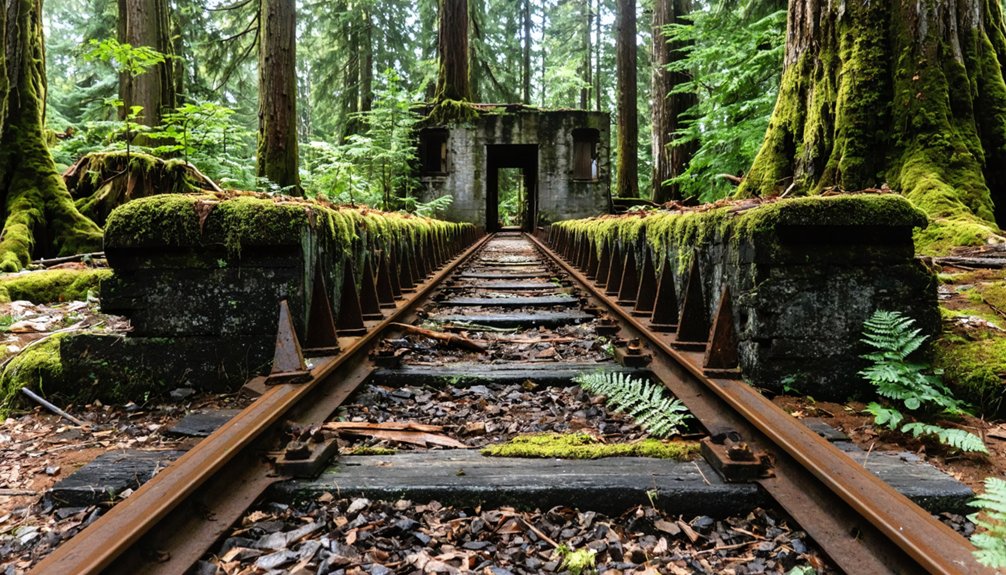
Founded in 1900 by the Northwest Improvement Company, Melmont exemplifies the ephemeral nature of single-resource settlements that once dotted America’s frontier landscapes.
This Northern Pacific Railway subsidiary established the town to extract high-grade blacksmith coal, producing nearly 900,000 tons during its brief 16-year operation.
Melmont’s history reflects the stark reality of resource-dependent economies. You’d have found a self-contained community with a school, hotel, store, and saloon—all serving the mining operation.
When Northern Pacific shifted from coal to diesel power around 1918, Melmont’s purpose vanished. Economic forces ruthlessly determined the town’s fate, as coal prices dropped amid competition from emerging energy sources.
Today, only stone foundations and remnants remain, silent testimonies to a bygone coal mining era.
Why Mining Towns Were Abandoned: Economic Factors
You’ll find that mining towns typically followed a predictable boom-bust cycle, where initial resource discovery sparked rapid development followed by eventual decline.
Transportation innovations, including railroads and improved highways, transformed once-isolated communities into obsolete waypoints as resources could be shipped more efficiently from centralized facilities.
The ultimate death knell for most mining settlements came when mineral deposits reached exhaustion or became too costly to extract, leaving communities without their economic foundation and unable to pivot toward sustainable alternatives.
Boom-Bust Resource Cycles
Mining towns across the Pacific Northwest experienced devastating boom-and-bust cycles that ultimately led to their abandonment as economic forces proved relentlessly unsustainable.
You’ll find these socioeconomic impacts created insurmountable challenges that overwhelmed community resilience efforts:
- Market saturation drove coal prices from $28 per ton in the 1880s to unsustainable lows, with San Francisco exports plummeting from 85% to 35% by 1890.
- Accessible ore depletion required increasingly expensive extraction methods, as Newcastle’s once-profitable 100-ton daily output became economically unviable.
- Critical markets evaporated when railroads abandoned coal fuel and San Francisco developed alternative energy sources.
- Corporate withdrawals, exemplified by Pacific Coast Coal Company’s 1929 departure from Newcastle, triggered the collapse of entire communities built around single-industry economies.
Transportation Technology Shifts
While often overlooked in historical accounts, transportation innovations played a decisive role in both the rise and eventual abandonment of Pacific Northwest mining towns.
The transportation evolution progressed from primitive wooden tramways and barge networks ($5/ton) to steam locomotives by the 1870s, dramatically increasing daily coal movement to 100 tons.
When transcontinental railroads arrived in the 1880s, they initially fueled mining prosperity by connecting to national markets.
Yet these same rail networks eventually enabled the demise of local operations.
As tracks expanded from 3,673 miles in 1906 to over 6,000 by 1948, logistical challenges for remote towns intensified.
Suddenly, cheaper Wyoming and Montana coal could economically reach Puget Sound markets.
When railroads realigned routes or diesel locomotives reduced coal demand, towns lacking strategic transport positioning quickly faded into obscurity.
Mineral Depletion Effects
When natural resources vanish, so too does the economic foundation of communities built upon them. Across the Pacific Northwest, once-thriving mining communities experienced devastating economic collapse as mineral deposits disappeared, revealing the fragile nature of extraction-based economies.
Mining towns lacked economic resilience primarily due to:
- Severe employment drops – Grant County lost nearly two-thirds of mining jobs between 1981-2001
- Income growth approximately 25% slower than non-mining regions during 1980-2000
- Geographic isolation that hindered community adaptation and economic diversification
- Declining tax revenues that crippled public services and infrastructure
Without alternative industries to absorb displaced workers, these towns faced persistent poverty, population exodus, and investment hesitancy.
The communities that survived typically possessed more diversified economies that could withstand the inevitable bust when minerals were depleted.
Preserved Relics: What Remains Today
Across the forgotten landscapes of the Pacific Northwest, physical remnants of once-thriving mining communities continue to tell stories of industrial ambition and human perseverance.
You’ll find partially collapsed mine portals revealing timber supports and ventilation shafts within, while hand-forged hooks, pneumatic drill halves, and fuse bundles demonstrate the artifacts’ significance in understanding historic mining technology. Rail system remnants and ventilation pipes speak to the ingenuity of early engineers.
In towns like Nighthawk and Liberty, original structures—hotels, schoolhouses, mills—stand as evidence of boom-era prosperity.
These preserved buildings, alongside personal artifacts and community infrastructure like furnaces and company stores, offer unfiltered access to a vanished way of life.
Walking former mining routes, you’ll discover foundations and ruins that liberate these forgotten histories from obscurity.
Environmental Impact of Abandoned Mining Operations
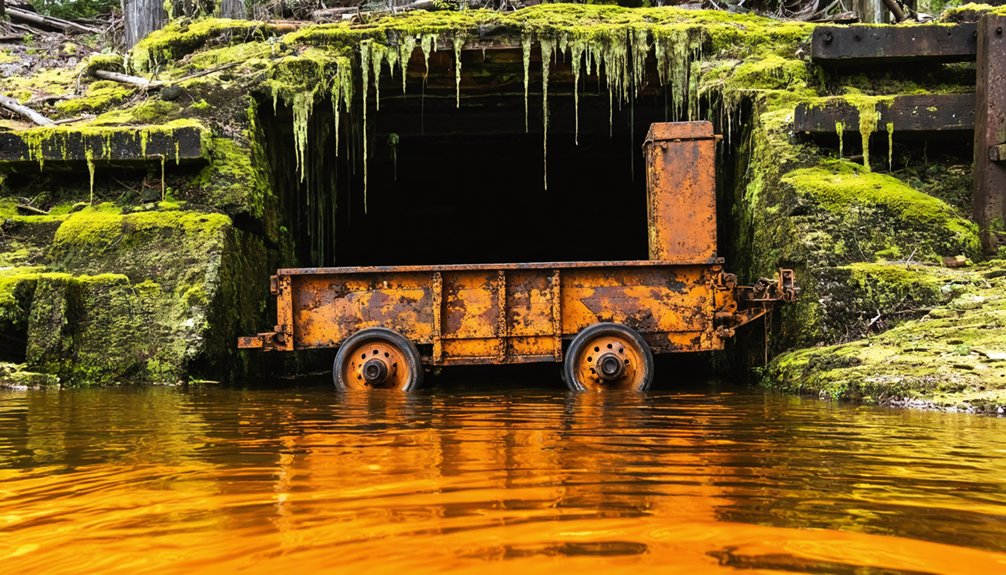
Beneath the nostalgic allure of abandoned mining towns lies a troubling environmental legacy that continues to affect ecosystems throughout the Pacific Northwest.
These sites silently discharge acid mine drainage and heavy metals into waterways, creating far-reaching consequences beyond their weathered structures.
When you explore these historic areas, you’re witnessing the tension between mining’s economic past and environmental restoration’s future challenges:
- Toxic heavy metals contaminate groundwater and soil, traveling miles downstream from original sources.
- Unstable slopes and abandoned shafts create physical dangers requiring modern mining regulations.
- Over 500,000 abandoned mines exist nationwide, with significant concentrations in Idaho, Oregon, and Washington.
- Remediation efforts face complex obstacles despite successful projects demonstrating recovery potential.
These environmental wounds represent the true cost of the region’s mineral wealth.
The Cultural Legacy of Pacific Northwest Mining Communities
Beyond the environmental impact of abandoned mines lies the rich tapestry of human experiences that shaped the Pacific Northwest’s cultural identity.
You’ll find these towns were crucibles of cultural fusion, where African Americans, immigrants, and Indigenous peoples converged, creating unique multicultural bonds through shared hardships in isolated environments.
Mining communities fostered distinctive cultural preservation through occupational folklore, music, and culinary traditions that blended diverse ethnic backgrounds. Their community resilience manifested in social institutions like saloons and churches, while temporary cabins and wooden structures defined their architectural landscape.
Today, collections of artifacts, photographs, and oral histories protect these legacies that mainstream narratives often overlook. The stories of these multicultural mining towns—built on Indigenous homelands—continue to influence the cultural landscape long after the mining booms ended.
Exploring Off the Beaten Path: How to Visit These Historic Sites

The journey to discover Pacific Northwest ghost towns requires careful planning and a spirit of adventure, as these weathered remnants of mining history often hide in challenging terrain.
Venturing further, many thrill-seekers choose to explore abandoned towns in California, where relics of the Gold Rush era whisper tales of prosperity and struggle. Each town presents a unique glimpse into the past, inviting intrepid explorers to uncover its hidden stories. The stark beauty of the California landscape adds an extra layer of intrigue to these forgotten places.
Ghost town exploration demands preparation, as most sites lack modern amenities and cell service.
For successful historical immersion, prioritize these essentials:
- Transportation strategy – Assess whether high-clearance vehicles or hiking boots are needed, as access varies from established trails like Monte Cristo’s 8-mile route to remote roads requiring four-wheel drive.
- Safety provisions – Carry ample water, food, first aid supplies, and weather-appropriate attire.
- Navigation tools – Obtain detailed maps from land management agencies or visitor centers.
- Documentation equipment – Bring cameras to record architectural remnants and artifacts that evidence the region’s mining legacy.
Frequently Asked Questions
Did Ghost Towns Ever Experience Revivals After Initial Abandonment?
Yes, ghost towns revived through heritage tourism and economic booms. You’ll find abandoned settlements reborn through seasonal migrations of tourists and small-scale mining continuations, preserving historical artifacts while enabling newfound freedom.
How Did Indigenous Communities Interact With Mining Settlements?
You’ll find indigenous communities engaged in complex relationships with mining settlements, balancing cultural exchanges and resource sharing while simultaneously resisting displacement, defending ancestral lands, and adapting traditional practices amid colonial disruption.
What Happened to Children’s Education in These Temporary Communities?
You’ll find children received inconsistent education through company-built school infrastructure and temporary teachers. When mines closed, these educational systems collapsed entirely or transformed into adult programming, disrupting generational learning in these transient settlements.
How Did Women’s Roles Differ in Mining Towns?
You’d find women’s labor extending from entrepreneurship to prostitution, while their social structures maintained communities through establishing schools, churches, and support networks that transformed camps from male outposts into settled societies.
Were There International Influences on Pacific Northwest Mining Communities?
Yes, you’ll find substantial international influences through cultural exchange between immigrant labor groups, including Black, Scandinavian, and European workers, alongside radical labor ideologies imported from global anarchist and socialist movements.
References
- https://www.islands.com/1988063/washington-off-radar-abandoned-mining-ghost-town-molson-free-visit-history/
- https://stateofwatourism.com/ghost-towns-of-washington-state/
- https://www.rvoutwest.com/episodes/13-ghost-towns-across-the-pacific-northwest
- http://pnwphotoblog.com/ghost-towns/
- https://www.youtube.com/watch?v=gdnGoH9Xb74
- https://en.wikipedia.org/wiki/List_of_ghost_towns_in_Washington
- https://molsonmuseums.org/history/
- https://www.youtube.com/watch?v=2Saj0oIS4tc
- https://westernmininghistory.com/towns/washington/molson/
- http://www.ghosttownsusa.com/bttales27.htm