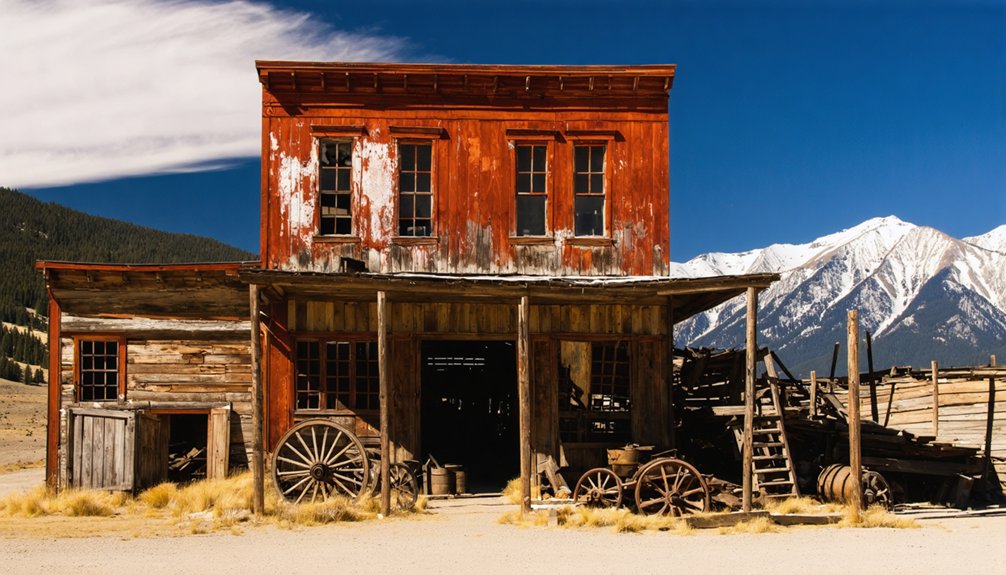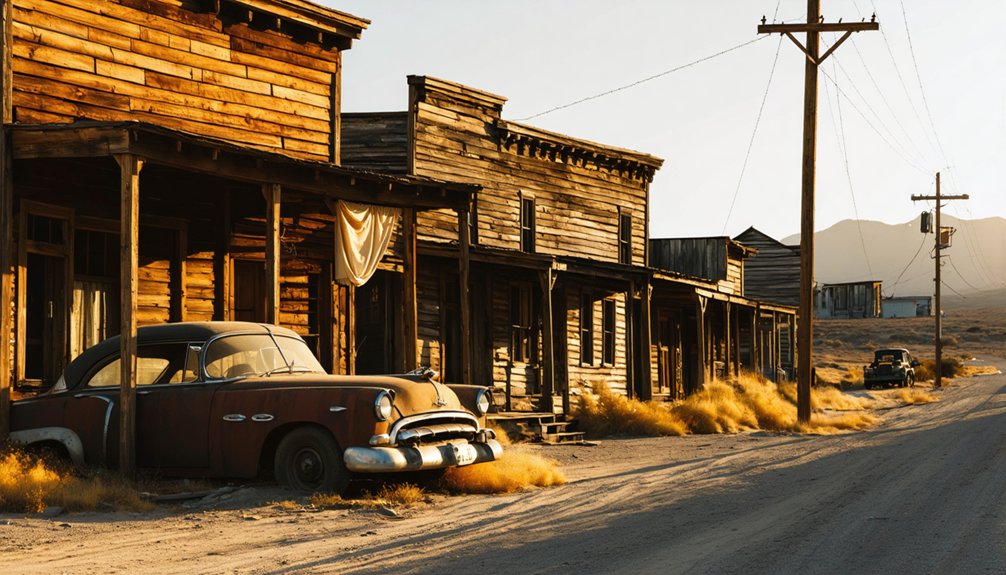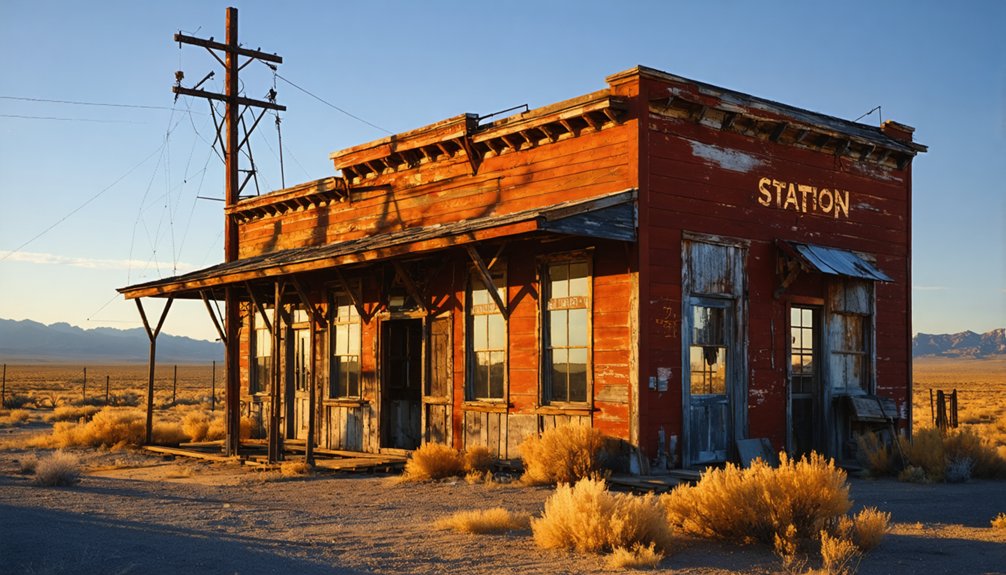
You’ll find America’s forgotten railroad towns scattered across the Western frontier—silent reminders of the 1889 Land Rush and 1862 Pacific Railroad Act. These once-bustling communities like Desert Springs and Alma sprang up around central depots and iconic grain elevators, transforming prairie into commercial hubs. Today, weathered foundations and abandoned rail beds tell stories of communities that lived by the train’s rhythm. Their preserved relics offer glimpses into a vanished era of Western development.
Key Takeaways
- Abandoned railroad towns like Desert Springs (Utah) and Alma (California) once thrived as transport hubs before being deserted.
- Ghost towns with preserved railroad infrastructure serve as historical windows into early 20th-century western expansion.
- These forgotten communities often feature weathered timbers, rusted rails, and abandoned depots that tell stories of past prosperity.
- Some ghost towns like Virginia City have been transformed into living museums showcasing America’s railroad heritage.
- Railroad towns declined when new transportation methods emerged or when rail companies changed routes, leaving communities isolated.
The Birth of Western Railroad Towns During the Great Land Runs
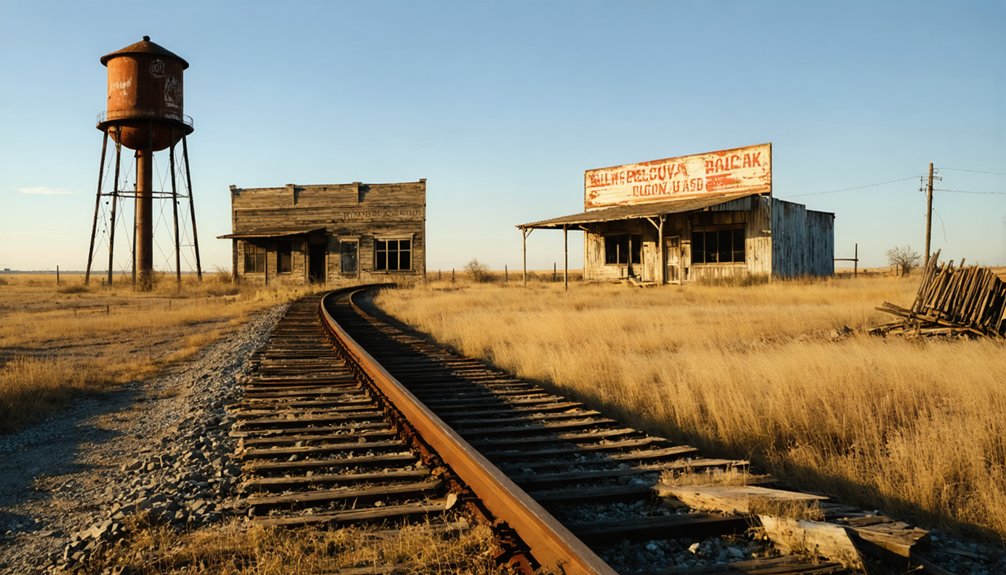
As the nineteenth century neared its close, the American West witnessed an unprecedented marriage of transportation technology and settlement patterns during the Great Land Runs.
You would have seen history unfolding before your eyes as the Santa Fe Railroad‘s completion in 1886-87 directly enabled the 1889 Land Rush. Rail stations at Guthrie, Edmond, Oklahoma City, Verbeck, and Norman became instant townsites, transforming empty prairie into bustling settlements overnight.
When “boomer trains” arrived at these destinations, they resembled “giant centipedes” with settlers clinging to every available surface.
These railroad connections determined the geography of opportunity—by day’s end, towns like Guthrie and Oklahoma City each housed 10,000 souls. The railroad didn’t merely transport settlers; it created the framework for civilization itself, establishing the urban blueprint that would define the territory’s future. The rush attracted diverse participants including farmers, tradesmen, and ambitious politicians seeking new opportunities in what was considered some of the best unoccupied public land in America. Following President Benjamin Harrison’s proclamation on March 23, 1889, thousands prepared for the Run of ’89 that would forever change the landscape of the Oklahoma Territory.
Infrastructure That Defined Rail-Dependent Settlements
As you walk through the remnants of these rail-dependent settlements, you’ll notice how the central depot once served as the heartbeat of the entire town’s existence.
Railroad depots weren’t merely transportation hubs but transformed communities into thriving commercial centers with hotels, general stores, and banks radiating outward from these architectural anchors.
The massive wooden grain elevators that still punctuate the horizon in abandoned railroad towns stand as silent sentinels of prosperity—functioning as both practical infrastructure for agricultural commerce and as navigational landmarks visible for miles across the prairie. These towns, like Cheyenne, Wyoming, which was established as a strategic depot for the Union Pacific Railroad, exemplified the pioneering spirit of America’s westward expansion. Many of these settlements began as temporary camps known as Hell on Wheels during the construction of the first transcontinental railroad in the 1860s.
Railroad Depots Transformed Towns
When railroad companies established depot towns across the American West, they didn’t merely build transportation hubs—they crafted economic ecosystems that would transform the landscape and dictate patterns of settlement for generations.
You could witness the stark contrast between depot architecture’s permanence and the surrounding transient culture in these hastily assembled communities. While companies like Union Pacific and Central Pacific controlled massive land holdings—roughly 180 million acres—the towns themselves often consisted of tents and board structures easily dismantled and relocated as construction advanced. These Hell on Wheels towns were notorious for their lawlessness and were populated largely by young Civil War veterans and Irish immigrants.
These strategic collection points connected rural hinterlands to distant markets, replicating familiar Eastern settlement patterns. Despite their sometimes temporary nature, depots revolutionized access to goods and services, reducing cross-country travel from months to weeks and creating commercial networks that would permanently alter Western development patterns. The Golden Spike Ceremony at Promontory Summit in 1869 marked a pivotal moment when these isolated depot towns became part of a unified national transportation system.
Grain Elevators As Landmarks
The towering grain elevators that punctuated the Western skyline represented more than mere storage facilities—they embodied the economic heartbeat of rail-dependent settlements across the expanding frontier.
When you travel through Minnesota’s forgotten railroad towns today, you’ll still spot these monumental structures standing as symbols to a bygone era.
Early elevator architecture evolved from wooden constructions to more durable concrete designs, always positioned strategically alongside railroad tracks for efficient loading. Their immense grain storage capacity enabled farmers to participate in national markets, turning isolated communities into essential commercial nodes.
By the 1890s, technological advancements including moveable marine towers dramatically improved the efficiency of grain transfer operations, further cementing the importance of these structures in the distribution network.
These landmarks anchored entire economies, attracting implement dealers, shops, and social establishments to their shadows.
Though truck transportation eventually diminished their importance, the silhouettes of these prairie sentinels continue to tell the story of how rail networks transformed the American West.
By 1900, McLean County boasted the most dense railroad system in the world, reflecting the rapid growth of grain distribution infrastructure throughout the region.
How Railroad Towns Shaped Western Economic Development
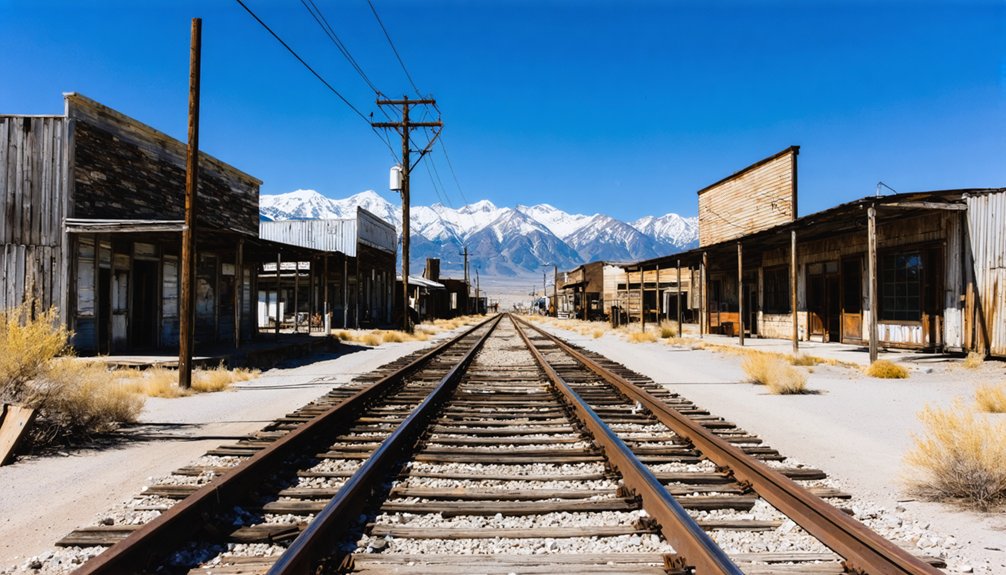
Railroad towns became the backbone of western economic expansion during America’s great push westward in the mid-to-late 19th century.
These strategic settlements transformed barren prairies into vibrant centers of commerce and settlement, fueled by unprecedented land grants exceeding 175 million acres.
You’d find these towns meticulously positioned along rail corridors, designed to capture agricultural bounty from surrounding regions.
Railroad expansion wasn’t merely about transportation—it fundamentally altered economic integration across the continent, connecting isolated western territories to national and international markets.
The economic architecture of these towns reflected corporate strategies, with townsite agents actively recruiting merchants, farmers, and tradespeople.
For every rail job created, nearly four additional positions emerged in related industries.
These towns effectively “annihilated time and space,” creating prosperity while reshaping the American West’s economic landscape forever.
The economic impact on Midwestern towns has been profound, often leading to a resurgence in local industries and a revitalization of community spirit. As businesses adapt and innovate, they attract new investments that further enhance their economic viability. This transformation illustrates how even the smallest towns can play a pivotal role in shaping regional economies.
The 1862 Pacific Railroad Act provided substantial financial incentives for construction companies to establish these settlements across the frontier.
The historic Golden Spike ceremony in 1869 marked the completion of the first transcontinental railroad that would accelerate this western development.
Ghost Towns Along Abandoned Rail Lines: What Remains
Time has frozen across the western landscape, where once-vibrant railroad towns now stand silent, abandoned as the rail lines that sustained them disappeared into history.
You’ll find these communities scattered from Utah’s Desert Springs to California’s Alma, each telling stories through their remains. Walk among foundations near Lexington Reservoir or explore Laws’ preserved railroad buildings—authentic windows into early 20th century Western life.
These scattered railroad ghosts whisper history through weathered timbers and rusted rail—each a portal to America’s westward dream.
In Montana, follow the Milwaukee Road’s ghost, where grading and bridges await your discovery.
Railroad heritage lives on through adaptive reuse—former depots now serve as museums and Amtrak stations. Ghost town preservation efforts have transformed places like Virginia City into living museums, while heritage railways like the Alder Gulch Shortline connect you to this vanished era, keeping freedom’s pioneering spirit alive in these forgotten settlements.
Stories From Forgotten Railroad Communities
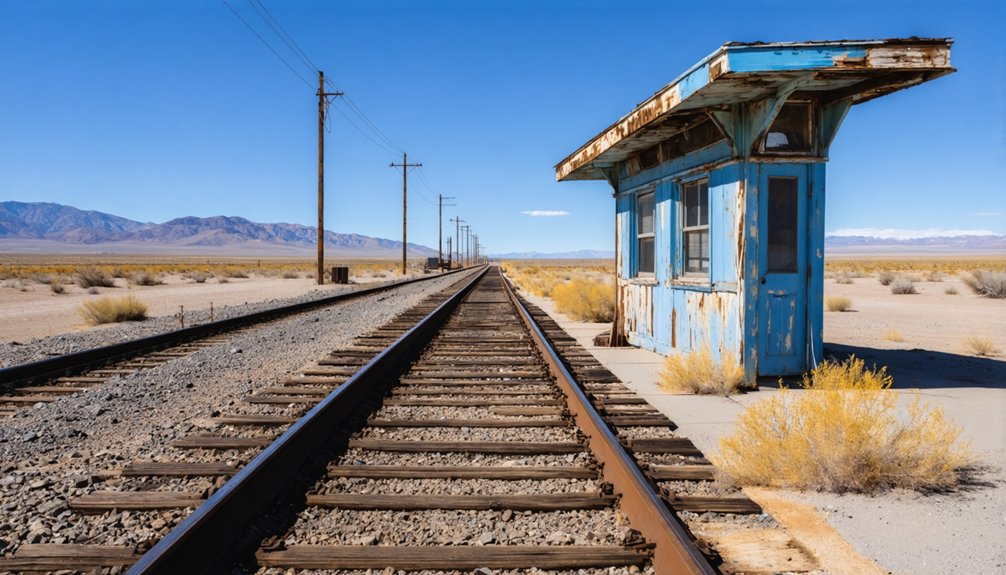
You’ll find glimpses of railroad town life preserved in recovered diaries, photographs, and newspaper clippings that chronicle everything from mundane workdays to festive community gatherings.
These documentary fragments reveal how residents created meaningful existences despite knowing their communities mightn’t survive changing transportation economics.
Train station logbooks, handwritten letters, and faded storefront ledgers offer particularly poignant evidence of communities that thrived briefly before disappearing from maps.
Daily Life Chronicles
Though physical remnants of these forgotten communities have largely disappeared, the personal narratives that survive paint vivid portraits of daily existence in railroad towns across the American West.
You’d find your daily routines dictated by train schedules—the whistle signaling not just arrivals but marking time itself. Community gatherings centered around depots where news, goods, and visitors converged. Your livelihood would depend on the iron rails: perhaps you’d run a boarding house for transient workers, tend bar at the saloon, or ship your farm’s harvest to distant markets.
In these isolated outposts, the train’s arrival transformed ordinary days into social events. Children would pause their schoolwork, merchants would prepare for new inventory, and the town would momentarily pulse with connection to the outside world.
Communities Before Extinction
Before these once-thriving railroad settlements vanished entirely from maps, they existed as vibrant microcosms of western expansion and human tenacity. You could’ve witnessed population stability briefly taking hold as schools opened and families established roots in places like Peckham, where education persisted even as decline set in.
These communities achieved remarkable economic resilience through agricultural exchanges and commercial enterprises. Grain elevators dominated skylines while general stores and saloons created social anchors.
Immigrant laborers—Italian and Irish workers laying track and maintaining infrastructure—formed the backbone of these precarious economies.
When you examine their fleeting existence, you’ll find communities that transformed barren landscapes into functioning societies, connecting remote regions to wider markets before technological shifts, resource depletion, and infrastructure changes rendered their purpose obsolete.
Modern Efforts to Document America’s Railroad Heritage
While the ghostly railroad towns of the American West gradually fade into the landscape, a diverse network of preservation institutions has emerged to document this vanishing heritage.
You’ll find organizations like the South Shore Line Museum Project employing virtual reality alongside physical artifacts to create immersive historical experiences that connect you with 125 years of railroad impact.
Federal programs including the Historic American Engineering Record meticulously capture these sites through measured drawings and large-format photography, with all documentation housed at the Library of Congress for your unrestricted access.
The nation’s heritage preserved in precise detail—meticulously measured, photographed, and freely available to all citizens.
Through digital preservation and archival initiatives, nonprofits with tax-exempt status guarantee that America’s railroad legacy—from roundhouses to water towers—remains documented even as the physical structures deteriorate.
These efforts transform forgotten places into permanent records of the West’s railroad era.
Frequently Asked Questions
How Did Railway Towns Impact Native American Communities and Land Rights?
You’ll find railway towns dramatically accelerated Native American land displacement through illegal seizures, treaty violations, and settlement encroachment, while simultaneously driving cultural erosion by disrupting traditional economies and sacred relationships with ancestral territories.
What Role Did Immigrant Labor Play in Building These Railroad Towns?
Like silently woven threads, you’ll find immigrant workers built western railroad towns under brutal labor conditions. Their contributions—establishing infrastructure, businesses, and cultural enclaves—remain preserved in every brick and foundation stone.
How Did Weather and Natural Disasters Affect Railroad Town Sustainability?
You’ll find railroad towns crumbled when blizzards triggered avalanches, burying infrastructure and lives. Without flood recovery systems or drought resilience planning, these free-spirited settlements couldn’t withstand nature’s archived fury, hastening their abandonment.
Did Railroad Towns Have Unique Cultural or Social Institutions?
Yes, you’ll find railroad towns possessed distinctive cultural institutions and social dynamics—depots serving as community hubs, ethnic enclaves maintaining traditions, and company-sponsored libraries preserving knowledge amid the frontier’s promise of liberty.
How Did Prohibition and Temperance Movements Influence Railroad Town Development?
You’ll find Prohibition effects transformed railroad towns dramatically—from “hell on wheels” communities to targets of Temperance movements. Refrigerated cars enabled bootleggers while corruption flourished along tracks, fundamentally altering these once-rowdy settlements.
References
- https://www.youtube.com/watch?v=VJXBWheKanY&vl=en-US
- https://www.wyohistory.org/encyclopedia/wyoming-north-and-south-railroad-1923-1935
- https://www.youtube.com/watch?v=YyHRc6-oGU8
- https://forum.trains.com/t/railroad-abandonment-disappearing-small-towns/234540
- https://www.youtube.com/watch?v=LuJStxRgHMQ
- https://backroadplanet.com/12-forgotten-railroad-towns-across-the-u-s/
- https://www.abandonedrails.com
- https://www.truewestmagazine.com/article/train-towns/
- https://www.frrandp.com/2020/05/
- https://www.okhistory.org/publications/enc/entry?entry=LA014