Rust Belt ghost towns emerged after America’s manufacturing collapse that began in the 1950s. Once-thriving industrial centers like parts of Detroit, Cleveland, and Gary saw populations plummet by up to 46% as factories shuttered and jobs vanished overseas. You’ll find abandoned neighborhoods, environmental devastation, and severed community ties throughout these regions. Yet amid the decay, resilient communities craft new identities through urban exploration, heritage tourism, and grassroots revitalization efforts that honor their industrial legacies.
Key Takeaways
- Entire neighborhoods vanished in Rust Belt cities, creating urban prairies where vibrant communities once thrived, particularly in racially segregated areas.
- Cities like McDougall-Hunt in Detroit lost over 50% of housing stock, leaving vacant lots as visible scars of industrial collapse.
- Abandoned factory towns symbolize economic devastation following manufacturing job losses that began in the 1950s and accelerated through the 1970s.
- Environmental devastation marks many ghost towns, with toxic corporate legacies causing generational health issues in former industrial centers.
- Single-industry towns faced complete community collapse after major employers shut down, leading to mass unemployment, increased crime, and widespread drug use.
The Golden Era: When Rust Belt Towns Flourished

While today’s Rust Belt region often evokes images of abandonment and decay, these industrial centers once stood as the backbone of American economic might.
During the late 19th and mid-20th centuries, these powerhouses reached their zenith in 1953, commanding the highest share of U.S. GDP through steel, automobile manufacturing, and coal mining.
You would have witnessed remarkable urban migration transforming small settlements into booming cities—Cleveland’s population more than doubled in just ten years (1850-1860).
Industrial innovation flourished as places like Dearborn’s River Rouge plant revolutionized mass production techniques that drew international attention.
Cities became interconnected through sophisticated transportation networks of canals, railways, and waterways, strategically positioned near natural resources that fueled their meteoric rise to economic dominance.
Infrastructure projects like the Erie Canal completed in 1825 played a crucial role in establishing the region’s industrial might by connecting the Great Lakes to the Atlantic seaboard.
The region’s abundant natural resources, including coal and iron ore, created the perfect conditions for innovative industries to thrive and establish America’s first major corporations.
The Perfect Storm: Factors Behind Industrial Collapse
You’ll find that by the 1970s, Rust Belt communities faced unprecedented global competition as manufacturing jobs fled to regions with lower labor costs and fewer union restrictions.
This deindustrialization accelerated when foreign competitors, particularly from Japan and later China, captured market share with more efficient production methods and modernized facilities.
Once-thriving industrial centers transformed into hollowed-out communities as factories closed, triggering devastating population exoduses and cascading economic failures throughout interconnected local economies.
Contrary to common belief, the Rust Belt’s economic troubles began in the 1950s with a prolonged downturn that was unique compared to other U.S. regions, despite its initial dominance in manufacturing.
The term “Rust Belt” itself emerged during Walter Mondale’s 1984 presidential campaign as a pejorative label that vividly captured the region’s industrial decay and economic struggles.
Global Competition Erupts
As the doors of American industry swung open to global markets in the mid-1970s, Rust Belt manufacturers faced an unprecedented assault from international competitors that would fundamentally reshape the industrial landscape.
You could witness once-dominant American firms struggling against lower-cost imports from Japan and China, ending decades of economic isolation that had shielded domestic production.
The comfortable lack of domestic competition had left these industries unprepared—they’d grown complacent without investing in modernization or innovation.
When global trade intensified, Rust Belt companies confronted a brutal reality: their higher wage structures and outdated technologies couldn’t compete internationally.
Labor conflicts only worsened their position as unions fought to maintain wages while management sought cost reductions. The trade union presence in the Northwest contributed significantly to the higher wages that made these regions less competitive against the emerging manufacturing centers in the South.
The stronger dollar, which benefited consumers and service sectors, delivered another blow by making exports more expensive in foreign markets.
Cities like Detroit and Pittsburgh that once served as manufacturing powerhouses saw their economic foundations crumble as factories closed and jobs disappeared in staggering numbers.
Deindustrialization Reshapes Communities
The perfect storm that devastated Rust Belt communities began decades earlier than commonly recognized, with manufacturing employment plummeting by 34% between 1950 and 1980.
You could trace this collapse to multiple converging forces: high union wages that discouraged innovation, automation reducing labor needs, and manufacturers fleeing to southern states with cheaper labor costs.
Deindustrialization impacts rippled beyond factory closures. Once-thriving cities like Detroit and Cleveland saw populations collapse by up to 46% as economic foundations crumbled.
Municipal services deteriorated as tax bases eroded, creating a downward spiral that tested community resilience. The post-WWII complacency of Rust Belt manufacturers proved fatal as they failed to modernize infrastructure and equipment, leaving them vulnerable to both domestic and international competition.
These weren’t merely economic shifts but profound social transformations that hollowed out America’s industrial heartland. The economic decline was exacerbated by frequent work stoppages driven by union activity during this period. The recovery chances were significantly influenced by the college-educated workforce, with US cities particularly disadvantaged compared to their European counterparts.
Ghost Neighborhoods: Where Communities Vanished

Throughout America’s Rust Belt, entire neighborhoods have silently disappeared over the past half-century, leaving behind urban prairies where vibrant communities once stood.
You’ll find these ghost towns concentrated in cities with roughly equal Black and white populations like St. Louis and Buffalo, where racial segregation patterns shaped abandonment.
In places like Detroit’s McDougall-Hunt neighborhood, over half the housing stock has vanished, transforming once-dense blocks into undeveloped land.
Community memories fade as vacant lots replace homes in ZIP codes with staggering 30% vacancy rates.
The stark contrast with similar Canadian cities suggests uniquely American factors at work.
Just across the border, Canadian industrial cities tell a different story—revealing America’s distinct path toward urban abandonment.
When manufacturing jobs vanished post-1950s, they triggered massive outmigration, leaving thousands of abandoned properties across cities like Gary and Cleveland—physical reminders of working-class dreams deferred.
Economic hardship has led to neighborhoods like Youngstown, Ohio, where median home values hover around $20,000, reflecting severe population decline.
Gary, Indiana, once a model industrial city founded in 1906, has experienced dramatic decline due to factory shutdowns and automation that left entire blocks vacant.
Environmental Scars: Ecological Disasters That Emptied Towns
Environmental devastation, not just economic collapse, drove many Rust Belt residents from their homes permanently.
You’ll find towns like Wittenoom, where asbestos mining condemned 25% of residents to death from related diseases, and Gilman, Colorado, where soil remains saturated with heavy metals decades later.
The environmental justice movement gained momentum after Cleveland’s Cuyahoga River ignited 13 separate times, eventually sparking creation of the EPA and Clean Water Act.
- Breathing Pittsburgh’s industrial air in the 1860s meant living under a perpetual toxic shroud that residents described as “looking over into hell with the lid taken off.”
- Walking through abandoned neighborhoods where methane seeps invisibly from beneath your feet.
- Discovering your family’s generational health issues stem from a corporate toxic legacy concealed for profit.
The Exodus: Migration Patterns and Population Decline

When you trace the mass exodus from Rust Belt cities, you’ll find entire communities emptied as the Industrial Heart Diaspora sent over 40% of residents fleeing shuttered factories between 1970-2020.
White Flight accelerated this demographic collapse, leaving mainly Black neighborhoods to shoulder the heaviest population losses and creating ripple effects of concentrated poverty and reduced public services.
Your analysis of migration patterns must account for the powerful Sunbelt Magnet Effect, which pulled younger working-class families toward economic opportunities in growing metropolitan areas like Phoenix and Dallas while Rust Belt urban cores withered.
Industrial Heart Diaspora
As the manufacturing giants of America’s industrial heartland began their slow collapse in the mid-20th century, a massive human exodus reshaped the demographic landscape of the Rust Belt.
You’ve witnessed a 32.9% decline in manufacturing jobs between 1969-1996, driving countless families to abandon their industrial nostalgia in search of opportunity elsewhere. College-educated young adults departed at higher rates—nearly 3% annually—while retirees sought warmer climates in Florida and Arizona, accelerating the population drain.
- Communities once defined by bustling factory shifts now stand eerily silent, their purpose vanished with global economic shifts.
- Family histories fractured as generations scattered to distant Sunbelt cities, severing multigenerational ties to place.
- Neighborhoods hollowed from within, leaving behind those with fewer resources to sustain community resilience.
White Flight Ripple Effects
While the industrial exodus decimated Rust Belt economies, a parallel demographic transformation unfolded through pronounced white flight during the 1960s and 1970s. You’d have witnessed younger white families abandoning urban cores for newly developed suburbs, leaving behind increasingly segregated cities. This wasn’t merely relocation—it fundamentally reshaped the region’s social geography.
The consequences rippled outward as fifteen Rust Belt metros became America’s most racially segregated regions. Highway construction and urban renewal projects inadvertently facilitated this exodus, carving physical barriers between communities while providing escape routes to suburban enclaves.
Economic downturns accelerated these patterns, as manufacturing decline pushed working-age whites toward perceived opportunities elsewhere. Meanwhile, central cities experienced concentrated poverty and population decline while surrounding suburban rings often flourished—creating stark divides that persist in today’s landscape.
Sunbelt Magnet Effect
Since the 1960s, the American population has experienced one of the most significant demographic shifts in modern history, with the Sun Belt acting as a powerful magnet drawing millions away from Rust Belt communities.
This exodus, estimated to exceed both the Great Migration and Dust Bowl relocations, saw Sun Belt states grow by 119% between 1970-2020.
You’re witnessing the continuation of this demographic revolution as over 500,000 people annually abandon industrial heartlands for the promises of Arizona, Texas, and Florida.
These migrations often stem from a desire to escape failed utopian experiments in America that have left many seeking more favorable living conditions. As newcomers settle into these vibrant states, they bring with them a fresh perspective and diverse experiences. This influx is reshaping local economies and communities, highlighting the stark contrasts between urban decay and burgeoning opportunities.
- Entire neighborhoods stand empty in once-thriving factory towns, their abandoned homes telling stories of generations lost to Sunbelt migration dynamics.
- The collective memory of bustling Main Streets fades with each U-Haul heading south.
- Rust Belt nostalgia now commodified into vintage postcards of industrial might that once symbolized American prosperity.
Small Town Extinction: When Single Industries Disappeared

When manufacturing and extractive industries reigned supreme across America’s Midwest and Northeast, they created numerous towns built entirely around a single economic purpose.
These communities thrived until shortly after WWII, when economic transformation triggered their downfall.
The mechanics of small town extinction followed a predictable pattern: a major employer—steel mill, auto plant, or mine—would shut down, triggering mass unemployment.
The death of a town begins with a single corporate decision, unleashing a cascade of economic devastation.
As residents fled in search of opportunities, tax revenue collapsed, causing infrastructure and services to deteriorate.
Towns dependent on a single industry proved especially vulnerable, with only 17% of U.S. manufacturing hubs recovering to previous employment levels, compared to nearly 50% in Germany.
The devastation wasn’t merely economic—community cohesion crumbled as social networks dissolved, leading to increased crime and drug use in these hollowed-out places.
Abandoned Architecture: The Haunting Beauty Left Behind
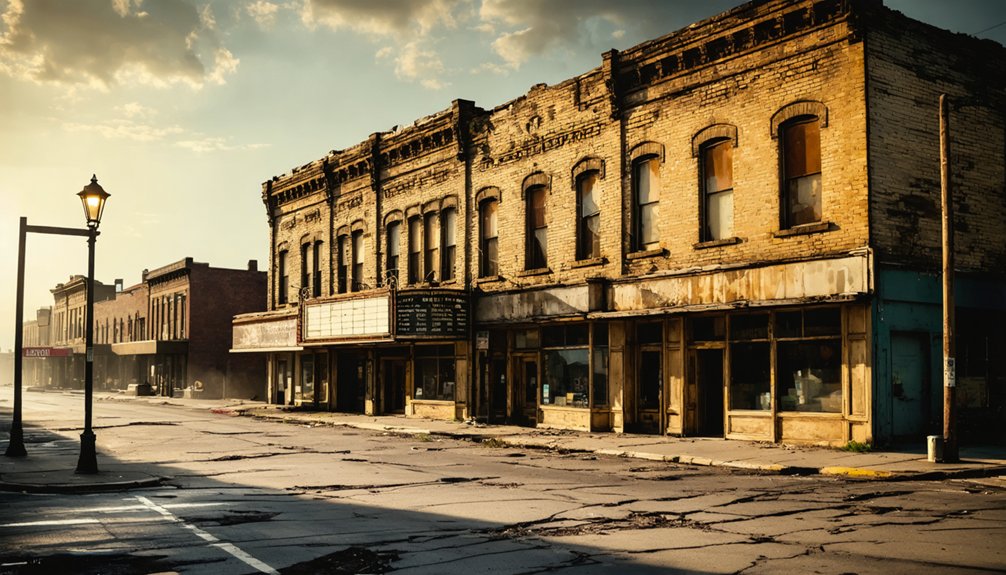
Walking through a Rust Belt ghost town today, you’ll encounter imposing steel mills and factory complexes standing as silent monuments to America’s industrial past, their massive structures simultaneously projecting strength and vulnerability.
The architectural remnants in places like Johnstown, Pennsylvania—where abandoned buildings that once housed 70,000 residents now serve only 15,000—reveal intricate craftsmanship in their weathered facades, crumbling cornices, and elaborate entranceways that modern construction rarely matches.
These frozen-in-time structures, from the faded signage of Texas motels to the fully-furnished homes of Bodie where residents seemingly vanished mid-life, offer a haunting glimpse into the economic forces that transformed thriving communities into architectural museums.
Frozen Industrial Grandeur
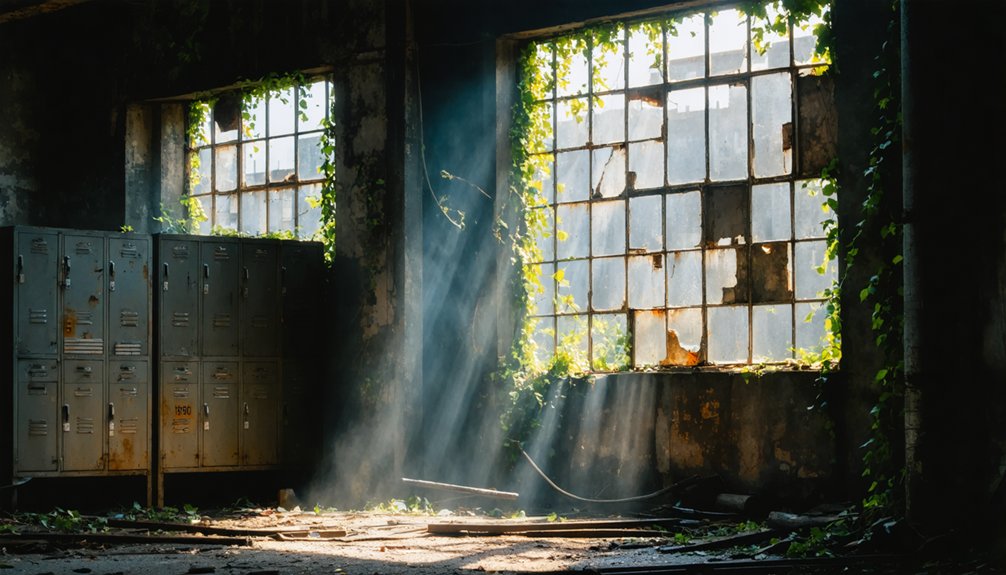
Despite their decaying facades and broken windows, the abandoned factories of America’s Rust Belt possess an unmistakable grandeur that commands attention across urban landscapes from Buffalo to Detroit.
These massive structures—designed by architects like Albert Kahn—showcase reinforced concrete, brick façades with sandstone accents, and large windows that once flooded assembly floors with daylight.
You’re witnessing industrial nostalgia frozen in time, where entire city blocks stand as monuments to America’s manufacturing might.
- The skeletal frames of these factories create a haunting silhouette against rust belt skies, evoking memories of bustling production lines now silent.
- Each cracked concrete pillar and rusting steel beam tells a story of architectural resilience that’s survived decades of neglect.
- The contrast between their former glory and current decay creates a uniquely American visual poetry.
Crumbling Architectural Icons
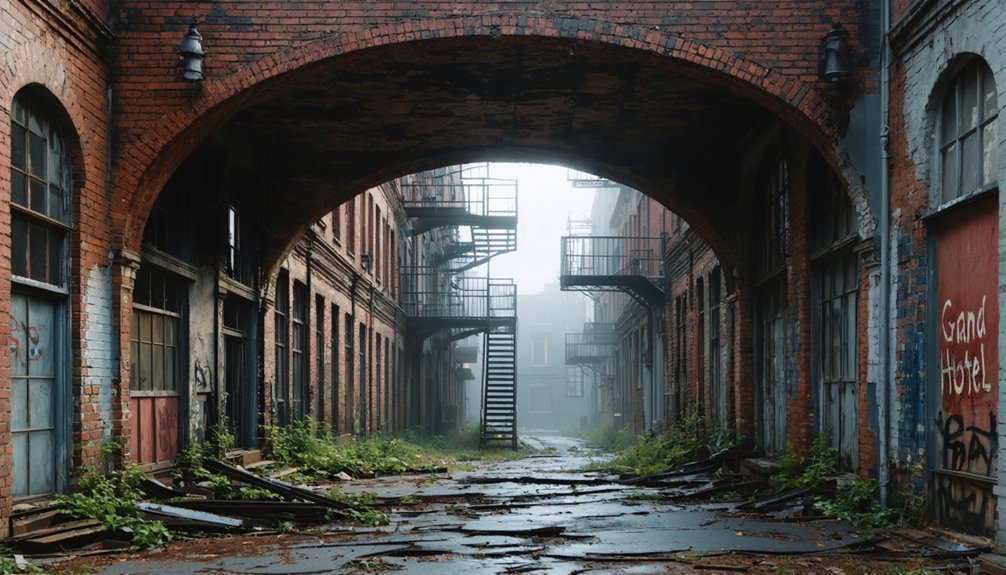
The architectural ghosts of America’s Rust Belt extend beyond mammoth factories into the very neighborhoods that once housed their workers.
You’ll find census tracts where over half the homes have vanished since 1970, leaving a haunting patchwork of vacancy and decay.
The abandoned beauty of these areas reveals itself in diverse architectural styles—Victorian mansions on former Millionaires’ Rows, uniquely constructed company houses with pre-fabricated concrete panels, and Craftsman homes now stripped of copper and wiring.
In Detroit’s McDougall-Hunt neighborhood, demolition has transformed urban blocks into pseudo-rural landscapes.
This architectural nostalgia often exists in legal limbo—buildings too historic to demolish yet too costly to save.
The result is a preservation paradox where protected structures deteriorate behind chain-link fences, frozen between their grand past and uncertain future.
Survival Stories: Communities That Refused to Die
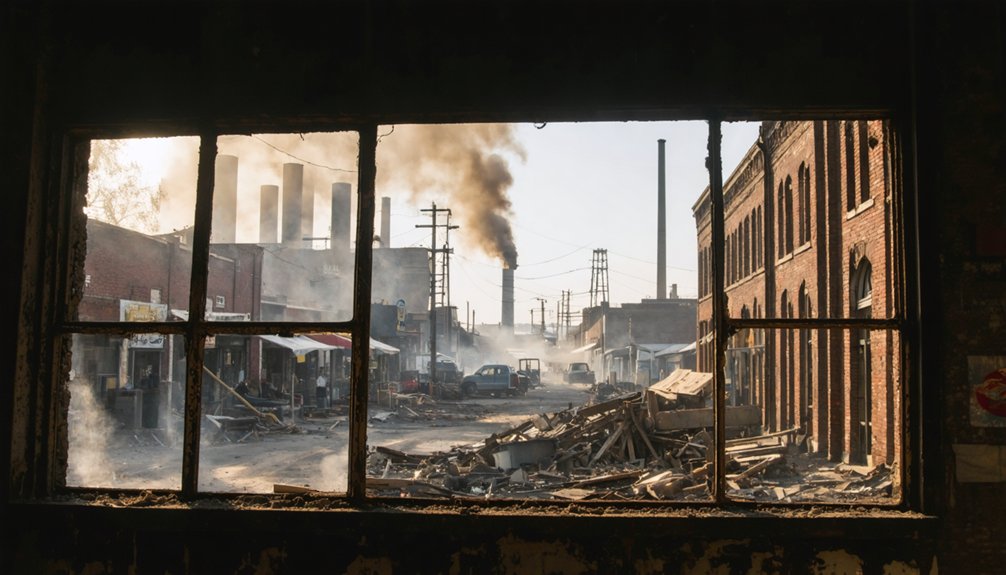
While many Rust Belt towns succumbed to economic devastation after industrial collapse, a remarkable subset of communities has refused to fade into obscurity, instead crafting innovative pathways to survival.
You’ll find community resilience manifesting through strategic diversification—former factory towns reinventing themselves as heritage tourism destinations or technology hubs. Local entrepreneurship flourishes in unexpected forms: craft breweries in abandoned warehouses, artist colonies in former industrial spaces, and small-scale manufacturing collectives.
These communities survive through tenacious preservation of social bonds despite demographic challenges.
- The emotional weight of intergenerational narratives that bind residents to place despite economic hardship
- The profound dignity in residents’ refusal to abandon their hometown’s legacy while embracing necessary change
- The quiet triumph of community-led revitalization efforts succeeding where large-scale interventions failed
Urban Exploration: Documenting What Remains
Urban exploration—often shortened to “urbex” by its practitioners—emerged in the late 1990s as a cultural response to the proliferation of abandoned buildings throughout America’s Rust Belt.
Urban exploration captures America’s industrial decline through the lens of those brave enough to document our forgotten architectural heritage.
As cities like Gary, Cleveland, and Youngstown witnessed dramatic population declines, their vacant steel mills, schools, and company housing became powerful symbols of industrial collapse.
You’ll find urbexers meticulously documenting these spaces, preserving visual histories through photography and online platforms.
This urban documentation serves both artistic and historical purposes, capturing what remains before nature reclaims these structures entirely. Many explorers collaborate with historians and preservationists to archive their findings.
However, exploration ethics remain complicated—trespassing concerns, structural dangers, asbestos exposure, and personal safety risks challenge even experienced urbexers.
Despite these hazards, the abandoned subway tunnels of Cincinnati and Clairton’s decaying steel works continue attracting those seeking freedom among America’s industrial ghosts.
Revitalization Efforts: Breathing New Life Into Forgotten Places
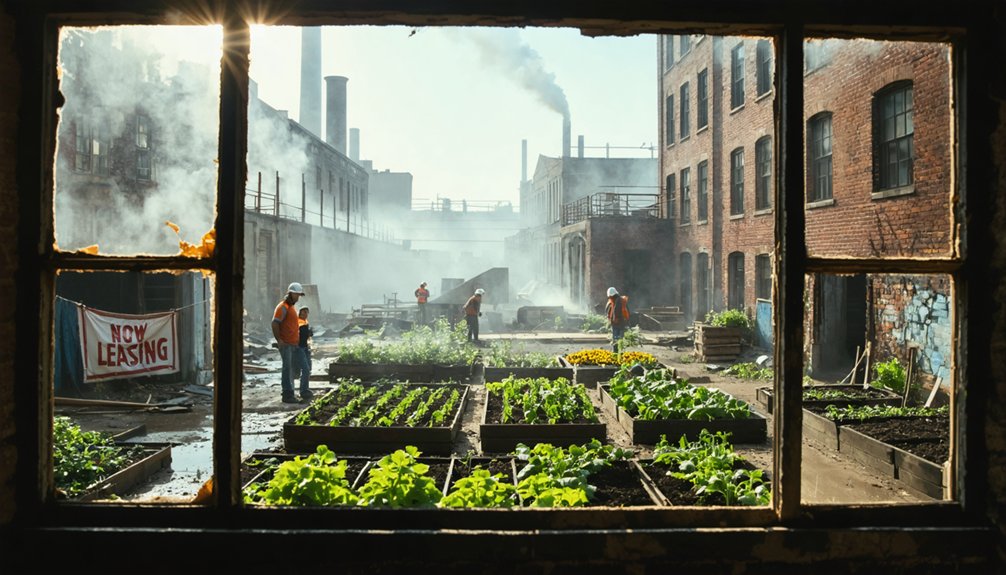
Beyond documenting abandoned landscapes, many Rust Belt communities have undertaken ambitious restoration and renewal campaigns since the early 2000s.
Through public-private partnerships, cities once defined by single industries now leverage community collaboration to transform abandoned factories into vibrant economic hubs. You’ll find adaptive reuse projects converting historic industrial structures into mixed-use developments while preserving architectural heritage that defines regional identity.
- Walking through revitalized main streets where boarded windows have been replaced by thriving local businesses
- Witnessing former steel mills transformed into entertainment districts where families gather where workers once toiled
- Experiencing the triumph of neighborhood-led initiatives that reclaimed abandoned spaces when government efforts faltered
These Renaissance-style programs balance demolition with preservation, creating multifunctional neighborhoods that honor industrial legacies while building resilient economies independent from manufacturing’s boom-and-bust cycles.
Frequently Asked Questions
Why Do Some Abandoned Towns Become Tourist Attractions While Others Don’t?
You’ll find that abandoned towns with strong historical narratives, preserved architecture, cultural significance, adequate infrastructure, and positive media exposure develop tourism allure, while others lacking these elements fail to capture wider tourism trends.
What Legal Challenges Exist When Purchasing Property in Ghost Towns?
You’ll face unclear ownership, clouded titles, lapsed permits, zoning regulations, property disputes, liability issues, and challenging financing when purchasing ghost town properties—all requiring extensive legal due diligence before acquisition.
How Do Former Residents Maintain Connections to Abandoned Hometowns?
Like threads in a worn tapestry, you maintain connections through nostalgic gatherings at cemeteries and landmarks, digital memorials on social media platforms, family storytelling, hometown associations, and preservation advocacy projects.
What Psychological Impacts Affect People Forced to Leave Dying Communities?
You’ll experience profound nostalgia effects, depression, anxiety, and PTSD when forced from dying communities. Your community identity fractures, leaving you vulnerable to ongoing psychological trauma and social disconnection.
How Do Ghost Towns Affect Surrounding Communities That Survived?
Your neighboring communities face economic impacts including diminished tax bases and market contraction. You’ll witness community identity shifts as displaced residents arrive, straining your services while fundamentally altering regional social dynamics.
References
- https://allthatsinteresting.com/rust-belt
- https://schoolofcities.utoronto.ca/neighbourhood-abandonment-in-the-american-rust-belt/
- https://www.industryweek.com/talent/article/22028380/the-abandonment-of-small-cities-in-the-rust-belt
- https://www.lovemoney.com/gallerylist/86648/americas-empty-ghost-towns-and-why-theyre-abandoned-today
- https://www.businessinsider.com/vintage-photos-us-small-towns
- https://www.youtube.com/watch?v=HZFw7MZFycU
- https://www.cato.org/blog/economic-mobility-not-manufacturing-decline-real-rust-belt-story
- https://en.wikipedia.org/wiki/Rust_Belt
- https://www.loveexploring.com/gallerylist/127789/then-and-now-us-rust-belt-cities-that-bounced-back
- https://www.britannica.com/place/Rust-Belt