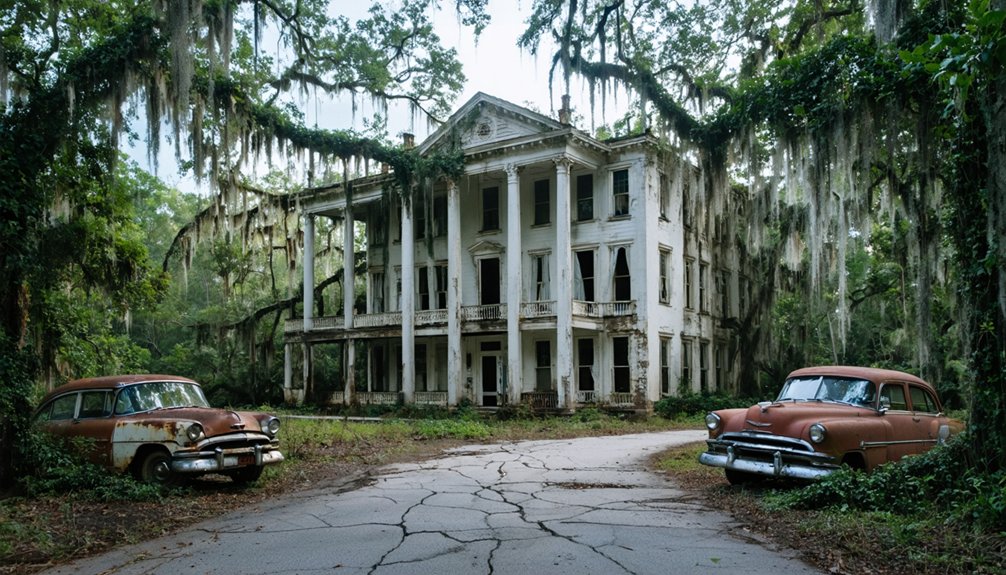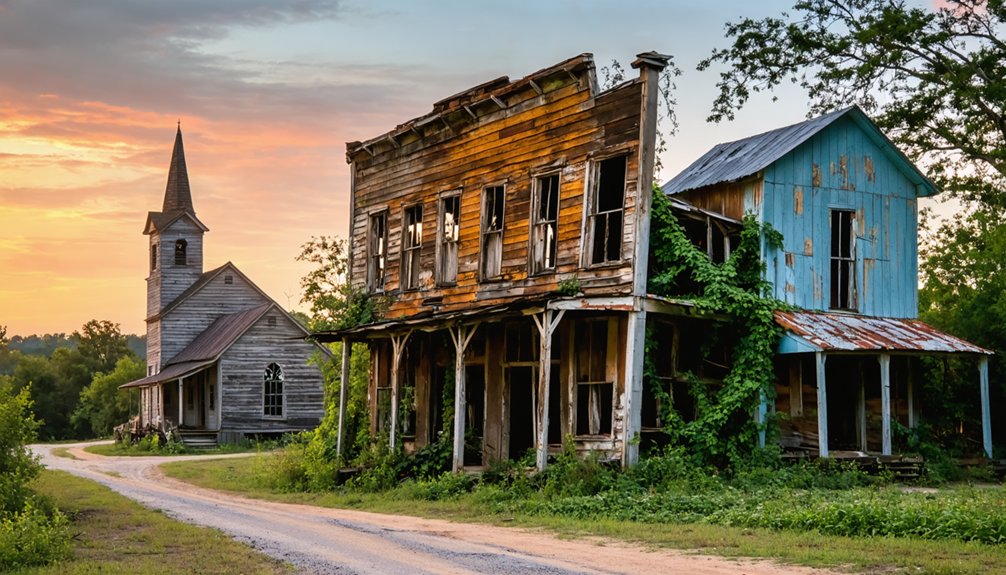
Southern ghost towns tell tales of abandoned dreams and nature’s dominance. You’ll discover Cahaba, Alabama’s first capital surrendered to floods, and Terlingua, once thriving on mercury mining before economic collapse. The Mississippi River’s shifting course created numerous riverside ghost settlements, while catastrophic events like Thistle’s landslide forced entire communities to flee. Government buyouts of environmentally compromised towns continue this haunting tradition of human surrender to greater forces.
Key Takeaways
- Cahaba, Alabama’s first capital, was abandoned after devastating floods and disease outbreaks forced government relocation to Tuscaloosa in 1826.
- Terlingua, Texas thrived as a mercury-producing boomtown until depleted resources and economic challenges transformed it into a ghost town by 1942.
- Mississippi River avulsions created numerous ghost towns when changing river courses cut communities off from vital resources.
- Buyout programs have created modern ghost towns across the South, with over 55,000 properties purchased since 1993.
- Abandoned southern settlements reveal how environmental disasters, resource depletion, and economic shifts ultimately reclaim human developments.
Alabama’s Lost Capital: The Rise and Fall of Cahaba
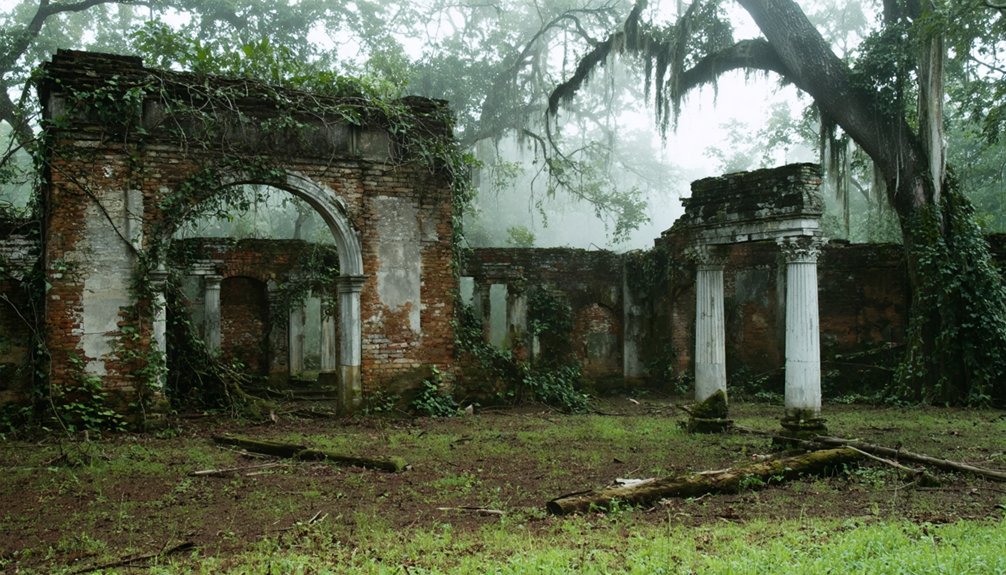
A confluence of ambition and geography marked the birth of Cahaba, Alabama’s first state capital, established in 1818 following the state’s constitutional convention.
You’d find the site strategically positioned where the Alabama and Cahaba rivers meet—land gifted by President Monroe himself.
Cahaba History reveals a rapid transformation as government buildings, homes, and hotels emerged by 1820.
However, the capital’s low-lying location proved its undoing. Devastating floods, coupled with outbreaks of malaria and yellow fever, prompted the Capital Relocation to Tuscaloosa in 1826.
Despite briefly flourishing as a cotton commerce center and railway hub in the 1850s, Cahaba couldn’t sustain prosperity. The wealthy town once boasted some of the most grand architectural structures in the state, including the impressive Saltmarsh Hall.
The population swelled to over 3,000 residents before the devastating impact of the Civil War changed everything.
The Civil War brought further hardship with an overcrowded Confederate prison.
Mississippi River Ghosts: When the Water Changed Course
While Alabama’s Cahaba fell victim to flooding and disease, other southern settlements met their demise through an even more dramatic hydrological force—the Mississippi River‘s tendency to change course entirely.
These river avulsions occur when the Mississippi abandons its channel for a steeper path, creating profound consequences for riverside communities. After the 1876 avulsion, Reverie, Tennessee found itself physically cut off from its state, while Vicksburg lost its essential river access and faced economic collapse. Harold Fisk’s iconic meander maps from 1944 beautifully illustrate these dramatic course changes that have reshaped the landscape over millennia.
When the Mississippi changes course, entire towns can vanish from prosperity into desolation overnight.
Many thriving ports transformed into ghost towns overnight as the river’s fickle path redirected commerce elsewhere. Historically, the Mississippi River has naturally changed its course approximately every 1000 years, creating new waterways and abandoned settlements.
Though engineers later constructed the Old River Control Structure to prevent catastrophic channel switching to the Atchafalaya, you can still explore these abandoned settlements—haunting reminders of how nature’s power trumps humanity’s quest for permanence along America’s greatest waterway.
Mining’s Legacy: Terlingua and the Quicksilver Boom

Deep in the rugged terrain of southwestern Brewster County, Texas, Terlingua emerged as one of America’s most significant mercury-producing regions during the early 20th century.
You’re witnessing the remnants of a quicksilver legacy that once supplied 40% of America’s mercury demand.
The Chisos Mining Company, established in 1903 by Howard Perry, transformed this remote district into a thriving community of 2,000 residents.
Mining history reveals a segregated town with Mexican laborers living east of the company store, while Anglo residents occupied the western section.
Terlingua’s strategic importance peaked during World War I when European mercury supplies were disrupted.
The town prospered with various amenities including a commissary and hotel by 1913, serving the needs of its growing population.
Many workers extracted valuable cinnabar ore from shafts hundreds deep, working in dangerous conditions.
By 1942, however, depleted cinnabar deposits, groundwater infiltration, and economic challenges forced the Chisos into bankruptcy.
The mining town’s prosperity evaporated, leaving behind the ghost town you can explore today.
Natural Disasters and Abandonment: The Flooding of Thistle
Unlike Terlingua’s gradual decline, Thistle, Utah faced a sudden and catastrophic end when, in April 1983, the most devastating landslide in U.S. history transformed this once-thriving railroad community into a submerged ghost town.
The slide, measuring 1,000 feet wide and over a mile long, dammed Spanish Fork River, creating “Thistle Lake” up to 160 feet deep. Flooding impacts were immediate—22 homes disappeared under 50 feet of water, causing $200 million in damage ($750 million today).
Nature’s dam transformed a town into memory, as Thistle Lake swallowed generations of history beneath 50 feet of unforgiving water.
Despite recurring flood problems dating back to 1952, nothing compared to this catastrophe.
Community resilience manifested as residents evacuated with warning, salvaging belongings before generations of history vanished underwater. Utah received its first Presidential disaster declaration as Thistle’s submersion permanently altered the landscape, leaving only rooftops visible where a community once thrived.
Today, visitors can observe the red schoolhouse remains and other partially visible structures from designated viewpoints along U.S. Route 6/89.
Before the 1983 landslide, Thistle had been a key railroad junction with a once-thriving population that peaked at over 1,600 by 1917, supporting various businesses including a depot, roundhouse, and schoolhouse.
Toxic Remains: Government Buyouts and Environmental Ghost Towns
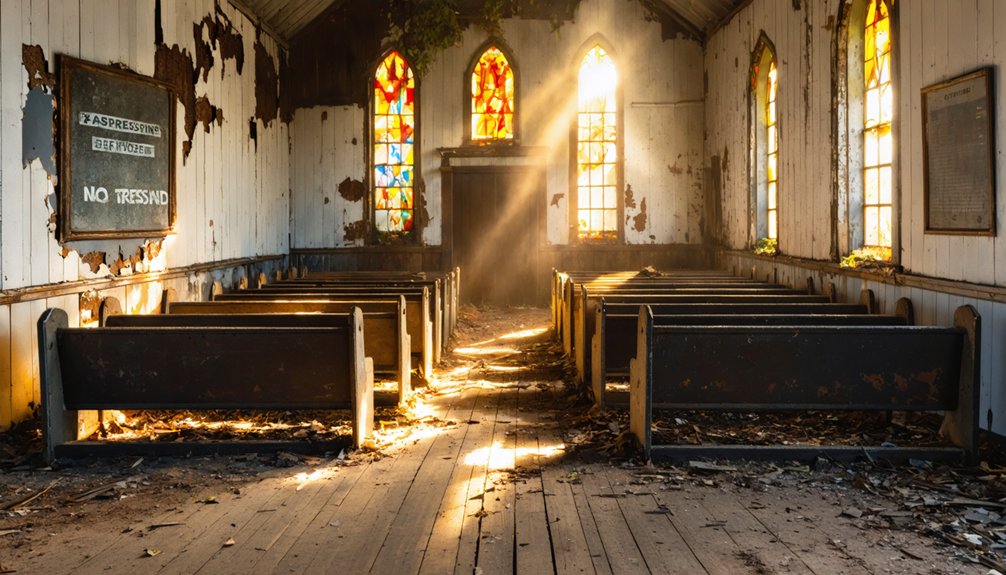
As environmental disasters and recurring floods have plagued numerous communities across America, the federal government has increasingly implemented buyout programs that create a unique type of ghost town—one deliberately emptied for safety and ecological reasons.
You’ll find over 55,000 properties acquired since 1993, with FEMA programs saving $5-$9 for every $1 spent.
These ghost towns serve environmental justice purposes, transforming toxic waste sites into ecological assets. The abandoned properties, once demolished, provide critical flood water absorption, wildlife habitats, and reduced heat island effects.
The revitalization of these spaces also inspires reflection on forgotten utopian ideals in America, emphasizing community engagement and sustainable living. By reimagining how we inhabit and interact with our surroundings, we can foster a new sense of purpose that transcends mere environmental remediation. This shift not only benefits the ecosystem but also rekindles a collective vision for a more equitable future.
However, implementation challenges persist—applications stall for years, tax bases erode, and communities fragment. The five-year wait times for buyout approvals leave vulnerable homeowners in limbo, forcing many to sell at significant losses. The EPA has seen staffing reductions in critical enforcement divisions, further complicating oversight of these environmental transition zones. While the economic benefits appear substantial, the human cost of these environmental relocations creates a haunting landscape of deliberately abandoned homes awaiting nature’s reclamation.
Frequently Asked Questions
Are Ghost Towns Legally Accessible to Tourists and Urban Explorers?
Ghost towns’ accessibility depends on ownership status. You’ll face tourist regulations at public sites but need permission for private locations. Unauthorized urban exploration constitutes trespassing with legal consequences you’d want to avoid.
What Personal Belongings Were Left Behind by Fleeing Residents?
You’ll find resident memories preserved in abandoned artifacts: clothing, family photos, birth certificates, china dishes, bullets, religious statues, and even unopened food supplies that tell stories of hasty departures.
Do Any Descendants of Original Residents Still Visit These Towns?
Yes, descendants regularly return to these abandoned towns. You’ll find them maintaining cemeteries and sharing town memories during annual gatherings that preserve family connections spanning generations—part of their quest to reclaim descendant stories.
How Do Historians Document Ghost Towns Before Structures Completely Disappear?
You’ll find historians employing archival research, systematic field surveys, visual documentation, and digital preservation methods to catalog ghost towns’ structural remains before they’re reclaimed by nature or historical preservation efforts cease.
Can Ghost Towns Be Legally Purchased or Claimed Today?
Yes, you can legally purchase ghost towns if they’re privately owned, though your property rights may be limited by zoning, historic designations, and parcel fragmentation across multiple landowners.
References
- https://deepsouthurbex.com/2020/01/02/6-south-alabama-ghost-towns/
- https://quirkytravelguy.com/ghost-towns-of-the-deep-south/
- https://www.visitutah.com/things-to-do/history-culture/ghost-towns
- https://www.geotab.com/ghost-towns/
- https://www.colorado.com/articles/colorado-ghost-towns
- https://styleblueprint.com/everyday/ghost-towns-in-the-south/
- https://www.mythfolks.com/haunted-us-ghost-towns
- https://en.wikipedia.org/wiki/Lists_of_ghost_towns_in_the_United_States
- https://www.youtube.com/watch?v=tErPiMbfhsw
- https://encyclopediaofalabama.org/article/cahaba/