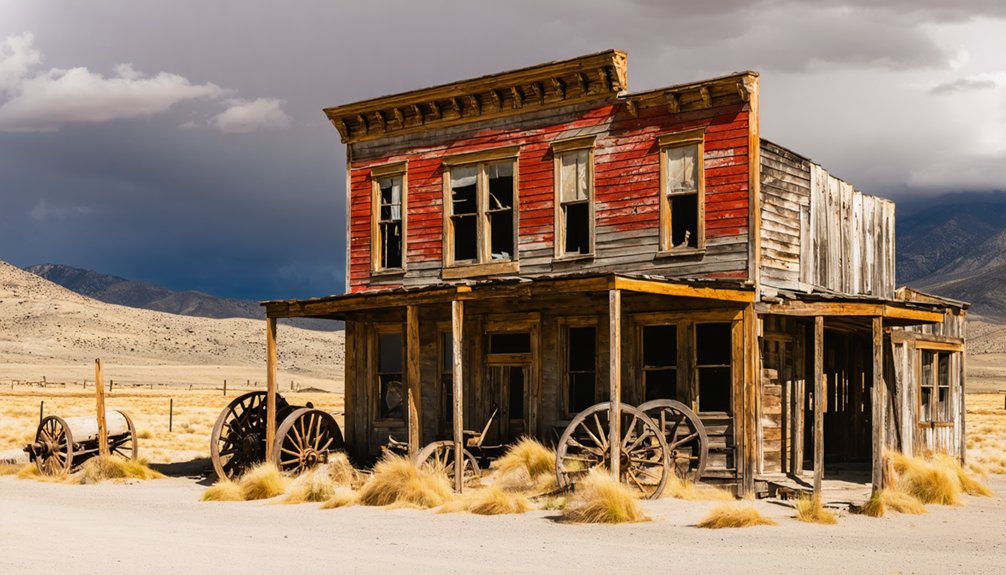
Across America, over 3,800 forgotten towns stand frozen in time, abandoned by industries and residents who sought better futures. You’ll find these time capsules scattered from Rust Belt factories to Western mining camps, their stories etched in crumbling infrastructure and empty storefronts. Economic collapse, natural disasters, and shifting policies have transformed once-thriving communities into haunting reminders of boom-and-bust cycles. These silent main streets hold deeper lessons about American resilience and reinvention.
Key Takeaways
- Ghost towns across America reveal the economic boom-bust cycles of industries like mining, steel, and textiles.
- Historic mining settlements in California, Nevada, and Arizona stand frozen in time due to arid climates preserving structures.
- Abandoned Rust Belt manufacturing cities have lost up to 65% of their populations since industrial decline began.
- Natural disasters and climate change accelerate town abandonment, creating modern ghost communities across vulnerable regions.
- Heritage tourism offers economic revival for forgotten towns through preservation of authentic historical structures and stories.
The 75% Club: America’s Most Dramatically Depopulated Communities
While America’s urban narrative often celebrates growth and expansion, a striking counter-trend has emerged in communities experiencing dramatic population collapse.
Beneath America’s growth-focused narrative lies the sobering reality of communities in free-fall population decline.
You’ll find places like Paradise, Nevada, which lost a staggering 27% of its residents in just five years – roughly 65,000 people vanishing from its streets.
New Braunfels, Texas tells an equally sobering story with its 30% population decline over the same period. These aren’t isolated incidents but symptoms of profound demographic shifts reshaping America’s landscape.
Economic volatility has devastated once-thriving communities.
Spring Valley, Nevada shed over 10% of its population in a single year. Manufacturing centers like Flint continue their decades-long decline, while tourism-dependent economies suffer rapid contractions.
The impact extends beyond population numbers as quality-of-life concerns drive residents to seek better opportunities elsewhere.
What remains are hollowed-out communities where time seemingly stands still, waiting for revival that may never come.
St. Louis mirrors this pattern with its population dropping by 8,400 residents in 2024 alone, continuing a decline that dates back to 1950.
Ghosts of Industry: How Economic Forces Emptied Our Towns
When industrial giants retreated from America’s heartland, they left more than shuttered factories and silent machinery—they created economic ghost towns that still haunt our national landscape.
You can trace the collapse through stark statistics: Youngstown lost 50,000 steel jobs, Lowell saw 10,000 textile workers displaced, and coal towns experienced 38% workforce reductions in just five years.
This devastation wasn’t merely economic—it transformed communities fundamentally.
The aftermath brings more than industrial nostalgia; it creates “death zones” where health outcomes deteriorate, drug use rises, and tax bases crumble.
While Buffalo, Detroit, and Cleveland have lost over 40% of their populations, the true tragedy lies in diminished economic resilience.
Manufacturing centers like Janesville experienced 49% job losses, with middle-class populations shrinking correspondingly.
These aren’t just statistics—they’re communities where time stands still, trapped in economic purgatory.
The national decline has been widespread, with the middle-class share falling in 203 of 229 U.S. metropolitan areas from 2000 to 2014, showing this isn’t an isolated problem but a sweeping transformation.
The social fabric tears as abandoned properties become magnets for criminal activity, undermining safety and deterring potential new businesses from taking root.
Natural Disasters and Policy Shifts: Unexpected Catalysts of Decline

Nature itself has sometimes dealt the final blow to already-struggling communities across America. When hurricanes and severe storms strike, they trigger outmigration of roughly 1 percentage point per 2.4 disasters, disproportionately affecting vulnerable populations.
Climate disasters deliver cruel finality to struggling American communities, accelerating exodus among those least able to withstand the blow.
You’ll find the evidence in housing markets, where disaster-struck areas see values plummet 2.5-5%, accelerating economic decline.
This isn’t merely about weather—it’s about policy adaptation reshaping America’s landscape. As billion-dollar disasters mount ($182 billion in 2024 alone), federal programs increasingly favor managed retreat over rebuilding in high-risk zones.
You’re witnessing a fundamental shift: communities caught between rising disaster resilience costs and diminishing economic viability. The economic burden falls heaviest on low-income households, who often lack insurance coverage against devastating storms.
The pattern is clear—flood-prone river towns, coastal communities, and drought-affected regions face compounded pressures, creating “climate abandonment zones” where time truly stands still amid accelerating depopulation. Every dollar not spent on resilience measures creates up to $33 in future economic losses for these vulnerable communities.
Northeast to Southwest: Geographic Patterns of Abandonment
As you journey across America’s forgotten landscape, you’ll notice distinctive abandonment patterns emerging from the Rust Belt’s hollowed factories in the Northeast, through Appalachia’s coal-mining towns left behind after resource depletion.
These regional differences reflect not only economic shifts but also environmental and geological realities that determined both town prosperity and eventual decline. Texas and California boast the highest concentration of ghost towns nationwide, primarily resulting from abandoned mining operations and oil discoveries.
The Southwest’s ghost towns, preserved by arid climates that slow decomposition, offer the most intact glimpses into America’s boom-and-bust cycles, with weathered saloons and mine entrances standing as time capsules in the desert sun. Many locations like Bodie, California remain in an arrested state of decay, intentionally preserved to maintain their historical significance.
Rust Belt’s Empty Factories
Stretching across America’s heartland like a rusted chain, the Rust Belt‘s abandoned factories tell a stark geographic story of industrial decline from Northeast to Southwest.
You’ll find these monuments to factory decay scattered through New York, Pennsylvania, Ohio, Indiana, Illinois, Michigan, Missouri, and West Virginia.
Cities like Gary, Detroit, Buffalo, and Pittsburgh have witnessed dramatic population collapse—Gary alone lost nearly 65% of its residents since its steel industry peak.
Over 2.2 million people have fled the region’s ten fastest-shrinking cities, leaving behind silent manufacturing corridors and hollow neighborhoods.
This economic decline isn’t merely about empty buildings; it represents manufacturing’s regional collapse, with employment plummeting from 20 million in 1979 to 12.8 million by 2025.
The landscape you see reflects not just globalization but fierce interstate competition as southern states lured away remaining factories. These once-vibrant industrial centers have experienced a troubling normalization of decline, suggesting more American cities could follow similar paths of deterioration.
The decline began in the late 20th century as foreign competition and automation transformed traditional manufacturing, leaving behind a legacy of economic challenges that persist despite various revitalization efforts.
Appalachian Mining Exodus
Moving southwestward from the collapsing Rust Belt, you’ll find Appalachia’s mining towns forming another distinct pattern of abandonment across the region’s curved geographic spine.
The devastation varies dramatically by location—Central Appalachia suffering an 80% coal output collapse compared to Northern Appalachia’s 47% decline.
You’ll witness the exodus firsthand: nearly 300,000 people gone since 1980, with working-age residents fleeing fastest. Coal mining jobs have vanished from over 125,000 to fewer than half that number, triggering community-wide employment crashes.
Where miners once descended into Double Mountain’s depths, you’ll find only silence since 2017.
This uneven geographic collapse has fractured coal community resilience, with once-thriving economies now sustained only by government transfers.
Mining workforce movement remains elusive as towns hollow out, leaving zombie mines leaking pollution across the landscape.
Western Ghost Towns Persist
Unlike Appalachia’s concentrated mining collapse, the American West displays a more scattered pattern of abandoned settlements that trace the nation’s resource extraction history from Northeast to Southwest.
You’ll find California leading with 34 ghost town locations, while Nevada and Arizona boast 25 and 27 respectively.
Mining camp stories reveal brief but intense boom periods—towns like St. Elmo, Colorado attracted 2,000 residents during the 1880s gold rush before rapidly declining.
The timeline shifts as you travel southwest, where Texas oil towns emerged after the 1901 Spindletop discovery created new settlement waves.
Ghost town legends often revolve around transportation infrastructure; rail expansion determined which towns thrived and which perished.
The remains of these settlements—from copper mining districts that rose during electrification to farming communities abandoned during the Dust Bowl—form a geographic tapestry of America’s resource-driven past.
When Main Street Falls Silent: The Ripple Effects of Population Loss
Dozens of America’s once-vibrant small towns now face an existential crisis as their populations steadily diminish, leaving behind a cascade of economic and social consequences that reverberate through every aspect of community life.
You’ll find these communities caught in downward spirals—shrinking labor pools, particularly of working-age adults, cripple business operations while declining tax bases render infrastructure maintenance nearly impossible.
The ripple effects are profound. As young families flee, fertility rates plummet below replacement levels, schools close, and businesses shutter.
The burden of maintaining essential services falls increasingly on aging residents without successors. Community engagement wanes as volunteer pools dry up, hampering revitalization strategies.
Even towns seeing temporary pandemic-driven population boosts face long-term challenges as demographic trends forecast fewer young workers nationwide, threatening their very survival.
Preserving the Past, Planning the Future: Strategies for Forgotten Towns
As you wander through America’s forgotten towns, you’ll witness the remarkable transformation of ghost towns into heritage tourism destinations, where adaptive reuse breathes new life into historic structures once destined for demolition.
Communities like Eatonville and Colquitt demonstrate how grassroots preservation initiatives—from historical societies to arts programs like Swamp Gravy—can successfully attract visitors while honoring authentic local heritage.
Despite persistent funding challenges, including the National Park Service’s maintenance backlog exceeding $12 billion, these preservation strategies represent vital lifelines for communities seeking economic revitalization through their irreplaceable cultural assets.
Heritage Tourism Revival Efforts
Throughout America’s heartland and forgotten fringes, heritage tourism has emerged as a powerful catalyst for revitalization, offering struggling communities a pathway toward economic sustainability while honoring their historical significance.
When you walk through these towns, you’ll discover heritage storytelling that transcends conventional tourism—immersive experiences featuring guided tours, cultural reenactments, and interpretive signage that breathe life into forgotten narratives.
Successful initiatives balance preservation with innovation, encouraging adaptive reuse of historic structures while maintaining their integrity. The most authentic programs incorporate indigenous perspectives alongside settlement histories, creating deeper cultural engagement through music, folklore, and seasonal festivals.
You’ll find these communities aren’t creating artificial attractions but rather mapping their authentic landmarks, vernacular architecture, and cultural events—demonstrating how thoughtful heritage tourism can revive economies without sacrificing a town’s soul.
Community-Led Preservation Initiatives
While heritage tourism offers pathways for economic revival, the most resilient forgotten towns embrace community-led preservation initiatives that place decision-making power directly in residents’ hands.
Through robust community engagement, you’ll witness the transformation of abandoned structures into vibrant historical centers where local storytelling thrives.
- Digitization efforts preserve collective memories, preventing histories from fading “out of memory and into myth”
- Community outreach “jamborees” enable you to collaborate on tangible renderings of generational stories
- Public art installations celebrate local identity while simultaneously deterring vandalism
- Small investments yield returns when communities drive economic transformation themselves
You’ll find the strongest preservation efforts aren’t imposed from outside but emerge organically when workers and residents participate in consultation processes.
These communities understand that revitalization depends on honoring their intimate knowledge of place and cultivating existing social ties.
Adaptive Reuse Models
Beyond mere preservation of historic facades, adaptive reuse models provide forgotten towns with a sustainable path toward economic revitalization without sacrificing their unique character or heritage.
You’ll find these approaches effectively transform underutilized buildings into vibrant mixed-use spaces while diverting construction waste from landfills.
Consider how places like Cincinnati’s Findlay Parkside neighborhood have rehabilitated historic structures into affordable housing and commercial spaces, simultaneously stimulating small business activity and preventing displacement.
Through flexible zoning ordinances and tax credit programs, you’re able to leverage existing infrastructure at lower environmental and financial costs.
Frequently Asked Questions
Can Depopulated Towns Legally Dissolve Their Municipal Status?
Your crumbling town halls, like fallen crowns, symbolize governance at crossroads. Yes, you can pursue municipal dissolution through petitions, public hearings, and resident votes as state laws typically permit voluntary disincorporation.
How Do Remaining Residents Maintain Social Connections in Forgotten Towns?
You’ll find residents maintaining bonds through persistent community gatherings in shared spaces, while embracing digital outreach through virtual communities. They’re preserving social fabric through both traditional interactions and modern connectivity solutions.
What Happens to Cemeteries and Burial Grounds in Abandoned Towns?
While you might expect guaranteed perpetual care, cemeteries in abandoned towns frequently suffer neglect. You’ll find deteriorating headstones, overgrown vegetation, and compromised burial rights as cemetery maintenance responsibilities fall to distant descendants or volunteer preservationists.
Do Property Values Ever Recover in Significantly Depopulated Areas?
Property values rarely fully recover in depopulated areas. You’ll find recovery hinges on economic revitalization and renewed property demand—often through broadband expansion, natural amenities, or remote work opportunities that attract liberty-seeking newcomers.
How Do Seasonal Tourism Patterns Impact Forgotten Town Economies?
You’ll witness economic revival through seasonal tourism influxes, creating temporary employment waves and demanding strategic tourism marketing to transform your forgotten town’s dormant spaces into vibrant, albeit ephemeral, economic lifelines.
References
- https://www.youtube.com/watch?v=UjcIlk6Dlbk&vl=en-US
- https://www.empirecenter.org/publications/eight-in-10-new-york-towns-and-cities-have-lost-population-since-2020/
- https://www.popularmechanics.com/science/a46410256/half-of-us-cities-depopulating-ghost-town-era/
- https://en.wikipedia.org/wiki/Shrinking_city
- https://www.census.gov/library/stories/2023/05/large-cities-no-longer-biggest-population-losers.html
- https://carsey.unh.edu/publication/rural-america-lost-population-over-past-decade-first-time-history
- https://joybird.com/blog/top-ghost-towns-in-america/
- https://www.youtube.com/watch?v=Z2Zw_IJ2GY0
- https://essentialmoveoutcleaning.com/blog/which-us-cities-are-people-leaving-in-2025
- https://ktvz.com/stacker-news/2025/01/06/population-declined-the-most-in-these-us-cities/