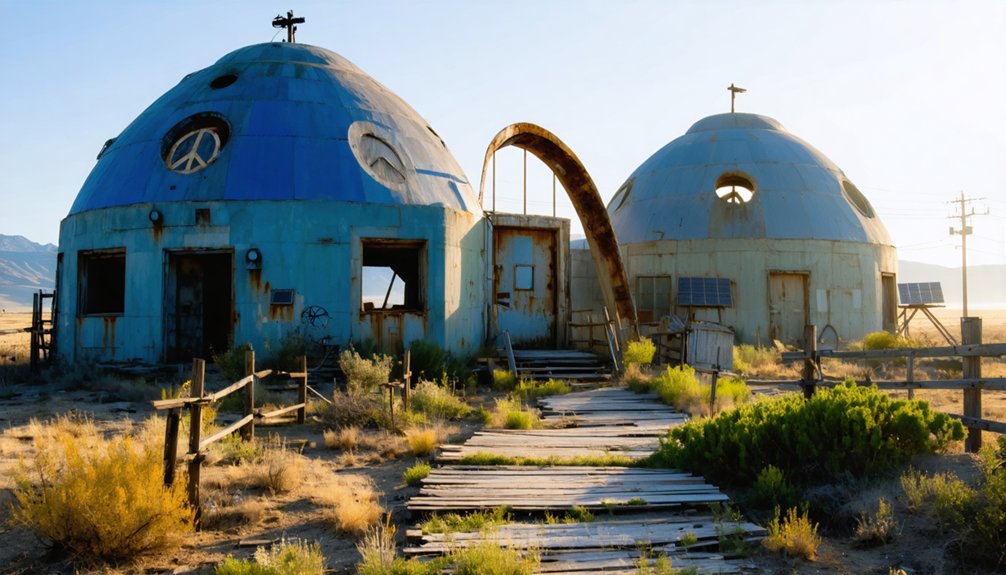
You’ll find America’s forgotten utopian communities scattered across the landscape—remnants of bold social experiments like New Harmony, Brook Farm, and the North American Phalanx. These 19th-century settlements collapsed despite innovative economic models and architectural designs. Today, their crumbling communal halls and preserved meeting houses attract visitors seeking connections to America’s experimental past. These weathered monuments reveal the tension between idealistic vision and practical reality that doomed each ambitious endeavor.
Key Takeaways
- New Harmony collapsed by 1827 due to internal conflict and financial issues, leaving architectural remnants as silent witnesses to its utopian vision.
- The Harmony Society faced extinction by 1905 despite initial success, primarily due to its celibacy doctrine that prevented natural population growth.
- Brook Farm’s intellectual-manual labor experiment lasted only six years before financial struggles and a devastating fire ended the community.
- North American Phalanx disbanded after a fire in 1856, despite its innovative three-tier compensation structure balancing capital, skill, and labor contributions.
- Many abandoned utopian sites are now preserved as historical landmarks, offering visitors glimpses into America’s experimental communal living attempts.
The Rise and Fall of New Harmony: Owen’s Grand Experiment

While many American ghost towns emerged from mining booms, New Harmony stands apart as the remnant of one of America’s most ambitious social experiments.
In 1825, industrialist Robert Owen purchased this ready-made town for up to $150,000, acquiring 20,000 acres and 180 buildings from the Harmony Society.
You can trace Owen’s vision of social reform through the community’s physical layout, where nearly 1,000 participants attempted communal living under a constitution allowing personal belongings while maintaining communal assets.
The “Boatload of Knowledge”—scientists, educators, and artists—arrived in 1826 to fuel the intellectual atmosphere, but practical challenges mounted quickly.
Unlike the Harmonists’ organized community, the Owenite experiment suffered from day-to-day chaos with persistent conflicts over labor division and financial matters.
Economic motivation faltered without sufficient skilled laborers, and by 1827, Owen’s experiment collapsed under the weight of internal strife and poor productivity, leaving behind architectural remnants of utopian aspirations.
The transition from Rapp’s religious community to Owen’s secular ideals represented a significant shift in communitarianism, marking the evolution from faith-based to rationalist approaches to social reform in pre-Civil War America.
Harmony Society: From Pennsylvania to Indiana and Back
Before America witnessed Robert Owen’s utopian vision collapse, the Harmony Society had already established a pattern of carefully calculated migrations across the American frontier.
Under Rapp’s leadership, these German separatists transformed wilderness into industrial centers three times between 1805 and 1825.
You’ll find their journey began in Butler County, Pennsylvania, where 400 members signed away individual property rights to create their first communal settlement. The Articles of Association, signed on February 15, 1805, formalized this arrangement by establishing a common fund with an initial working capital of $23,000 for necessities.
Community dynamics shifted dramatically when celibacy became doctrine in 1807, even as their population reached 1,000.
Community membership swelled to 1,000 even as Rapp’s controversial celibacy doctrine reshaped their fundamental social structure.
After relocating to Indiana’s Wabash River in 1814, they built an even more impressive settlement before returning to Pennsylvania in 1824 to establish Economy.
This final community showcased their manufacturing prowess, particularly in silk production, but celibacy eventually guaranteed their extinction by 1905. The group was initially founded by George Rapp in 1803 as a way for followers to escape religious persecution in their native Germany.
Brook Farm’s Intellectual Haven: When Transcendentalism Met Socialism

Among the most influential intellectual experiments of American utopianism, Brook Farm emerged in 1841 when George Ripley, a former Unitarian minister and Transcendental Club leader, established a cooperative community on 175 acres in West Roxbury, Massachusetts.
At Brook Farm, you’d find members pursuing transcendentalist ideals through an innovative balance of manual labor and intellectual cultivation. The community sought to insure natural union between intellectual and manual labor as one of its primary objectives. The community challenged conventional economics, paying all workers equally regardless of gender or task while providing necessities at cost.
This cooperative society attracted luminaries like Hawthorne and Fuller before embracing Fourier’s socialist principles in 1844. The community’s social hub was The Hive, which served as the central dining and gathering space for all members.
Despite its revolutionary vision, Brook Farm’s experiment lasted just six years. Financial struggles plagued the community, culminating in the devastating 1846 fire that destroyed their nearly-completed Phalanstery building.
Ephrata Cloister: A Religious Commune’s Remarkable Longevity
When you visit the remains of Ephrata Cloister today, you’ll encounter the physical remnants of America’s longest-surviving religious commune, where German Pietist monastic traditions emphasized celibacy, midnight prayer sessions, and strict discipline.
Through remarkable self-sufficiency, the community’s inhabitants excelled in calligraphy, bookbinding, and musical composition, producing over 1,000 original hymns and operating a printing press that created works treasured by neighboring religious groups.
As membership declined following founder Conrad Beissel’s death in 1768, the community pragmatically shifted from strict celibacy to allowing marriage, ultimately transforming into the German Seventh Day Baptist Church that preserved the settlement until 1934, nearly two centuries after its 1732 founding. The commune once thrived under Beissel’s charismatic leadership, attracting many followers particularly after the death of Brethren founder Alexander Mack in 1735. During the Revolutionary War, the Cloister demonstrated its broader societal engagement by serving as a hospital for soldiers while maintaining its spiritual identity.
German Pietist Monastic Traditions
Hidden amid Pennsylvania’s rolling hills, Ephrata Cloister stands as one of America’s most fascinating and enduring religious experiments. Founded by German émigré Conrad Beissel in 1732, this community embodied rigorous Pietist practices centered on celibacy, asceticism, and preparation for Christ’s return.
You’ll discover the monks and nuns slept on wooden benches with block pillows, observed midnight prayer vigils, and sustained themselves on sparse vegetarian meals. Their communal spirituality manifested through distinctive musical compositions—among America’s earliest religious music—and elaborate Frakturschriften calligraphy. The Ephrata Cloister is also known for its printing press that produced the Martyrs Mirror, an important text in Amish and Mennonite homes. Archaeological digs in 1998 unearthed a unique glass trumpet believed to have been intentionally buried at the site.
At its height, approximately 80 celibate Brothers and Sisters lived alongside 200 non-celibate “householders.”
Though the monastic order ended in 1813 with the last celibate’s death, remaining members continued worship until 1934, creating a remarkable two-century legacy of spiritual devotion and cultural contribution.
Self-Sufficiency Through Craftsmanship
The Ephrata Cloister‘s extraordinary longevity stemmed directly from its members’ masterful craftsmanship and economic self-sufficiency.
You’ll find evidence of their sustainable practices in the nine preserved Germanic-style structures that have withstood nearly three centuries. Their craftsmanship techniques encompassed everything needed for community survival—from textile production to operating their own printing press.
When you visit this National Historic Landmark, you’ll witness how their labor system balanced spiritual devotion with practical necessities:
- Frakturschriften calligraphy—pioneering American folk art
- Self-composed acapella music that attracted neighboring communities
- Papermaking and carpentry that supported both internal needs and external trade
- Textile production providing essential clothing and goods for community use
This remarkable self-contained economy allowed them to thrive independently while preparing for their anticipated spiritual transformation.
Celibacy Versus Pragmatic Survival
While craftsmanship guaranteed material sustainability at Ephrata Cloister, the community’s stark ascetic practices reflected a deeper spiritual philosophy balancing celibacy with practical survival needs.
You’ll notice the community navigated celibacy challenges through structured hierarchies—80 celibate “Solitary” members maintained rigorous discipline while 200 married “Householders” guaranteed population stability.
This dual-membership approach proved a masterful survival strategy. When celibates slept on 15-inch wooden benches with wooden block pillows and maintained six-hour split sleep schedules, the married congregation sustained community continuity.
The community’s shift mechanisms reveal remarkable adaptation—after the last celibate died in 1813, the Householders seamlessly transformed into the German Seventh Day Baptist Church, extending religious presence for another 120 years.
This strategic balance between ascetic idealism and pragmatic succession planning explains their exceptional longevity.
North American Phalanx: Fourierism in Practice
In the rural fields of Red Bank, New Jersey, you’ll find the weathered remnants of North American Phalanx, America’s most enduring Fourierist community where members shared living quarters in a phalanstery while distributing profits according to labor, capital, and skill contributions.
The cooperative’s economic model sustained itself through diverse enterprises including fruit farming, flour milling, and blacksmithing operations—all organized around Charles Fourier’s utopian socialist principles of collective labor and mutual benefit.
This remarkable social experiment came to an abrupt conclusion when its main communal building collapsed after a devastating fire, effectively ending the longest-lasting American application of Fourierism’s cooperative ideals.
Communal Living Experiment
Visionaries seeking utopian social reform established the North American Phalanx in Colts Neck, New Jersey, in September 1843 as America’s flagship experiment in Fourierism.
The community pioneered communal governance where members lived in a two-story phalanstery, sharing facilities while maintaining private family quarters.
Collective decision making determined labor distribution, with jobs categorized and compensated based on difficulty and skill.
- Returns distributed annually: 5% on capital investment, $1 per ten-hour workday
- Structured labor system with premiums for arduous tasks, penalties for lighter work
- Specialized services and coordinated domestic labor maximized efficiency
- Common dining facilities served meals accommodating diverse dietary preferences
You’d have witnessed this experiment in cooperative living until January 1856 when, following a devastating 1854 fire that destroyed crucial workshops, America’s longest-lasting Fourierist community disbanded.
Economic Cooperative Model
The North American Phalanx operated on an intricate economic system derived directly from Charles Fourier’s philosophy of cooperative association.
Unlike radical communists, members retained private property while embracing cooperative labor within their 5,000-acre settlement.
You’d find a sophisticated three-tier compensation structure at work: capital investments earned 5% returns, specialized compensation rates rewarded difficult tasks, and ordinary labor received $1 per ten-hour day.
The repugnant or exhausting jobs commanded wage premiums, while attractive work incurred deductions—a practical application of Fourierist principles.
The phalanx’s economic success stemmed from diverse enterprises: fruit cultivation, milling operations, and workshops.
Annual accounting distributed proceeds systematically among capital, labor, and talent categories.
This balanced approach to collective production with individual ownership sustained the community through 1856, outlasting all other American Fourierist experiments.
Fiery Building Collapse
Disaster struck the North American Phalanx on September 10, 1854, when flames engulfed their flour mill, reducing the structure and its contents to ash. Without fire safety measures or insurance protection, the community faced devastating losses exceeding $20,000. This catastrophe exposed their financial vulnerability, with debt quickly mounting to $30,000.
- Warehouses, shops, and wheat inventory purchased on credit were completely destroyed.
- No insurance was recovered, amplifying the financial devastation.
- Stockholders voted for dissolution rather than fundraising for rebuilding.
- The property was eventually sold in 1856, ending America’s most successful Fourierist experiment.
Despite attempts to sell to Victor Considerant for his Texas colonization project, no agreement materialized.
The community’s inability to demonstrate resilience against this disaster effectively terminated the last surviving phalanx from the 1840s Fourierist movement.
The Architecture of Utopia: What Remains Today
Across America’s forgotten landscapes, utopian architectural remnants stand as weathered monuments to communities that once sought to reshape society through their built environments.
Among these relics, ghost towns in the United States reveal the dreams and aspirations of their former inhabitants. Each structure tells a story of prosperity followed by decline, where the passage of time has left an indelible mark. Exploring these sites allows us to reflect on the transience of human endeavor and the enduring nature of our built environment.
These utopian remnants reveal revolutionary concepts: thick-walled structures with flat roofs for natural cooling, circular radial grids, and kitchenless homes connected by underground passages.
You’ll find architectural legacies in various states of decay—stone foundations reclaimed by desert at Llano, preserved structures at Ephrata Cloister, and repurposed buildings at Brook Farm.
The ruins tell stories through their layouts: large communal halls, segregated functional zones, and innovative domestic designs meant to liberate residents from traditional labor burdens.
What survives reflects core ideals—shared spaces, climate-responsive materials, and infrastructure supporting self-sufficiency—physical representations to alternative visions of American life.
Economic Models That Failed: Why These Communities Collapsed

While these architectural remnants reflect idealistic visions, their physical decay mirrors the economic collapse that ultimately doomed these communities.
You’re witnessing the aftermath of failed economic models that couldn’t withstand capitalism’s relentless pressure. Despite noble intentions, communal resource allocation systems faltered when confronted with harsh realities.
- Financial instability crippled operations as debt accumulated from ambitious building projects without sufficient revenue.
- Communal ownership principles clashed with incentives needed to maximize productivity in competitive markets.
- Leadership disputes weakened economic planning, while rigid social constraints hindered necessary adaptation.
- Equal work-reward schemes struggled against unequal labor motivation, causing critical resource deficits.
These economic contradictions weren’t merely theoretical – they manifested in abandoned workshops, crumbling communal halls, and overgrown fields that once promised abundance through cooperation rather than competition.
Modern Pilgrimages: Visiting America’s Utopian Ruins
Today’s travelers seeking more than typical tourist attractions find profound meaning in the decaying remnants of America’s utopian experiments.
You’ll discover these historical treasures preserved on the National Register, from New Harmony, Indiana to the North American Phalanx site in New Jersey.
Utopian tourism has evolved beyond passive observation—sites like Hancock Shaker Village and Amana Colonies offer immersive experiences through living history demonstrations and interactive exhibits.
Access varies, with many sites open year-round, though some require reservations for guided tours.
Historical preservation efforts maintain architectural authenticity while digital archives extend these communities’ legacies beyond physical boundaries.
Audio guides and mobile apps enhance your exploration, revealing the intricate social frameworks that once promised alternative lifestyles.
These destinations aren’t merely relics—they’re portals into radical visions of American possibility.
Frequently Asked Questions
Did Women Hold Leadership Positions in Utopian Communities?
Yes, you’ll find female leadership in select utopian communities, particularly Shaker societies where gender equality principles elevated women to administrative positions alongside men, while others showed limited implementation despite idealistic constitutions.
How Did Utopian Communities Handle Healthcare and Medicine?
You’d think mainstream doctors would laugh, but utopian communities revolutionized healthcare through volunteer-run free clinics, alternative medicine practices, and communal health systems that eliminated financial barriers while prioritizing preventive, equitable care for all.
What Educational Systems Existed for Children in These Communities?
You’ll find these communities established one-room schoolhouses with educational philosophies blending practical skills and religious values. Child development centered on multi-age classrooms where few teachers delivered broad curricula adapted to local conditions.
How Did Utopian Communities Interact With Neighboring Native American Tribes?
You’ll find complex relationships emerged: some communities established rare mutual respect through treaties like Meusebach-Comanche, while others perpetuated displacement. Cultural exchange flourished in Quaker settlements, yet many utopians simply ignored native presence entirely.
Did Any Former Utopian Community Members Achieve Later Fame?
You’ll find numerous famous alumni emerged from utopian experiments, including Louisa May Alcott from Fruitlands and Drop City artists. Their lasting legacies transformed American literature, art, and food culture throughout subsequent decades.
References
- https://open.baypath.edu/his114/chapter/utopian-communities/
- https://historycollection.com/10-american-utopian-communities-rose-perfection-dramatically-collapse/
- https://fee.org/articles/the-dark-side-of-paradise-a-brief-history-of-americas-utopian-experiments-in-communal-living/
- https://www.nps.gov/articles/000/secular-utopias-in-america.htm
- https://en.wikipedia.org/wiki/List_of_American_utopian_communities
- https://www.britannica.com/story/american-utopias
- https://guides.loc.gov/chronicling-america-early-utopian-communities
- https://www.yesmagazine.org/health-happiness/2022/06/01/american-communes-failed-experiment
- https://archive.curbed.com/2019/8/5/20748964/new-harmony-indiana-history-utopia
- https://www.ebsco.com/research-starters/history/communitarian-experiments-new-harmony