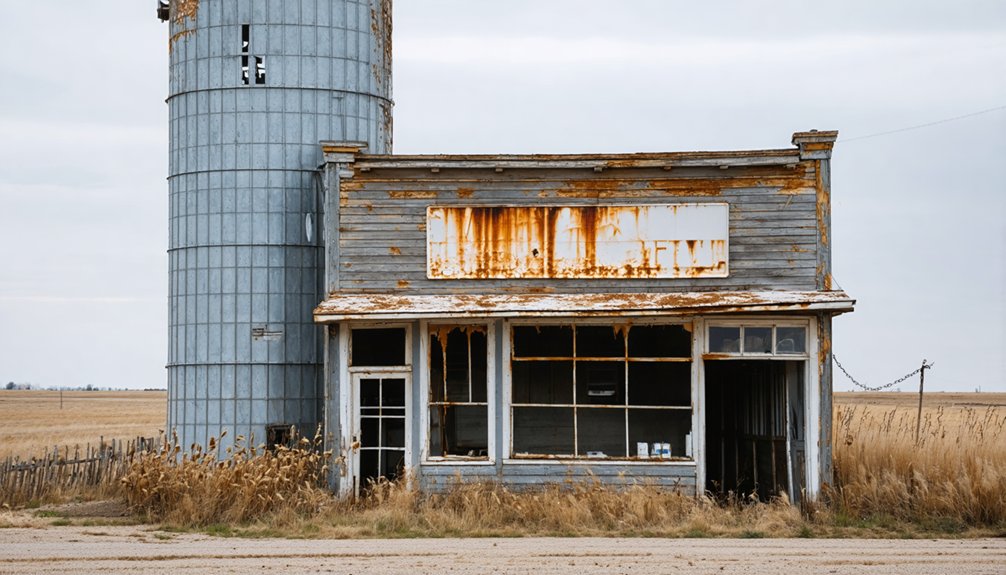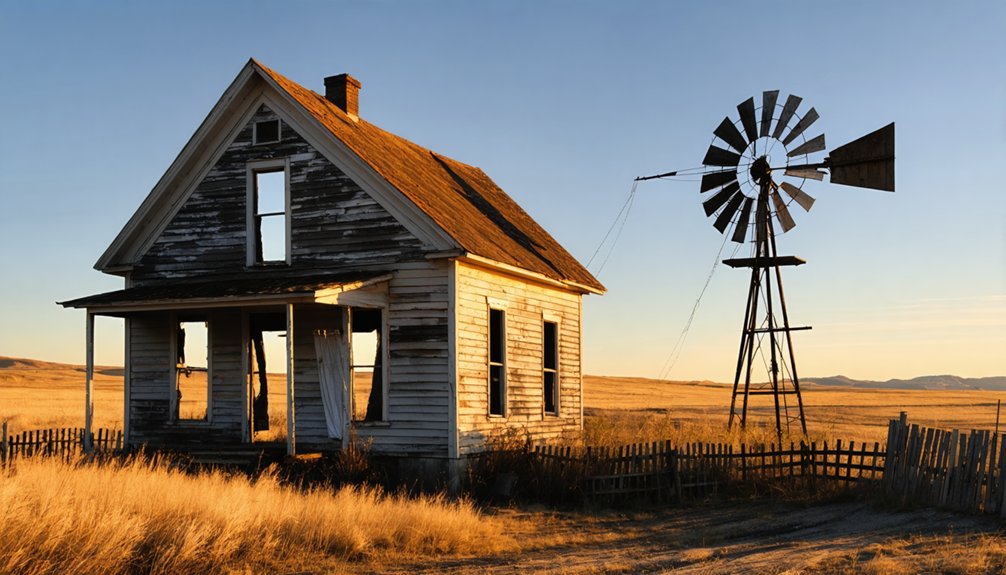
The Great Plains’ ghost towns stretch from Texas to North Dakota, marking America’s rural demographic shift. You’ll find abandoned storefronts, crumbling foundations, and empty schoolhouses—physical remnants of communities devastated by agricultural mechanization, the Dust Bowl, and economic changes. Once-thriving settlements like Dearfield, Colorado transformed from 700 residents to virtual abandonment by 1940. These silent prairie monuments reveal how farm consolidation, drought, and population exodus forever altered the heartland landscape.
Key Takeaways
- Ghost towns across the Great Plains reflect widespread rural exodus caused by agricultural mechanization, the Dust Bowl, and economic shifts.
- Mining communities experienced dramatic boom-and-bust cycles, with towns like Teller City emerging rapidly and disappearing almost completely within decades.
- Nearly half of Great Plains counties lost over 10% of their population between 1990-2010, accelerating the abandonment process.
- Architectural remnants from earth lodges to commercial districts serve as physical testaments to diverse cultural heritage across the plains.
- Preservation efforts including drone mapping and grassroots campaigns aim to document ghost towns before their complete deterioration.
The Silent Prairie: Defining the Ghost Towns Phenomenon

While gazing across the windswept expanses of the Great Plains today, you’ll encounter the skeletal remains of once-thriving communities scattered across the landscape like architectural fossils.
These aren’t merely sites of urban decay but physical remnants of America’s rural past, stretching from Texas to North Dakota.
Unlike Western mining settlements that emptied overnight, Great Plains ghost towns experienced gradual abandonment—casualties of agricultural mechanization, the Dust Bowl’s devastation, and economic shifts. Dearfield, Colorado exemplifies this pattern, transforming from a prosperous African-American farming community with 700 residents to virtual abandonment by 1940.
The heartbeat of Plains communities slowed not with sudden silence, but with the quiet rhythm of prolonged farewell.
You’re witnessing a distinctly regional pattern where communities lost population steadily over decades, leaving behind abandoned schoolhouses and empty storefronts that evoke profound cultural nostalgia.
The phenomenon transcends simple abandonment; it represents freedom lost and sought elsewhere.
These settlements—many once vibrant farming communities—tell stories of adaptation and movement across the American heartland.
Recent studies show these rural declines mirror patterns seen in Rustbelt and Sunbelt regions, where housing vacancy rates have dramatically increased following economic downturns.
Boom and Bust: Mining Communities That Vanished
Beyond the gradual decline of prairie farming settlements lies a more dramatic pattern of abandonment across the Great Plains—the meteoric rise and fall of mining communities. You’ll find their remnants scattered throughout the landscape, where extraction economies created volatile mining cycles.
Towns like Teller City exploded with nearly 30 saloons before vanishing by 1902, while South Pass City hosted 2,000 souls before collapsing two decades later.
The precious metals boom sparked the first wave—gold and silver camps flourished briefly before ore depletion. Later, industrial minerals drove development, with lead and zinc sustaining communities like Treece until environmental contamination forced evacuation. In the Black Hills region, many bustling settlements lasted only months during intense gold rushes.
Copper towns like Kennicott thrived with electrification’s spread but faded by 1938. Community resilience proved strongest where diversification occurred—Butte survived while isolated single-resource settlements disappeared into prairie silence. Texas and California contain the highest concentration of these abandoned communities due to their extensive mining and oil industries.
Dust Bowl Casualties: Agricultural Towns Left Behind

When the rains stopped and the winds began scouring the Great Plains in the 1930s, a wave of environmental devastation transformed the agricultural landscape of America’s heartland.
You can still trace patterns of agricultural decline across abandoned farmsteads where approximately 2.5 million people fled, seeking refuge from the dusty wasteland their homes had become.
Across the landscape, three markers of this exodus remain:
Echoes of the Dust Bowl linger as silent sentinels marking a desperate migration from lands that could no longer sustain life.
- Empty storefronts where once-thriving agricultural supply businesses served prosperous farming communities
- Crumbling foundations of foreclosed family farms later consolidated into massive corporate operations
- Abandoned schoolhouses standing as monuments to communities that refused surrender despite nature’s fury
The severe drought struck in three distinct waves, with some regions suffering under drought conditions for up to eight years, leaving communities with no choice but to abandon their homes.
Despite this devastation, seeds of community resilience took root through conservation practices and water management that would eventually allow some towns to recover, though many remain only as windswept memories.
The removal of native prairie grasses across millions of acres exposed vulnerable topsoil that would ultimately fuel the catastrophic dust storms of the period.
When the Railroad Left: Transportation Shifts and Abandonment
The disappearance of railroad infrastructure across the Great Plains carved permanent voids into the region’s settlement patterns, creating a distinct category of ghost towns that you can trace along abandoned rail corridors.
When companies like the Kansas City Terminal Railway purchased lines only to file for abandonment, they erased communities’ lifelines overnight.
You’ll find this transportation legacy etched into the landscape—Highlandlake, Colorado withered after being bypassed, with residents describing the event as their community’s “death knell.”
Public buildings were physically relocated to railroad-favored towns.
Rail abandonment triggered cascading failures: Steins, New Mexico lost both its water supply and economic purpose when trains stopped in 1944.
Mining operations collapsed, hotels shuttered, and entire populations evacuated—sometimes on the final train out, as witnessed in St. Elmo in 1922.
The last train passed Ottawa over 30 years ago, leading to economic struggles for many small towns that had been historically dependent on railway connections for their commerce and growth.
Similar to Colorado’s ghost towns, many abandoned settlements were once mining boomtowns that flourished during the gold rush era before declining into historical relics.
These ghost towns of the Midwest tell stories of hope and despair, filled with remnants of the lives once lived within their now silent streets. As nature reclaims these spaces, visitors can explore the ruins of old storefronts and homes, witnessing history frozen in time. Each settlement reflects the dreams and struggles of those who sought fortune on the frontier, leaving behind a haunting reminder of the past.
Haunting Remains: Architectural Legacy of Forgotten Settlements

Across the abandoned plains, you’ll find circular depressions marking where earth lodges once stood—sacred spaces where architecture mirrored cosmic beliefs through four central posts symbolizing sky pillars.
Your journey through these weathered remnants reveals how tribes optimized dome-shaped structures against harsh prairie elements, with thick earthen walls providing superior insulation compared to later rectangular buildings.
Wind-resistant designs and communal village layouts showcase indigenous engineering brilliance that balanced practical needs with cultural significance, though only scattered reconstructions preserve this architectural heritage today. These structures represent genuine architecture of place rather than merely structures imposed upon the landscape without consideration for regional characteristics. Like the historic town of Dearfield with its all-Black settlement history, these indigenous sites tell stories of communities adapting to challenging environments through thoughtful design.
Weathered Prairie Icons
Scattered across the windswept expanse of the Great Plains, weathered structures stand as haunting tributes to abandoned dreams and forgotten communities.
These prairie architecture remnants tell stories through their decaying frames and crumbling foundations, each weathered facade a reflection of the harsh realities of frontier life.
As you explore these ghostly settlements, you’ll encounter:
- False-front commercial buildings – once-proud symbols of prosperity now stripped bare by dust storms and neglect
- Stone ruins of churches and homes – more resilient than their wooden counterparts, yet still surrendering to time
- Skeletal grain elevators – vertical sentinels marking where communities once thrived before drought forced abandonment
The Dust Bowl‘s devastating legacy lives in collapsed roofs and peeling paint, while fireplaces stand as final witnesses to homes where settlers once gathered for warmth against unforgiving prairie winters.
Preserving Sacred Spaces
Beyond the weathered facades and collapsed rooftops lies a more profound challenge: preserving what remains of these architectural treasures before they vanish entirely.
You’ll find the sacred heritage of places like Dearfield, Colorado particularly vulnerable—where Black pioneers created thriving communities that lasted two decades before succumbing to environmental and economic devastation.
Drone mapping now creates digital twins of these structures, capturing their cultural significance before the harsh prairie elements claim them completely.
The collaboration between the Black American West Museum and preservation organizations demonstrates a growing recognition of these sites’ importance.
When you explore these forgotten landscapes, notice how architectural patterns reveal community values—integrated schools near Dearfield speak to progressive ideals, while the strategic positioning of buildings around dried creek beds shows how water access determined settlement patterns.
Population Exodus: Demographic Trends Across the Plains
While examining the demographic landscape of the Great Plains over recent decades, you’ll find a stark pattern of human exodus that has transformed vast stretches of rural America into increasingly emptier spaces.
These population shifts have hollowed out once-vibrant communities, leaving behind skeletal frameworks of former prosperity.
The rural demographics reveal three critical patterns:
Demographic fingerprints expose the Plains’ transformation—population drain, youth exodus, and minority repopulation reshape America’s heartland.
- Nearly half of Great Plains counties lost over 10% of their population between 1990-2010
- Young adult populations (20-34) declined by 15% in rural counties, creating generational gaps
- Hispanic communities partially offset losses, adding 48,000 residents while overall rural counties lost 104,000 people
This spatial reorganization isn’t merely statistical—it’s inscribed on the land itself, where population densities have fallen below two persons per square mile in some areas, creating freedom through emptiness.
Economic Lifelines Cut: How Rural Commerce Collapsed

As farm consolidation reshaped the agricultural landscape across the Great Plains, economic lifelines that once sustained rural communities were systematically severed.
You’ll find the evidence etched across the terrain—empty storefronts standing as monuments to rural entrepreneurship decline, their weathered facades revealing the spatial pattern of commerce’s retreat.
Where vibrant mercantile districts once served dispersed populations, now convenience stores and gas stations dot isolated intersections.
Community banks—once the financial backbone of small town resilience—have vanished from 78% of depopulating counties across the Plains and Corn Belt.
The landscape tells this economic story clearly: fewer farms meant fewer customers, creating a downward spiral as businesses closed, jobs disappeared, and young people departed—leaving behind commercial districts that stand as silent testimonies to prosperity that once was.
Preservation Efforts: Saving Historical Remnants
Across the windswept Great Plains, four major preservation strategies have emerged to rescue the physical remnants of abandoned communities from total erasure.
You’ll find innovative grant strategies leveraging partnerships between federal agencies and universities, creating powerful funding coalitions that transform crumbling structures into stabilized historical assets. Community involvement forms the backbone of these efforts, with descendants and local historians driving grassroots preservation campaigns.
Grassroots passion and institutional resources unite to breathe new life into our forgotten prairie heritage.
- Digital preservation through drone mapping and 3D scanning creates “digital twins” of deteriorating structures.
- Archaeological field schools document spatial relationships while training future preservationists.
- Strategic land acquisition negotiations protect site integrity from encroaching development.
These preservation patterns reveal a landscape where forgotten places find new purpose through documentation.
Your exploration of these sites contributes to their survival, as public interest strengthens the case for continued protection.
Tourism Revival: Second Lives for Abandoned Communities

Once destined for complete abandonment, numerous Great Plains ghost towns have discovered unexpected second lives through tourism development. You’ll find former mining settlements like St. Elmo transforming their picturesque landscapes into seasonal destinations, where heritage tourism now supports economies once dependent on resource extraction.
Community engagement drives these revivals. Local organizations in places like Goliad, Texas implement branding strategies and host events such as Market Days, drawing visitors while preserving historical authenticity.
The landscape patterns reveal thoughtful infrastructure improvements—historic district walks, restored buildings, and museums—that maintain the spatial character while accommodating modern needs.
These towns now thrive through economic diversification, combining cultural attractions with natural settings. By balancing tourism growth with local resources, these communities have carved paths to sustainability where extractive industries once dominated—offering you glimpses into both past and future possibilities.
Modern Ghost Towns: 21st Century Rural Decline
While tourism has breathed new life into certain abandoned communities, the 21st century has paradoxically accelerated rural decline throughout the Great Plains.
The geographic concentration of this modern migration reveals a stark pattern: as you travel across Texas High Plains, you’ll witness 27 counties hemorrhaging residents, with Claude losing 7% of its population in a single year.
Three critical factors driving this transformation:
- Agricultural collapse creating economic vacuums
- Critical infrastructure closures eliminating essential services
- Youth exodus (ages 16-26) depleting future workforce potential
The landscape tells this story through visible markers—vacant storefronts, declining building permits, and homes sitting empty for years.
Despite rural revitalization efforts, projections suggest nearly 15,000 American communities could become ghost towns by century’s end.
Frequently Asked Questions
Can Ghost Towns Be Legally Purchased by Individuals?
Where there’s a will, there’s a way. You can purchase ghost towns individually, though complex legal ownership situations and fragmented property rights often create a patchwork landscape requiring careful title verification.
What Paranormal Activity Is Commonly Reported in Great Plains Ghost Towns?
You’ll encounter ghost sightings of settlers and disembodied eerie sounds across Great Plains ghost towns. Abandoned structures create patterns of paranormal activity, with historical trauma imprinted on the landscape you’re free to explore.
How Do Seasonal Weather Patterns Affect Abandoned Structures?
You’ll witness weather damage most severely where seasonal decay meets abandoned dreams. Freeze-thaw cycles crack foundations, while summer heat warps timbers—creating landscape patterns that document nature’s reclamation of human structures.
Which Ghost Towns Have Been Repurposed for Film Production?
You’ll find Bannack, Montana and 1880 Town, South Dakota transformed into cinematic history hubs, while Bodie, California and Virginia City serve as authentic film locations across the rugged western landscape.
Are There Indigenous Communities Among Great Plains Ghost Towns?
Yes, you’ll find indigenous heritage persists among Plains ghost towns. Archival evidence reveals displaced communities whose resilience shaped landscape patterns before settler expansion fragmented their spatial connections to ancestral territories.
References
- https://www.lincolninst.edu/publications/articles/new-american-ghost-towns/
- https://plainshumanities.unl.edu/encyclopedia/doc/egp.ct.024.html?stream=top
- https://www.geotab.com/ghost-towns/
- https://www.legendsofamerica.com/gt-emergingghosttowns/
- https://en.wikipedia.org/wiki/Ghost_town
- https://www.britannica.com/topic/ghost-town
- https://www.ndstudies.gov/sites/default/files/LessonPlans/LessonPlan-HighSchool-GhostTownsOfNorthDakota.pdf
- https://jasontdunn.com/files/ghost_towns_big_cities.pdf
- https://www.richmondfed.org/-/media/richmondfedorg/publications/research/econ_focus/2011/q3/pdf/feature2.pdf
- https://jrap.scholasticahq.com/api/v1/articles/9543-the-economics-of-ghost-towns.pdf