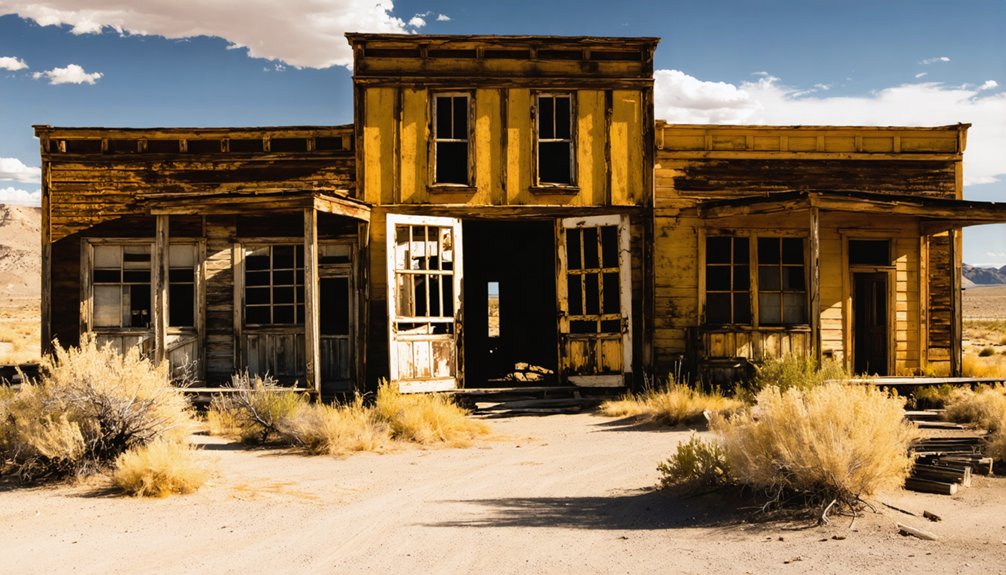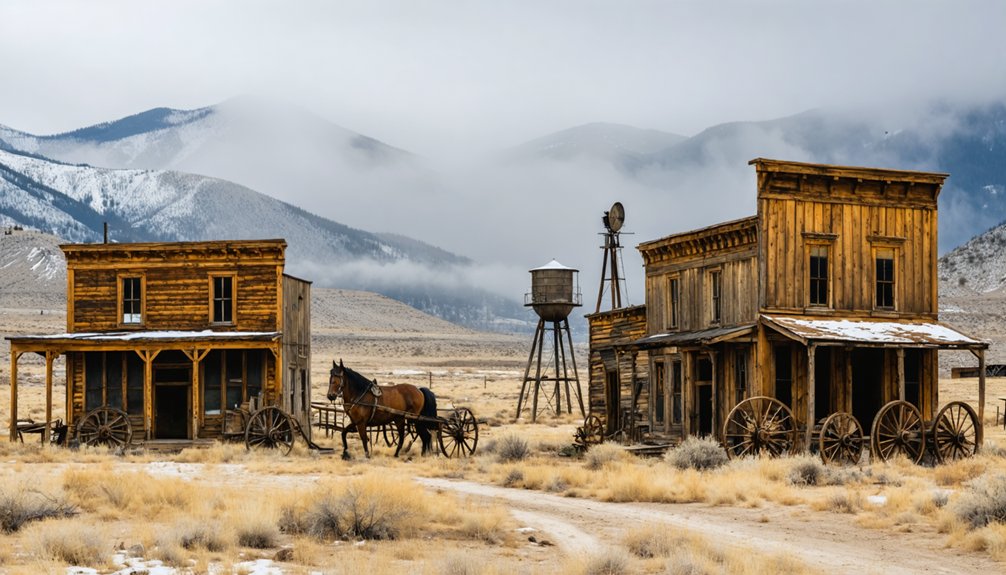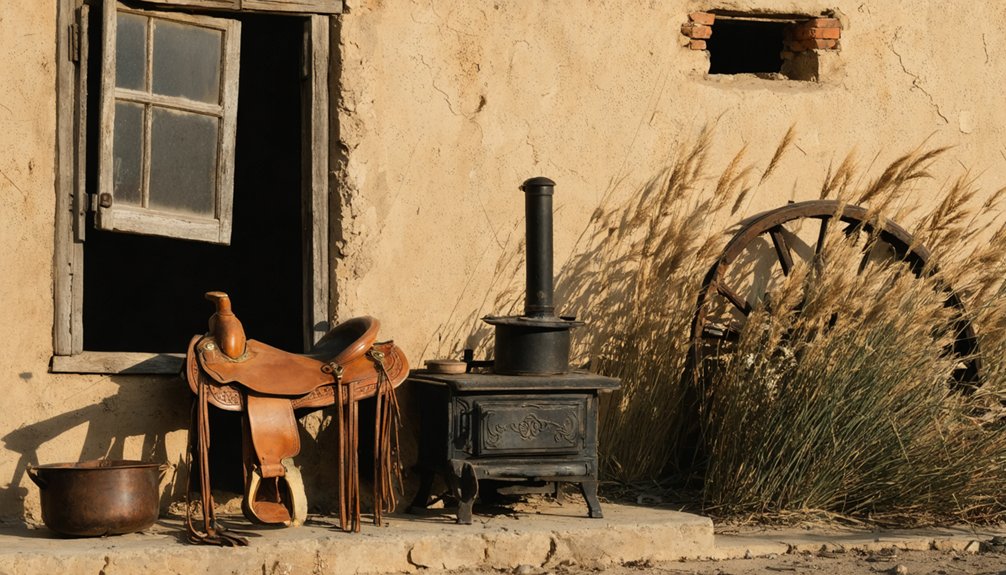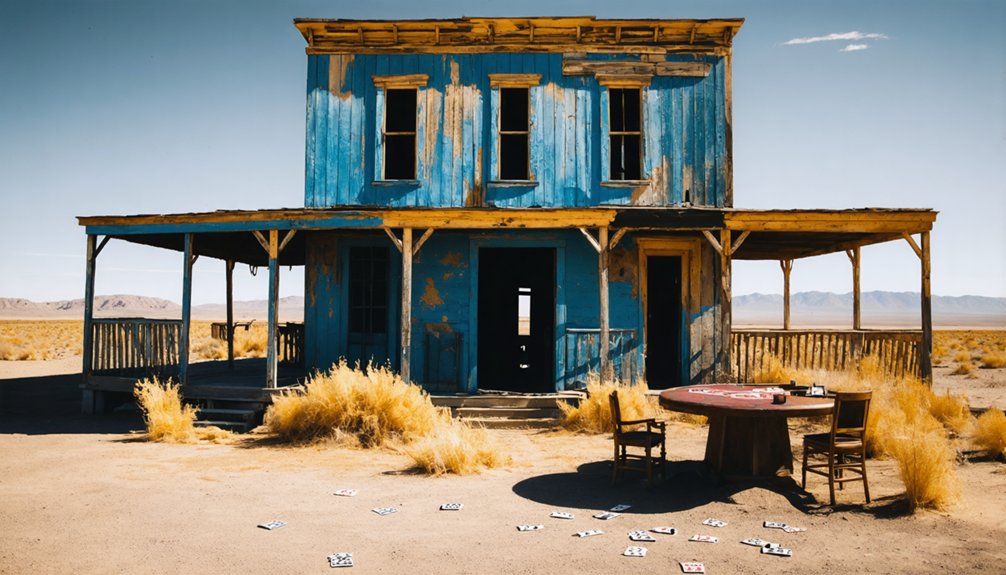
America’s ghost towns offer windows into the boom-and-bust cycles of westward expansion. You’ll find nearly 300 abandoned settlements in California alone, preserved in various states of “arrested decay.” Places like Bodie, Calico, and Rhyolite showcase authentic 1800s structures where mining fortunes vanished overnight. These silent monuments tell complex tales of resource exploitation, vigilante justice, and economic collapse. The dusty remains await your exploration into frontier America’s forgotten chapters.
Key Takeaways
- California’s Bodie remains in “arrested decay” with over 100 authentic structures from its 1870s mining heyday.
- Ghost towns like Calico, Rhyolite, and Gleeson showcase the boom-bust cycle of Western frontier settlements.
- Virginia City and Bannack offer immersive historical experiences with preserved buildings and reenactments.
- Abandoned mining towns reveal frontier justice histories with vigilance committees and public executions.
- Ghost stations and railroad towns reflect economic collapse when transportation routes changed or ceased operations.
The Gold Rush Legacy: California’s Most Haunting Abandoned Mining Towns
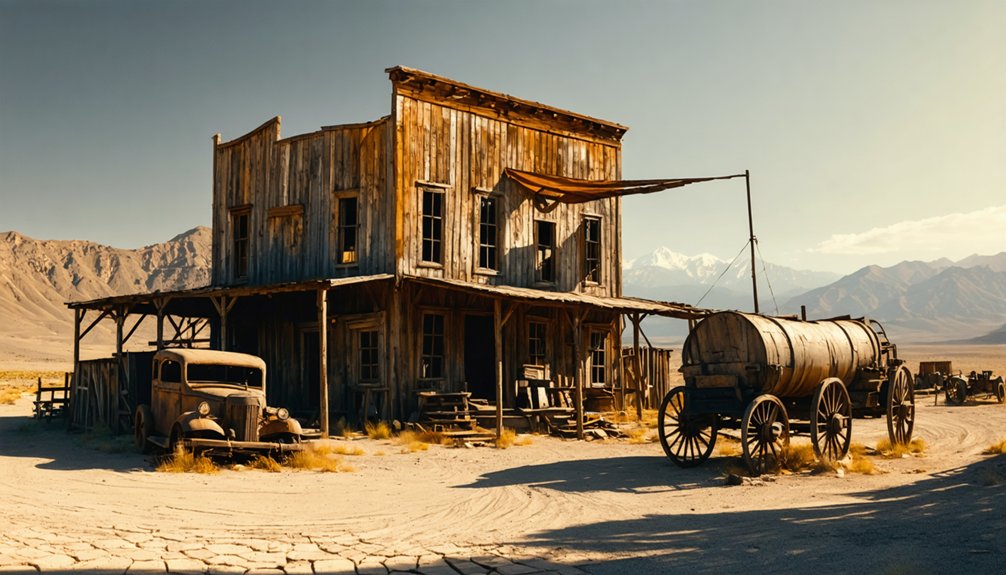
When California’s legendary Gold Rush swept across the western frontier in the mid-19th century, it left behind a remarkable legacy of abandoned settlements that now stand as haunting reminders of America’s westward expansion.
You’ll find nearly 300 ghost towns scattered throughout California, each telling stories of boom-and-bust cycles that defined the era.
Bodie preservation efforts have maintained this once-thriving settlement of 8,000 in a state of “arrested decay,” offering you an authentic glimpse into 1870s mining life.
Meanwhile, Calico tourism showcases California’s largest silver mining operation before its 1890s collapse.
Other notable sites include Shasta, once the “Queen City” north of San Francisco, and Ballarat near Death Valley, where weathered adobe structures reveal the transient nature of frontier dreams. Colonel Allensworth State Historic Park preserves the remarkable story of a town established in 1908 that represented a vision of Black American self-governance.
Empire Mine State Historic Park in Grass Valley preserves one of the state’s oldest and richest gold mines where an impressive 5.6 million ounces of gold was extracted over a century of operation.
Desert Remnants: Ghost Towns of the Southwestern Frontier
Across the sun-baked terrain of the American Southwest, desert ghost towns stand as weathered monuments to the region’s tumultuous mining history and frontier ambitions.
You’ll encounter Arizona’s Gleeson, where Native Americans once mined turquoise before settlers discovered copper and silver. Despite a devastating 1912 fire, it persisted until 1940, leaving photogenic ruins amid rocky desert landscapes.
Gleeson survived flames and changing fortunes, its weathered structures now silent storytellers of Arizona’s mining past.
Nearby, Goldfield flourished with 4,000 residents before gold veins ran dry, now preserved as Youngsburg. Southern Arizona’s Charleston processed Tombstone’s silver while attracting notorious outlaws, its remains reflecting the volatility of mining-dependent communities.
California’s Bodie stands frozen in an arrested state of decay, protected by the state parks system after once housing 10,000 residents and over 60 saloons during its 1880s mining heyday.
Nevada’s Rhyolite offers visitors a chance to explore photogenic ruins including the famous Bottle House and remnants of the bank, abandoned after the mine closed in 1911.
Cross into New Mexico and you’ll find Chloride, born from Harry Pye’s silver strike, while Utah offers Old Irontown and flood-ravaged Thistle—all testimonials to the harsh realities of frontier life and the Southwest’s rich mining heritage.
Boom and Bust: How Resource Depletion Created America’s Ghost Towns

The rapid rise and dramatic collapse of numerous settlements across the American West exemplifies one of history’s most striking economic cycles, fundamentally driven by resource extraction and subsequent depletion.
When you examine towns like Bodie and Calico, you’ll discover how mineral discoveries triggered explosive growth, followed by inevitable decline. As gold, silver, and other resources vanished, these communities experienced catastrophic economic volatility.
Infrastructure crumbled, businesses shuttered, and residents fled. Heritage tourism has emerged as a means of preserving these historical sites for future generations to explore and understand their cultural significance.
The pattern repeated throughout Oklahoma in places like Jumbo, Meers, and Bickford. Once thriving communities became silent testimonies to boom-bust capitalism. These towns suffered particularly after being bypassed by railroads, creating transportation challenges that accelerated their economic isolation.
Today, these abandoned settlements stand as stark reminders of prosperity’s fleeting nature when built upon finite resources—preserved ruins testifying to the fragility of resource-dependent economies.
Preserved in Time: Historic Ghost Towns You Can Visit Today
While ghost towns represent the sobering remnants of resource depletion, many have found new purpose as preserved historical sites that offer visitors tangible connections to America’s frontier past.
Bodie, California exemplifies “arrested decay” historic preservation, allowing you to witness over 100 authentic structures with original interiors.
Freeze-framed in time, Bodie’s weathered structures reveal life exactly as its last inhabitants left it.
At Bannack, Montana, you’ll explore 60+ buildings and potentially experience “Bannack Days” reenactments.
Virginia City, Nevada offers immersive visitor experiences through accessible silver mining artifacts and operational museums.
Beyond mining settlements, industrial ghost towns like Batsto Village showcase 18th-century ironworks and Revolutionary War production sites.
Remote destinations like Kennecott, Alaska and St. Elmo, Colorado combine historic exploration with scenic wilderness adventures.
These carefully maintained sites balance authentic deterioration with accessibility, creating powerful windows into America’s pioneering spirit without sacrificing the raw authenticity that makes these abandoned places compelling.
Rhyolite, Nevada once thrived with electricity and telephone lines provided by wealthy investors before its population dwindled to just 14 residents by 1920.
Belmont, Nevada features Dirty Dick’s Saloon, an off-the-grid establishment that dates back to 1867 when the town was thriving after a significant silver discovery.
Dusty Legends: Tales of Lawlessness and Wild West Justice

Beyond the weathered storefronts and abandoned saloons, ghost towns harbor darker histories of frontier justice that reveal the complex social dynamics of America’s westward expansion.
When you walk these deserted streets, you’re treading where vigilante justice once ruled in the absence of formal law enforcement. Frontier lawlessness wasn’t merely circumstantial—it was systemic. Citizens formed vigilance committees that operated without trials, while public executions followed flawed proceedings. Wealthy individuals often hired private lawmen and offered substantial rewards to pursue their version of justice.
You’d have witnessed judges presiding over cases while intoxicated and minorities facing harsher punishments than whites. After executions, outlaws’ bodies were typically photographed standing upright against walls to verify their death and claim bounties.
In this environment, you’d have carried firearms as both protection and status symbol. Bounty hunters—not sheriffs—pursued criminals with rewards payable “dead or alive.” This legitimized lethal force and undermined due process, creating the very conditions that turned once-thriving communities into the ghost towns you explore today.
Underground Fires and Natural Disasters: Towns Forced Into Abandonment
Unlike abandoned towns that faded gradually through economic decline, numerous Western settlements met their demise through catastrophic natural disasters, with underground fires representing perhaps the most insidious form of environmental destruction.
While ghost towns often wither through economic abandonment, many died violently by nature’s hand—none more hauntingly than by fire beneath their streets.
You’ll find no more striking example than Centralia, Pennsylvania, where a 1962 landfill fire penetrated unsealed coal mine tunnels, creating an inferno that’s burned for over sixty years.
This subterranean blaze, reaching depths of 300 feet across 400 acres, transformed a thriving community into a condemned zone. As toxic gases and ground instability created sinkholes up to 150 feet deep, the government spent $42 million relocating residents.
Despite these dangers, the site has ironically attracted tourism, with its “Graffiti Highway” becoming a macabre attraction. The fire continues burning today—a stark indication of environmental negligence—and experts project it will persist for centuries.
From Thriving to Forgotten: The Economic Collapse of Western Railroad Towns

You’ll find haunting reminders of the railroad’s fleeting prosperity in the abandoned stations that dot America’s western landscape, testifying to towns that collapsed when rail companies changed routes or ceased operations.
These once-thriving communities experienced catastrophic economic decline when railroad networks contracted, with towns developed specifically around rail service becoming especially vulnerable as transportation technologies evolved beyond trains.
The systematic reduction of Nebraska’s rail network since 1915 exemplifies this pattern, leaving behind ghost towns whose very existence had been predicated on their position along transcontinental routes that eventually became economically obsolete.
Railroad Departure’s Fatal Impact
When railroad companies altered their routes or abandoned stations in the late 19th and early 20th centuries, the economic consequences for affected Western towns proved catastrophic and often irreversible.
You’d find merchants and settlers immediately abandoning communities that lost rail access, as their economic lifelines were severed overnight.
The period from 1880-1940 revealed the stark economic fragility of transportation-dependent settlements. Without rail connections, towns couldn’t compete with nearby communities that maintained railroad routes.
Farmers redirected their business to stations offering lower costs through efficient transportation, while bypassed towns experienced immediate business failures as customer traffic vanished.
Mining operations, utterly dependent on rail infrastructure to convert extracted resources into profit, collapsed when lines closed.
This single-industry vulnerability, coupled with transportation abandonment, transformed once-thriving commercial centers into the ghost towns you’ll find scattered across today’s Western landscape.
Ghost Stations Stand Empty
The skeletal remains of once-bustling railroad depots now stand as silent monuments to the West’s economic transience.
You’ll find these ghostly echoes of prosperity scattered across remote landscapes where thousands once gathered for commerce and community.
What were previously centers of activity—with hotels, saloons, and repair shops—have deteriorated into hollow structures hosting only memories.
When railroad companies rerouted lines or modernized operations, they effectively sentenced these towns to death.
The abandoned railroads that once delivered economic lifeblood now lead nowhere.
Maintenance facilities that employed hundreds sit empty, their machinery rusted and buildings crumbling.
Communities that flourished with schools, libraries, and cultural institutions dissolved as essential services vanished.
Today, these stations exist primarily as historical curiosities, their architectural details slowly eroding—physical reminders of how quickly prosperity can vanish when economic foundations shift.
Modern Ghost Towns: America’s Continuing Cycle of Urban Abandonment
You’ll find striking parallels between Detroit’s automotive industry collapse and Silicon Valley’s recent tech exodus, as both represent contemporary iterations of the ghost town phenomenon.
While Detroit lost 25% of its population between 2000-2010 following manufacturing decline, San Francisco’s 7.4% population drop from 2020-2023 stems from tech companies relocating amid rising costs and remote work policies.
These modern urban abandonments demonstrate how economic monocultures remain vulnerable to industry shifts, creating vacant commercial corridors and declining housing markets reminiscent of historical Western ghost towns.
Detroit’s Auto Collapse
Detroit’s auto industry collapse represents perhaps America’s most dramatic example of modern urban abandonment, transforming a once-thriving metropolis into a contemporary ghost town.
You’re witnessing the aftermath of a perfect storm: manufacturing decentralization that began in the 1950s, technological stagnation amid rising global competition, and the devastating 2008 financial crisis.
The city’s population plummeted from 1.85 million in 1950 to 713,777 by 2011, as factories that once employed tens of thousands—Dodge Main, River Rouge, Packard—drastically reduced workforces or shuttered completely.
This urban decay manifests in 600,000 abandoned structures and widespread brownfield contamination.
Unlike the Old West ghost towns that died when resources depleted, Detroit’s collapse occurred during the auto industry’s economic peak, revealing capitalism’s capacity to create modern ruins even amid prosperity.
Silicon Valley’s Tech Exodus
While Detroit’s decline occurred over decades, Silicon Valley’s transformation into America’s newest ghost town phenomenon has unfolded with striking rapidity since 2020.
You’re witnessing a historic tech talent migration as over 151,000 workers were displaced in 2024 alone, with traditional hubs losing their dominance to emerging centers like Washington D.C. and Austin.
These economic shifts reflect fundamental restructuring rather than cyclical downturns. As AI disrupts 42% of Silicon Valley jobs and companies like Salesforce replace thousands with automated systems, the region faces unprecedented urban abandonment.
Tech workers now prioritize affordability and quality of life, fleeing to lower-tax states with favorable business climates. This decentralization is creating modern ghost towns in once-thriving tech corridors while simultaneously democratizing access to high-skill jobs across previously overlooked American regions.
Frequently Asked Questions
Can You Legally Claim Abandoned Property in Ghost Towns?
You can legally claim abandoned property through adverse possession, following state-specific abandoned property laws and claiming procedures that typically require continuous occupation, tax payments, and court filings for several years.
What Ghost Towns Have Become Successful Revitalization Stories?
You’ll observe successful revitalization projects in Terlingua, Jerome, and Bodie, where historical preservation efforts have transformed abandoned mining settlements into vibrant destinations balancing heritage with contemporary economic viability.
Do Any Ghost Towns Still Have Permanent Residents?
Yes, you’ll find modern day inhabitants in several ghost towns like Helena (Texas) with 200 residents maintaining structures of historical significance, Centralia (Pennsylvania) with fewer than five despite toxic conditions, and Johnstown (Pennsylvania) with 15,000.
How Do Ghost Towns Impact Surrounding Property Values?
You’ll find ghost towns typically depress nearby property values, though successful ghost town tourism can reverse this trend, generating new property market trends that attract investment despite historical abandonment patterns.
This phenomenon is particularly evident in regions with historically rich narratives, such as ghost towns along the east coast. As visitors flock to experience these remnants of the past, local economies can thrive, leading to revitalization efforts and an increase in tourism-related businesses. This unexpected resurgence not only enhances community pride but also opens the door for new opportunities in real estate and local services.
Which Ghost Towns Are Most Endangered by Climate Change?
While you may think all ghost towns face similar threats, Alaska’s Shishmaref and Kivalina are most endangered, creating climate refugees due to severe erosion risks. New Orleans and Charleston face catastrophic subsidence-related flooding by 2050.
References
- https://themortgagepoint.com/2024/10/25/americas-new-ghost-towns/
- https://247wallst.com/housing/2024/04/11/americas-modern-ghost-towns-2/
- https://www.youtube.com/watch?v=BCEJSNF6nW8
- https://www.youtube.com/watch?v=odbOj8W4V9o
- https://www.geotab.com/ghost-towns/
- https://nightofthejack.com/2025/01/23/top-creepy-ghost-towns-in-america/
- https://www.youtube.com/watch?v=UujbImwiLfA
- https://joybird.com/blog/top-ghost-towns-in-america/
- https://patch.com/california/banning-beaumont/13-ghost-towns-explore-california
- https://www.visitcalifornia.com/road-trips/ghost-towns/