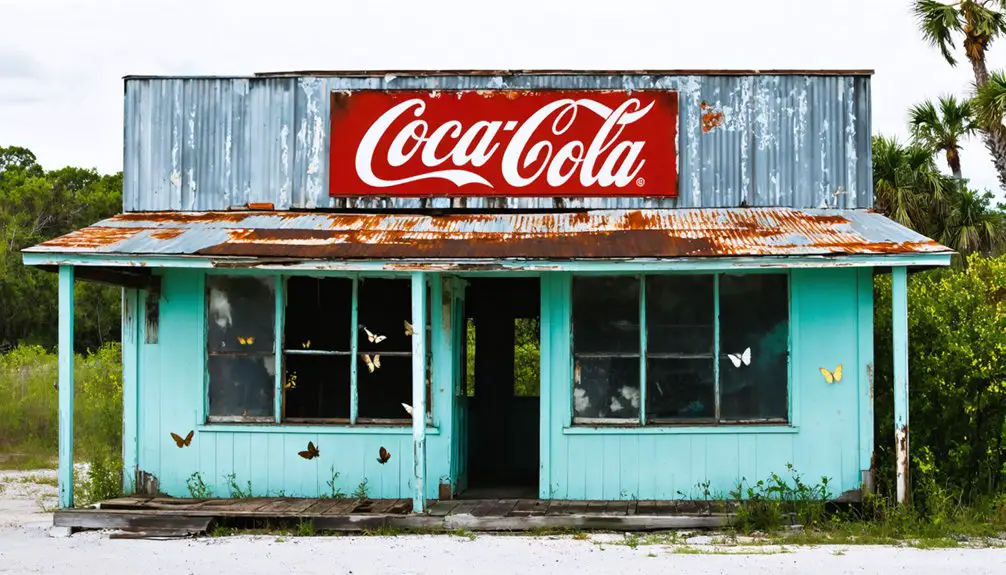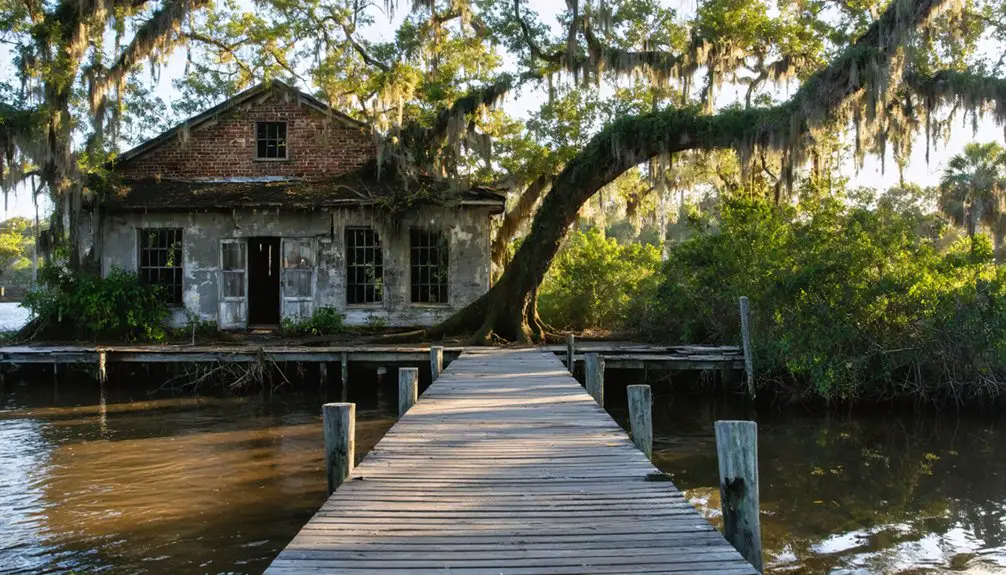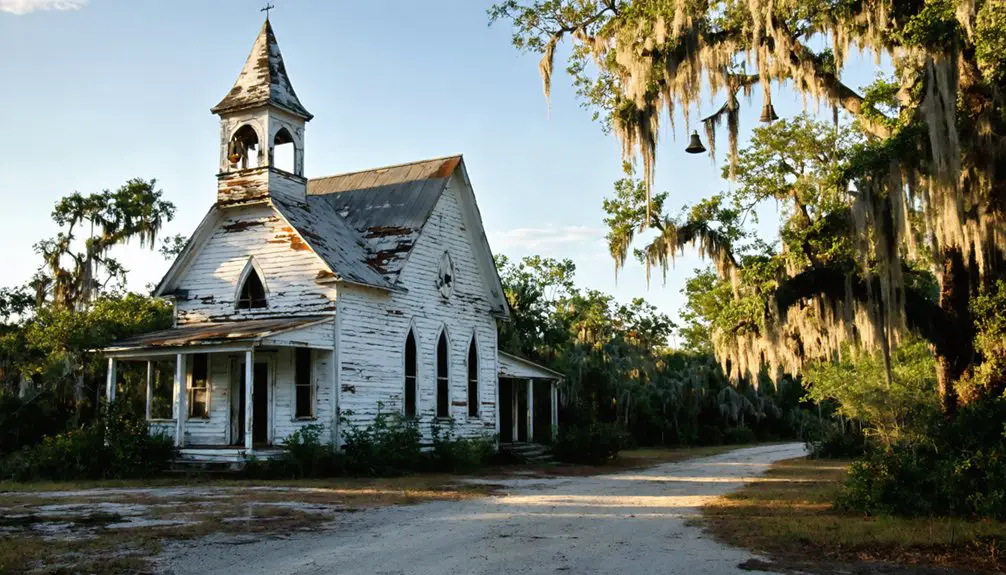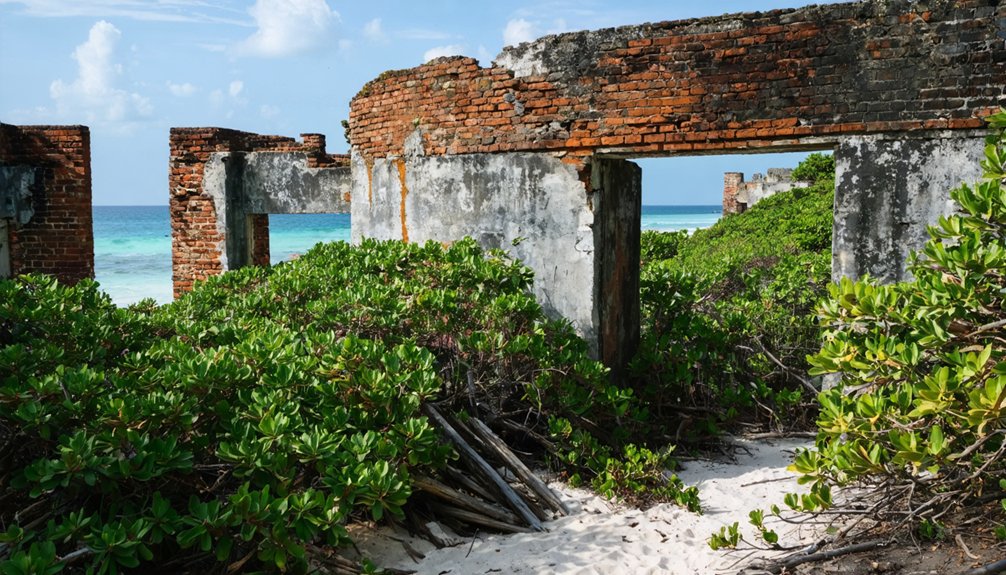
You’ll find Fort Dade’s haunting ruins scattered across Egmont Key, a military ghost town that once defended Tampa Bay during the Spanish-American War and World War I. Built in 1898, this strategic fortress housed over 300 personnel and featured massive concrete gun batteries, barracks, and a complete military community with brick roads and modern amenities. A devastating 1921 hurricane ultimately forced the fort’s closure in 1923, leaving behind weathered remnants that tell the story of America’s coastal defense evolution.
Key Takeaways
- Fort Dade was constructed in 1898 on Egmont Key as a coastal defense installation during the Spanish-American War.
- The fort grew into a self-contained military community with over 300 residents and 75 buildings by 1920.
- A devastating hurricane in October 1921 destroyed key infrastructure, leading to the fort’s closure in May 1923.
- Today, visitors can explore weathered ruins including concrete gun batteries, brick roads, and remnants of military buildings.
- Park ranger “Mr. Tom” serves as the only permanent resident overseeing this historic ghost town site.
From Spanish-American War Outpost to World War I Artillery Base
When the Spanish-American War erupted in April 1898, the U.S. military rushed to construct Fort Dade on Egmont Key at the mouth of Tampa Bay, fearing a Spanish naval invasion of Florida’s strategic coastline.
You’ll find this fortification was strategically paired with Fort De Soto on Mullet Key, creating a formidable defense network. The military erected a thousand tents housing approximately 300 personnel, including Teddy Roosevelt’s famous Rough Riders.
Military innovations transformed the fort’s capabilities as five artillery batteries were constructed post-1898. These coastal defenses featured high-tech rapid-fire guns with 12-mile ranges and concrete batteries housing 2-3 large guns each. During World War I, the installation served as a training center for National Guard Coast Artillery units. The fort remained active until the mid-1920s, when military operations were discontinued.
Life on a Military Island: Buildings, Amenities, and Daily Operations
Behind the impressive artillery defenses, Fort Dade developed into a self-contained military community that housed over 300 residents by 1920.
You’d find yourself living in a bustling island community with over 75 buildings, including two massive 109-man artillery barracks, officers’ quarters, and a hospital. The military lifestyle offered unexpected comforts: brick roads, electricity, telephones, and entertainment facilities like a movie theater, bowling alley, and tennis courts.
Daily operations centered around manning coastal gun batteries and anti-submarine mine stations that controlled Tampa Bay’s mouth. Artillery crews lived alongside their families in this isolated but well-equipped outpost. The fort’s infrastructure continued expanding well into the 1910s, with the final major addition being a power plant completed in 1919.
The elaborate quartermaster infrastructure supported everything from explosives storage to maintenance operations, creating a unique blend of military readiness and domestic normalcy on this strategic Florida island. When the fort was deactivated in 1923, the Tampa Bay Pilots Association began operations in 1926, marking a transition from military to civilian maritime use.
Strategic Defense of Tampa Bay and the Endicott Period Fortifications
The mouth of Tampa Bay presented both opportunity and vulnerability that military strategists recognized long before the Spanish-American War transformed coastal defense thinking.
You’ll find that Robert E. Lee himself selected this site in 1848, understanding its commanding position over the primary shipping lane.
When Congress authorized the Endicott Period fortifications in the 1890s, engineers designed Fort Dade as one of twenty-one strategic locations protecting America’s coast from Maine to the Gulf.
The fort’s military strategy centered on five concrete artillery batteries, each deploying two to three large guns with five-mile ranges.
You can still see remnants of the massive storage depot that housed mines capable of sealing Tampa Bay’s mouth.
Working alongside Fort De Soto, these installations created an impenetrable defensive network that protected one of Florida’s most crucial waterways. Following the Spanish-American War, Teddy Roosevelt and the Rough Riders were briefly stationed at Fort Dade as part of the coastal defense operations.
The fort also served a humanitarian role during the Third Seminole War, functioning as a temporary internment camp for displaced Seminole families.
Hurricane Damage and the End of Coastal Artillery Era
Although Fort Dade‘s artillery batteries had successfully defended Tampa Bay’s shipping lanes for decades, nature proved more destructive than any enemy fleet ever could.
The October 1921 hurricane devastated the installation, completely destroying the boathouse and wharf while severely damaging numerous buildings. This catastrophic storm accelerated the fort’s obsolescence, as elaborate coastal defense systems had already been deemed outdated following World War I.
The fort had operated in coordination with Fort De Soto to control Tampa Bay’s strategic shipping channels through joint artillery operations. During the Spanish–American War, Fort Dade served as a crucial quarantine facility where returning soldiers from Cuba underwent mandatory ten-day isolation periods.
- Hurricane impacts included complete destruction of the boathouse and wharf facilities
- Coastal defense installations were deemed obsolete by military strategists in 1921
- Fort closure occurred in May 1923, directly following the devastating hurricane damage
- Caretaker status replaced active military operations throughout the 1920s
- Brief World War II reactivation focused on harbor patrol rather than coastal artillery
Exploring the Ruins: What Remains of Fort Dade Today
More than a century after Fort Dade’s abandonment, visitors to Egmont Key can still walk among the weathered remnants of this once-bustling military installation.
Time has weathered Fort Dade’s walls, but its military legacy endures for modern explorers on Egmont Key.
You’ll discover nearly one mile of brick roads connecting the lighthouse to the pilot station, plus six miles of brick pathways winding through the fort’s remains. The historical significance becomes apparent as you explore massive concrete gun batteries stripped of their weapons along the northwest shore, including Battery McIntosh with its accessible interior steps.
You can examine gutted shells of the mess hall, post-jail, and the iconic guardhouse that remains largely intact.
Ammunition bunkers and spotting tower ruins dot the landscape, though jungle growth increasingly reclaims these structures, creating a haunting memorial to military history. The island’s only permanent resident today is park ranger “Mr. Tom,” who maintains watch over these historic ruins.
Frequently Asked Questions
Can Visitors Access Egmont Key and Fort Dade Ruins Today?
Yes, you can access the island today via boat or ferry from Fort De Soto Park. Follow current visitor guidelines: respect closed zones near lighthouse structures, bring supplies, and explore Fort Dade ruins freely.
What Happened to Major Francis L. Dade in the 1835 Massacre?
Major Francis Dade died outside the breastworks at December 28, 1835’s ambush, killed with nearly his entire 110-man command. Dade’s legacy sparked the Second Seminole Wars’ bloodiest chapter.
How Many Seminoles Were Held at the Internment Camp?
Hundreds held: You’ll find at least 300 Seminoles suffered in this strategic Seminole internment camp. Camp history reveals the Army’s calculated cruelty, targeting families to force warriors’ surrender during the 1850s removal operations.
Are There Any Paranormal Activities Reported at Fort Dade?
Yes, you’ll find documented ghost sightings including shuffling footsteps at dusk, unexplained commotion sounds, and anomalous noises replacing typical waves. Paranormal investigations have recorded these phenomena, particularly during early morning hours near the abandoned ruins.
Visitors often seek out ghost town attractions in Helen to experience the eerie atmosphere for themselves. Local legends speak of lost souls wandering the streets, and enthusiasts often report feeling an inexplicable chill in the air. The juxtaposition of history and haunting tales makes this destination uniquely captivating.
What Role Did Tampa Bay Hotel Play as War Headquarters?
You’ll find Tampa Bay’s significance monumentally transformed when it became the epicenter of America’s Cuban invasion planning. War headquarters history shows you’d witness generals strategizing campaigns while troops arrived by rail for liberation operations.
References
- https://www.legendsofamerica.com/fort-dade-egmont-key/
- https://www.floridastateparks.org/learn/history-egmont-key
- https://floridaseminoletourism.com/a-dark-history-at-egmont-key/
- https://floridabrokerjordan.com/blog/the-significance-of-egmont-key
- https://digitalcommons.usf.edu/cgi/viewcontent.cgi?article=1303&context=sunlandtribune
- https://baysoundings.com/egmont-key-stories-from-eyewitnesses-to-history/
- https://www.fortwiki.com/Fort_Dade_(3)
- https://abandonedfl.com/fort-dade/
- https://savingplaces.org/stories/the-quest-to-save-a-fragile-florida-island-with-a-difficult-history
- https://sites.google.com/honors.usf.edu/gulfbeachestoday/egmont-key