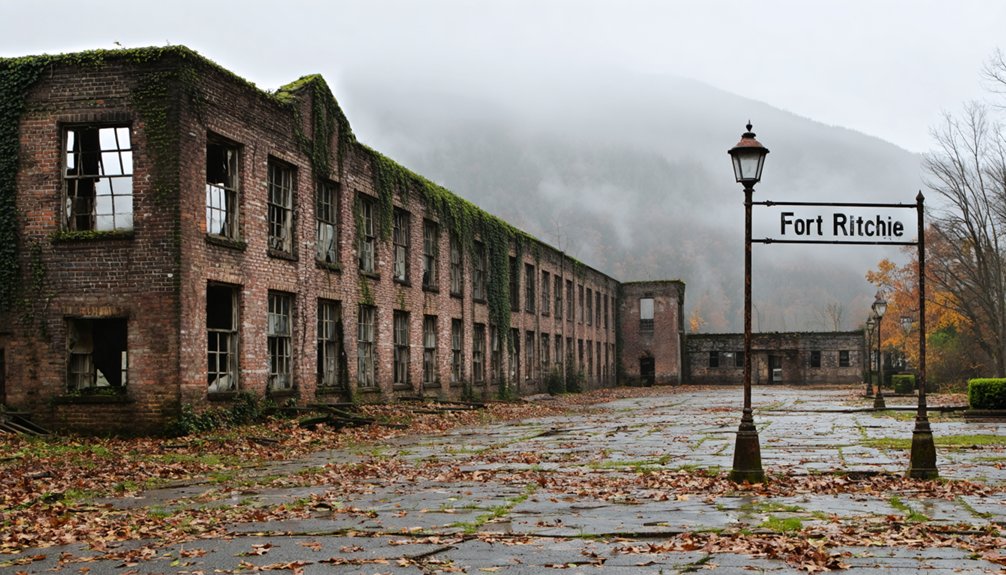
You’ll find Fort Ritchie stands as Maryland’s most significant abandoned military installation, transformed from a 1926 National Guard training camp into America’s premier World War II intelligence center. The facility trained approximately 20,000 operatives, including the famous “Ritchie Boys” – many Jewish refugees who became vital Allied intelligence assets. After the 1995 Base Realignment and Closure Commission designated it for shutdown, operations ended in 1998, leaving behind deteriorating buildings and economic devastation that multiple redevelopment attempts couldn’t resolve, though recent preservation efforts promise renewed hope.
Key Takeaways
- Fort Ritchie was abandoned in 1998 after military closure, creating a ghost town effect in rural Maryland.
- The former military intelligence training facility housed 20,000+ personnel but stands largely empty after failed redevelopment attempts.
- Environmental complications and vandalism plagued the site between 1998-2020, contributing to its deteriorated ghost town appearance.
- Economic devastation from base closure caused significant job losses, impacting the surrounding local community severely.
- Abandoned buildings include mock German villages, ice houses, and military structures now decaying without proper maintenance.
From Ice Production to Military Training Grounds
Around 1889, the Buena Vista Ice Company purchased 400 acres of Maryland terrain that would evolve from commercial ice production to military training grounds over the span of four decades.
You’ll discover this site operated as one of the East’s most southern ice harvesting operations, constructing Lake Royer around 1901 and a railroad spur for shipping to Baltimore and Washington markets. The company built Upper Lake to avoid locomotive soot contamination and included two ice houses for storage.
The Buena Vista Ice Company strategically engineered dual lakes and rail connections to serve major mid-Atlantic markets while preventing industrial contamination.
When natural ice demand declined in the mid-1920s, Maryland’s state government purchased the property on May 21, 1926.
This military conversion capitalized on existing railroad infrastructure and the Blue Ridge Mountains’ cooler altitude. The location’s elevation provided relief from summer heat and mosquito populations. The site became Camp Ritchie, serving Maryland National Guard training operations from 1926-1942. Initial construction utilized native stone for buildings, reducing costs significantly.
Camp Ritchie Becomes an Army Intelligence Hub
After Pearl Harbor transformed America’s military priorities, you’ll find that Camp Ritchie underwent a dramatic conversion from its modest beginnings.
The War Department seized control in 1942 and established the Military Intelligence Training Center on June 19, 1942, recognizing the urgent need for specialized intelligence operations.
You’re looking at what became the Army’s premier intelligence training facility, strategically positioned in Maryland’s Blue Ridge Mountains where the terrain closely resembled the German countryside soldiers would soon encounter. The camp would go on to train approximately 20,000 men and 2,000 Women’s Army Corps members through about 30 classes during World War II.
This marked the Army’s first centralized intelligence school, bringing together scattered training programs under unified command and standardized curriculum.
Pearl Harbor Upgrade
When Japanese forces struck Pearl Harbor on December 7, 1941, the attack didn’t just propel America into World War II—it exposed critical gaps in the nation’s intelligence capabilities.
The Pearl Harbor repercussions forced the War Department to confront America’s military preparedness deficiencies and rapidly expand intelligence operations.
Camp Ritchie’s strategic Blue Ridge Mountains location made it perfect for the urgent transformation. The War Department seized control from Maryland’s National Guard in 1942, converting the former summer camp into a permanent Army intelligence facility. The facility’s specialized training in psychological warfare operations would prove so effective that military historians estimate it shortened the war by up to a year.
Among the trainees were nearly 3,000 Jewish immigrants, including Holocaust survivors who brought unique linguistic skills and motivation to the intelligence mission.
- Former National Guard structures were renovated for year-round, top-secret operations
- Railroad proximity and mountain isolation provided enhanced security for classified training
- Jewish refugee recruits became specialized interrogators targeting German prisoners of war
This repurposing established Camp Ritchie as America’s premier intelligence training hub.
Military Intelligence Training Center
By June 19, 1942, the War Department had transformed Camp Ritchie into America’s Military Intelligence Training Center (MITC), launching the nation’s first centralized intelligence school. This intelligence evolution emerged from General George C. Marshall’s spring 1941 officer training experience in England, where he recognized America’s critical need for specialized intelligence capabilities.
You’d witness remarkable training innovations at this secluded Maryland mountain location. The facility featured full-scale German and Japanese vehicle replicas, a complete German village square for combat training, and sophisticated courses in Morse code, aerial photo analysis, and psychological warfare. Many of these trainees would later become the famous Ritchie Boys who fought in every major European battle and contributed significantly to U.S. military intelligence operations. The official flag displayed the center’s identity with golden yellow and purple colors representing Military Intelligence, along with a distinctive green wreath and silver star design.
The Military Intelligence Training Center Operations
You’d witness the MITC transform Camp Ritchie into America’s premier intelligence training facility, graduating approximately 19,000 specialists by October 1945.
The center’s operations centered on training the famous Ritchie Boys—including 2,200 Jewish refugees from Germany and Austria—using realistic mock European villages and captured German materials.
You’d observe instructors teaching interrogation techniques, aerial photography analysis, and psychological warfare through hands-on field exercises lasting 2-8 days.
Training the Ritchie Boys
After General George C. Marshall arranged officer training in England during spring 1941, you’d witness the birth of America’s most vital Intelligence Training program.
The Military Intelligence Training Center transformed thousands of Jewish refugees into the legendary Ritchie Boys, leveraging their linguistic abilities and intimate geographic knowledge of Europe.
You’d see these specialists master essential wartime skills:
- Morse code transmission and aerial photography analysis for battlefield communications
- Psychological warfare techniques and close combat training for frontline operations
- Prisoner-of-war interrogation methods using captured documents and German prisoners
The Ritchie Boys’ Legacy proves extraordinary – they secured over 60% of wartime intelligence in Europe and participated in every major European battle.
From Camp Ritchie’s secluded Blue Ridge Mountains location, these former refugees became America’s intelligence backbone.
Mock European Village Setup
When Camp Ritchie’s commanders recognized the need for realistic combat training, they constructed an elaborate mock German village that became the centerpiece of intelligence operations.
You’d find reconstructed European buildings made from native stone, designed by Barrick for cost efficiency. The setup included houses with removed walls, allowing staff to observe training activities from strategic positions.
Axis artillery pieces lined the main street, while cardboard tanks and ill-fitting uniforms added authenticity to scenarios. You’d witness soldiers conducting mock battles throughout the village, learning essential street fighting techniques through house-to-house combat exercises.
Night operations featured American troops facing others dressed as Germans, creating realistic confrontations. Some trainees attempted to use the Appalachian Trail as an unauthorized shortcut during these demanding exercises. Professional actors were brought in to simulate difficult prisoners and provide the most challenging interrogation scenarios possible. This “Mythical Institution of Total Confusion” prepared 20,000 operatives for European theater combat through immersive training environments.
Intelligence Gathering Techniques
Beyond the mock village’s physical training grounds, Camp Ritchie‘s Military Intelligence Service established America’s first centralized intelligence school on June 19, 1942.
You’d find soldiers mastering sophisticated intelligence techniques that revolutionized battlefield operations. The month-long curriculum transformed 19,000 military personnel into specialists who’d secure over 60% of America’s wartime intelligence.
The training emphasized practical interrogation strategies using actual German prisoners when available. Instructors integrated captured documents, maps, and G-2 theater reports for authentic learning experiences.
- Prisoner Interrogation: Specialized training with real POWs and captured enemy materials for battlefield intelligence
- Document Analysis: Aerial photography interpretation and enemy document examination using actual theater reports
- Language Mastery: Intensive cultural and linguistic training enabling deep enemy understanding and tactical advantage
Field exercises lasting two to eight days concluded each course, preparing you for immediate combat deployment.
The Ritchie Boys: Europe’s Secret Weapon
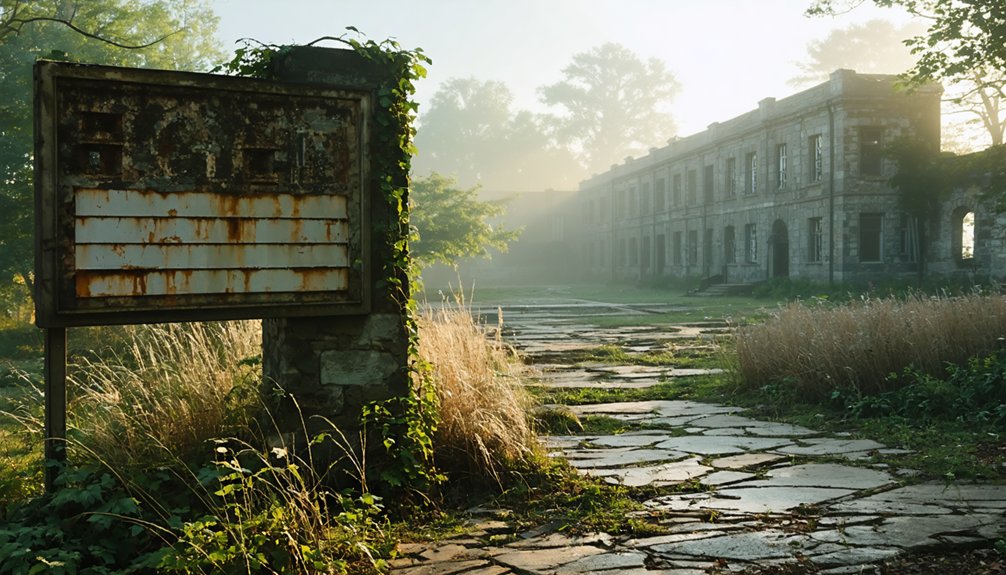
While Fort Ritchie’s barracks now stand empty, they once housed one of World War II’s most effective intelligence units—the Ritchie Boys. You’d find approximately 22,000 German-speaking soldiers, many Jewish refugees fleeing Nazi persecution, who transformed military intelligence operations.
They trained with life-sized German village models and real prisoners of war, mastering interrogation and counter-intelligence techniques.
On D-Day, you’d see them leading Allied forces into Europe, operating in six-man teams as prisoner interrogators. Their Intelligence Innovations provided vital warnings about Germany’s Bulge offensive, enabling precise American artillery strikes.
The Ritchie Boys’ Legacy includes over 60 Silver Star medals and participation in every major European battle. They’ve earned lasting recognition, receiving the Elie Wiesel Award in 2022 for helping end the Holocaust.
Cold War Communications and Chemical Testing
After World War II ended, the U.S. Army repurchased Fort Ritchie in 1948, transforming it into the Alternate Joint Communications Center supporting the underground Site R at Raven Rock.
You’ll find that Cold War Communications became the installation’s primary mission when operations began in 1954. The fort connected to WHCA’s microwave network linking Camp David, Mt. Weather, and Site R, ensuring reliable presidential communications during nuclear emergencies.
Despite Cold War tensions, Chemical Testing Absence characterizes Fort Ritchie’s history. No records indicate any chemical testing occurred during this period, as the facility focused exclusively on communications and intelligence support.
- Creed Tower featured eight underground floors with blast door access
- Cadre facility maintained Eisenhower farm communication links
- Deactivation occurred in 1977 for microwave terminals
Base Closure and Economic Devastation
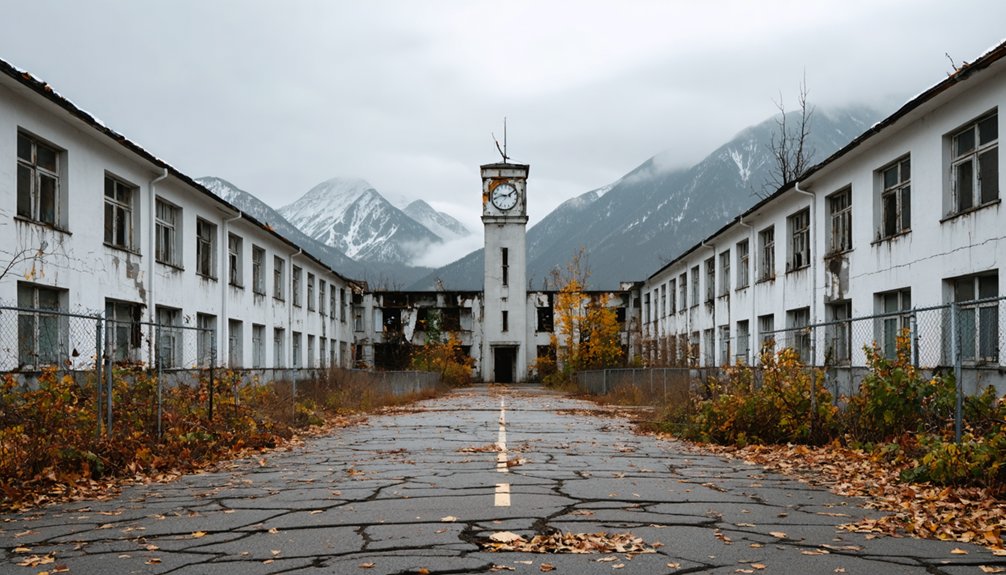
Though Fort Ritchie had served as a critical communications hub throughout the Cold War, the 1995 Base Realignment and Closure (BRAC) Commission designated it for shutdown to reduce federal spending.
You’d witness the base’s final operations ending by 1998, with support for Raven Rock Mountain Complex transferring to Fort Detrick in October 1997.
The economic consequences devastated Cascade’s residents. As the area’s top employer, Fort Ritchie’s closure eliminated thousands of jobs overnight.
Fort Ritchie’s closure wiped out thousands of jobs overnight, devastating the local economy as Cascade lost its largest employer.
You’d see home prices collapse slowly as families fled seeking employment elsewhere. Despite community resilience efforts, the housing market declined dramatically.
Multiple redevelopment attempts failed between 1998-2020, including Corporate Office Properties Trust and PenMar Development Corporation.
Environmental complications, including unexploded ordnance and groundwater contamination, deterred civilian reuse while vandalism accelerated the base’s decay.
Decay and Abandonment in the Late 1990s
Once the last military personnel departed in 1998, Fort Ritchie’s transformation into a decaying monument began almost immediately.
You’d find rows of empty barracks and classrooms standing vacant, their windows staring blankly across deserted streets. The surrounding community felt the economic decline as home prices collapsed and the area’s top employer vanished.
Without maintenance, the abandoned structures began their inevitable deterioration. Vandals quickly targeted the property, smashing windows and covering walls with graffiti.
You’d witness evidence of illicit occupation and parties throughout the site.
- Stately early-1900s stone buildings proved most resilient against decades of neglect
- Broken windows and vandalism became widespread across the entire complex
- WWII-era barracks containing asbestos created additional safety hazards for trespassers
The Ritchie Boys’ Wartime Contributions
Before Fort Ritchie became a forgotten ruin, it served as the birthplace of America’s most effective intelligence unit during World War II.
You’d find over 11,000 soldiers training here starting in 1942, with nearly 3,000 being Jewish refugees who’d fled Nazi persecution. They mastered interrogation, counterintelligence, and psychological warfare through rigorous exercises using real German POWs and mock combat scenarios.
The Ritchie Boys’ legacy proved invaluable on European battlefields. They participated in D-Day landings and collected essential wartime intelligence during the Battle of the Bulge.
Their expertise convinced entire German units to surrender without fighting, directly contributing to Allied victory. After the war, they served as interrogators at Nuremberg trials, ensuring Nazi war criminals faced justice for their crimes.
Modern Revival and Historic Preservation
After Fort Ritchie’s closure in 1998 under the Base Realignment and Closure Act, the once-thriving military installation faced decades of decline that mirrored countless abandoned bases across America.
You’ll find that successive redevelopment efforts stalled due to red tape and lawsuits until 2021, when private investor John Krumpotich acquired the property. His Ritchie Revival initiative transforms the site into a vibrant community hub while preserving its historical significance through careful rehabilitation of early 1900s stone structures.
Private investor John Krumpotich’s 2021 acquisition launched the ambitious Ritchie Revival initiative, transforming decades of stalled redevelopment into meaningful historical preservation.
The revival emphasizes community engagement through:
- Mixed-use development incorporating housing and businesses
- Ritchie History Museum preserving the fort’s complete story
- Public access to man-made lakes dating to 1889
This ambitious preservation effort showcases how abandoned military installations can become thriving community assets rather than forgotten ruins.
Frequently Asked Questions
Can Visitors Legally Explore the Abandoned Fort Ritchie Buildings Today?
You can legally explore Fort Ritchie’s revitalized buildings daily from dawn to dusk. There aren’t legal restrictions since 2021’s private purchase, though you should prioritize visitor safety around ongoing restoration work.
What Specific Health Risks Remain From Agent Orange Testing at the Site?
Dioxin TCDD persists decades after 1963 testing. You’d face potential Agent Orange exposure through contaminated soil contact, with health implications including neurological disorders and Parkinson’s disease risk documented in veteran cases.
How Much Did John Krumpotich Pay to Purchase Fort Ritchie in 2021?
You’ll find Krumpotich’s investment reached $1.8 million for the 500-acre Fort Ritchie property in April 2021. Fort Ritchie history shows price increases from the original $1,712,500 agreement through multiple amendments.
Are There Any Paranormal Activities Reported at the Abandoned Military Facilities?
Despite zero documented ghost sightings from 1943-1998 operations, you’ll find no verified paranormal investigations at these facilities. Commercial haunted attractions now exploit the eerie abandonment, but actual supernatural reports remain completely absent from military records.
What Happened to the Original Manmade Lake From the Ice Company Era?
Lake Royer, the original 1901 manmade lake, wasn’t abandoned—you’ll find it’s still maintained today as part of Fort Ritchie’s two-dam system, retaining its historical significance through ongoing lake restoration efforts.
References
- https://bikewalkdrive.wordpress.com/2022/08/23/a-ghost-fort-with-a-secret-past/
- https://www.youtube.com/watch?v=urbwad9GpF4
- https://www.abandonedcountry.com/2013/07/29/fort-ritchie-maryland-and-the-remnants-of-an-indispensable-allied-weapon/
- https://siteselection.com/revival-of-a-legend/
- https://www.ritchierevival.com/history
- https://www.ritchiemuseum.org
- https://www.youtube.com/watch?v=KAFnEn6ZP5I
- https://en.wikipedia.org/wiki/Fort_Ritchie
- http://uxoinfo.com/uxofiles/enclosures/Ft_Ritchie.pdf
- https://klangslattery.com/camp-ritchie-maryland-development-of-the-intelligence-training-center/