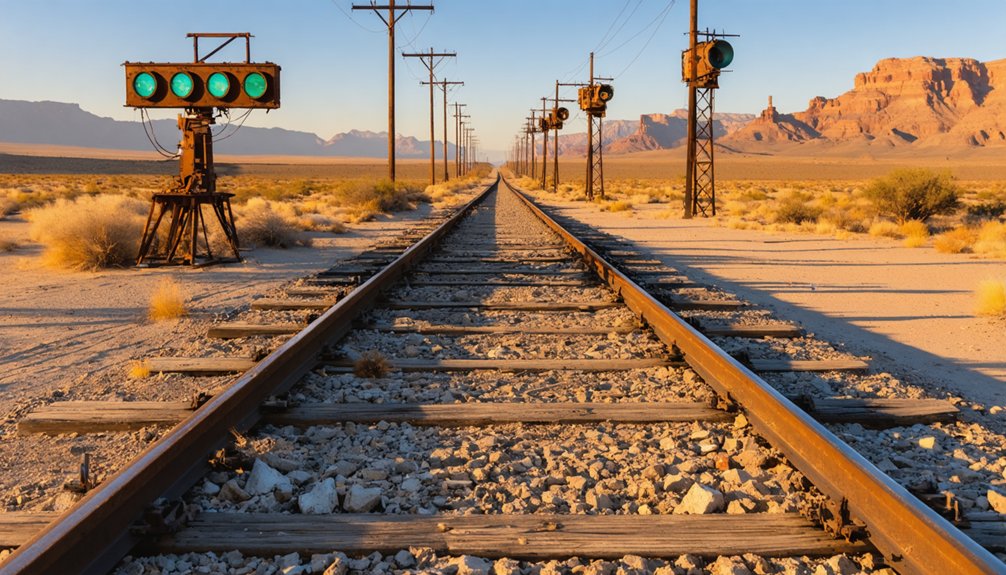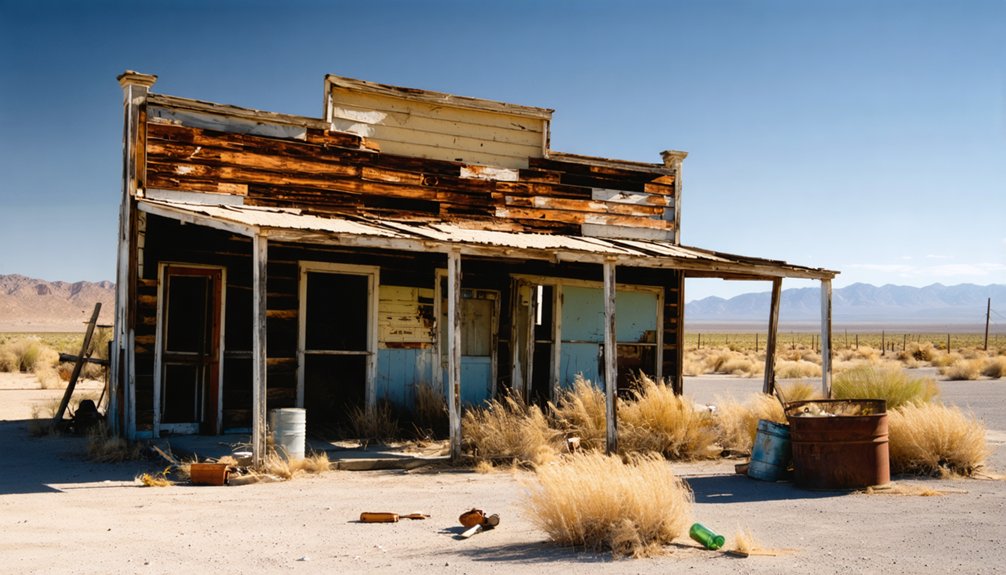
You’ll discover over 200 abandoned mining settlements scattered across Arizona’s deserts and mountains, remnants of the copper boom that transformed the territory into America’s second-largest copper producer by the 1880s. Towns like Ruby preserve over two dozen roofed buildings, while Pearce features structures on the National Register of Historic Places. Some require permits like Ruby, others offer free BLM access at Swansea and Fairbank. These ghost towns reveal Arizona’s complete mining heritage story.
Key Takeaways
- Arizona’s ghost towns originated from the 1800s mining boom when copper production surged from 2 to 20 million pounds.
- Well-preserved sites include Ruby with two dozen buildings, Pearce’s 1894 Old Store, and Castle Dome’s 50 original structures.
- Access varies by location: Ruby requires permits, Vulture City offers guided tours, while BLM sites provide free entry.
- Peak populations reached 15,000 in Jerome and 3,000 in Castle Dome before ore depletion caused widespread abandonment.
- Ghost towns span from southern border regions like Ruby and Harshaw to northern desert areas including Jerome.
Mining Boom Heritage Across Arizona Counties
When Arizona’s mining boom exploded across the territory in the mid-1800s, it transformed a sparsely populated frontier into America’s second-largest copper producer within just a few years.
You’ll discover that copper production skyrocketed from 2 million pounds in 1880 to 20 million by 1882, surpassing even Lake Superior mines.
By 1864, 25% of non-native males worked as prospectors, establishing diverse communities that built railroads, schools, and businesses.
Mining communities rapidly transformed Arizona’s frontier, with one in four non-native men becoming prospectors who built lasting infrastructure and diverse settlements.
The cultural influences of this influx created lasting settlements across multiple counties, while mining techniques evolved from simple prospecting to sophisticated operations with 33 smelters erected between 1881-1883. These mining districts followed a northwest-trending belt of metallic mineralization that spans across Arizona. Silver discoveries like the Silver King Mine operated from 1875 to 1889 and produced 6.2 million troy ounces before the boom’s eventual decline.
Preserved Structures and Remaining Buildings
Scattered across Arizona’s desert landscape, these abandoned mining settlements preserve tangible remnants of the state’s extractive past through walls, foundations, and complete structures that have weathered decades of neglect.
You’ll find preserved structures ranging from Courtland’s concrete jail and scattered stone foundations to Ruby’s impressive collection of over two dozen roofed buildings, including a sturdy jail and schoolhouse.
Pearce showcases its 1894 Old Store and Catholic church, both listed on the National Register of Historic Places.
Vulture City maintains over 16 original 1800s buildings, with extensive restoration work completed since 2017.
Castle Dome Landing offers the most thorough preservation with over 50 original remaining buildings plus 60 renovated structures containing period artifacts and merchandise.
Fairbank features several 1880s buildings that have been stabilized by the Bureau of Land Management and offers self-guided tours for visitors. Gleeson preserves its original jail structure built in 1910 alongside remnants of the old school, hospital, and general store from its early 1900s heyday.
Private Property Access and Tourist Attractions
These historic remnants exist under varying ownership structures that directly impact your ability to explore them.
Ruby requires advance permit applications through their website plus admission fees, though you’ll gain private access to camping grounds and fishing lakes stocked with bluegill and catfish.
Vulture City operates seasonally from October through May with self-guided tours of sixteen original 1800s buildings, including their restored assay office and blacksmith shop. The site also offers evening flashlight ghost tours featuring haunted tales and historic ruins for visitors seeking a more immersive experience.
You’ll find unrestricted exploration at BLM-managed sites like Swansea and Fairbank, both offering free access without tourist fees or permits.
Harshaw landowners allow road viewing of the Finley house, while Gleeson’s derelict structures remain viewable only from public paths due to private property restrictions. The town’s concrete jail built in 1910 now serves as a museum that opens the first Saturday of each month.
Peak Populations and Economic Decline Patterns
Arizona’s mining boom towns reached their zenith between the 1860s and 1940s, with populations ranging from hundreds to tens of thousands before inevitable economic collapse left them as ghost towns.
You’ll find Jerome topped the charts with 15,000 residents during copper’s heyday, while silver towns like Castle Dome attracted 3,000 in the 1880s.
Population dynamics shifted dramatically when ore deposits depleted—Pinal City was deserted by 1891 after silver exhaustion, and Courtland emptied post-1909 when copper reserves vanished.
Economic factors beyond mining also triggered decline. The Great Flood of 1862 destroyed Adamsville, while the 1930s Depression devastated Pearce. Ray reached approximately 2,000 residents at its peak before mine closures transformed it into a deserted ghost town by 1958. Bisbee once claimed the title of largest town in the Southwest between St. Louis and San Francisco with over 20,000 residents at its mining peak.
Railroad closures killed Goldroad in 1942. Today, only Jerome survives with 450 residents, standing as Arizona’s largest inhabited ghost town.
Geographic Distribution From Border to Desert
Mining operations carved out ghost towns across Arizona’s diverse terrain, from the Mexican border to the northern desert changes.
These historic mining towns in Arizona serve as a testament to the once-thriving communities that sprang up during the gold and silver rushes. Today, visitors can explore the remnants of these towns, witnessing the fascinating history etched into their abandoned structures and relics. Each site tells a story of fortune, hardship, and the relentless pursuit of wealth in the rugged landscapes of the Southwest.
You’ll find these abandoned settlements strategically positioned near mineral deposits and geographic features that shaped their historical significance.
The distribution follows distinct regional patterns:
- Southern Border Region – Ruby, Harshaw, Gleeson, and Duquesne clustered near Mexico for cross-border trade access.
- Southeast Desert Areas – Charleston, Pearce, and Dos Cabezas positioned along river valleys and transportation routes.
- Central Southern Zones – Helvetia, Pantano, and Twin Buttes established in Pima County’s mineral-rich terrain.
- Northern Desert Change – Jerome, Congress, and Oatman marking the shift from desert to highland mining.
Each zone’s geographic features determined settlement locations, with proximity to water sources, ore deposits, and transportation networks driving these communities’ rise and eventual abandonment. Towns like Charleston were strategically built along the San Pedro River to access crucial water resources for mining operations. The Colorado River provided crucial access for early mining operations, particularly in Yuma County which became the county seat following the first major gold strike in the region.
Frequently Asked Questions
What Safety Precautions Should Visitors Take When Exploring Abandoned Mine Shafts?
Don’t enter abandoned mine shafts—they’re deadly traps. Practice proper mine shaft safety by staying away from openings, bringing emergency equipment, and following abandoned site precautions. You’ll avoid structural collapse, toxic gases, and unstable ground.
Are There Guided Tours Available for These Ghost Towns?
Yes, you’ll find ghost town tours available like treasure maps leading to Arizona’s past. These guided experiences showcase historical significance through Jerome’s walking tours, Chloride’s Route 66 adventures, and Vulture City’s self-guided explorations.
What Is the Best Time of Year to Visit Arizona Ghost Towns?
You’ll find fall weather from October through May offers ideal conditions for exploring Arizona’s ghost towns. Cooler temperatures make hiking comfortable, while local events like Jerome’s holiday celebrations enhance your winter visits perfectly.
Can Visitors Camp Overnight Near These Historic Mining Sites?
Yes, you can camp overnight near historic mining sites following specific camping regulations. Ghost town facilities like Goldfield offer paid campgrounds, while BLM and forest lands provide free dispersed camping options with designated restrictions.
What Artifacts or Souvenirs Are Visitors Legally Allowed to Take?
You can’t legally take any artifacts or souvenirs from Arizona’s ghost towns. Like prospectors respecting claims, artifact preservation and souvenir regulations protect these sites—you’re limited to photographs and memories only.
References
- https://en.wikipedia.org/wiki/List_of_ghost_towns_in_Arizona
- https://kids.kiddle.co/List_of_ghost_towns_in_Arizona
- https://www.arizonahighways.com/article/arizona-ghost-towns
- https://www.visittucson.org/blog/post/8-ghost-towns-of-southern-arizona/
- https://www.atlasobscura.com/things-to-do/arizona/ghost-towns
- https://www.visitarizona.com/like-a-local/4-arizona-ghost-towns-you-may-have-never-heard-of
- https://goldfieldghosttown.com
- https://www.youtube.com/playlist?list=PLRXoNdo9YII4kqqtQMga2d9fjdIRmic6R
- https://en.wikipedia.org/wiki/Silver_mining_in_Arizona
- https://digitalrepository.unm.edu/cgi/viewcontent.cgi?article=2351&context=nmhr