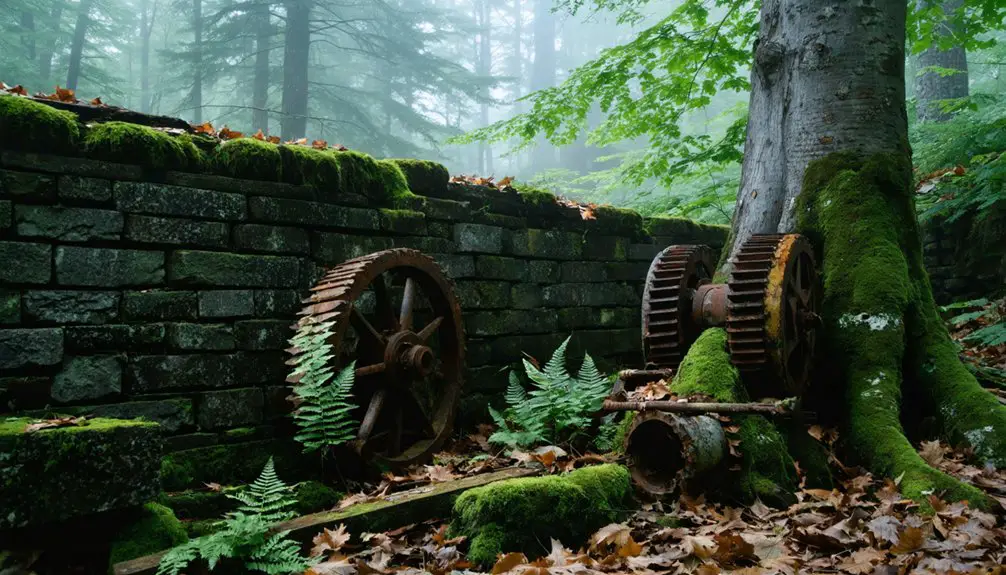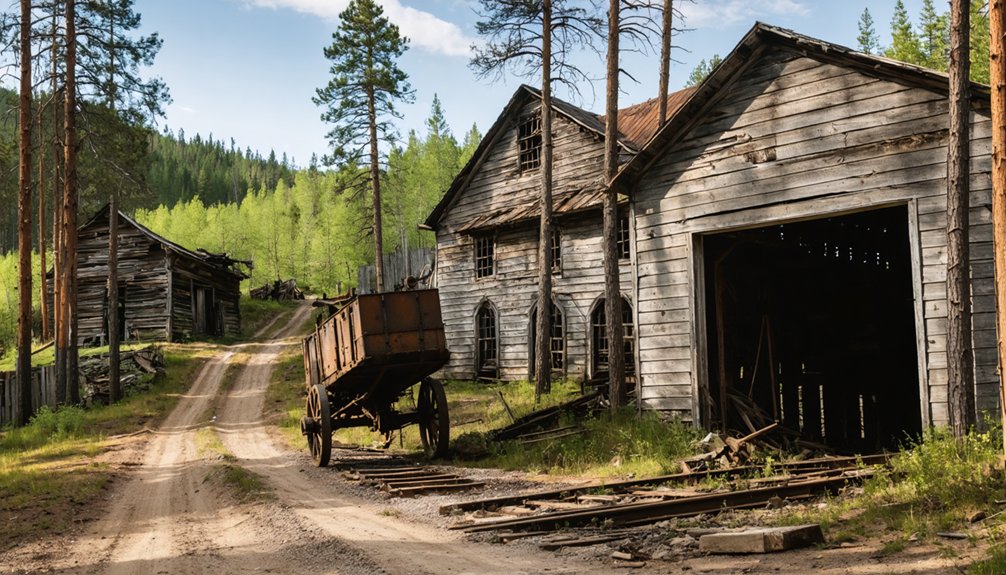
You’ll find Vermont’s ghost mining towns scattered across remote valleys where entire communities once thrived before vanishing into history. Tyson Furnace produced iron from 1835-1872 with diverse immigrant workers, while Copperfield witnessed violent labor disputes in the 1880s. Plymouth Five Corners experienced a brief gold rush in 1855, and West Castleton’s slate quarries employed 1,000 workers by 1900. These abandoned settlements reveal fascinating stories of economic ambition, environmental challenges, and the immigrant experience that shaped Vermont’s industrial heritage.
Key Takeaways
- Vermont’s ghost mining towns include Tyson Furnace (iron ore), Copperfield (copper), Plymouth Five Corners (gold), and West Castleton (slate quarrying).
- Tyson Furnace operated from 1835-1872, producing 600-1,000 tons of iron annually using innovative anthracite coal processing and hot blast techniques.
- Copperfield experienced violent labor disputes in the 1880s, requiring 200 Vermont National Guard troops during the Ely War in 1883.
- West Castleton peaked around 1900 with 250 quarries employing 1,000 slate workers before declining after WWI and the Great Depression.
- Many sites remain contaminated and require preservation efforts, including Copperfield’s Superfund designation and accessible ruins at Little River State Park.
Tyson Furnace: Rise and Fall of an Iron Mining Community
When Isaac Tyson discovered iron ore deposits in Vermont’s Black River valley near Plymouth in 1835, he set in motion the creation of what would become one of New England’s most innovative iron-smelting operations.
You’ll find that Tyson’s innovations revolutionized iron production by introducing the nation’s first anthracite coal processing system combined with hot blast techniques, yielding 600-1,000 tons annually.
The workforce dynamics created a melting pot of Irish immigrants, French-Canadian lumberjacks, German charcoal makers, and African-American laborers who performed grueling work across 45 years of operation. Tyson’s expertise in metallurgy stemmed from his chemistry studies in France after surviving a shipwreck as a teenager.
After Tyson’s 1855 retirement, the furnace briefly revived during Civil War demand, contributing iron to Monitor-class gunboats. The Baltimore Chrome Works founder had built his reputation through diverse mining ventures before establishing this remote Vermont operation.
Competition from other states forced the final blast in 1872, leaving only foundation ruins where nature reclaimed this once-thriving community.
Copperfield: Labor Unrest and Environmental Legacy
While iron mining operations like Tyson Furnace faced gradual decline from market forces, Vermont’s copper mining communities experienced far more violent upheavals that scarred both the landscape and labor relations for generations.
You’ll find Vershire’s copper mines exemplify these devastating labor disputes. When falling 1880s copper prices forced payroll failures, striking miners seized explosives and controlled the town for days. The “Ely War” erupted after management demanded pay cuts, prompting 200 Vermont National Guard troops to deploy on July 7, 1883. Many displaced miners eventually left Vermont entirely, seeking opportunities in western mining regions and overseas operations.
The environmental consequences proved equally severe. Sulfur fumes from smelting suffocated workers while smoke killed vegetation for miles around. Local farmers sued over crop deaths from pollution, creating lasting community tensions that outlived the mines themselves.
Plymouth Five Corners: The Short-Lived Gold Rush Era
Unlike the prolonged industrial conflicts that plagued Vermont’s copper mines, the state’s gold rush burst onto the scene with sudden excitement when William Hankerson‘s discovery hit the Vermont Watchman and State Journal on January 5, 1855.
The 45-year-old returned Californian sparked unprecedented community growth around Plymouth Five Corners, where gold mining operations flourished along multiple waterways:
- Placer mining concentrated on Reading Pond Brook, Broad Brook, and Buffalo Brook tributaries
- Infrastructure boom included hotels, saloons, stores, and a post office serving miners
- Economic success saw Hankerson extract $13,000 worth of gold in two years
- Corporate expansion culminated with Rooks Mining Company becoming the state’s largest operation
You’ll find only crumbling foundations today at this ghost town, where over 100 miners once worked claims that generated thousands in gold but ultimately proved economically unsustainable. The mining community also featured dance halls where workers gathered for entertainment after long days extracting gold from the earth. Henry Fox’s death in 1919 marked the final chapter of Plymouth’s gold mining era, ending nearly three decades of his solitary work at Rooks Mine.
Lewiston: From Railway Hub to Forgotten Settlement
You’ll find Lewiston’s transformation from bustling railway hub to abandoned settlement began with the Passumpsic and Connecticut Railroad’s arrival in 1848, which established the town as an essential freight depot serving Dartmouth College’s coal transportation needs.
The settlement thrived through the early 1900s as presidents Grant and Hayes visited, students traveled to campus, and local businesses flourished alongside the rail operations.
However, Dartmouth’s shift from coal to oil in the late 1920s marked the beginning of Lewiston’s decline, ultimately sealing its fate as Vermont’s infrastructure modernized around automobile travel. The Wilder Dam construction in 1947 further devastated the community by flooding parts of the town and displacing residents. Like many rail-dependent communities, the automobile arrival in the late 1890s fundamentally changed transportation dynamics and contributed to the eventual abandonment of passenger services.
Railway Trading Center Rise
You’d witness Lewiston’s rapid evolution into a bustling freight center:
- Freight depot construction boosted the town’s regional importance.
- Dartmouth College coal transport operated from 1898 through the late 1920s.
- Presidential visits included Ulysses S. Grant (1869) and Rutherford B. Hayes (1887).
- Diverse businesses flourished, including mills, general stores, and warehouses.
The station became your gateway for passengers and freight, marking Lewiston’s golden era of prosperity and connectivity. The depot served as the Ellis Island of Lewiston, welcoming waves of French-Canadian immigrants who shaped the community’s cultural identity. Rail transport proved to be the greenest transportation alternative in the region, efficiently moving freight that would have required hundreds of horse-drawn wagons.
Coal to Oil Decline
Lewiston’s prosperity peaked in the 1920s before external forces began dismantling its economic foundation.
You’ll find that Dartmouth College’s decision to switch from coal to oil in the late 1920s created an immediate economic impact on this once-thriving village. The college had relied on railroad coal shipments through Lewiston’s station since 1898, but this energy change eliminated the need for regular freight deliveries.
You can trace the village’s rapid decline directly to this alteration. Mills that had operated successfully throughout the 1920s began closing as the broader economic base eroded.
The railroad’s reduced importance meant fewer travelers, less commerce, and diminished prosperity. What you’re witnessing isn’t just technological progress—it’s how external decisions can completely reshape a community’s destiny, transforming a bustling railway hub into an economic ghost town.
Ricker Basin: Lumber Town Lost to Time and Floods
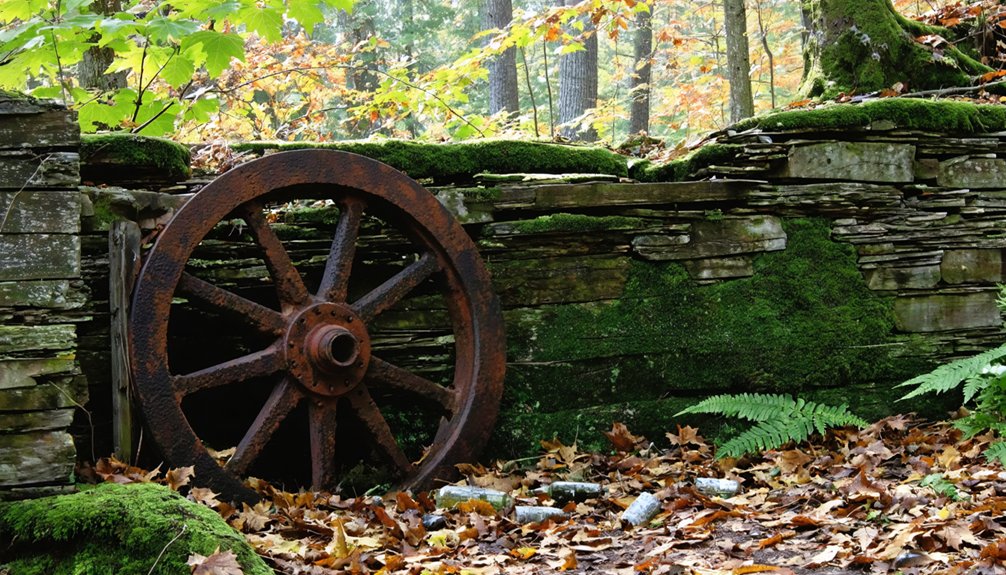
When Joseph Ricker established his farm on Ricker Mountain in 1816, he couldn’t have anticipated that his modest homestead would eventually anchor one of Vermont’s most vibrant lumber communities—or that it would ultimately vanish beneath the waters of a man-made reservoir.
By mid-century, Ricker Basin thrived with fifty families operating sawmills, farms, and maple sugarbushes. The Vermont Central Railroad‘s arrival transformed logging operations, enabling efficient transport of lumber and agricultural products.
However, nature’s fury struck decisively:
- November 1927’s devastating flood destroyed mills and livestock
- Half-billion dollars in damages (today’s currency) devastated the region
- Community abandonment accelerated as viability collapsed
- Waterbury Dam construction in 1935 permanently submerged remaining structures
Today, you’ll find scattered foundations within Little River State Park—silent testimony to flood impact on Vermont’s independent mountain communities.
West Castleton: Welsh Immigrants and the Slate Industry
By 1853, you’d find 43 houses, schools, and multiple quarries supporting this booming industry.
Workers endured dangerous 10-hour days for under $2, while the company controlled housing and supplies.
The industry peaked around 1900 with 250 quarries employing 1,000 workers.
However, post-WWI demand declined, and the Great Depression delivered the final blow, leaving West Castleton abandoned within today’s Bomoseen State Park.
Exploring Vermont’s Abandoned Mining Heritage Today
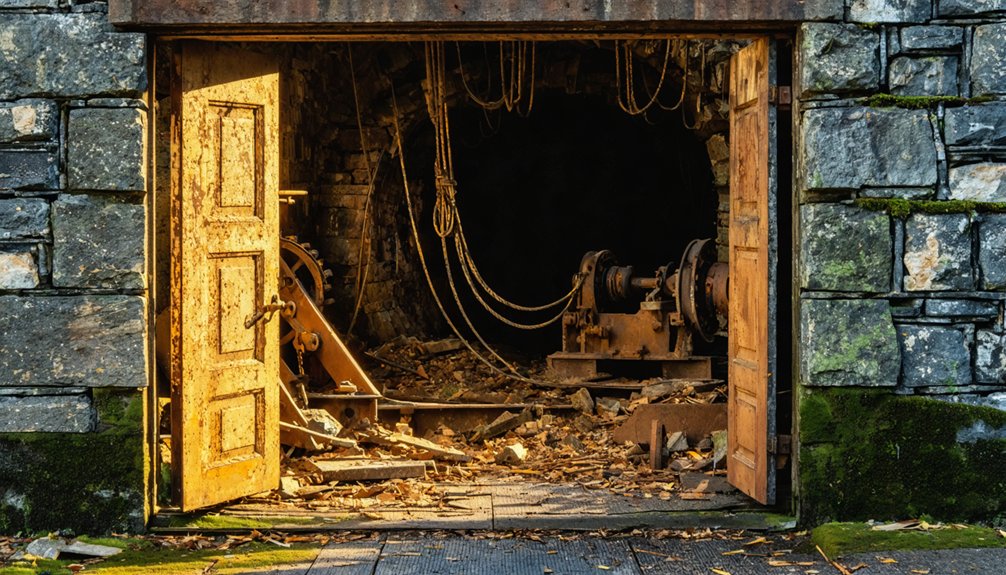
Although Vermont’s mining boom has long since ended, scattered remnants across the state offer compelling glimpses into this industrial heritage.
You’ll discover abandoned infrastructure that tells stories of immigrant workers, corporate ambitions, and economic transformation. These sites require careful historical preservation as they’re threatened by environmental contamination and natural decay.
When exploring Vermont’s mining ghost towns today, you’ll encounter:
- Copperfield’s Superfund site – contaminated land where America’s copper empire once thrived
- Ricker Basin’s accessible ruins – mill foundations and schoolhouses within Little River State Park trails
- Iron ore mining remnants – rusted facades and crumbling mansions in remote mountain valleys
- Glastenbury’s mysterious legacy – disincorporated town with violent history and Bennington Triangle folklore
Each location offers authentic encounters with Vermont’s industrial past through preserved architectural fragments.
Frequently Asked Questions
Are There Any Safety Precautions Visitors Should Take When Exploring These Sites?
You’ll need proper exploration gear including headlamps, helmets, and first aid supplies. Follow safety guidelines: travel with partners, inform others of your plans, research property laws, and avoid unstable structures completely.
What Artifacts or Relics Can Still Be Found at These Locations?
You’ll discover historic tools dating from 1835, mining equipment scattered across four sites, plus coins, merchant goods, and copper smelter ruins. Metal detector enthusiasts regularly uncover discarded implements from Vermont’s abandoned settlements.
Which Ghost Towns Offer the Best Preserved Structures for Photography?
Greenbanks Hollow offers you the best preserved covered bridge for photography tips, while Glastonbury provides excellent stone foundations. You’ll find ideal best angles at Ricker Basin’s accessible farmhouse remnants and atmospheric hillside cemetery.
Can You Legally Metal Detect or Collect Items From These Sites?
You can’t legally metal detect Vermont’s ghost towns. Metal detecting regulations and historical preservation laws strictly prohibit artifact removal from sites like Tyson Furnace, protecting these 100+ year-old resources for future generations.
What’s the Best Time of Year to Visit Vermont’s Abandoned Mining Towns?
You’ll find fall’s peak foliage season offers the best seasonal highlights for exploring Vermont’s abandoned mining towns. Mid-September through mid-October provides ideal photography tips with vibrant colors framing ruins and comfortable temperatures.
References
- https://newenglandwithlove.com/ghost-towns-in-vermont/
- https://thebridgevt.org/2022/10/ghost-towns-of-new-england/
- https://kids.kiddle.co/List_of_ghost_towns_in_Vermont
- http://freepages.rootsweb.com/~gtusa/history/usa/vt.htm
- https://en.wikipedia.org/wiki/List_of_ghost_towns_in_Vermont
- https://www.youtube.com/watch?v=ScW-H7A8yL8
- https://obscurevermont.com/curious-wallingford/
- https://www.youtube.com/watch?v=YrQNbrIrNT8
- https://vtdigger.org/2018/03/25/maryland-man-forged-early-metal-works-vermont/
- https://www.mininghistoryassociation.org/Journal/MHJ-v8-2001-Johnsson.pdf