Your ghost town road trip begins at Cumberland Gap, where you’ll trace Daniel Boone’s 1775 path along the historic Wilderness Road to Fort Boonesborough on the Kentucky River’s banks. Though the original settlement fell silent by 1820, you’ll discover a reconstructed fort where living historians demonstrate frontier crafts amid working cabins and blockhouses. Navigate via Kentucky Route 627 to coordinates 37.90°N, 84.27°W in Madison County, where musket smoke and period reenactments reveal how 300,000 pioneers carved civilization from wilderness.
Key Takeaways
- Fort Boonesborough, Kentucky’s second-oldest settlement established in 1775, became obsolete by 1820 with revolutionary spirit echoing through empty blockhouses.
- The historic site sits along the Kentucky River’s west bank in Madison County, accessible via Route 627 at coordinates 37.90°N, 84.27°W.
- Trace Daniel Boone’s original route via the Backcountry Byway from Cumberland Gap, following ancient buffalo paths turned Wilderness Road.
- Explore the reconstructed fort featuring working cabins, living historians demonstrating frontier crafts, and dramatic annual siege reenactments commemorating the 1778 battle.
- The campground remains closed until 2027; winter visits offer fewer crowds but limited services, so check seasonal programs before planning your trip.
The Rise and Fall of Kentucky’s Second Oldest Settlement
On April 1, 1775, Daniel Boone and thirty axe-wielding frontiersmen crossed the Kentucky River and carved out what would become the commonwealth’s second oldest European-American settlement. You’ll discover how Richard Henderson’s Transylvania Company envisioned this wilderness outpost as capital of America’s 14th colony—a bold rejection of colonial authority that Virginia and North Carolina governors quickly declared illegal.
By summer’s end, twenty-six log cabins and four blockhouses stood defiant against the emerging political landscape. Here, Kentucky’s first legislative assembly convened in May 1775, establishing representative government west of the Appalachians.
Despite weathering the Great Siege of September 1778—when forty defenders held off 444 Shawnee warriors—shifting settlement patterns eventually rendered Boonesborough obsolete. By 1820, this once-vital sanctuary lay abandoned, its revolutionary spirit echoing through empty blockhouses.
Daniel Boone’s Trail: Following the Historic Route to the Fort
You’ll retrace Daniel Boone’s legendary 200-mile wilderness route that carved civilization into Kentucky’s untamed heart, beginning at Cumberland Gap where Virginia, Kentucky, and Tennessee converge.
The trail follows ancient buffalo paths that migrating herds pressed through dense canebrakes and mountain passes—the same natural corridors Boone recognized as pathways to settlement. These worn traces guided his axmen through the Appalachian barrier in 1775, transforming animal migration routes into the Wilderness Road that delivered thousands of pioneers to Fort Boonesborough‘s protective walls.
Tracing Boone’s 200-Mile Path
Starting from Long Island in Kingsport, Tennessee, Daniel Boone and his crew of 35 axmen hacked their way through 200 miles of wilderness beginning March 10, 1775, creating what was barely more than a single-file mud path snaking toward the Kentucky River. You’ll follow his route through Virginia’s Bristol, then loop through Gate City and Clinchport before crossing Moccasin Gap.
The path plunges through Devils Raceway, traverses Powell Mountain at Kanes Gap, and breaches Cumberland Gap into Kentucky’s wild interior.
Today’s Daniel Boone Backcountry Byway lets you trace this historic passage using modern navigation tools like CartoTracks or Gaia GPS. Don’t expect trail signage everywhere—you’ll encounter rugged terrain mixing paved roads with gravel and muddy tracks, demanding the same adventurous spirit that drove 300,000 pioneers through these mountains.
Cumberland Gap Entry Point
Everything about Cumberland Gap speaks to its role as nature’s perfect doorway—a saddle carved through Cumberland Mountain where Kentucky, Virginia, and Tennessee converge. You’ll stand where Daniel Boone and his 30 axemen blazed through in 1775, following ancient buffalo traces that became the Wilderness Road.
The key terrain features remain unchanged: the eastern slope ascending from Tennessee, the saddle’s natural pass, and the northeast curve descending near Davis Branch. Wilderness road access follows a preserved 2,700-foot section through original switchbacks to the saddle.
Nearly 300,000 pioneers pushed through this gateway seeking cheap Kentucky lands, enduring attacks and hardship. Today’s 24,000-acre National Historical Park protects the path where your ancestors likely walked, pursuing the same freedom you’re chasing now.
Buffalo Trails to Settlement
Long before Daniel Boone’s axemen carved their legendary path, massive buffalo herds thundered through Appalachian passes, their countless hooves pounding trails that would reshape American history. These animal migratory patterns created the Great Buffalo Trace—nature’s blueprint for westward expansion. You’re following routes that predated early frontier cartography, where indigenous hunters first recognized these strategic corridors into Kentucky’s heartland.
In 1775, Boone’s crew widened these existing pathways, marking trees along 105 miles from Cumberland Gap to Fort Boonesborough. They weren’t pioneers—they were pragmatists, letting buffalo wisdom guide their axes. At Flat Lick, you’ll stand where multiple trails converged, a natural junction point where settlers chose their destinies. The wilderness itself showed the way; humans simply had the audacity to follow.
Surviving the Great Siege of 1778
The September morning of 1778 brought Daniel Boone face-to-face with his adoptive father across the barrel of a rifle. Chief Blackfish led 444 warriors against the fort, but Daniel Boone’s questionable loyalty worked in the defenders’ favor—his months with the Shawnee revealed their tactics.
The negotiation strategies employed on September 9th bought precious time while reinforcements arrived. You’ll appreciate how 50 settlers conserved every grain of gunpowder, picked off torch-bearing attackers in darkness, and countered tunnel excavations beneath their walls.
When the final assault came on September 17th, heavy rain extinguished the flames that threatened to consume their freedom. Two died defending what mattered most: the right to claim this wilderness as their own.
What Remains: Archaeological Discoveries at the Original Site
Centuries of Kentucky soil concealed the truth until 2012, when ground-penetrating radar pierced through layers of earth at Fort Boonesborough State Park. You’ll discover what magnetometers and conductivity meters revealed: anomalies marking Daniel Boone’s original 1775 station, collapsed cabin stockades, and Lick Spring—the water source that sustained settlers during the 1778 siege.
Archaeologists led by Nancy O’Malley unearthed tunnel collapse evidence from a Native American passage connecting the Kentucky River to the fort. They’ve recovered French encampment artifacts alongside Fort Ancient ceramics dating to 1400 AD, glass trade beads, copper fragments, and aboriginal gun flints. This National Historic Landmark preserves Kentucky’s second-oldest Euro-American settlement, where each excavated artifact challenges sanitized historical narratives you’ve been fed.
Exploring the Reconstructed Fort Boonesborough Today
You’ll explore working cabins and blockhouses furnished exactly as they appeared in the late 18th century. Living historians in period costume demonstrate frontier crafts, breathing life into pioneer existence.
The gift shop marks your entry point, offering handmade items crafted on-site. Though gravel walkways limit accessibility, you’re free to wander this authentic recreation where Kentucky’s bold frontier spirit still resonates through every weathered timber.
Living History Experiences and Annual Reenactments
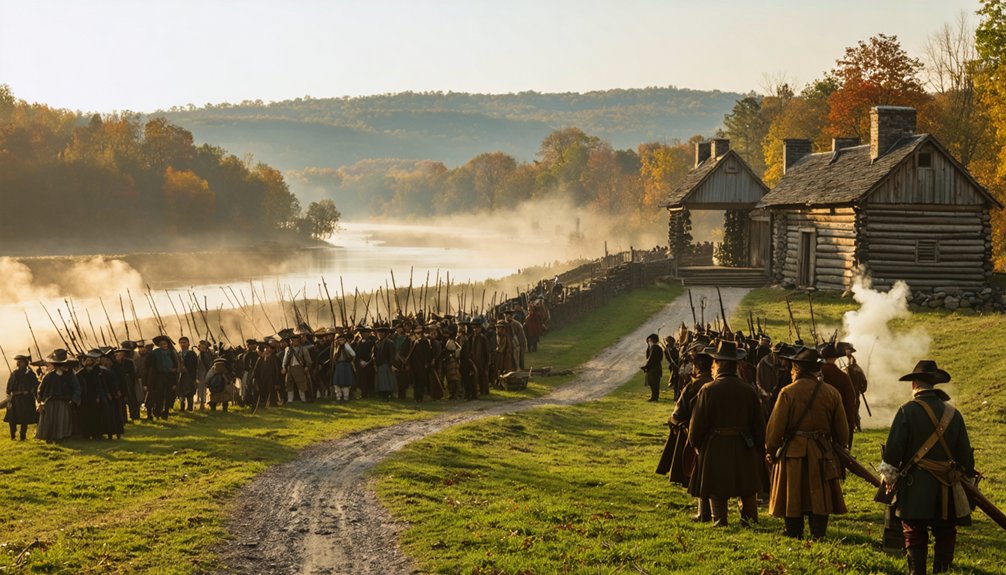
You’ll witness skilled interpreters in period clothing demonstrating essential frontier crafts—weaving, soap making, candle dipping, and woodworking—bringing the rhythms of 18th-century Kentucky life into sharp focus.
Each September, the fort transforms into a battlefield as reenactors recreate the dramatic 1778 siege with militia camps, a Native American village, and thundering 2 pm battles that echo across the Kentucky River valley.
These immersive experiences, included with standard admission, let you step beyond the reconstructed log walls into the daily struggles and skills that defined survival on America’s first western frontier.
Authentic 18th-Century Craft Demonstrations
At Fort Boonesborough, history doesn’t hide behind glass cases or velvet ropes—it comes alive through the skilled hands of period interpreters who transform raw materials into essential frontier goods. You’ll watch blacksmiths hammer glowing iron into tools at their forges, each strike echoing the self-reliance that defined frontier survival.
Seasonal textile demonstrations reveal wool’s complete journey—from picking and washing fleece through carding, spinning yarn, and knitting caps that replicate 17th-18th century shipwreck artifacts. Interpreters dye yarns using period-specific plants like madder and goldenrod, creating authentic colors settlers knew.
Candle making techniques illuminate how pioneers crafted their own light. During special weekend events, children participate in hands-on lessons, experiencing firsthand the skills that meant independence on Kentucky’s untamed frontier.
September Siege Reenactment Event
Each September, musket smoke drifts across Fort Boonesborough’s wooden palisades as history repeats itself through the dramatic siege reenactment—a thunderous spectacle that plunges you into the desperate September 1778 standoff between Kentucky settlers and Chief Blackfish’s Shawnee forces.
This extended weekend transforms the frontier survival narratives that defined early Kentucky into living reality:
- Battle reenactments at 2 p.m. daily, plus Saturday’s atmospheric dusk engagement
- Militia camps and Native American villages presenting both perspectives of the British Shawnee alliance
- Living historians demonstrating 18th-century trades, commerce, and survival techniques
- Period music and authentic cuisine immersing you in revolutionary-era frontier life
You’ll witness the same strategic positioning and defensive tactics that protected Daniel Boone’s adopted community during this pivotal moment in Kentucky’s settlement history—admission included with regular fort entry.
Planning Your Visit: Location, Access, and What to Expect
Nestled along the west bank of the Kentucky River in Madison County, Fort Boonesborough State Park beckons history enthusiasts to one of Kentucky’s most significant colonial sites. You’ll find this frontier landmark southeast of Lexington at coordinates 37.90°N, 84.27°W, accessible via Kentucky Route 627.
The park’s reconstructed fort features working demonstrations by resident blacksmiths and potters, bringing 1775 to life before your eyes. You can explore the Kentucky River Museum, hike the Pioneer Trail, or launch your canoe into the same waters Daniel Boone navigated. Check seasonal programs through the Fort Boonesborough Foundation for immersive experiences.
Review park rules before arriving, and note the campground remains closed until 2027 due to flooding. Winter visits offer fewer crowds but limited water service.
Frequently Asked Questions
Are There Any Nearby Accommodations or Campgrounds for Overnight Stays?
You’ll find 167 campground sites with hookups, plus scenic camping sites along Kentucky River’s banks. Local bed and breakfasts dot Winchester and Richmond, while chain hotels offer convenient bases for exploring this historic frontier territory at your own pace.
What Are the Park’s Operating Hours and Admission Fees?
The fort’s open Wednesday-Sunday, 9am-4:45pm during operating season (April-October). Adults pay $8, kids 6-12 are $5, under 6 free. You’ll find admission discounts for groups, plus special events that won’t cost extra with paid entry.
Is Fort Boonesborough Accessible for Visitors With Mobility Limitations?
Like traversing a time capsule, you’ll find wheelchair accessibility limited at Fort Boonesborough. Trail conditions feature gravel and hard-packed dirt walkways that restrict full access, though you can explore with non-licensed vehicles if you have disabilities.
Can Visitors Bring Pets to the State Park Grounds?
Yes, you can bring pets to Fort Boonesborough State Park! Their pet policies welcome visiting with animals throughout campgrounds and picnic areas. Keep your furry companion leashed within six feet, and avoid restricted zones like beaches and public buildings.
What Dining Options Are Available Near Fort Boonesborough?
You’ll find local restaurants like Waterfront Grill and Hall’s On The River within minutes, offering riverside dining and hearty portions. Seasonal food trucks often appear near the park, giving you convenient, casual options during your adventure.