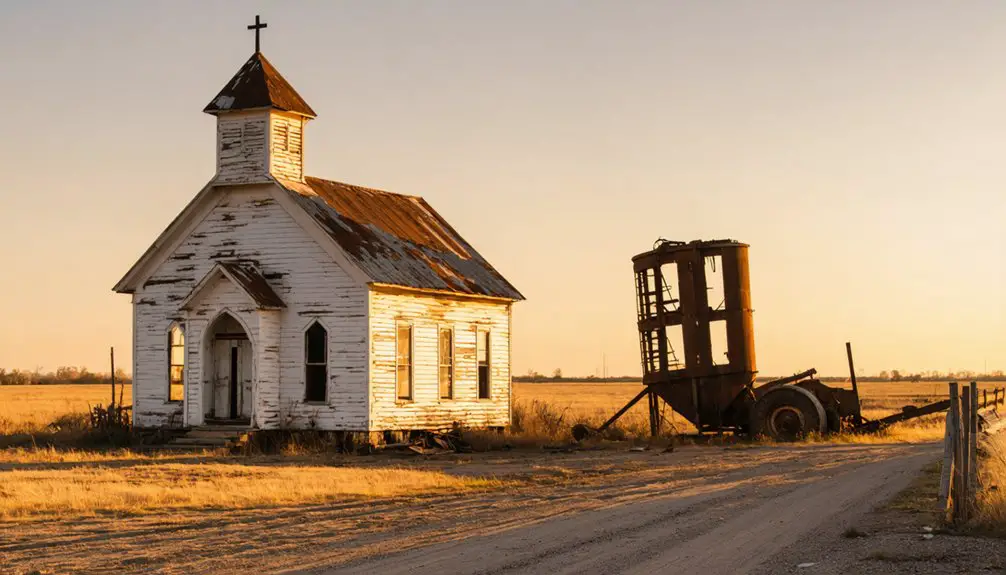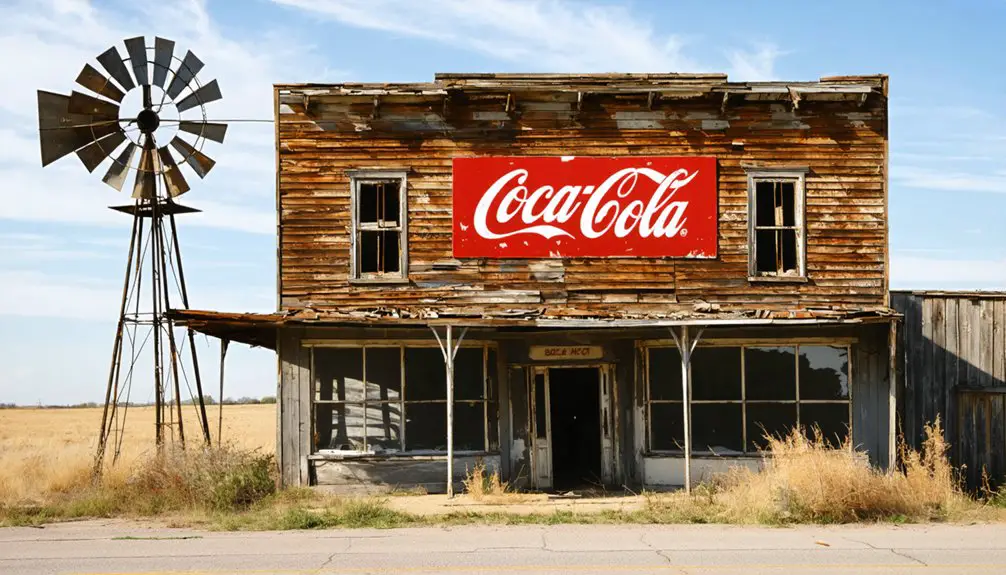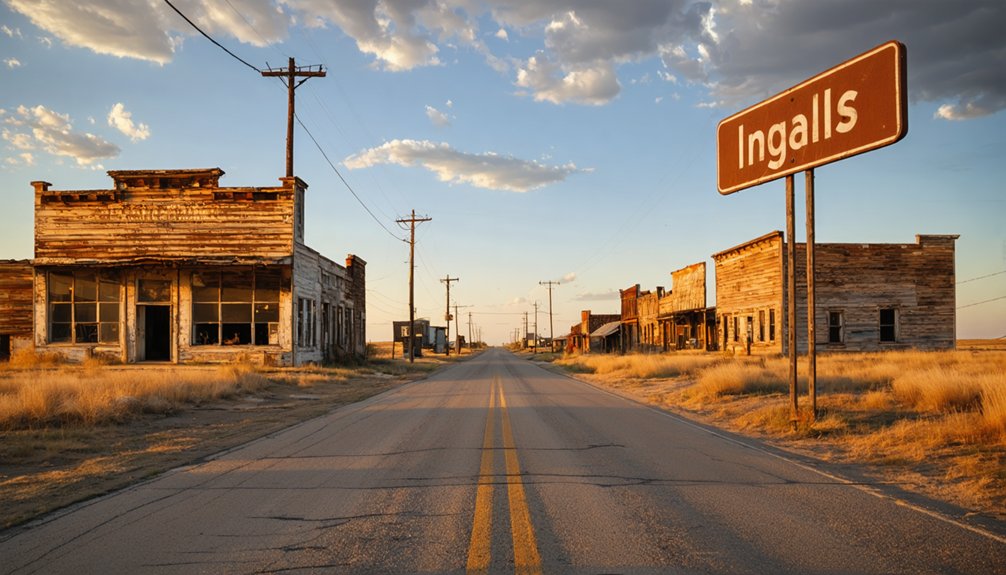
You’ll find Ingalls about 50 miles northeast of Oklahoma City, a windswept prairie settlement where fewer than two dozen residents share space with ghosts of the Doolin-Dalton gang. The reconstructed Ingalls Hotel stands as the town’s centerpiece, while crumbling stone foundations mark where outlaws once drank and gambled. Visit the old schoolhouse-turned-community center, and walk the dusty streets where deputy marshals and desperados clashed in 1893’s infamous shootout. This haunting landscape holds stories of betrayal, bloodshed, and the untamed frontier that shaped Oklahoma’s outlaw legacy.
Key Takeaways
- Ingalls is a census-designated place with approximately two dozen residents, located near U.S. Highways 51 and 108 in Oklahoma.
- Visit the imposing Ingalls Hotel replica, the most photographed structure showcasing the town’s notorious outlaw history.
- Explore the reconstructed school building, now a community center hosting Saturday night concerts for visitors and locals.
- View stone foundations and rubble remnants from the 1893 Battle of Ingalls, where lawmen ambushed the Doolin-Dalton gang.
- Experience a living ghost town that preserves Wild West outlaw heritage from the 1889 land rush era.
The Wild History Behind Oklahoma’s Most Notorious Outlaw Town
Dust swirled through the streets of Ingalls in the early 1890s as wanted men rode freely through town, their saddlebags heavy with stolen cash. You’ll discover how this Oklahoma settlement, born from the 1889 land rush, earned its outlaw town reputation by sheltering Bill Doolin’s notorious gang.
The 150 residents didn’t just tolerate these outlaws—they embraced them. George Ransom’s saloon became gang headquarters, where bartender Murray supplied ammunition and intel on approaching marshals. Community support for outlaws ran deep: townsfolk fed them at their tables, stabled their horses, and helped them escape during raids.
Why? The gang’s generous spending kept commerce thriving. This freedom-loving settlement chose prosperity over propriety, welcoming men others feared.
What Happened During the Battle of Ingalls in 1893
On the morning of September 1, 1893, you’d have witnessed a carefully planned ambush unravel into chaos when a local boy’s warning reached the Doolin-Dalton Gang too late. The moment Bitter Creek Newcomb stepped from Ransom Saloon and mounted his horse, Marshal Nix’s deputies opened fire, igniting a brutal shootout that turned Ingalls’ dusty streets into a killing ground.
Before the gun smoke cleared, three lawmen lay dead or dying, horses littered the thoroughfare, and an innocent bystander had paid the ultimate price for being in the wrong place at the wrong time.
The Ambush Begins
As dawn broke over Ingalls on September 1, 1893, approximately thirteen deputy U.S. Marshals crept silently into town while gang members drank inside the Ransom Saloon. The tension shattered when Bitter Creek Newcomb stepped outside and mounted his horse—drawing immediate fire that disabled his weapon.
Arkansas Tom Jones, sick in bed at the O.K. Hotel’s second story, returned fire from his window while Bill Doolin engaged the marshals below. The gang’s desperate defense against the lawmen’s superior firepower transformed Ingalls into a battlefield. Deputy Marshal Richard Speed fell first, then Shadley took a mortal wound.
From his elevated position, Arkansas Tom shot Deputy Thomas Hueston, who’d die the next day. The street ran red with blood.
Fierce Gunfight Casualties
The gunfight’s deadly toll mounted rapidly as bullets tore through Ingalls that September morning. You’d witness a devastating scene unfold as three deputy marshals fell—Speed, Hueston, and Shadley—victims of outlaw desperation.
The gang didn’t escape unscathed: Dynamite Dick, Charlie Pierce, and Bitter Creek Newcomb all rode away bleeding, while Arkansas Tom Jones took rounds to his ribs and arm before capture.
Civilian casualties and property losses painted the true cost:
- Young Simmons died from a stray bullet while seeking cover
- Frank Briggs fell to final shots from fleeing outlaws
- Eight to ten horses lay dead in Ingalls’ dust-choked streets
This wasn’t justice—it was carnage. The territorial government’s heavy-handed raid transformed a quiet town into a killing ground where freedom-loving citizens paid the ultimate price.
Gang’s Narrow Escape
Suddenly, the morning calm shattered when Deputy Marshal John Hixon spotted Bitter Creek Newcomb near the gang’s hideout. After a brief exchange that left Newcomb severely wounded, chaos erupted across Ingalls.
You’d have witnessed outlaws firing desperately from the Ransom Saloon while Arkansas Tom Jones‘s rifle cracked from his second-story hotel room above. This near miss could’ve ended the gang’s run, but Doolin’s close call became legendary instead.
While Jones pinned marshals behind cover, Bill Doolin and his men slipped through the saloon’s side door into the adjoining livery stable. They mounted their horses and thundered away through the smoke and gunfire.
Only Jones remained behind, eventually surrendering after marshals dynamited his position. The gang had escaped again.
How the Doolin-Dalton Gang Made Ingalls Their Hideout
By summer 1893, the Doolin-Dalton Gang had transformed this quiet Oklahoma settlement into their primary base of operations.
You’ll find the outlaws chose Ingalls strategically—its isolated location and tolerant residents created the perfect sanctuary between their daring raids across Kansas and Oklahoma.
The gang’s free-spending ways and surprisingly civil behavior won over locals who turned a blind eye to their criminal pursuits, allowing them to hide in plain sight.
Gang’s Summer 1893 Arrival
After consolidating power in the wake of the Coffeyville disaster, Bill Doolin and his gang needed sanctuary from the relentless pursuit of federal marshals. By August 1893, they’d discovered Ingalls—a remote Oklahoma Territory settlement perfect for a low profile hideout.
The gang’s arrival wasn’t subtle. These outlaws rode into town with:
- Long dusters billowing behind them as they dismounted at Murray’s Saloon
- Saddlebags heavy with stolen cash they’d spend freely among locals
- Winchester rifles and Colt revolvers prominently displayed as warnings
The small town welcomed their money while local informants kept watch for approaching lawmen. Bill Doolin, Bill Dalton, “Bitter Creek” Newcomb, “Arkansas Tom” Jones, and others settled in, transforming Ingalls into their operational base between raids across four states.
Residents Tolerated Outlaw Presence
The townsfolk of Ingalls weren’t blind to who’d taken up residence in their dusty streets—they simply found profit more persuasive than principle.
Bill Doolin’s gang understood this transaction perfectly, exercising outlaw discretion while spending freely at George Ransom’s saloon and the local hotel. For weeks at a time, gang members like Bitter Creek Newcomb and Arkansas Tom Jones occupied rooms, their money flowing into merchants’ pockets.
Economic incentives kept ammunition stocked, horses tended, and lips sealed about deputy marshal movements. Citizens carried warnings to the outlaws, ensuring their lucrative guests stayed safe.
The gang reciprocated by maintaining peace within town limits, transforming this remote northeastern Payne County settlement into a bandit haven where everyone benefited—until September 1, 1893.
Why This Once-Thriving Settlement Became a Ghost Town
When violent gunfire erupted on Ingalls’ dusty streets on September 1, 1893, the small Oklahoma settlement’s fate was sealed. The battle between U.S. Marshals and the Doolin-Dalton Gang left five dead and marked the town’s descent into criminal notoriety.
You’ll discover multiple factors destroyed this promising frontier community:
- Railroad bypassed the settlement, routing elsewhere despite founders’ desperate hopes
- Failed reputation restoration efforts, including an 1894 resolution that couldn’t erase the outlaw stigma
- Strategic isolation as U.S. Highways 51 and 108 skirted the town entirely
Travelers avoided the infamous location, residents abandoned their properties, and even a brief oil boom couldn’t revive the dying settlement. By 1907, the post office shuttered permanently, leaving behind today’s ghost town with merely two dozen souls.
What You’ll Find in Ingalls Today
Today’s Ingalls exists as a haunting contradiction—approximately two dozen residents inhabit this census-designated place in eastern Payne County, yet its streets echo with absence. You’ll discover the imposing Ingalls Hotel replica, the most photographed structure standing sentinel over Doolin and Dalton Streets. The reconstructed school building serves as a community center, hosting Saturday night concerts where locals gather beneath Oklahoma stars.
Stone foundations and weathered buildings mark what prosperity once claimed. A monument on Ash Street honors three fallen marshals, while historical markers guide you through the legendary gunfight’s choreography. Local businesses remain scarce—just the general store persists. Until 2011, community events included annual battle reenactments at replica saloons and stables, keeping outlaw legends alive for wanderers seeking authentic Western heritage.
Getting There: Directions and Location Details
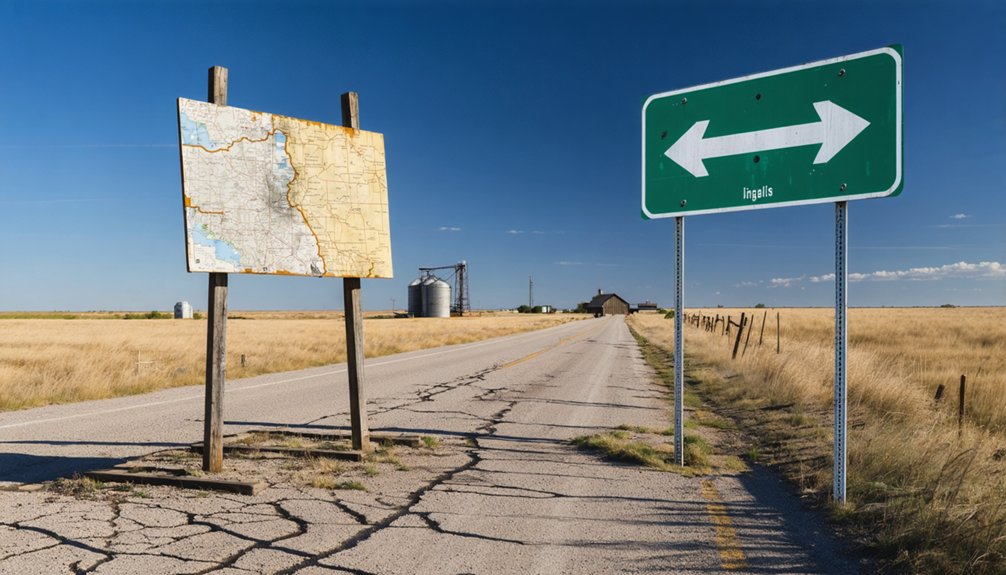
Nestled in eastern Payne County approximately ten miles east of Stillwater, Ingalls awaits discovery along Oklahoma’s rural highways where asphalt meets legend. You’ll find this ghost town at coordinates 36.101686° N, -96.878828° W, accessible year-round via Highway 51.
Your journey unfolds in three stages:
- From Stillwater: Drive ten miles east on Highway 51, watching for the “Famous Land Mark” sign
- Turn South: Follow Ingalls Road into town on well-maintained 2WD-friendly routes
- Arrival: Take the first intersection right to reach historical buildings
The entire drive takes roughly thirty minutes with ample parking options available near the main sites. Seasonal weather conditions range from snowy winters to blazing summers, but every season offers unobstructed access to this slice of Wild West history where freedom once meant survival.
Must-See Sites and Points of Interest
Once you’ve parked your vehicle along Ingalls’s quiet streets, five remarkable sites stand ready to transport you back to that violent September day in 1893. Start at the 1938 stone monument commemorating three fallen Deputy Marshals—its historic monument significance anchors the town’s identity.
The replica Old Ingalls Hotel dominates the skyline, where Arkansas Tom fired from second-story windows during the shootout. Between these landmarks, an interpretive sign orients you to the battle’s geography without demanding prior knowledge.
Explore the Wilson General Store and R.M. Saloon, where outlaws once headquartered and received insider information. Finally, visit Ingalls Cemetery across from the monument, where resident cultural attitudes toward preservation become evident through carefully cataloged graves dating to 1889.
Where to Stay and Eat Near Ingalls
Since Ingalls itself offers no lodging, you’ll base yourself in either Cushing (15 miles southwest) or Stillwater (18 miles northeast). Cushing delivers budget-friendly stays from $58 nightly at properties like Boomtown Inn and Best Western Plus. Stillwater ups the ante with modern hotel amenities—think fitness centers, seasonal pools, and complimentary hot breakfasts.
Your best bets for home base include:
- Hampton Inn & Suites Stillwater West ($84/night) with free WiFi and breakfast to fuel your exploration
- Home2 Suites by Hilton Stillwater earning perfect 10/10 ratings for extended adventures
- Holiday Inn & Suites Stillwater featuring pet-friendly rooms and an on-site restaurant
For dining options, Stillwater’s university scene delivers varied choices, while Cushing offers local flavor. Both towns provide the freedom to roam ghost-town roads by day, returning to comfortable refuge by night.
Frequently Asked Questions
Is It Safe to Explore Ingalls Alone or at Night?
You shouldn’t explore Ingalls alone at night. Despite tour safety improvements, the remote prairie location lacks lighting and emergency services. Take security precautions: visit during daylight hours with companions, and you’ll experience this historic outlaw site more safely.
Are There Guided Tours Available for the Ghost Town?
No, guided tours aren’t offered at Ingalls. You’ll explore independently through self-guided tours, wandering freely among replica structures without restrictions. This unstructured approach lets you discover the ghost town’s outlaw history at your own pace and curiosity.
Can I Enter the Abandoned Buildings or Take Artifacts?
You can’t enter the decaying replicas or take artifacts—freedom here means respecting boundaries. Avoid trespassing on remnants that tell stories beyond ownership. Respect private property and preservation efforts, letting history remain untouched for future wanderers seeking authentic connections.
What’s the Best Time of Year to Visit Ingalls?
Spring and fall offer ideal seasonal weather conditions for exploring Ingalls freely. You’ll enjoy comfortable temperatures, vibrant landscapes, and fewer crowds. Don’t miss September’s Battle of Ingalls reenactment—this local event brings history alive through immersive festival activities.
Are There Restroom Facilities or Services Available in Town?
No public restrooms available exist in abandoned Ingalls. You’ll need to plan ahead—Stillwater, ten miles west, offers food/gas stations nearby. This ghost town’s authentic abandonment means zero modern amenities, so prepare accordingly before exploring.