Natural disasters create ghost towns through catastrophic events that force immediate abandonment. You’ll find nuclear accidents like Chernobyl evacuated 49,000 residents within 36 hours, while volcanic eruptions buried entire communities in minutes, preserving 5,000 inhabitants under volcanic material. Underground coal fires release toxic compounds like benzene, forcing permanent relocations. Landslides and earthquakes trigger economic collapse, with property values dropping $55-153 million in affected areas. These preservation challenges reveal the devastating mechanisms behind community extinction.
Key Takeaways
- Nuclear accidents like Chernobyl and Fukushima create instant ghost towns, forcing mass evacuations within hours due to radiation contamination.
- Volcanic eruptions can bury entire communities in minutes, as Vesuvius did to 5,000 inhabitants in 79 CE under volcanic material.
- Underground coal fires release toxic compounds like benzene, making towns like Centralia, Pennsylvania uninhabitable and permanently abandoned.
- Major earthquakes and landslides trigger economic collapse, displacing thousands and transforming populated areas into abandoned wastelands.
- Emergency evacuations strip communities of preparation time, leaving behind preserved belongings and infrastructure that nature gradually reclaims.
When Underground Fires Force Entire Communities to Flee
When underground coal fires ignite, they transform entire communities into uninhabitable zones within years, forcing mass evacuations that create permanent ghost towns.
You’ll witness how these disasters unfold when examining Centralia, Pennsylvania, where a 1962 trash fire ignited coal seams, spreading through underground mine tunnels across a two-mile area.
Carbon monoxide poisoning caused residents to collapse, while ground subsidence swallowed people alive by 1981. Congress allocated $42 million for relocation, demolishing homes and leaving nine holdouts in a deserted town.
By 1981, toxic gases felled residents while unstable ground consumed victims, prompting a $42 million federal buyout that emptied the community.
Despite $4 million in suppression efforts, the fire burns uncontrolled after 50 years. These fires release toxic compounds including benzene and toluene into the surrounding environment, creating additional health hazards for any remaining residents.
Coal fires can ignite spontaneously at temperatures as low as 86°F, making them unpredictable threats that can emerge without warning signs.
Underground fires create permanent community displacement because they’re virtually unstoppable once established, making relocation your only viable escape from environmental devastation.
Nuclear Disasters That Create Instant Ghost Towns
Nuclear accidents transform populated areas into radioactive wastelands within hours, forcing you to witness instant community extinction on an unprecedented scale.
You’ll find contamination levels reaching 1,000-square-mile exclusion zones like Chernobyl’s, where radiation exposure risks persist decades after initial meltdowns.
These disasters create permanent displacement scenarios where evacuation becomes indefinite abandonment, leaving behind frozen-in-time settlements that nature slowly reclaims. Residents receive less than an hour to pack their belongings before mandatory evacuation, creating scenes of interrupted daily life preserved exactly as people left them.
Even smaller nuclear incidents like the SL-1 reactor accident can expose hundreds to radiation during cleanup efforts, leading entire communities to abandon their homes permanently.
Radiation’s Lasting Impact
Unlike other disasters that destroy communities gradually, nuclear accidents transform thriving towns into uninhabitable wastelands within hours, leaving behind contaminated landscapes that’ll remain dangerous for decades or centuries.
Radiation exposure forces immediate evacuations that become permanent displacement. You’ll find Chernobyl’s 1,000-square-mile exclusion zone still restricts access thirty-seven years later.
Fukushima’s Futaba remains under evacuation advisory, while Tomioka’s population dropped from 15,960 to mere hundreds despite lifted restrictions in 2017.
Contamination effects persist across uranium mining towns like Jeffrey City, Wyoming, which lost 95% of residents when markets collapsed in 1982. The town’s population had peaked at 4,500 in 1979 before the mine closure devastated the community.
Unlike natural disasters where rebuilding follows recovery, nuclear contamination creates perpetual ghost towns where time stops, infrastructure crumbles, and nature slowly reclaims abandoned structures. The Hanford Site’s deteriorating storage tanks containing over 50 million gallons of radioactive waste demonstrate how nuclear facilities continue threatening surrounding areas long after abandonment.
Evacuation and Abandonment
While conventional disasters allow gradual evacuations and planned relocations, nuclear emergencies trigger immediate mass departures that transform populated areas into radioactive wastelands within hours.
You’ll witness how Pripyat’s 49,000 residents abandoned everything within 36 hours of Chernobyl’s meltdown, leaving tea cups and newspapers frozen in time.
Fukushima’s tsunami-triggered disaster emptied Futaba’s 7,000 people instantly, creating overgrown streets where vending machines rust among scattered children’s toys.
Unlike planned evacuations, these emergency evacuation procedures strip communities of their ability to prepare or salvage belongings. Community resilience becomes irrelevant when radiation exposure demands immediate departure.
Uravan’s uranium processing town faced complete demolition by 2003, while Atomic City’s population plummeted from 140 to 25 following reactor incidents. The contaminated site required 260 structures to be demolished during the extensive cleanup process that followed the town’s evacuation.
How Landslides Transform Thriving Villages Into Ruins
When you’re evaluating landslide-prone areas, soil instability indicators like cracking foundations and tilting structures provide critical early warnings before catastrophic slope failures that can kill thousands and destroy entire communities within minutes.
You’ll observe how economic decline accelerates village abandonment as infrastructure destruction—including the 745 road blockages documented between 2011-2019—cuts off access to markets and essential services, forcing residents to relocate permanently. Heavy rainfall triggers over 50% of landslides, making monsoon seasons particularly dangerous for vulnerable communities built on unstable terrain.
You can examine preserved ruins in former settlements like El Porvenir and Rolando Rodriguez, where landslides completely demolished these towns and created haunting testimonies to the devastating power of unstable slopes. Landslides fundamentally alter the topography and morphology of affected areas, permanently transforming landscapes and making former settlement sites uninhabitable for future development.
Soil Instability Warning Signs
Before catastrophic landslides reduce bustling communities to abandoned ruins, the earth broadcasts distinct warning signals that trained observers can identify and interpret.
Recognizing these ground shifts and soil indicators empowers you to make informed evacuation decisions before it’s too late.
Critical warning signs manifest across three primary categories:
- Ground deformation – New cracks in pavements, expanding fissures in roadways, and unusual bulges creating hummocky slope surfaces signal imminent failure.
- Structural displacement – Soil pulling away from foundations, tilting patios, and sagging utility lines indicate dangerous subsurface movement.
- Hydrological changes – Springs appearing in previously dry areas, sudden creek level fluctuations, and disrupted drainage patterns reveal destabilized underground conditions. Auditory alerts such as rumbling sounds or cracking noises often accompany these visible water changes.
Your ability to interpret these soil indicators could determine whether you escape before your community joins history’s ghost towns.
Economic Decline Accelerates Abandonment
Once landslides strike thriving communities, economic devastation follows with mathematical precision—64% of affected households face hunger within the first year, while nearly one in five children can no longer attend school due to financial collapse.
You’ll witness villages transform from self-sustaining economies into financial wastelands where income drops eliminate your neighbors’ ability to rebuild. The economic impacts cascade through entire regions, forcing mass community displacement as over 14,000 people abandon their homes permanently.
When baseline incomes between affected and unaffected areas show no pre-disaster differences, you’re seeing pure economic destruction in action. Climate change and population density amplify these losses, creating systematic patterns where weaker economies suffer disproportionate damage, accelerating the ghost town phenomenon across vulnerable landscapes.
Preserved Ruins Tell Stories
After landslides tear through communities, preserved ruins become silent archives documenting the precise moment thriving villages collapsed into ghost towns.
You’ll find that Campi Flegrei’s geodatabase reveals how 277 documented events since 1912 transformed settlements into abandoned landscapes, with peaks in 1986, 1997, and 2005 creating the most dramatic ruins.
These preserved structures serve as cultural memory anchors, freezing catastrophic moments in time.
The architectural preservation of landslide-affected areas provides critical insights:
- Volume displacement patterns – 40% of events moved ≤10 cubic meters, leaving partial structures intact
- Fatal impact zones – 53 deadly slides created distinct ruin signatures across affected villages
- Settlement exposure data – 563 inhabited slow-moving landslides demonstrate ongoing transformation processes
You can analyze these ruins to understand risk patterns and prevent future abandonment scenarios.
Earthquake Devastation That Leaves Towns Permanently Empty
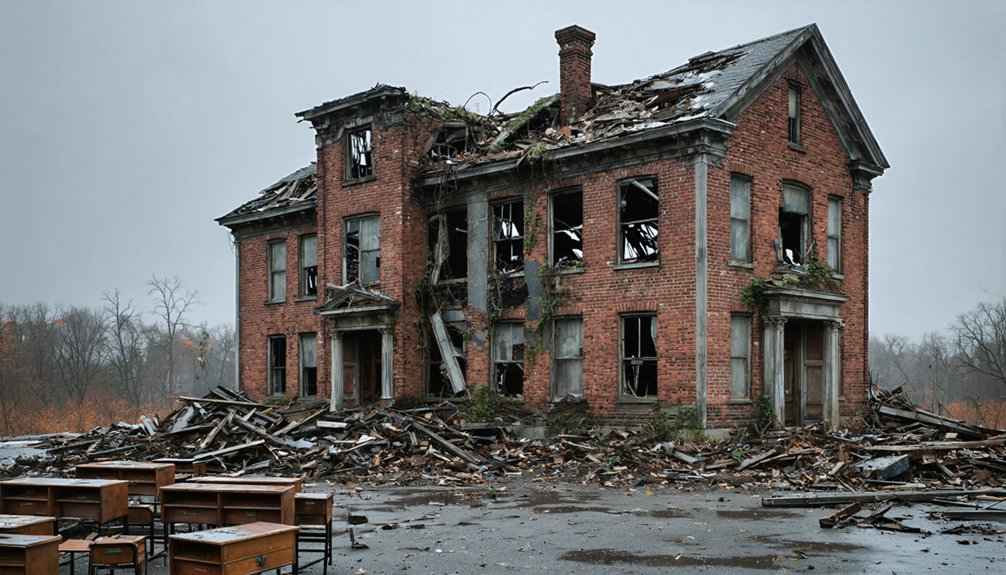
When earthquakes strike with sufficient magnitude, they don’t just damage buildings—they erase entire communities from habitability.
The 1994 Northridge earthquake’s magnitude 6.7 force displaced 22,000 residents, creating $35 billion in today’s residential damage. You’ll witness entire neighborhoods transform into ghost towns when rebuilding costs exceed residents’ financial capacity.
When rebuilding costs surpass what residents can afford, entire neighborhoods become uninhabitable ghost towns overnight.
China’s 2008 Sichuan earthquake demonstrated this devastation on a massive scale—displacing four million people across the province with $150 billion in reconstruction costs.
Ghost town dynamics accelerate when only 13% of Californians carry earthquake insurance, leaving most homeowners financially trapped after disaster strikes.
The earthquake aftermath creates cascading abandonment as damaged properties attract crime, forcing additional residents to flee.
Scientists predict California faces another Northridge-scale event within thirty years, potentially creating new ghost towns across vulnerable communities.
Volcanic Eruptions That Bury Settlements in Minutes
Unlike earthquakes that create gradual abandonment patterns, volcanic eruptions instantly transform thriving communities into buried archaeological sites within hours or minutes.
You’ll find these catastrophic events create immediate ghostly landscapes where civilizations vanish beneath pyroclastic flows and ash deposits.
The volcanic aftermath demonstrates nature’s devastating speed:
- Pompeii and Herculaneum (79 CE) – Vesuvius buried 5,000 inhabitants under 4 cubic kilometers of ejecta with VEI 6 intensity
- Thera eruption (1600 BC) – Deposited 7 meters of pumice on Akrotiri, burying Minoan settlements under 40 meters of material
- Lanzarote eruptions (1730-1736) – Destroyed nine villages completely, displacing 1,500 inhabitants across continuous six-year eruption sequence
You can’t escape when pyroclastic surges travel at hundreds of kilometers per hour, creating instant fossilized communities.
The Science Behind Ground Instability and Town Abandonment

Ground instability operates through fundamentally different mechanisms than explosive volcanic events, creating gradual yet equally devastating pathways to community abandonment.
You’ll find that ground subsidence primarily results from aquifer compaction when underground water’s removed, causing land to settle permanently. Soil erosion accelerates this process—heavy rains destabilize foundations while organic matter biodegradation creates dangerous sinkholes.
These mechanisms trigger cascading economic collapse.
You’re looking at property values plummeting by $55–153 million in affected areas, while violent crime increases 3.2 times near unstable structures. Insurance companies cancel policies or raise premiums drastically. Municipal revenues crash as taxable values disappear and public safety costs skyrocket.
The data shows you can’t fight geological reality—when ground fails, communities follow.
Preserving Abandoned Disaster Sites as Historical Monuments
Although disaster zones typically face demolition or neglect, you’ll find that preserving these abandoned sites as historical monuments presents complex engineering and financial challenges that require immediate intervention.
Disaster sites demand urgent preservation action before engineering deterioration and funding constraints eliminate these irreplaceable historical monuments forever.
Your preservation efforts must balance structural integrity with historical significance while securing sustainable funding streams.
Consider these critical preservation approaches:
- Stabilization protocols – Implement emergency structural support systems to prevent further deterioration of flood-damaged foundations and compromised load-bearing elements.
- Documentation initiatives – Create thorough 3D scanning records and archival photography before irreversible decay eliminates cultural evidence.
- Community engagement frameworks – Establish local stewardship programs that maintain community memory through interpretive programming and educational access.
You’re racing against time, as environmental exposure accelerates material degradation.
Without immediate intervention, these sites lose both structural viability and their capacity to preserve collective trauma narratives for future generations.
Frequently Asked Questions
Can Abandoned Ghost Towns Ever Be Safely Repopulated After Natural Disasters?
You’ll find ghost towns can absolutely be repopulated—if you’re willing to invest billions in decontamination and rebuilding strategies. Community resilience requires data-driven risk assessment, environmental remediation, and sustainable economic foundations for successful resettlement.
Exploring ghost towns to explore by ATV can offer unique insights into the challenges of revitalizing these areas. As you navigate through remnants of past lives, you’ll encounter stories of resilience and the possibility of future development. These adventures can also serve as a reminder of what it takes to bring communities back to life, blending history with the hope of renewal.
What Happens to Property Ownership and Legal Rights in Evacuated Towns?
Your property rights remain intact during evacuations, but legal implications multiply—you’ll face zoning restrictions, environmental assessments, and potential eminent domain proceedings that threaten your ownership autonomy and development freedoms.
How Do Wildlife and Ecosystems Adapt to Reclaim Abandoned Human Settlements?
Nature abhors a vacuum—you’ll witness rapid wildlife resurgence within decades as adaptive species exploit vacant infrastructure for nesting while ecosystem restoration accelerates through selective pressures, creating evolved populations perfectly suited to reclaimed human settlements.
Are There Psychological Effects on Former Residents Who Lost Their Hometowns?
You’ll experience severe trauma recovery challenges when your hometown’s permanently abandoned. Community displacement creates lasting PTSD in 25-49% of survivors, with psychological impacts persisting years beyond physical reconstruction, fundamentally disrupting your secure base.
What Valuable Items or Artifacts Are Typically Recovered From Ghost Towns?
You’ll recover valuable relics including silver bars, rare coins, mining tools, and historical artifacts like bottles and hardware. Risk assessment’s essential—these sites contain documented concentrations of recoverable materials worth significant investment returns.
References
- https://pg.world/articles/abandoned_places_part_1
- https://www.italytravelandlife.com/travel/italian-ghost-towns/
- https://www.youtube.com/watch?v=bUv-90oaQl8
- https://www.okhistory.org/publications/enc/entry?entry=GH002
- https://en.wikipedia.org/wiki/Category:Environmental_disaster_ghost_towns
- https://www.gem.wiki/Coal_fires
- https://coloradosun.com/2022/01/30/marshall-fire-underground-coal-fire/
- https://coloradogeologicalsurvey.org/wp-content/uploads/woocommerce_uploads/IS-26.pdf
- https://eros.usgs.gov/doi-remote-sensing-activities/2015/osm/underground-coal-fires-new-mexico
- https://www.osmre.gov/programs/mine-fires